Introduction
Spend Management Platforms are comprehensive software solutions that unify procurement, expense tracking, accounts payable, and corporate card management into a single digital ecosystem. Unlike traditional accounting software which records history, spend management platforms focus on controlling the future. They provide organizations with real-time visibility and proactive control over every dollar leaving the company. By integrating directly with banking systems and accounting ledgers, these platforms automate the arduous tasks of receipt collection, invoice matching, and budget enforcement. In a landscape where “maverick spend” and subscription sprawl can quietly erode profit margins, these tools act as a financial air traffic control tower, ensuring all expenditures are authorized, categorized, and compliant with company policy.
The importance of these platforms has surged as businesses shift toward decentralized work and digital-first operations. Without a centralized system, finance teams are often forced to wait until the end of the month to “discover” what was spent, leading to reactive budgeting. Key real-world use cases include managing SaaS subscription renewals, automating employee travel reimbursements, issuing project-specific virtual cards, and streamlining international vendor payments. When choosing a platform, users should evaluate automation depth, mobile app intuitiveness, real-time reporting capabilities, and the seamlessness of the ERP (Enterprise Resource Planning) integration.
Best for: CFOs, Controllers, and Finance Managers in fast-growing startups, mid-market companies, and global enterprises. It is particularly beneficial for industries with high operational expenses, such as technology, professional services, retail, and manufacturing.
Not ideal for: Solo entrepreneurs or micro-businesses with very few transactions who can manage expenses via basic banking apps, or companies that operate exclusively on a “cash and carry” basis without the need for digital audit trails.
Key Real-World Use Cases
- SaaS Subscription Management: Identifying duplicate software seats and automating the cancellation of unused “ghost” subscriptions.
- Corporate Card Control: Issuing virtual cards to employees with pre-set limits, specific merchant categories, and automated receipt prompts.
- Automated Accounts Payable: Utilizing AI to “read” invoices, match them to purchase orders, and schedule payments without manual data entry.
- Real-time Budget Enforcement: Blocking a transaction at the point of sale if the department’s monthly budget has already been exceeded.
What to Look For (Evaluation Criteria)
Selecting a spend management platform is a foundational financial decision. Look for these critical criteria:
- Unified Experience: Does the tool combine corporate cards, expenses, and bill pay, or will you still need multiple logins?
- ERP Integration: How well does it sync with NetSuite, Sage Intacct, QuickBooks, or SAP? Is it a “one-click” sync or a manual CSV export?
- Automation Level: Does it use OCR (Optical Character Recognition) to extract data from receipts accurately?
- Global Capabilities: Can it handle multi-currency reimbursements and international tax compliance (VAT/GST)?
- Policy Customization: Can you build complex approval hierarchies based on department, amount, or project?
Best for: Finance teams that want to eliminate manual work through high-level AI automation and integrated banking.
Not ideal for: Companies that are legally required to use a specific legacy bank and cannot switch to a platform-based corporate card.
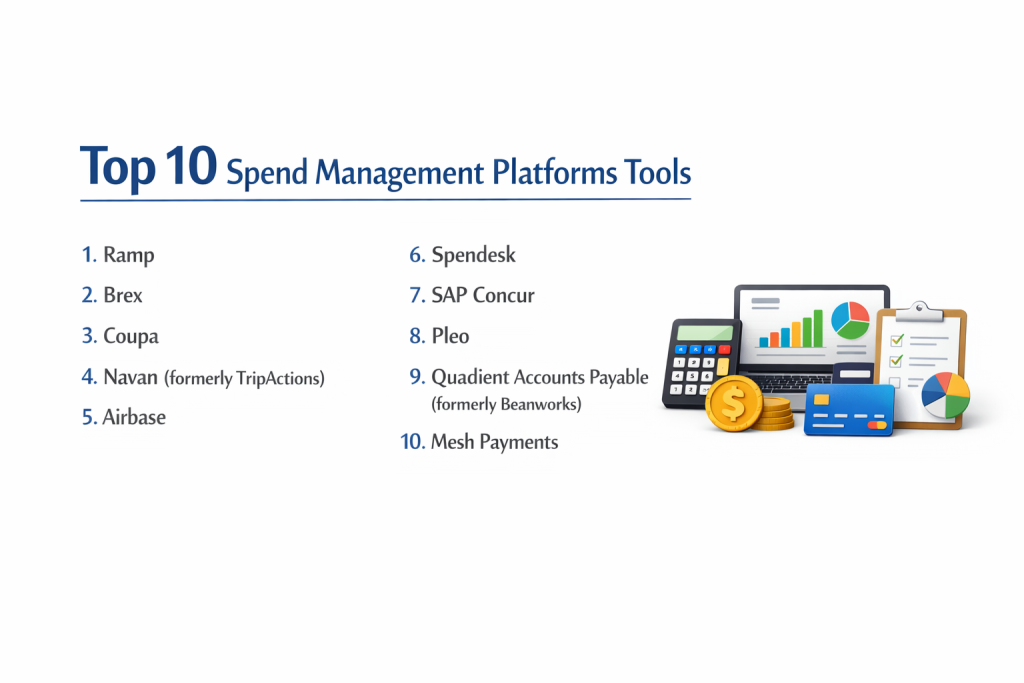
Top 10 Spend Management Platforms Tools
1 — Ramp
Ramp has rapidly become a market leader by focusing on a bold promise: helping companies spend less. It is an all-in-one platform that combines corporate cards, expense management, and bill pay.
- Key features:
- AI Invoice Processing: Automatically extracts data and GL codes from uploaded invoices.
- Savings Insights: Proactively alerts you if you are overpaying for software or have duplicate subscriptions.
- Global Corporate Cards: Issued in minutes with granular, real-time spending controls.
- Automated Receipt Matching: Matches receipts sent via SMS, email, or Slack to transactions instantly.
- Advanced Approval Flows: Multi-stage approvals tailored to organizational structure.
- Pros:
- No per-user fees, making it exceptionally scalable for growing teams.
- The most intuitive and modern user interface in the industry.
- Cons:
- Currently focused heavily on US-based entities (though expanding).
- Requires businesses to use Ramp as their primary card issuer for full benefits.
- Security & compliance: SOC 2 Type II, PCI DSS Level 1, GDPR compliant, and 256-bit encryption.
- Support & community: Extensive knowledge base, 24/7 chat support, and a growing community of finance professionals.
2 — Brex
Brex is a powerhouse in the spend management space, originally famous for serving startups but now a major player in the mid-market and enterprise sectors.
- Key features:
- Empower Platform: A global spend management engine built for large-scale compliance.
- Global Reimbursements: Pay out employees in local currencies across 100+ countries.
- Live Budget Tracking: Real-time visibility into spend against department goals.
- Auto-generated Receipts: High-fidelity data from merchants eliminates the need for manual receipt photos.
- Travel Management: Integrated booking and expense tracking for business trips.
- Pros:
- Exceptional for venture-backed startups and companies with a global footprint.
- Very high credit limits based on cash balance rather than personal credit scores.
- Cons:
- Recently shifted focus away from very small businesses/micro-SMEs.
- Some premium features are behind higher-tier subscription walls.
- Security & compliance: SOC 2 Type II, ISO 27001, GDPR, and multi-factor authentication (MFA).
- Support & community: 24/7 phone/chat support and dedicated relationship managers for enterprise accounts.
3 — Coupa
Coupa is the “titan” of the enterprise spend management world, offering a vast “Source-to-Pay” ecosystem that manages billions of dollars in global spend.
- Key features:
- Procure-to-Pay: End-to-end management from requisition to payment.
- Community Intelligence: Benchmarking data to show how your spend stacks up against industry leaders.
- Supplier Risk Management: Deep vetting of vendors for compliance and financial health.
- Spend Analysis: AI-powered categorization of all historical and current expenditures.
- Contract Management: Centralized repository with automated renewal alerts.
- Pros:
- The most comprehensive tool for massive global conglomerates.
- Incredible depth of features for strategic sourcing and procurement.
- Cons:
- Implementation is a major, month-long project often requiring consultants.
- The user interface is complex and can be intimidating for non-finance users.
- Security & compliance: SOC 1 & 2, HIPAA, FedRAMP, GDPR, and ISO 27001.
- Support & community: Global user conferences, “Coupa University” for training, and 24/7 enterprise support.
4 — Navan (formerly TripActions)
Navan is a unique player that began as a travel management tool and evolved into a full-scale spend management platform, perfect for companies with heavy travel needs.
- Key features:
- Unified Travel & Expense: Book trips and manage expenses in a single app.
- Navan Connect: Links your existing corporate cards into the Navan ecosystem.
- Real-time Reporting: Instant visibility into travel spend and traditional expenses.
- Automated Reconciliation: Virtually eliminates the manual “end of month” expense report.
- Sustainability Tracking: Measures the carbon footprint of corporate travel.
- Pros:
- The best user experience for employees who travel frequently.
- “Navan Connect” allows you to keep your existing banking relationships.
- Cons:
- Procurement and inventory features are not as deep as Coupa or Airbase.
- Heavily focused on the travel vertical; might be overkill for sedentary businesses.
- Security & compliance: SOC 2 Type II, GDPR, and PCI DSS compliant.
- Support & community: 24/7 global travel agents available via chat and dedicated account management.
5 — Slash
Description:
Slash is a business banking and spend management platform that unifies checking, ACH and wire transfers, global payments, corporate cards, and expense tracking in a single system.
Features
- Automated Expense Capture: Transactions are categorized instantly.
- Real-Time Spend Controls: Policies are enforced at the point of purchase so every transaction follows preset rules and approvals.
- Accounting Integrations: Sync with QuickBooks Online and Xero.
- Unlimited Cashback: Earn up to 2% cashback on eligible business spending.
- Unlimited Cards: Issue virtual and physical corporate cards with full visibility and control.
Pros
- All-in-One Platform: Replace multiple financial tools with a single intuitive dashboard.
- Real-Time Reporting: Monitor payments live and quickly flag out-of-policy spending.
Cons
- Less Suited for Larger Enterprises: Primarily built for modern, growing companies rather than large enterprises.
- Emerging Provider: Shorter track record compared to traditional banking platforms.
Support & Community
Dedicated 24/7 assistance available whenever support is needed.
Security & Compliance
SOC 2 Type II and PCI compliant, with MFA, biometric authentication, hardware tokens, and 256-bit encryption. 🔐
6 — Spendesk
Spendesk is a leading European spend management platform that excels in handling the complexities of multi-entity, multi-currency VAT compliance.
- Key features:
- 7-in-1 Platform: Cards, invoices, expenses, approvals, and budgets in one place.
- VAT Extraction: Automatically pulls VAT data from receipts to simplify tax recovery.
- Smart Approval Flows: Automatically routes requests to the right manager.
- Supplier Management: Track all vendor contacts and payment terms centrally.
- Mobile App: One of the highest-rated apps for on-the-go receipt capture.
- Pros:
- The top choice for European companies managing different local regulations.
- Excellent localized support for French, German, and UK markets.
- Cons:
- Less focus on North American-specific banking features.
- Pricing is per-user, which can become expensive for large workforces.
- Security & compliance: GDPR specialist, SOC 2, and PCI DSS.
- Support & community: Localized support in multiple languages and an active community for CFOs (“CFO Connect”).
7 — SAP Concur
A legacy giant, SAP Concur remains the standard for large-scale enterprise travel and expense management, especially for those already in the SAP ecosystem.
- Key features:
- Concur Expense: Automated expense report generation via receipt photos.
- Concur Travel: Integrated booking with corporate policy enforcement.
- Concur Invoice: Automated capture and payment of vendor invoices.
- App Center: Integration with hundreds of third-party apps (Uber, Starbucks, etc.).
- Audit Services: Managed services where SAP professionals audit your reports for you.
- Pros:
- Unrivaled global scale and regulatory support.
- Native, deep-level integration for companies running SAP ERP.
- Cons:
- The interface is often described as dated and less user-friendly than Ramp or Brex.
- Implementation is notoriously long and requires significant configuration.
- Security & compliance: ISO 27001, SOC 1 & 2, HIPAA, and GDPR.
- Support & community: Global enterprise support, extensive documentation, and a massive user base.
8 — Pleo
Pleo is a simplified spend management tool that focuses on “smart company cards” for teams, emphasizing decentralization and trust.
- Key features:
- Smart Cards: Every employee can have their own card with individual limits.
- Automated Accounting: Categorizes spend and syncs with Xero/QuickBooks instantly.
- Pocket: Manages reimbursements for cash spend and mileage.
- Direct Invoicing: Allows employees to upload invoices for central payment.
- Fetch: Automatically finds missing receipts in your email inbox.
- Pros:
- Extremely high employee satisfaction due to its ease of use.
- Great for SMBs that want to move away from “the boss sharing their card.”
- Cons:
- Lacks the heavy-duty procurement/RFP features of enterprise tools.
- Primary focus is on Northern Europe and the UK.
- Security & compliance: PCI DSS, GDPR, and data encryption.
- Support & community: Fast-growing help center and proactive email/chat support.
9 — Quadient Accounts Payable (formerly Beanworks)
Quadient focuses specifically on the “Accounts Payable” side of spend management, automating the flow from purchase order to final payment.
- Key features:
- PO Management: Automated matching of purchase orders to invoices.
- Multi-Entity Support: Manage spend across different locations or legal entities.
- Payment Automation: Pay vendors via ACH, wire, check, or virtual card.
- Expense Module: Basic employee expense tracking that feeds into the AP flow.
- Audit Trail: Unlimited storage for historical invoices and approval logs.
- Pros:
- Superior for businesses with high volumes of vendor invoices.
- Excellent at reducing manual data entry errors in the AP department.
- Cons:
- Not a “card-first” platform; the corporate card feature is secondary.
- The interface is more utilitarian/accounting-focused than employee-focused.
- Security & compliance: SOC 2 Type II and standard data encryption.
- Support & community: Dedicated training sessions and reliable phone support.
10 — Mesh Payments
Mesh is a flexible spend management platform that distinguishes itself through its “cardless” and integration-heavy approach to corporate spend.
- Key features:
- Virtual Card Specialization: Advanced features for managing online SaaS spend.
- Plugin for ERPs: Real-time sync that doesn’t require exiting your accounting software.
- Budget Ownership: Empowers managers to own their budgets without constant finance oversight.
- Tailored Controls: Set limits based on specific vendors (e.g., “Only $500/month for AWS”).
- Global Payouts: Fast international payments with competitive rates.
- Pros:
- Highly flexible; works well for companies with complex digital spend.
- Allows for very granular “merchant-specific” controls.
- Cons:
- The physical card offering is not as robust as Ramp or Brex.
- Brand recognition is lower than the major market leaders.
- Security & compliance: SOC 2, PCI DSS, and GDPR compliant.
- Support & community: Strong 24/7 technical support and personalized onboarding.
Comparison Table
| Tool Name | Best For | Platform(s) Supported | Standout Feature | Rating (Gartner) |
| Ramp | Efficiency & Savings | Cloud / Mobile | AI Savings Insights | 4.8 / 5 |
| Brex | Global Startups | Cloud / Mobile | Global Reimbursements | 4.7 / 5 |
| Coupa | Global Enterprise | Cloud / Mobile | Community Spend Data | 4.5 / 5 |
| Navan | Travel-Heavy Orgs | Cloud / Mobile | Unified Travel/Expense | 4.6 / 5 |
| Airbase | Mid-Market AP | Cloud / Mobile | Deep ERP Sync (NetSuite) | 4.7 / 5 |
| Spendesk | European Entities | Cloud / Mobile | VAT Extraction Logic | 4.6 / 5 |
| SAP Concur | Legacy Enterprise | Cloud / Mobile | Managed Audit Services | 4.1 / 5 |
| Pleo | SMB Employee Trust | Cloud / Mobile | “Fetch” Receipt Finder | 4.7 / 5 |
| Quadient AP | Invoice Automation | Cloud | 3-Way Invoice Matching | 4.4 / 5 |
| Mesh Payments | Digital/SaaS Spend | Cloud / Mobile | Merchant-Level Controls | N/A |
Evaluation & Scoring of Spend Management Platforms
| Category | Weight | Evaluation Logic |
| Core Features | 25% | Card management, AP automation, expense tracking, and bill pay. |
| Ease of Use | 15% | Employee mobile experience and manager dashboard intuitiveness. |
| Integrations | 15% | Native, real-time sync with NetSuite, Sage, Xero, and QuickBooks. |
| Security & Compliance | 10% | SOC 2 status, GDPR adherence, and audit trail immutable logs. |
| Performance | 10% | Transaction processing speed and mobile app reliability. |
| Support & Community | 10% | Onboarding quality and 24/7 technical support availability. |
| Price / Value | 15% | Fee structure vs. savings generated and time saved. |
Which Spend Management Platform Is Right for You?
Solo Users vs SMB vs Mid-Market vs Enterprise
If you are an SMB with 5-50 employees, your priority should be simplicity and high adoption. Pleo or Ramp are excellent choices because they require very little training. Mid-Market companies (50-500 employees) often face complex AP issues and should look at Airbase or Brex for their robust procurement and international features. Enterprises (500+ employees) with legacy systems and global tax needs must prioritize Coupa or SAP Concur, as these are the only tools with the industrial-grade compliance required for public companies.
Budget-conscious vs Premium Solutions
If you are Budget-conscious, Ramp is arguably the best value on the market today, offering a robust free tier and generating revenue from interchange fees rather than per-user costs. For those seeking Premium Solutions with high-touch service and specialized features like managed auditing, SAP Concur or Airbase provide a level of oversight that justifies their subscription costs.
Feature Depth vs Ease of Use
If your finance team is small and employees are non-technical, Ease of Use is your north star—choose Ramp or Pleo. If you have a large finance team that wants to control every minute detail of the “Source-to-Pay” lifecycle, you need Feature Depth. In that case, Coupa is the undisputed champion, though it requires a significant time investment to master.
Integration and Scalability Needs
Always work backwards from your accounting software. If you use NetSuite, Airbase and Ramp have built some of the most seamless integrations. For Scalability, choose a platform like Brex or Mesh that handles multi-currency and multi-entity structures natively, allowing you to add new international subsidiaries with a single click.
Security and Compliance Requirements
Companies in highly regulated sectors (Healthcare, Fintech) should prioritize SOC 2 Type II and ISO 27001. If you have heavy operations in Europe, Spendesk is the standout for Security and Compliance because it is built from the ground up around GDPR and European VAT laws.
Frequently Asked Questions (FAQs)
1. What is the difference between spend management and accounting software?
Accounting software (like QuickBooks) records what has already happened. Spend management software (like Ramp) controls what is happening in real-time by setting limits before the money is spent.
2. Is it safe to give every employee a corporate card?
Yes, with modern platforms. You can set a $50 limit on a card, restrict it to “Food & Beverage,” and have it automatically freeze if a receipt isn’t uploaded within 24 hours.
3. Do these platforms replace my bank?
Not necessarily. Most platforms (like Airbase or Navan) can link to your existing bank. Others (like Ramp or Brex) provide their own “banking-like” features but work alongside your main operating account.
4. How do these tools help with taxes?
They automatically extract VAT/GST data from receipts and categorize spend into the correct GL codes, making the “end of year” tax filing much faster for your CPA.
5. What is “3-way matching” in AP?
It is a security check that ensures the Purchase Order (what you asked for), the Receiving Report (what you got), and the Invoice (what they are charging you) all match before payment is sent.
6. Can I use these tools for international employees?
Yes. Platforms like Brex and Spendesk allow you to reimburse employees in their local currency and manage different tax requirements per country.
7. How long does implementation take?
For SMB tools like Ramp, you can be live in 15 minutes. For enterprise tools like Coupa or SAP Concur, implementation can take 3 to 6 months.
8. Do these tools cost money per month?
It varies. Some (like Ramp) are essentially free for the core platform. Others (like Airbase or Spendesk) charge a monthly subscription fee based on features or user count.
9. Can I set up a “Travel Policy” in these tools?
Yes. You can create a rule that says “Flight must be economy” and “Hotel must be under $300,” and the tool will flag or block any bookings that break the rule.
10. What happens to the receipts?
The software stores digital copies of all receipts in a searchable, audit-ready cloud database. You can usually throw away the physical paper receipt immediately after taking a photo.
Conclusion
Choosing a Spend Management Platform is one of the most impactful moves a finance leader can make. It is the transition from “looking in the rearview mirror” to “driving with a clear windshield.”
The “best” tool is relative: it’s the one that fits your current ERP, matches your company’s growth stage, and—most importantly—is easy enough for your employees to use. For sheer efficiency and value, Ramp and Brex lead the pack for the modern workforce. For the complex needs of the Fortune 500, Coupa and SAP Concur remain the reliable heavyweights.