Introduction
Sourcing & RFX Platforms are software tools that help businesses find, compare, and choose suppliers. They manage the whole process of requesting information (RFI), proposals (RFP), and quotes (RFQ) from vendors in an organized, digital way. Think of them as a central control room for all your company’s buying needs.
These tools are important because they take the mess out of buying things for your business. Instead of using hundreds of emails and spreadsheets, everything happens in one clear place. This saves time, finds better prices, avoids mistakes, and keeps a clean record of every decision. They are used when a company needs new office furniture, a marketing agency, raw materials for a factory, or even a new software system.
When choosing a tool, you should think about: Is it easy to use? Does it have the specific features you need? Can it connect with your other business software? Is it secure? Is the support good? And finally, is it worth the price?
Best for: These tools are perfect for people whose job is to buy things for a company—like procurement managers, sourcing specialists, and operations leaders. They are very helpful for medium and large companies, especially in fields like manufacturing, healthcare, retail, and technology, where buying is complex.
Not ideal for: A very small shop or a freelancer who only buys a few things here and there probably does not need such a powerful tool. It would be too expensive and complicated. For simple needs, a basic quoting tool or even a well-organized spreadsheet might be enough.
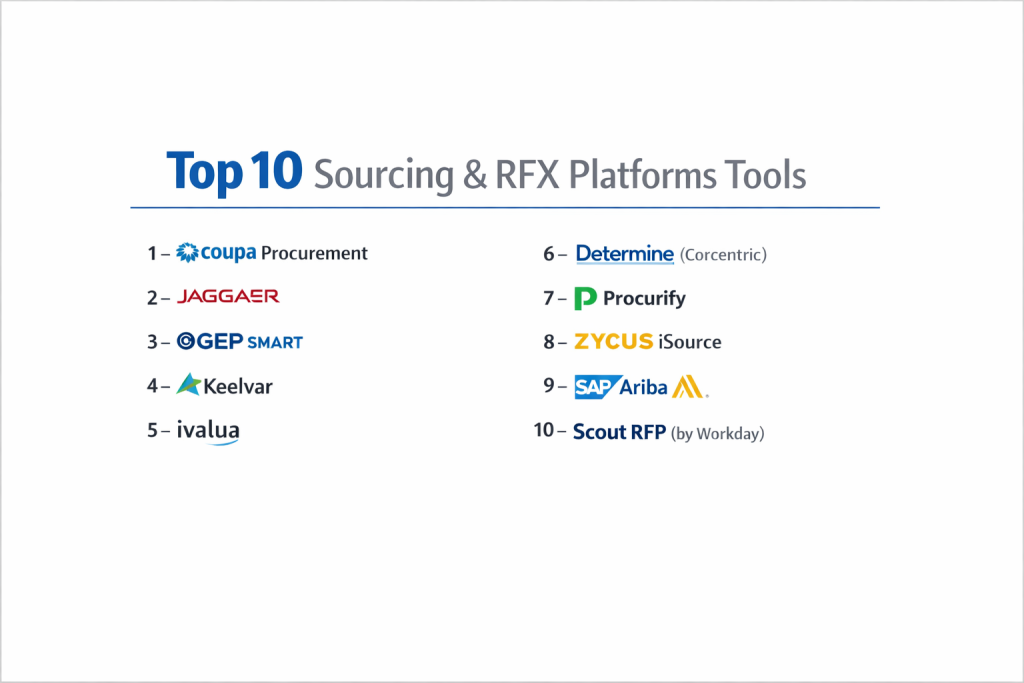
Top 10 Sourcing & RFX Platforms Tools
1 — Coupa Procurement
Coupa Procurement is a wide-ranging business spending platform. It connects sourcing directly to ordering, invoicing, and managing expenses, all in one system. It is built for growing and large companies.
Key features:
- Links sourcing, buying, and paying into one smooth process.
- Runs live online auctions to get the best price from suppliers.
- Easy-to-use tools to create RFPs and manage bids.
- Clear dashboards that show your spending and savings.
- A large network to find and connect with new suppliers.
- Manages contracts that come from sourcing projects.
- Automatic approval flows to keep projects moving.
Pros:
- Gives you total control and visibility over all company spending.
- Everything is connected, so data is never lost between steps.
- Known for being user-friendly and easy to learn.
Cons:
- Can be a costly investment.
- Has so many features it can feel too big for teams that only need sourcing.
- Setting it up can take time and effort.
Security & compliance: Very strong security. Includes single sign-on (SSO), data encryption, full activity logs, and meets major standards like SOC 2 and GDPR.
Support & community: Good help guides, training for new customers, and round-the-clock support. Has a large user community for sharing tips.
2 — Jaggaer
Jaggaer is a powerful tool made for big, complex companies. It is especially strong for sourcing physical parts and materials, like in manufacturing or aerospace.
Key features:
- Advanced tools for buying direct materials (parts for products).
- Highly customizable spaces to run RFPs and auctions.
- Deep tools to manage supplier relationships and risks.
- Works very well with big business systems like SAP.
- Helps analyze the true cost of parts.
- Flexible scoring to judge supplier proposals fairly.
Pros:
- Excellent for very complicated, strategic buying projects.
- Built for large global supply chains.
- Can be tailored to fit unique company processes.
Cons:
- The interface is less modern and can be harder to learn.
- Pricing is for large enterprises.
- Too heavy for companies with simple buying needs.
Security & compliance: Top-level enterprise security with SSO, encryption, and compliance with standards like SOC, ISO, and GDPR.
Support & community: Offers dedicated help and management for large clients. Strong professional services team.
3 — GEP SMART
GEP SMART is a modern, all-in-one cloud platform for procurement. It is known for its clean design and smooth experience, built as one connected system.
Key features:
- A single platform for sourcing, buying, and supply chain.
- All parts work together seamlessly.
- Cleans up and analyzes your spending data to find opportunities.
- Simple tools for RFPs and working with suppliers.
- Tracks contracts and how suppliers perform.
- Uses smart technology (AI) to suggest savings and better choices.
Pros:
- Very clean, simple, and easy-to-use interface.
- No disconnected modules—everything flows together.
- Strong focus on smart insights and data.
Cons:
- As a full suite, it may have more than some teams need.
- Mainly for medium and large businesses.
- Might not be as customizable as some older tools.
Security & compliance: Built on secure cloud infrastructure. Includes SSO, encryption, audit logs, and complies with SOC 2 and GDPR.
Support & community: Known for good client partnership and support. Offers global help and training resources.
4 — Keelvar
Keelvar is a smart tool that uses automation and AI for complex sourcing. It is a specialist, particularly great for sourcing logistics and transportation services.
Key features:
- “Sourcing Automation” bots that can run bidding events on their own.
- Powerful engine to optimize complex bids with many options.
- Specializes in logistics and shipping sourcing.
- Easy setup for automated buying workflows.
- Compares different bid scenarios to find the best total value.
Pros:
- Saves a huge amount of time on data-heavy, complex sourcing.
- Finds savings and efficiencies humans might miss.
- The best tool for optimizing shipping and logistics spend.
Cons:
- Its special power is most clear for specific, complex buys.
- May not be needed for simple price quotes.
- Aimed at larger companies with significant spending.
Security & compliance: Uses strong enterprise security standards. Specific details vary by customer setup.
Support & community: Provides high-touch, expert support due to the specialized nature of the software.
5 — Ivalua
Ivalua offers a complete source-to-pay platform that is very flexible. It is built to be customized and to scale for large global companies.
Key features:
- One platform for sourcing, procurement, invoices, and supplier management.
- Highly adaptable to your company’s unique ways of working.
- A good portal for collaborating with suppliers.
- Manages the entire contract lifecycle.
- Strong tools for analyzing spending.
- Good for buying services and managing work agreements.
Pros:
- Can be shaped to fit complex business rules.
- Excellent for managing all information and performance of suppliers.
- Grows well with your business.
Cons:
- High flexibility can mean a longer setup time.
- The interface is functional but not the most modern looking.
- Can be complex for smaller teams to handle.
Security & compliance: Comprehensive security with SSO, encryption, and compliance with SOC 2, ISO, and GDPR.
Support & community: Provides global support and services. Has an active user group.
6 — Determine (Corcentric)
Determine is a flexible platform that automates buying processes. It is good for companies that want to digitize their existing workflows without forcing a completely new method.
Key features:
- Tools for guided strategic sourcing and managing suppliers.
- An engine to build and automate your approval workflows.
- Integrated contract management.
- Tracks supplier performance and risk.
- Analyzes spending and tracks savings.
- Supports online auctions and standard RFPs.
Pros:
- A good mix of power and flexibility for mid-size to large companies.
- Strong at automating process steps.
- Part of Corcentric, which also offers payment and financing solutions.
Cons:
- Not as widely known as some bigger names.
- Some users feel the interface could be more intuitive.
- Might need technical skill to set up perfectly.
Security & compliance: Cloud platform with standard enterprise security. Relevant certifications are typically in place.
Support & community: Support is provided through Corcentric. Offers documentation and help resources.
7 — Procurify
Procurify makes it easy for mid-size companies to control spending. It is very user-friendly and strong on the purchasing side, with sourcing features to help decide what to buy.
Key features:
- Simple creation and tracking of purchase orders.
- Basic but useful tools for running RFQs.
- Live budget tracking so departments don’t overspend.
- Easy approvals and receipt capture on mobile phones.
- Connects easily with accounting software.
- Simple supplier and catalog management.
Pros:
- Extremely easy for everyone in the company to use.
- Excellent for controlling everyday spending and following rules.
- Quick to set up and shows where money is going instantly.
Cons:
- Lacks the deep, powerful sourcing features of bigger platforms.
- Not for highly complex bidding or optimization.
- Best for office supplies and services, not complex material sourcing.
Security & compliance: Includes security like SSO and data encryption. Complies with standards like SOC 2.
Support & community: Known for very responsive and helpful customer support. Good online help center.
8 — Zycus iSource
Zycus iSource uses artificial intelligence (AI) to automate and improve sourcing. It is part of a larger AI-powered procurement suite for businesses.
Key features:
- AI helps sort spending data and find saving opportunities.
- Can automate the creation of RFPs and picking suppliers.
- Smart analytics to compare bids and supplier history.
- Manages supplier risk and performance.
- Connects to other Zycus procurement tools.
- Supports e-auctions and contract management.
Pros:
- AI reduces manual work and finds hidden insights.
- Good at automating routine sourcing tasks.
- Part of a complete, modern procurement suite.
Cons:
- Needs clean data for the AI to work well.
- Can be complex to configure for specific needs.
- Some users feel the design could be smoother.
Security & compliance: Enterprise-level security with data encryption and compliance with SOC 2 and other standards.
Support & community: Provides implementation help and customer service. Has active user groups.
9 — SAP Ariba Sourcing
SAP Ariba is one of the biggest global networks connecting buyers and sellers. Its sourcing tool plugs into this huge network to reach many suppliers.
Key features:
- Direct access to the enormous Ariba supplier network.
- Full tools for RFPs, auctions, and contract talks.
- Collaboration features for buyers and suppliers on the network.
- Guided sourcing project management.
- Analytics on sourcing results.
- Strong integration with SAP business software.
Pros:
- Connects you to a massive global pool of suppliers.
- Powerful for digitizing all communication with suppliers.
- Feature-rich for large, global sourcing projects.
Cons:
- Can be expensive and complex to implement.
- The user experience is sometimes seen as less intuitive.
- Best when your suppliers are also active on Ariba.
Security & compliance: Uses SAP’s strong enterprise security. Complies with many global standards.
Support & community: Support is available through various channels. The large network itself is a kind of community.
10 — Scout RFP (by Workday)
Scout RFP is designed to make the RFP process simple, fast, and collaborative. It focuses on a great experience for both the buying team and the suppliers.
Key features:
- A very clean, intuitive, and easy-to-use interface for RFPs.
- Simple tools to create, send, and evaluate proposals.
- Real-time chat and collaboration for your internal team.
- Makes it very easy for suppliers to respond.
- Connects with Workday and other systems.
- Basic reporting on project status.
Pros:
- Probably the easiest and most pleasant tool to use.
- Speeds up the RFP process dramatically.
- Excellent for companies that run many collaborative projects.
Cons:
- Less focused on complex sourcing optimization or advanced auctions.
- Naturally a great fit for existing Workday customers.
- May lack some deep, niche features of older platforms.
Security & compliance: As part of Workday, it has high security standards like SSO, encryption, and major compliance certifications.
Support & community: Benefits from Workday’s support. Known for good service and a community focused on best practices.
Comparison Table
| Tool Name | Best For | Platform(s) | Standout Feature | Rating |
|---|---|---|---|---|
| Coupa Procurement | Companies wanting one system for all spending. | Cloud, Web, Mobile | All-in-One Spend Management | High |
| Jaggaer | Large companies sourcing complex parts & materials. | Cloud, Web | Deep Direct Material Sourcing | High |
| GEP SMART | Companies wanting a modern, easy, all-in-one system. | Cloud, Web, Mobile | Unified & User-Friendly Platform | High |
| Keelvar | Large companies with complex logistics to buy. | Cloud, Web | AI Automation for Complex Bids | High |
| Ivalua | Large global companies needing a flexible system. | Cloud, Web | Highly Customizable Platform | High |
| Determine (Corcentric) | Companies wanting to automate their own workflows. | Cloud, Web | Flexible Workflow Automation | Medium/High |
| Procurify | Mid-size companies prioritizing easy spending control. | Cloud, Web, Mobile | Super Easy to Use & Adopt | High |
| Zycus iSource | Companies wanting AI help in sourcing. | Cloud, Web | AI-Powered Sourcing Assistant | Medium/High |
| SAP Ariba Sourcing | Large companies, especially SAP users, wanting wide reach. | Cloud, Network | Huge Global Supplier Network | High |
| Scout RFP (Workday) | Teams that want a simple, collaborative RFP tool. | Cloud, Web | Best User Experience & Collaboration | High |
Evaluation & Scoring of Sourcing & RFX Platforms
To compare tools fairly, score them (1-10) on these points. Multiply your score by the weight to get a total out of 100.
| What to Check | Weight | Details to Look For |
|---|---|---|
| Core Features | 25% | Does it have the right RFP, auction, supplier management, and reporting tools you need? |
| Ease of Use | 15% | Is the design simple? Is it easy to learn for your team and for suppliers? |
| Connections to Other Apps | 15% | Can it connect to your ERP, accounting, or other business software easily? |
| Security & Trust | 10% | Does it keep data safe? Does it meet security standards your industry requires? |
| Speed & Reliability | 10% | Is it always available? Does it run fast, even with lots of data? |
| Help & Support | 10% | Is help easy to get? Are the guides good? Is there a user community? |
| Price for Value | 15% | Is the total cost fair for the benefits and features you get? |
Which Sourcing & RFX Platform Tool Is Right for You?
Think about your own situation to find the best match:
- By Company Size:
- Small Business / Startup: You might not need a full platform. Tools like Procurify offer lighter options. Often, a good spreadsheet works.
- Growing/Mid-Size Company: You need balance. Look at Procurify, Scout RFP, GEP SMART, or Coupa.
- Large / Global Enterprise: You need power and scale. Focus on Jaggaer, Ivalua, SAP Ariba, Keelvar (for special cases), or enterprise versions of Coupa and GEP SMART.
- By Budget:
- Tight Budget: Look for clear, simple pricing. Procurify is a good starting point. Remember to include setup and training costs.
- Ready to Invest for Value: If sourcing is key to your business, tools like Jaggaer or Coupa offer strong returns despite higher costs.
- By Need:
- Need Power & Depth: Choose Jaggaer, Keelvar, or Ivalua.
- Need Simplicity & Adoption: Choose Scout RFP, Procurify, or GEP SMART.
- By Your Current Software:
- If you use SAP, look at SAP Ariba and Jaggaer.
- If you use Workday, look at Scout RFP.
- For easy growth, choose cloud-native tools like GEP SMART or Coupa.
- By Rules in Your Industry:
- For highly regulated fields (health, government, finance), check that the tool has specific certifications. Jaggaer, Ivalua, and SAP are often strong here.
Frequently Asked Questions (FAQs)
1. What do RFI, RFP, and RFQ mean?
RFI asks for general supplier info. RFP asks for detailed project solutions and prices. RFQ asks for prices on specific, defined items.
2. Is this software only for the purchasing department?
No. Many teams like Marketing, IT, and Operations use them to run their own RFPs in a controlled way, with oversight.
3. How do we get suppliers to use the platform?
Good platforms make it very easy for suppliers. They get a simple link to a clean webpage to submit their bid. Some platforms have huge networks where suppliers are already signed up.
4. What is a reverse auction?
It’s like a live online auction where suppliers compete by lowering their price to win your business. Good for simple, standard items.
5. How are we charged for these tools?
Usually a monthly or yearly subscription fee per user. Price can also depend on how much you spend through the system or how many events you run.
6. Can it connect to our current finance system?
Yes, most modern platforms can connect to major systems like QuickBooks, NetSuite, SAP, or Oracle.
7. What’s the biggest mistake when choosing?
Picking a tool that is too complicated for your team, so nobody uses it. Or picking one that is too simple, so you outgrow it fast.
8. Is the AI in these tools actually useful?
Yes. It saves real time by auto-categorizing spend, suggesting suppliers, analyzing bid documents, and finding saving chances you might miss.
9. How long does setup take?
For a mid-size company, 3 to 6 months. For a large global rollout, it can take a year or more.
10. Do we need this if we only buy a few big things a year?
Possibly. Even for a few projects, a good tool can ensure a fair, transparent process and save you money. But calculate if the cost is worth it.
Conclusion
Finding the right Sourcing & RFX Platform is about making a smart choice for how your company buys things. The goal is to move away from messy, slow manual processes to a clear, efficient digital system. As we have seen, there is a tool for every need—from the straightforward ease of Procurify and Scout RFP to the specialized power of Keelvar and the deep control of Jaggaer.
The most important step is to understand your own needs first. Think about your team’s skills, your company’s size, your budget, and your biggest buying challenges. There is no single winner for everyone. The best tool is the one that fits your specific situation, makes your team’s job easier, and helps your business make smarter, more valuable buying decisions. Take your time, involve the people who will use it, and choose a platform that will support your growth. A good choice here will save time, reduce costs, and build stronger supplier partnerships for the long term.