Introduction
A Service Mesh is a dedicated software layer designed to handle inter-service communication within a distributed application. Unlike traditional networking, which focuses on getting traffic into a cluster (North-South), a service mesh specializes in the traffic moving between services within the cluster (East-West). It typically utilizes a “sidecar” proxy—a small helper container that runs alongside every application instance—to intercept and manage network traffic without requiring changes to the application code itself.
The importance of a service mesh lies in its ability to provide security (mTLS), reliability (retries and circuit breaking), and observability (tracing and metrics) out of the box. In a world where a single user request might trigger dozens of internal service calls, having a central way to visualize and control that traffic is critical. Key real-world use cases include:
- Zero-Trust Networking: Enforcing encrypted communication between every microservice.
- Canary Deployments: Routing a small percentage of traffic to a new version of a service to test its stability.
- Fault Injection: Deliberately introducing delays to test system resilience.
- Compliance: Maintaining detailed audit logs of every internal network interaction.
When choosing a service mesh, evaluation criteria should include performance overhead, ease of installation, community maturity, and whether the platform supports your specific infrastructure (Kubernetes, VMs, or multi-cloud).
Best for: Platform engineers, SREs, and DevOps teams managing large-scale Kubernetes environments or complex microservices architectures. It is essential for high-security industries like FinTech and Healthcare that require strict identity verification for internal traffic.
Not ideal for: Small teams with simple applications, monolithic architectures, or organizations just starting their container journey. In many cases, an API Gateway or basic Kubernetes Ingress is more than sufficient without the added operational “tax” of a mesh.
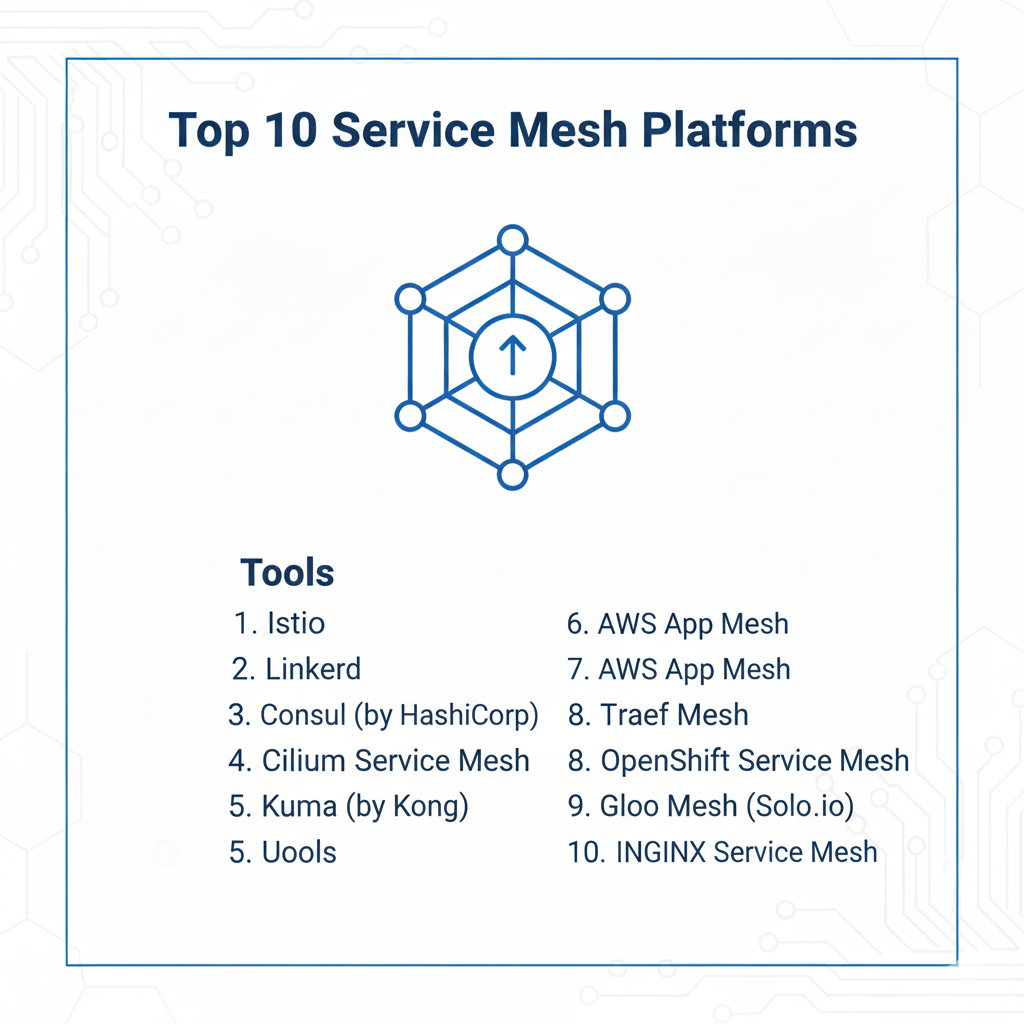
Top 10 Service Mesh Platforms
1 — Istio
Istio is the “gold standard” of service mesh technology. Originally developed by Google, IBM, and Lyft, it is now a CNCF graduated project and offers the most comprehensive feature set in the industry.
- Key Features:
- Ambient Mesh Mode: A sidecar-less architecture that reduces resource overhead and simplifies operations.
- Advanced Traffic Steering: Support for complex routing rules, including header-based and weighted traffic splitting.
- Zero-Trust Security: Automatic mutual TLS (mTLS) with integrated certificate management.
- Rich Observability: Built-in integration with Prometheus, Grafana, and Kiali for topology visualization.
- Policy Enforcement: Fine-grained access control and rate limiting.
- Pros:
- Massive ecosystem and the largest community support in the world.
- Virtually every feature you could ever need for service management is built-in.
- Cons:
- High learning curve and complex configuration (though “Ambient” mode helps).
- Can be resource-intensive if not tuned correctly.
- Security & Compliance: SOC 2, HIPAA, GDPR, and FIPS 140-2 support via enterprise distributions.
- Support & Community: Largest user community; extensive documentation; enterprise support available via Solo.io, Google (ASM), and Red Hat.
2 — Linkerd
Linkerd is known as the “ultralight” service mesh. Written in Rust and Go, it prioritizes performance and simplicity above all else, making it the favorite for teams that want “just enough” mesh.
- Key Features:
- Rust-based Data Plane: Uses a specialized, high-performance proxy that is faster and safer than Envoy.
- Zero-Configuration mTLS: Encryption is on by default for all meshed traffic.
- Linkerd Viz: A built-in dashboard for real-time monitoring of service health and latency.
- CNCF Graduated: One of the most mature and stable open-source projects.
- Multi-cluster Mirroring: Simplifies cross-cluster communication and failover.
- Pros:
- Extremely low latency and resource footprint.
- Simple to install—often taking less than 60 seconds to get running.
- Cons:
- Does not support non-Kubernetes workloads (like VMs) as easily as Istio.
- Fewer advanced “knobs” for niche traffic management scenarios.
- Security & Compliance: Focus on memory safety (via Rust); SOC 2 and GDPR compliant architectures.
- Support & Community: Very active and helpful community; commercial support via Buoyant.
3 — Consul (by HashiCorp)
Consul is the premier choice for organizations running hybrid-cloud environments. It bridges the gap between traditional Virtual Machines (VMs) and modern Kubernetes containers.
- Key Features:
- Service Discovery: A robust, industry-standard registry that tracks services across any infrastructure.
- Consul Connect: Provides mTLS and service-to-service authorization.
- Multi-Platform Support: Works seamlessly on Kubernetes, AWS EC2, Azure VMs, and on-premises bare metal.
- HashiCorp Ecosystem: Deep integration with Vault (secrets) and Terraform (IaC).
- Intentions: Simple, identity-based policies to allow or deny service traffic.
- Pros:
- Best-in-class for “brownfield” environments (mixing legacy and new tech).
- Highly reliable and battle-tested at massive scale.
- Cons:
- Can be complex to architect for multi-region global setups.
- The open-source version lacks some advanced features found in the Enterprise edition.
- Security & Compliance: FIPS 140-2, SOC 2, HIPAA, and ISO 27001 support.
- Support & Community: Professional enterprise support from HashiCorp and a massive library of tutorials.
4 — Cilium Service Mesh
Cilium is the “next-gen” player that leverages eBPF (Extended Berkeley Packet Filter) to provide networking, security, and observability directly within the Linux kernel.
- Key Features:
- Sidecar-less by Default: Handles traffic at the kernel level, eliminating the need for a proxy in every pod.
- Hubble: A specialized observability layer that provides graphical flow maps.
- Transparent Encryption: Uses IPsec or WireGuard for high-performance node-to-node security.
- L7-aware Policy: Can enforce security rules based on HTTP methods or API paths.
- Cloud-Native Networking: Often serves as both the CNI (Container Network Interface) and the service mesh.
- Pros:
- Unrivaled performance; by far the lowest latency in the market.
- Provides deep visibility into the networking stack that other tools can’t reach.
- Cons:
- Requires a modern Linux kernel, which might not be available on older infrastructure.
- The learning curve for eBPF concepts can be steep for traditional network engineers.
- Security & Compliance: High-grade encryption; GDPR and SOC 2 compatible security models.
- Support & Community: Rapidly growing; enterprise support via Isovalent (now part of Cisco).
5 — Kuma (by Kong)
Kuma is an open-source service mesh built on top of the Envoy proxy. It is designed to be “universal,” managing services across Kubernetes, VMs, and even serverless environments.
- Key Features:
- Multi-Zone Control Plane: Easily synchronize policies across different regions or clouds from a single point.
- GUI Dashboard: A clean, intuitive interface for managing mesh policies.
- Kong Integration: Works perfectly with the Kong API Gateway for a unified networking stack.
- Automatic mTLS: Simplifies the issuance and rotation of certificates.
- Fault Injection & Health Checks: Comprehensive resilience testing tools.
- Pros:
- Very easy to operate, even for teams with minimal service mesh experience.
- Handles the “Global Mesh” use case better than most competitors.
- Cons:
- Community is smaller compared to Istio or Linkerd.
- Deployment on VMs requires more manual configuration than on Kubernetes.
- Security & Compliance: mTLS, ACLs, and support for enterprise security standards.
- Support & Community: Strong professional backing from Kong; detailed documentation and forums.
6 — AWS App Mesh
For organizations that have standardized on Amazon Web Services, App Mesh provides a managed, cloud-native way to handle service communication.
- Key Features:
- Managed Control Plane: AWS handles the availability and scaling of the mesh infrastructure.
- EC2, ECS, and EKS Support: Works across all AWS compute platforms.
- CloudWatch Integration: Native export of metrics and logs to AWS monitoring tools.
- Envoy Based: Uses the industry-standard Envoy proxy for its data plane.
- Service Discovery: Integrates with AWS Cloud Map for seamless endpoint tracking.
- Pros:
- No management overhead for the control plane.
- Consistent experience across different AWS compute services.
- Cons:
- Locked into the AWS ecosystem; not suitable for multi-cloud or on-prem.
- Feature set lags behind open-source leaders like Istio.
- Security & Compliance: Fully integrated with AWS IAM; HIPAA and SOC compliant.
- Support & Community: Professional support via AWS Support plans.
7 — Traefik Mesh
Traefik Mesh (formerly Maesh) focuses on being non-invasive and easy to integrate for teams already using the popular Traefik Ingress controller.
- Key Features:
- SMI Compliant: Follows the Service Mesh Interface (SMI) standard for interoperability.
- Non-invasive: Does not require modifying your Kubernetes pod specifications.
- CoreDNS Integration: Uses standard DNS for service discovery within the mesh.
- Traffic Shifting: Simple weight-based routing for deployments.
- Lightweight: Minimal impact on cluster resource consumption.
- Pros:
- The easiest “next step” for teams already comfortable with Traefik Ingress.
- Very intuitive for developers compared to the YAML-heavy Istio.
- Cons:
- Lacks the deep security and advanced tracing features of larger platforms.
- Not designed for massive, global-scale enterprises.
- Security & Compliance: Basic TLS support; GDPR compliant.
- Support & Community: Community-driven with professional backing from Traefik Labs.
8 — OpenShift Service Mesh
OpenShift Service Mesh is Red Hat’s enterprise-hardened version of Istio, fully integrated into the OpenShift Container Platform.
- Key Features:
- Kiali Integration: Comes pre-packaged with a visual console for mesh topology.
- Jaeger Support: Built-in distributed tracing for finding performance bottlenecks.
- Maistra Operator: Simplifies the installation and lifecycle management of the mesh.
- Multi-tenancy: Superior isolation of resources between different teams on the same cluster.
- Integrated RBAC: Maps directly to OpenShift user permissions.
- Pros:
- Best choice for enterprises already using Red Hat OpenShift.
- Hardened security defaults that are ready for production out of the box.
- Cons:
- Primarily restricted to the OpenShift ecosystem.
- Inherits some of Istio’s inherent complexity.
- Security & Compliance: FIPS 140-2, SOC 2, HIPAA, and GDPR.
- Support & Community: World-class enterprise support from Red Hat.
9 — Gloo Mesh (by Solo.io)
Gloo Mesh is a centralized management plane for Istio. It is designed for enterprises running hundreds of clusters across multiple clouds.
- Key Features:
- Unified API: Manage multi-cluster Istio deployments with a single configuration.
- Federal Identity: Seamlessly manage user identities across different cloud providers.
- Global Load Balancing: Sophisticated routing across clusters based on latency or health.
- FIPS-Hardened Istio: Provides a security-vetted version of the Istio control plane.
- Role-Based Workspaces: Delegated administration for different departments.
- Pros:
- Solves the “Day 2” operational headaches of managing Istio at scale.
- Excellent for highly regulated industries requiring strict compliance.
- Cons:
- It is a commercial product; not ideal for teams looking for 100% free open-source.
- Adds another layer of software to your stack.
- Security & Compliance: FIPS 140-2, SOC 2, HIPAA, and ISO 27001.
- Support & Community: Industry-leading experts and 24/7 enterprise support.
10 — NGINX Service Mesh
NGINX Service Mesh leverages the world’s most popular web server proxy to provide a lightweight and predictable service mesh experience.
- Key Features:
- NGINX Plus Data Plane: Uses the battle-tested NGINX Plus engine as the sidecar.
- mTLS and ACLs: Secure service identities and access control.
- Metrics and Tracing: Native integration with Prometheus and OpenTelemetry.
- Easy Deployment: A dedicated CLI tool to install and manage the mesh.
- Service Discovery: High-speed registry for modern Kubernetes environments.
- Pros:
- Consistent performance for teams already using NGINX for Ingress.
- Highly predictable resource usage.
- Cons:
- Newer to the market; community and feature depth are still growing.
- Primarily designed for Kubernetes-only environments.
- Security & Compliance: mTLS encryption; GDPR compliant.
- Support & Community: Professional support provided by F5/NGINX.
Comparison Table
| Tool Name | Best For | Platform(s) Supported | Standout Feature | Rating (Gartner) |
| Istio | Large Enterprises | Kubernetes, VMs | Most Feature-Rich | 4.8 / 5 |
| Linkerd | SMBs / Performance | Kubernetes | Lightweight (Rust) | 4.7 / 5 |
| Consul | Hybrid / Multi-cloud | K8s, VMs, Bare Metal | Cross-Platform | 4.6 / 5 |
| Cilium | Speed / Modern Infra | Kubernetes | eBPF Sidecar-less | 4.8 / 5 |
| Kuma | Global Multi-Zone | K8s, VMs, Cloud | Multi-Zone Sync | 4.5 / 5 |
| AWS App Mesh | AWS Native Users | AWS (ECS, EKS, EC2) | Fully Managed | 4.7 / 5 |
| Traefik Mesh | Simplicity | Kubernetes | Non-invasive Install | 4.3 / 5 |
| OpenShift | Red Hat Users | OpenShift | Pre-Integrated Stack | 4.4 / 5 |
| Gloo Mesh | Multi-Cluster Mgmt | Multi-Cloud Istio | Federal Identity | 4.8 / 5 |
| NGINX Mesh | NGINX Shops | Kubernetes | NGINX Plus Data Plane | 4.2 / 5 |
Evaluation & Scoring of Service Mesh Platforms
| Criterion | Weight | Winner | Evaluation Notes |
| Core Features | 25% | Istio | Unrivaled in breadth of traffic and security features. |
| Ease of Use | 15% | Linkerd | Simplest installation and daily operations. |
| Integrations | 15% | Consul | Connects everything from mainframes to microservices. |
| Security | 10% | Cilium | Kernel-level isolation and API-aware security. |
| Performance | 10% | Cilium | eBPF significantly reduces network latency. |
| Support | 10% | Gloo Mesh | Exceptional high-touch enterprise expertise. |
| Price / Value | 15% | Linkerd | Massive performance for zero licensing cost. |
Which Service Mesh Platforms Tool Is Right for You?
Solo Users vs. SMBs vs. Enterprises
- Solo Users: You almost certainly do not need a service mesh. Unless you are learning for career development, the overhead will slow you down.
- Small Businesses (SMBs): Linkerd is the clear winner. It gives you the “golden signals” of monitoring and mTLS without requiring a PhD in networking to operate.
- Enterprises: Istio or Consul are the go-to choices. If you have thousands of services and complex compliance requirements, you need the robustness these platforms provide.
Budget-Conscious vs. Premium
If you have zero budget, Linkerd and Cilium offer the most power for free. For companies that value time over money, a managed service like AWS App Mesh or a commercial control plane like Gloo Mesh will save you from hiring three extra engineers just to manage the mesh.
Feature Depth vs. Ease of Use
If you need complex traffic shifting (e.g., “send users with this specific cookie to the beta version”), Istio is your only real choice. If you just want to see a map of your services and encrypt traffic, Traefik Mesh or Linkerd will be much more pleasant to use.
Frequently Asked Questions (FAQs)
1. Does a service mesh make my app slower?
Yes, adding a proxy in front of every service call adds some latency. However, modern meshes like Linkerd (Rust) or sidecar-less options like Cilium (eBPF) have reduced this to less than a millisecond.
2. Is Istio better than Linkerd?
It depends on your goal. Istio is better for features and flexibility, while Linkerd is better for speed and simplicity.
3. What is “mTLS” and why do I need it?
Mutual TLS (mTLS) ensures that not only is traffic encrypted, but both the sender and receiver have verified identities. It prevents an attacker from impersonating a legitimate service in your cluster.
4. Can I run a service mesh on Virtual Machines?
Yes. Consul, Kuma, and Istio all support including VMs in the mesh, though the setup is slightly more manual than on Kubernetes.
5. What is “Sidecar-less” service mesh?
Traditionally, a mesh uses a “sidecar” container in every pod. Sidecar-less meshes (like Cilium or Istio Ambient) handle traffic at the node or kernel level, saving significant CPU and RAM.
6. Do I need a service mesh if I already have an API Gateway?
Usually, yes. An API Gateway manages traffic coming from the outside world. A Service Mesh manages traffic moving between your internal services. They work together.
7. Is eBPF the future of service mesh?
Many experts believe so. By moving logic into the Linux kernel, tools like Cilium can provide security and observability with much less overhead than traditional proxies.
8. How much does an enterprise service mesh cost?
Open-source is free. Enterprise licenses (like those from HashiCorp or Solo.io) typically charge based on the number of services or nodes, often ranging from $10k to $100k+ per year.
9. Can a service mesh help with debugging?
Absolutely. Because a mesh sees every request, it can provide “Distributed Tracing,” showing you exactly which service in a long chain is causing a delay or error.
10. What is the biggest mistake people make with service mesh?
Installing it too early. Many teams install a complex mesh like Istio when they only have five microservices, resulting in more time spent managing the mesh than the actual application.
Conclusion
Choosing a Service Mesh Platform is a pivotal decision for any modern engineering organization. While Istio remains the dominant force for sheer power, the rise of specialized tools like Linkerd for simplicity and Cilium for performance has created a much more competitive landscape in 2026.
The “best” tool is the one that fits your team’s operational maturity. If you are a lean team, prioritize ease of use. If you are a global enterprise, prioritize feature depth and multi-cloud support. Remember: a service mesh should be an invisible helper, not a bottleneck.