Introduction
SD-WAN Management Platforms are centralized software solutions that control and optimize the way data moves between your offices, data centers, and the cloud. In the past, connecting a new branch office required complex hardware and weeks of setup. Today, SD-WAN platforms use software to intelligently route traffic across any available connection—whether it’s high-speed fiber, standard business internet, or even 5G.
The importance of these platforms lies in their ability to provide agility at the edge. By separating the “control plane” (the brain) from the “data plane” (the muscles), IT managers can prioritize critical traffic like Zoom calls over less urgent data like software updates. Real-world use cases include reducing telecommunications costs by replacing expensive MPLS lines, improving application performance for remote workers, and automating security across hundreds of locations simultaneously.
When choosing a platform, you should evaluate its application awareness, security integration (SASE), cloud-connectivity options, and zero-touch provisioning capabilities.
Best for: Multi-location enterprises, retailers, healthcare providers, and financial institutions that need secure, reliable connectivity between branches and the cloud.
Not ideal for: Single-location small businesses or solo users. If you don’t have multiple sites or heavy cloud-application needs, the cost and complexity of SD-WAN may outweigh the benefits.
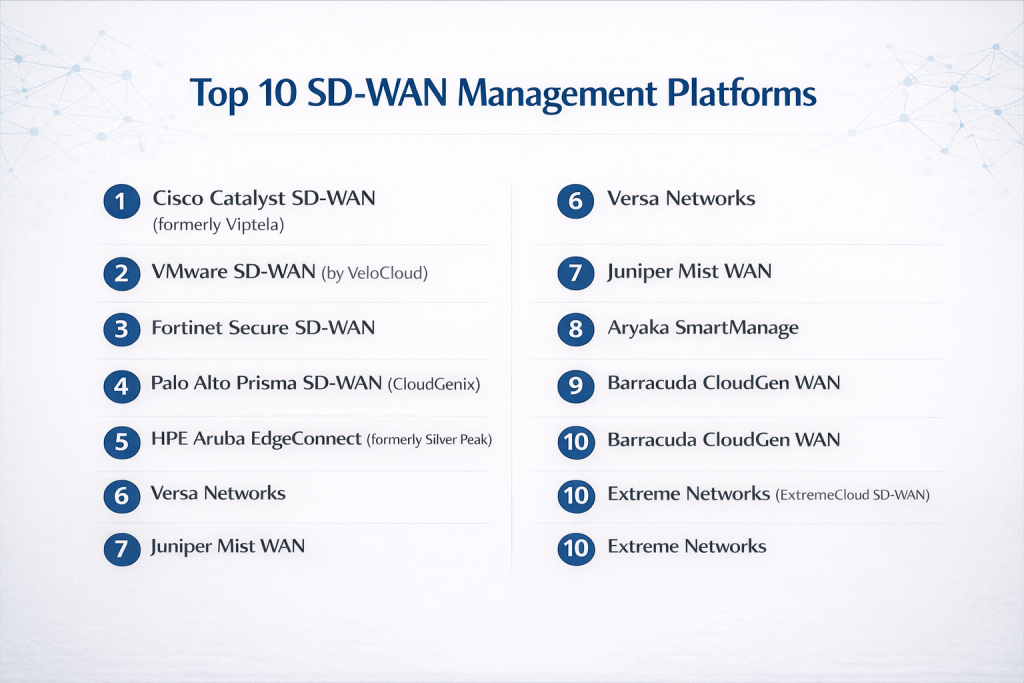
Top 10 SD-WAN Management Platforms
1 — Cisco Catalyst SD-WAN (formerly Viptela)
Cisco is the heavyweight champion of networking, and their Catalyst SD-WAN platform is designed for large-scale, complex environments that require maximum control and reliability.
- Key Features:
- vManage Dashboard: A single pane of glass for configuration, monitoring, and troubleshooting.
- Advanced Path Selection: Dynamically routes traffic based on real-time circuit quality.
- Cisco Umbrella Integration: Built-in cloud security that protects users the moment they connect.
- Multi-Region Fabric: Simplifies global deployments by dividing the network into manageable regions.
- Predictive Analytics: Uses AI to identify potential outages before they happen.
- Cloud OnRamp: Automatically optimizes connections to AWS, Azure, and Google Cloud.
- Pros:
- Unmatched scalability for global companies with thousands of sites.
- Deep integration with the existing Cisco hardware ecosystem.
- Cons:
- Steep learning curve; often requires specialized Cisco certifications to manage.
- Licensing can be expensive and complex to navigate.
- Security & Compliance: FIPS 140-2, SOC 2, HIPAA, and GDPR compliant. High-level encryption for all data in transit.
- Support & Community: Access to the world-class Cisco TAC (Technical Assistance Center) and a massive global user community.
2 — VMware SD-WAN (by VeloCloud)
VMware’s solution is famous for its “Gateway” architecture, which makes it incredibly easy for businesses to connect to cloud services without installing heavy hardware.
- Key Features:
- Cloud Gateways: Over 3,000 global gateways that optimize SaaS performance.
- Dynamic Multi-Path Optimization (DMPO): Fixes packet loss and jitter on the fly.
- Zero-Touch Provisioning: Send a box to a branch, plug it in, and it configures itself.
- Application Performance Monitoring: Provides a “quality score” for every app on your network.
- Integrated SASE: Combines networking and security into a single cloud-delivered service.
- Pros:
- Extremely fast deployment times; ideal for rapid retail rollouts.
- Superior performance for voice and video over “dirty” internet lines.
- Cons:
- Some advanced features require the use of VMware’s proprietary cloud gateways.
- May feel less “rugged” for purely on-premise, non-cloud environments.
- Security & Compliance: First SD-WAN to offer PCI DSS certification; also SOC 2 and HIPAA ready.
- Support & Community: Strong enterprise support and a wide network of managed service providers (MSPs).
3 — Fortinet Secure SD-WAN
Fortinet is unique because it treats SD-WAN and Security as the same thing. Their “Secure SD-WAN” is built directly into their famous FortiGate firewalls.
- Key Features:
- ASIC-Powered Performance: Uses custom hardware chips to speed up security and networking.
- FortiManager: A unified console that manages firewalls, switches, and SD-WAN.
- AI-Powered Threat Protection: Built-in antivirus, IPS, and web filtering.
- Automated Overlay: Simplifies the creation of VPN tunnels between locations.
- Self-Healing WAN: Automatically switches paths if a link becomes unstable.
- Pros:
- Best value; you get a top-tier firewall and SD-WAN in a single device.
- Excellent for “Lean IT” teams that want to manage everything from one dashboard.
- Cons:
- The interface can be complex for those not familiar with Fortinet’s “FortiOS.”
- Deep packet inspection can slow down older hardware models.
- Security & Compliance: ISO 27001, SOC 2, HIPAA, and GDPR compliant. Industry-leading threat intelligence.
- Support & Community: Extensive documentation and an active “Fortinet Guru” community.
4 — Palo Alto Prisma SD-WAN (CloudGenix)
Palo Alto focus is on “App-Defined” networking. Instead of looking at packets, the platform understands exactly which application is running and what it needs.
- Key Features:
- Layer 7 Visibility: Sees applications like Salesforce or Slack rather than just data ports.
- Autonomous Ops: Uses machine learning to fix common network issues automatically.
- Cloud-Blades Architecture: Seamlessly integrates third-party services like Zoom or ServiceNow.
- Agentless Monitoring: Measures user experience without installing software on laptops.
- Consistent Policy: Set a policy once, and it applies across branch, mobile, and cloud.
- Pros:
- Eliminates up to 99% of “trouble tickets” through its self-healing AI.
- Best-in-class security integration with Palo Alto’s Prisma Access.
- Cons:
- Premium pricing reflects its high-end enterprise positioning.
- Transitioning from legacy routing to its “App-Defined” model takes careful planning.
- Security & Compliance: SOC 2 Type II, HIPAA, and GDPR compliant. Strong focus on Zero Trust architecture.
- Support & Community: High-quality professional support and a well-regarded expert certification program.
5 — HPE Aruba EdgeConnect (formerly Silver Peak)
Following the acquisition of Silver Peak, HPE Aruba offers a platform that is unrivaled when it comes to “WAN Optimization”—making slow links feel fast.
- Key Features:
- Unity Boost: Built-in data compression and deduplication for high-speed file transfers.
- Unity Orchestrator: A centralized “brain” that manages the entire global fabric.
- Tunnel Bonding: Combines multiple links into a single, high-performance “virtual” pipe.
- Automated Breakouts: Sends trusted cloud traffic directly to the internet while keeping private data secure.
- First-Packet iQ: Identifies over 10,000 applications on the very first data packet.
- Pros:
- The best choice for companies with “skinny” or unreliable bandwidth.
- Significant cost savings by allowing companies to fully replace MPLS with broadband.
- Cons:
- License costs can escalate quickly as you add more bandwidth.
- Some users report a slower support response following the HPE acquisition.
- Security & Compliance: FIPS 140-2, SOC 2, GDPR, and HIPAA compliant.
- Support & Community: Robust global presence with extensive training modules for partners.
6 — Versa Networks
Versa is a “visionary” platform built from the ground up as a multi-tenant, cloud-native solution. It is a favorite among Service Providers and large global corporations.
- Key Features:
- Multi-Tenancy: One system can safely manage many different sub-organizations.
- Versa Director: A highly detailed orchestration platform for massive networks.
- Unified SASE: Includes Firewall, ZTNA, CASB, and SD-WAN in one software stack.
- Context-Aware Policies: Adjusts networking based on user, device, and location.
- Analytics Engine: Provides deep forensics into every session on the network.
- Pros:
- Unmatched flexibility; can be deployed on-premise, in the cloud, or as a service.
- Extremely powerful for Service Providers building their own SD-WAN offerings.
- Cons:
- High complexity; requires a skilled engineering team to unlock its full potential.
- Documentation can be dense and geared toward expert-level users.
- Security & Compliance: SOC 2, ISO 27001, HIPAA, GDPR, and PCI DSS compliant.
- Support & Community: Excellent support for large enterprise clients and service provider partners.
7 — Juniper Mist WAN
Juniper has integrated its SD-WAN (from the 128 Technology acquisition) into its “Mist AI” platform, focusing on the “Client-to-Cloud” experience.
- Key Features:
- Tunnel-Free Architecture: Reduces data overhead, saving up to 40% of bandwidth.
- Marvis Virtual Network Assistant: An AI that lets you ask questions like “Why is Bob’s Zoom call laggy?”
- Session Smart Routing: Routes individual sessions rather than just packets.
- Mist Cloud Orchestration: Manages Wi-Fi, Switching, and WAN in one AI-driven cloud.
- Zero Trust Security: Built-in “deny-by-default” security at every step.
- Pros:
- Significant bandwidth savings due to the lack of “tunnel” overhead.
- The Marvis AI makes troubleshooting faster than almost any other tool.
- Cons:
- The tunnel-free approach is revolutionary but can be a mindset shift for traditional engineers.
- Hardware options are somewhat more limited compared to Cisco or Fortinet.
- Security & Compliance: FIPS 140-2, SOC 2 Type II, HIPAA, and GDPR compliant.
- Support & Community: Fast-growing community and high-rated customer support.
8 — Aryaka SmartManage
Aryaka is different because they don’t just sell software; they provide a Global Private Core. It’s like having your own private internet for your business.
- Key Features:
- Private Backbone: Your data travels over Aryaka’s private fiber, avoiding the “public” internet.
- Fully Managed Service: Aryaka’s engineers do the monitoring and configuration for you.
- Layer 2 Mesh: Simplifies global connectivity without complex routing protocols.
- Built-in WAN Optimization: Accelerates applications globally with sub-30ms latency.
- SmartPortal: Provides a clear view of your global performance and SLAs.
- Pros:
- Best-in-class performance for international offices (e.g., connecting US and China).
- No need for a large internal IT team; Aryaka handles the heavy lifting.
- Cons:
- You are “locked in” to Aryaka’s private network infrastructure.
- More expensive than “do-it-yourself” broadband SD-WAN solutions.
- Security & Compliance: ISO 27001, SOC 2, HIPAA, and GDPR compliant.
- Support & Community: Professional 24/7 proactive support—they often fix issues before you notice them.
9 — Barracuda CloudGen WAN
Barracuda offers a unique, Azure-native SD-WAN solution designed specifically for organizations that have moved their primary workloads to Microsoft’s cloud.
- Key Features:
- Azure Integration: Built directly on the Microsoft Global Network backbone.
- One-Click Connectivity: Connects branches to the nearest Azure data center instantly.
- Cloud-Managed Security: Includes Barracuda’s legendary firewall and security features.
- Bypass Technology: Ensures connectivity even if the primary software fails.
- Dynamic Link Balancing: Automatically shifts traffic across multiple internet providers.
- Pros:
- The absolute best choice for “Microsoft-first” companies using Office 365 and Azure.
- Very simple deployment for small-to-medium enterprise branches.
- Cons:
- Less flexible for companies using AWS, Google Cloud, or complex on-premise data centers.
- Not as feature-rich in “WAN optimization” as Aruba or Aryaka.
- Security & Compliance: SOC 2, HIPAA, GDPR, and ISO 27001 compliant.
- Support & Community: Excellent customer service and a loyal user base in the SMB/Mid-market.
10 — Extreme Networks (ExtremeCloud SD-WAN)
Extreme Networks provides a simplified, highly visual SD-WAN platform that is part of their broader “ExtremeCloud IQ” ecosystem.
- Key Features:
- Unified Management: Manages wireless APs, wired switches, and SD-WAN in one place.
- Application Visibility: Identifies over 4,000 applications for granular control.
- Simple Orchestration: Designed for IT generalists rather than just network specialists.
- Integrated Firewall: Provides essential security for branch internet breakouts.
- Subscription-Based: Easy to scale up or down based on your business needs.
- Pros:
- One of the most user-friendly dashboards in the networking industry.
- Great for schools and mid-sized businesses with limited IT staff.
- Cons:
- May lack some of the “extreme” scalability features needed by the world’s largest banks or ISPs.
- Newer to the SD-WAN space compared to veterans like Cisco or VeloCloud.
- Security & Compliance: SOC 2, GDPR, and HIPAA compliant.
- Support & Community: Strong user community and reliable technical support desk.
Comparison Table
| Tool Name | Best For | Platform(s) Supported | Standout Feature | Rating (Gartner) |
| Cisco Catalyst | Global Enterprises | On-Prem / Cloud | Scale & Reliability | 4.4 / 5 |
| VMware (VeloCloud) | Cloud-First SMB/Ent | Cloud Gateways | DMPO (Voice/Video) | 4.5 / 5 |
| Fortinet | Security-First IT | Hardware / VM | ASIC Acceleration | 4.4 / 5 |
| Palo Alto Prisma | App-Defined Ops | Cloud-Managed | AI Self-Healing | 4.6 / 5 |
| Aruba EdgeConnect | WAN Optimization | Physical / Virtual | Unity Boost | 4.5 / 5 |
| Versa Networks | MSPs / Large Ent | Software / Cloud | Multi-Tenancy | 4.4 / 5 |
| Juniper Mist | AI-Driven Ops | Cloud / Hardware | Tunnel-Free Routing | 4.6 / 5 |
| Aryaka | International Sites | Fully Managed | Global Private Core | 4.7 / 5 |
| Barracuda | Microsoft/Azure Shops | Azure-Native | One-Click Azure | 4.3 / 5 |
| Extreme Networks | Mid-Market / Education | Cloud-IQ | Unified Dashboard | 4.4 / 5 |
Evaluation & Scoring of SD-WAN Management Platforms
To help you make an informed choice, we have evaluated these platforms using a weighted scoring rubric based on current industry standards.
| Category | Weight | Evaluation Logic |
| Core Features | 25% | Application awareness, traffic steering, and path optimization. |
| Ease of Use | 15% | Dashboard design, orchestration simplicity, and zero-touch deployment. |
| Integrations | 15% | Support for major cloud providers (AWS/Azure) and third-party APIs. |
| Security | 10% | Built-in firewall, ZTNA, and encryption standards. |
| Performance12 | 10%34 | Latency handling, packet loss remediation, and failover speed.56 |
| Support & Community78 | 10%910 | Documentation, forums, and 24/7 technical response times.1112 |
| Price / Value1314 | 15%1516 | Licensing transparency and total cost of ownership (TCO).1718 |
Which SD-WAN Management Platform Is Right fo19r You?20
Solo Users vs SMB vs Mid-Market vs Enterprise
- Solo Users: Generally do not need SD-WAN. A simple VPN or modern router is sufficient.
- SMBs (1–50 sites): Look at Fortinet or Extreme Networks. These tools provide security and networking in a simple, affordable box.
- Mid-Market (50–200 sites): VMware (VeloCloud) or Barracuda offer the perfect balance of cloud-readiness and ease of use.
- Enterprise (200+ sites): Cisco and Palo Alto are the industry standards for their ability to handle massive scale and complex security rules.
Budget-Conscious vs Premium Solutions
If budget is the primary driver, Fortinet is hard to beat because you get a world-class firewall and SD-WAN in one license. For those willing to pay a premium for performance, Aryaka provides a private network that eliminates the unpredictability of the public internet.
Feature Depth vs Ease of Use
- Feature Depth: Versa Networks and Cisco offer the most knobs and dials for engineers who want total control.
- Ease of Use: Juniper Mist and VMware are designed to “just work,” with AI doing the heavy lifting so your IT team can focus on other tasks.
Frequently Asked Questions (FAQs)
1. Does SD-WAN replace MPLS?
Yes, for many companies. SD-WAN can combine multiple cheap broadband links to provide the same (or better) reliability as an expensive, private MPLS circuit.
2. Is SD-WAN secure?
Absolutely. Most modern SD-WAN platforms include built-in encryption and firewalls. Many have evolved into “Secure SD-WAN” or SASE, which includes Zero Trust security.
3. What is “Zero-Touch Provisioning” (ZTP)?
ZTP allows you to send a network device to a remote office where a non-technical person just plugs it in. The device then automatically downloads its configuration from the cloud.
4. Can I use my existing internet providers with SD-WAN?
Yes. One of the biggest benefits of SD-WAN is that it is “carrier-agnostic.” You can mix and match providers (e.g., Comcast, AT&T, Verizon) as you see fit.
5. How much does SD-WAN cost?
Pricing varies wildly based on bandwidth and features. Most follow a subscription model (per month, per site). Small sites might cost $50/month, while large data centers can cost thousands.
6. Do I need special hardware?
Usually, yes. You typically need an “SD-WAN Edge” device at each site. However, some vendors allow you to run their software on “standard” servers or as virtual machines.
7. Does SD-WAN improve Zoom and Teams calls?
Yes. Features like “Dynamic Multi-Path Optimization” can detect if one internet link is lagging and instantly move your voice call to a better link without the call dropping.
8. What is the difference between SD-WAN and a VPN?
A VPN is a simple encrypted “tunnel.” SD-WAN is an intelligent system that manages multiple tunnels, optimizes traffic, and provides centralized visibility.
9. How long does it take to deploy?
With Zero-Touch Provisioning, a single site can be online in minutes. A global rollout for hundreds of sites typically takes a few months of planning and testing.
10. Can I manage SD-WAN myself?
Yes, most platforms are designed for internal IT teams. However, if you don’t have the staff, companies like Aryaka offer “Fully Managed” services where they do it for you.
Conclusion
The shift to SD-WAN Management Platforms represents a fundamental change in how we think about the “Network.” No longer a collection of static wires, the modern network is a dynamic, software-driven engine that adapts to the needs of your business in real-time.
When choosing a platform, remember that the “best” tool is the one that fits your specific digital footprint. If you are heavily invested in the cloud, VMware or Palo Alto may be your best bets. If security and cost are your priorities, Fortinet is a standout. And if you have a global reach with critical latency needs, Aryaka provides a unique private backbone. By centralizing your management, you don’t just fix your network—you empower your entire organization to move faster and more securely than ever before.