Introduction
Sanctions Screening Tools are specialized compliance software designed to identify and block transactions or business relationships with individuals, entities, and countries that are legally prohibited by governments or international bodies. In the modern financial landscape, these tools act as an automated filtration system, comparing customer and transaction data against thousands of official “blacklists”—such as those issued by the US Office of Foreign Assets Control (OFAC), the United Nations, and the European Union. By using advanced technologies like fuzzy logic and AI-driven entity resolution, these platforms can detect sanctioned parties even when their names are misspelled, transliterated into different alphabets, or deliberately disguised using aliases.
The importance of sanctions screening cannot be overstated. We live in an era where global geopolitical tensions shift overnight; a business partner who was “safe” yesterday could be a sanctioned individual today. For organizations, failing to catch a single prohibited transaction can lead to catastrophic consequences, including multimillion-dollar fines, the revocation of banking licenses, and irreparable reputational damage. These tools transform compliance from a manual, error-prone burden into a real-time, proactive defense mechanism. By automating the screening process, firms can handle massive transaction volumes with precision, ensuring that “dirty money” stays out of the financial system while legitimate business continues without friction.
Key Real-World Use Cases
Sanctions screening tools are essential across various critical business functions:
- Customer Onboarding (KYC): Instantly checking new clients against global watchlists at the point of sign-up to prevent prohibited individuals from entering the ecosystem.
- Real-Time Payment Screening: Scanning cross-border wire transfers and digital asset movements in milliseconds to block funds before they reach a sanctioned destination.
- Continuous Monitoring: Re-screening an entire existing client database every time a regulatory body updates a sanctions list (often daily).
- Supply Chain Due Diligence: Verifying that vendors, shippers, and ultimate beneficial owners (UBOs) in a complex supply chain are not linked to sanctioned regimes.
- Vessel and Aircraft Tracking: Monitoring specialized lists of sanctioned ships and planes to ensure logistics companies aren’t facilitating prohibited trade.
What to Look For (Evaluation Criteria)
When evaluating sanctions screening tools, compliance leaders should prioritize these four pillars:
- Matching Precision (Fuzzy Logic): How well does the tool handle variations like “Jon Smith” vs. “John Smyth” or Arabic-to-English name transliterations?
- Data Update Frequency: In a fast-moving world, list updates must happen in real-time or every few hours—not weekly.
- False Positive Reduction: High-quality tools use AI to suppress “noise,” ensuring your compliance team isn’t buried under thousands of false alerts for common names.
- Explainability and Audit Trails: Regulators require you to show why a match was cleared. The tool must provide a clear, timestamped record of every decision.
Best for:
- Financial Institutions and Fintechs: Banks, neobanks, and crypto exchanges that must process high-volume transactions with zero room for error.
- Global Trade and Logistics: Companies moving goods across borders that need to verify entities in high-risk jurisdictions.
- Legal and Professional Services: Firms handling high-value client assets or complex corporate structures (KYB).
- Gaming and Gambling Platforms: Where rapid money movement requires instant, automated AML/CTF checks.
Not ideal for:
- Local, Single-Jurisdiction Small Businesses: A small domestic retail shop with no international customers likely doesn’t need a dedicated enterprise screening suite.
- Low-Volume Professional Practices: A solo accountant with three local clients can perform manual checks on government websites for free.
- Firms with Zero Digital Presence: These tools require digital data inputs; they cannot screen physical paper ledgers in real-time.
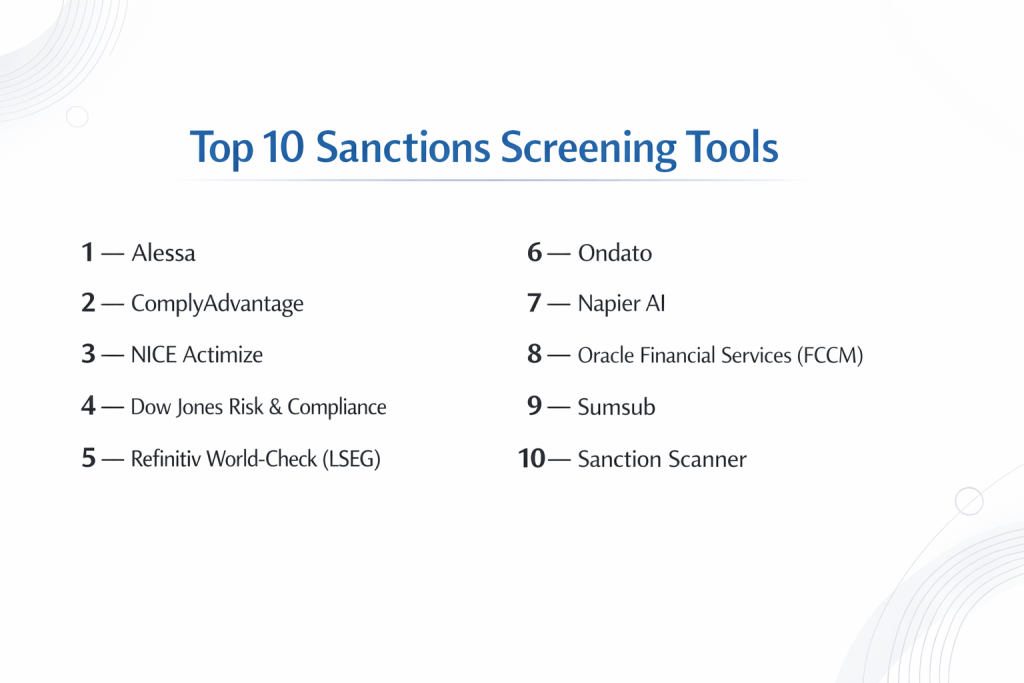
Top 10 Sanctions Screening Tools
1 — Alessa
Alessa is widely recognized as a top-tier sanctions screening and AML platform, offering a modular approach that combines data intelligence with powerful automation for financial institutions and corporates.
Key features:
- Comprehensive List Coverage: Aggregates data from OFAC, UN, EU, HMT, and hundreds of other local and global watchlists.
- AI-Powered Matching: Uses natural language processing (NLP) to reduce false positives by analyzing context, not just names.
- Daily List Refreshes: Ensures that your screening data is never more than 24 hours old.
- Configurable Risk Scoring: Allows firms to set their own risk appetites for different jurisdictions or product types.
- Crypto Exposure Monitoring: Integrates screening for 600+ crypto exchanges to identify high-risk digital asset flow.
Pros:
- Highly cost-effective “pay-for-what-you-use” model can save firms up to 50% compared to legacy competitors.
- Excellent visualization tools for investigating complex ownership structures and relationships.
Cons:
- The initial setup and rule configuration can be time-consuming for smaller teams.
- Some advanced features require a higher tier of technical support during implementation.
Security & compliance: SOC 2 Type II, GDPR compliant, and utilizes AES-256 encryption for all data at rest and in transit.
Support & community: Dedicated account managers, 24/7 technical support, and an extensive library of regulatory training materials.
2 — ComplyAdvantage
ComplyAdvantage is a “developer-first” RegTech leader that prides itself on providing real-time, AI-driven risk data through a modern, modular API.
Key features:
- Proprietary Risk Database: Unlike tools that just “scrape” lists, they build their own structured data for higher accuracy.
- Real-Time Adverse Media: Automatically tracks negative news related to individuals and entities alongside sanctions.
- API-First Architecture: Designed to be plugged directly into a fintech’s onboarding flow in minutes.
- Continuous Monitoring: Automatically alerts users the moment a client’s status changes on any global list.
- Dynamic PEP Screening: Covers four levels of Politically Exposed Persons (PEPs) with detailed relationship mapping.
Pros:
- The modern UI and API documentation are considered the gold standard for tech-savvy compliance teams.
- Extremely low latency, making it ideal for “instant-onboarding” apps.
Cons:
- Pricing can escalate quickly for high-volume startups.
- The focus on data science means it lacks some of the “on-premise” heavy features required by old-school banks.
Security & compliance: ISO 27001, SOC 2, and compliant with global AML/CTF mandates across the US, UK, and EU.
Support & community: Robust developer portal, responsive customer success team, and regular webinars on emerging financial crimes.
3 — NICE Actimize
NICE Actimize is the heavyweight of the industry, serving the majority of Tier 1 global banks with its enterprise-grade financial crime suite.
Key features:
- Watchlist Filtering (WLF): A massive engine capable of processing millions of transactions daily across global networks.
- Entity Resolution: Uses sophisticated graph technology to see “through” aliases and shell companies.
- Advanced Analytics: Employs machine learning to learn from past “false positives” and suppress them automatically.
- Multi-Asset Support: Screens everything from retail payments to complex trade finance and securities.
- Unified Case Management: Centralizes alerts from screening, fraud, and AML into one investigative hub.
Pros:
- Unrivaled scalability; if you are a global bank with 100 million customers, this is the tool.
- Deeply trusted by global regulators who are familiar with its logic and reporting formats.
Cons:
- Implementation is a major project that can take months and require significant professional services.
- The interface can feel dated and “heavy” compared to modern cloud-native startups.
Security & compliance: Bank-grade security standards, SOC 1/2, ISO 27001, and extensive regulatory audit features.
Support & community: Global 24/7 support desks, a massive user community, and dedicated enterprise account teams.
4 — Dow Jones Risk & Compliance
Dow Jones leverages its world-class journalistic roots to provide one of the most accurate and deeply researched risk datasets on the planet.
Key features:
- Human-Curated Data: Thousands of researchers verify sanctions and PEP data to ensure the highest integrity.
- Sanctions Ownership Research: Goes beyond the lists to identify entities 50% or more owned by sanctioned parties.
- Adverse Media Integration: Deeply integrated with the Dow Jones news ecosystem for early warning signals.
- Always-On Monitoring: Updates are pushed in near real-time as global events unfold.
- Third-Party Risk (TPRM): Specialized modules for screening vendors and supply chain partners.
Pros:
- The data accuracy is world-class, significantly reducing the “garbage in, garbage out” problem.
- Excellent for high-stakes due diligence where missing a 51% owned subsidiary would be a legal disaster.
Cons:
- Primarily a data provider; while they have a platform, many firms use their data via other software.
- Can be very expensive for small-to-mid-sized firms.
Security & compliance: ISO 27001, GDPR compliant, and strict data governance protocols.
Support & community: High-touch client service and access to a global network of risk and compliance experts.
5 — Refinitiv World-Check (LSEG)
Now part of the London Stock Exchange Group (LSEG), World-Check is a legacy name that remains a cornerstone of the AML and sanctions world.
Key features:
- Massive Profile Library: Millions of profiles covering sanctions, PEPs, and high-risk individuals.
- Vessels & Instruments: Specialized lists to screen sanctioned ships and specific financial securities (bonds/ISINs).
- World-Check One: A simplified web-based interface for manual or batch screening.
- UBO Identification: Tools to unwrap complex corporate layers to find the ultimate beneficial owner.
- Integrated Remediation: Built-in workflows to document and clear (or block) matches.
Pros:
- The sheer depth of the database is almost impossible for newer competitors to match.
- The “Vessel” and “Financial Instrument” screening is essential for shipping and investment firms.
Cons:
- The technology platform has historically been slower to modernize than cloud-first rivals.
- Customer support for smaller accounts can sometimes be less responsive than specialized boutiques.
Security & compliance: SOC 2, ISO 27001, and fully aligned with FATF and MiFID II requirements.
Support & community: Global presence with a long history of serving the world’s most regulated industries.
6 — Ondato
Ondato is an innovative European provider that has gained massive traction in 2026 for its “all-in-one” onboarding and screening platform.
Key features:
- Real-Time Updates: Global sanctions lists are refreshed every 3 hours, one of the fastest rates in the industry.
- AI Rangers: Dedicated “AI bots” that scan news and databases to provide risk reports in under 30 seconds.
- Unified Onboarding: Combines identity verification (IDV) and sanctions screening in a single user journey.
- Flexible Pricing: Offers modules that scale from small business needs to enterprise-level volume.
- No-Code Workflow Builder: Allows compliance officers to change screening logic without a developer.
Pros:
- The integration of identity verification and screening into one platform saves significant time and cost.
- Highly intuitive UI that requires very little training for new compliance staff.
Cons:
- Primarily focused on the European and North American markets; less depth in niche regional lists in APAC.
- The “AI Ranger” news scanning can occasionally produce irrelevant “noise” that requires filtering.
Security & compliance: SOC 2 Type II, ISO 27001, and fully compliant with the latest EU AMLD6 directives.
Support & community: Excellent digital documentation and a highly rated customer success team.
7 — Napier AI
Based in London, Napier AI is redefining compliance with a “Human-Centered AI” approach that focuses on making investigators faster and more accurate.
Key features:
- Intelligent Compliance Platform (ICP): A cloud-native hub that handles screening and monitoring in one view.
- Sandbox Testing: Unique feature allowing you to “test” new rules against old data to see the impact before going live.
- Natural Language Processing: Sophisticated entity matching that understands name variations and phonetics.
- Rapid Deployment: Can be spun up in the cloud significantly faster than traditional legacy systems.
- Explainable AI: Provides clear reasons for why the AI flagged or dismissed a specific match.
Pros:
- The “Sandbox” is a game-changer for tuning out false positives without risking a regulatory breach.
- Very modern, data-driven approach that appeals to quants and data scientists.
Cons:
- Being a newer, high-growth company, its global footprint of support offices is still expanding.
- The advanced AI features come at a premium price point.
Security & compliance: ISO 27001, SOC 2, and designed for GDPR data sovereignty requirements.
Support & community: High-touch implementation support and an active user feedback group.
8 — Oracle Financial Services (FCCM)
Oracle’s Financial Crime and Compliance Management (FCCM) is the bedrock for large institutions that already run on the Oracle enterprise ecosystem.
Key features:
- Oracle Cloud Infrastructure: Leverages the power of Oracle’s global data centers for massive throughput.
- Multi-List Management: Handles hundreds of external and internal “white/black” lists simultaneously.
- Behavioral Analysis: Looks beyond name matches to see if transaction patterns suggest sanctions evasion.
- Scenario Modeling: Advanced tools for compliance teams to build complex “what if” risk scenarios.
- Enterprise Reporting: Deep integration with Oracle’s business intelligence tools for board-level reporting.
Pros:
- If you are already an Oracle shop, the data governance and integration are seamless.
- Offers extreme “defense-in-depth” for the largest, most targeted banks in the world.
Cons:
- Notoriously difficult and expensive to implement for firms not already using Oracle.
- The system is very rigid and can be slow to adapt to fast-moving fintech needs.
Security & compliance: FIPS 140-2, SOC 1/2, ISO 27001, and FedRAMP authorized.
Support & community: Massive global partner network and 24/7 enterprise-level technical support.
9 — Sumsub
Sumsub is an “all-in-one” verification platform that has become the darling of the crypto and neobank sectors for its sheer ease of use.
Key features:
- One-Click Screening: Automates the check for sanctions, PEPs, and adverse media during user sign-up.
- Global Watchlist Access: Direct feeds into OFAC, UN, HMT, and specialized regional lists.
- Automated Rule Builder: Set simple “If/Then” logic for what happens when a match is found.
- Case Management: A clean, Kanban-style board for investigators to review and clear alerts.
- Travel Rule for Crypto: Specialized tools to help VASPs (Virtual Asset Service Providers) comply with crypto-specific sanctions.
Pros:
- Incredible speed; full KYC and sanctions checks often take less than 60 seconds.
- The most accessible pricing model for startups and early-stage fintechs.
Cons:
- Lacks the deep “investigative” power needed for high-stakes corporate trade finance.
- The focus is on onboarding, so long-term “transaction monitoring” is less robust than Actimize or Alessa.
Security & compliance: GDPR, SOC 2, and localized compliance settings for over 220 countries and territories.
Support & community: 24/7 chat support and a very helpful online “Compliance Academy.”
10 — Sanction Scanner
Sanction Scanner is a nimble, cloud-based solution that has carved out a niche by offering high-quality screening to small and mid-sized businesses.
Key features:
- Real-Time Querying: Scan any name or entity instantly via a web interface or simple API.
- Global List Coverage: Includes 3,000+ watchlists and PEP databases from around the world.
- Adverse Media Screening: Tracks negative news to provide a more holistic risk score.
- Batch Screening: Upload a CSV of your entire client list to screen them all at once in seconds.
- Developer-Friendly API: Simple REST API that can be integrated by a single developer in a few hours.
Pros:
- Perhaps the best “bang-for-your-buck” for firms that need baseline compliance without the enterprise price tag.
- Very fast onboarding; you can literally sign up and start screening today.
Cons:
- Lacks the complex “relationship mapping” and “entity resolution” of high-end tools.
- Reporting features are adequate but not as detailed as those required by Tier 1 regulators.
Security & compliance: ISO 27001, GDPR compliant, and utilizes secure AWS cloud infrastructure.
Support & community: Friendly, responsive support and a straightforward knowledge base.
Comparison Table
| Tool Name | Best For | Platform(s) Supported | Standout Feature | Rating |
| Alessa | Mid-Market & MSBs | Cloud / Hybrid | Crypto Exposure Tracking | 4.8 |
| ComplyAdvantage | Fintechs & Neobanks | SaaS (API-First) | Proprietary Risk Database | 4.6 |
| NICE Actimize | Tier 1 Global Banks | On-Prem / Cloud | Entity Resolution AI | 4.5 |
| Dow Jones | Deep Due Diligence | Data / SaaS | 50% Ownership Research | N/A |
| Refinitiv (LSEG) | Trade & Shipping | Web / API | Vessel/Aircraft Screening | 4.4 |
| Ondato | SME Onboarding | SaaS (Cloud) | 3-Hour List Refreshes | 4.8 |
| Napier AI | AI-First Compliance | Cloud (SaaS) | Sandbox Rule Testing | N/A |
| Oracle FCCM | Large Enterprises | On-Prem / Cloud | Oracle Ecosystem Sync | 4.3 |
| Sumsub | Crypto & Rapid KYC | SaaS (Cloud) | All-in-One Verification | 4.7 |
| Sanction Scanner | SMBs & Startups | SaaS (Cloud) | Extreme Ease of Use | 4.6 |
Evaluation & Scoring of Sanctions Screening Tools
| Criterion | Weight | Evaluation Focus |
| Core Features | 25% | Multi-list coverage, fuzzy matching precision, and adverse media. |
| Ease of Use | 15% | Dashboard intuitiveness, API documentation, and investigation UI. |
| Integrations | 15% | Connectivity to CRMs, core banking, and payment rails. |
| Security & Compliance | 10% | SOC 2/ISO status, data sovereignty, and audit log depth. |
| Performance | 10% | Latency (milliseconds), throughput, and list update frequency. |
| Support | 10% | 24/7 technical help and regulatory expertise of the staff. |
| Price / Value | 15% | Licensing cost vs. false positive reduction and fine avoidance. |
Which Sanctions Screening Tool Is Right for You?
Solo Users vs SMB vs Mid-Market vs Enterprise
Solo users (like high-net-worth advisors) rarely need these tools; manual checks suffice. SMBs should look at Sanction Scanner or Sumsub for their simplicity and low entry cost. Mid-Market firms requiring more robust investigations should pivot to Alessa or Ondato. Enterprises—especially those with massive global footprints—require the “powerhouse” capabilities of NICE Actimize or Oracle.
Budget-Conscious vs Premium Solutions
If you are strictly Budget-Conscious, Sanction Scanner offers a “pay-as-you-go” feel that is hard to beat. If you are a Premium institution with zero tolerance for risk, Dow Jones and Refinitiv provide the high-integrity, human-verified data that justifies their higher price points.
Feature Depth vs Ease of Use
For Ease of Use, Sumsub and Ondato lead the pack; a non-technical compliance officer can manage these without IT help. For Feature Depth, Napier AI and Actimize offer the “deep engine” features—like sandbox testing and graph-based entity resolution—that technical teams crave.
Integration and Scalability Needs
If your primary need is Integration with a modern tech stack, ComplyAdvantage is the winner due to its developer-centric design. For Scalability in a traditional banking sense, NICE Actimize is the only tool that has proven it can handle the load of the world’s top 100 banks.
Security and Compliance Requirements
Every tool here is highly secure, but for firms with the most rigid Compliance Requirements (like those needing FedRAMP or specialized data sovereignty), Oracle and Alessa offer the most robust “On-Premise” or “Private Cloud” installation options to keep data completely under your control.
Frequently Asked Questions (FAQs)
What is the difference between an AML check and a Sanctions check?
AML is a broad category that includes monitoring for suspicious patterns. A sanctions check is a specific part of AML that looks for matches against government “do not trade” lists.
What is “Fuzzy Matching”?
It is a technique that identifies matches that are similar but not identical (e.g., “Mhd” vs “Mohammed”). It is essential for catching name variations and typos.
How often are sanctions lists updated?
In 2026, leading tools update their lists every few hours. Regulators generally expect you to be using data that is no more than 24 hours old.
Can a tool tell me if a company is owned by a sanctioned person?
Yes, but only high-end tools like Dow Jones or Refinitiv have the “Ownership” data to see who owns 50% or more of a non-sanctioned company.
What is a “False Positive”?
It’s when the tool flags a match that isn’t actually the sanctioned person (e.g., flagging an innocent “John Smith” because a criminal has the same name).
Do these tools work for Crypto?
Yes. Tools like Alessa, Sumsub, and ComplyAdvantage have specific modules to screen crypto wallet addresses and exchanges.
Can I run these tools on-premise?
Some enterprise tools (Actimize, Oracle, Alessa) offer on-premise versions, but the industry has largely moved to secure, cloud-native (SaaS) models.
How do I prove compliance to a regulator?
The tool must generate a “case report” or audit log that shows when the check was done, what was found, and who “cleared” it and why.
What is “Adverse Media”?
It is negative news about a person (e.g., a news article about a fraud investigation) that hasn’t yet resulted in them being put on a formal sanctions list.
How much does a sanctions screening tool cost?
Small firms can pay $100–$500/month for basic tools, while global banks pay millions for enterprise-wide deployments with specialized data feeds.
Conclusion
The selection of a Sanctions Screening Tool is no longer just an IT decision; it is a core strategic pillar for any firm operating in the global economy. As we have seen, the landscape in 2026 ranges from cloud-native, agile APIs like ComplyAdvantage to enterprise behemoths like NICE Actimize. There is no “one size fits all” winner; the “best” tool is the one that fits your transaction volume, your technical capabilities, and your specific risk profile.
What matters most is the freshness of data and the reduction of manual noise. A tool that saves your compliance team from 10,000 false positives a month is not just a software purchase—it is a massive gain in operational efficiency. In a world where geopolitical borders are constantly shifting, having an automated, intelligent, and explainable screening foundation is the only way to ensure your business remains both compliant and resilient.