Introduction
Sales tax automation tools are software solutions designed to calculate, collect, report, and file sales and use tax obligations automatically. In an era of “economic nexus” laws, where selling online can create tax obligations in hundreds or thousands of jurisdictions, these tools replace manual spreadsheets and guesswork with precision. They act as a digital tax expert, continuously updated with the latest rates, rules, and boundaries for every city, county, and special district.
This software is critically important because sales tax compliance has become a high-stakes, complex burden for businesses. Mistakes are costly, leading to audits, penalties, interest, and reputational damage. Manual management is nearly impossible due to the volume of frequent rate changes (thousands occur yearly) and intricate product taxability rules (e.g., clothing is taxable in one state but exempt in another). Automation ensures accuracy, saves countless hours, and provides defensible audit trails, turning a major liability into a managed process.
Key real-world use cases include: An e-commerce store determining the correct tax rate for a customer in a specific ZIP+4 code. A SaaS company applying different tax rules to its digital services across multiple states. A multichannel retailer unifying tax calculations for online, in-store, and marketplace sales. A manufacturer determining use tax on out-of-state purchases. Any business selling goods or services across state lines needs these tools to navigate the patchwork of over 12,000 U.S. tax jurisdictions.
When choosing a tool, users should prioritize several criteria. Calculation Accuracy & Coverage is non-negotiable; the tool must have a proven, comprehensive database. Integration Depth determines practical utility; it must connect seamlessly to your e-commerce platform, POS system, and accounting software. Filing & Remittance Automation is a key time-saver—can it prepare and submit returns? Audit Defense Features like detailed reporting and certificate management are crucial for risk mitigation. Finally, consider scalability for business growth and the clarity of the pricing model.
Best for: These tools are essential for e-commerce businesses, accountants, CFOs, and financial controllers in companies that sell taxable goods or services across multiple jurisdictions. They are particularly vital for fast-growing online brands, SaaS and digital service providers, multichannel retailers, and manufacturers with complex supply chains. Mid-market and enterprise companies with large transaction volumes benefit enormously from the risk reduction and efficiency gains.
Not ideal for: Local brick-and-mortar businesses that only make sales within a single city or county where tax rates are static and simple. A sole proprietor operating a service business (like a local consultant or plumber) that is not subject to sales tax on their services. Businesses with a very small number of out-of-state sales (a handful per year) might manage with manual research, though the risk remains. In these cases, basic accounting software or a simple rate lookup tool might suffice.
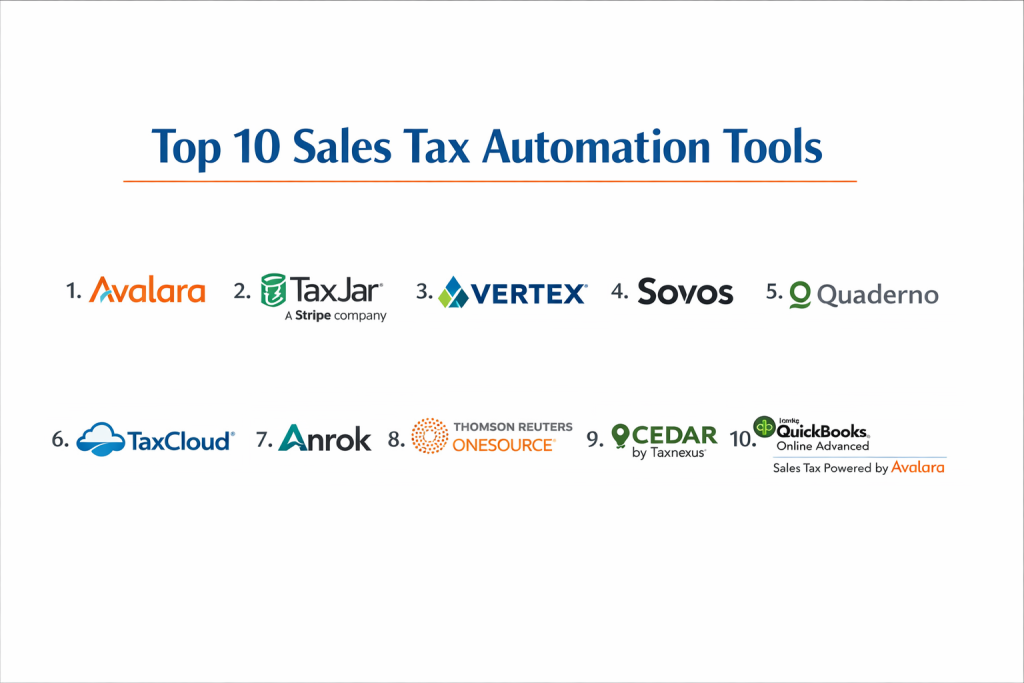
Top 10 Sales Tax Automation Tools
1 — Avalara
Avalara is the most widely recognized end-to-end sales tax compliance platform. It is designed for businesses of all sizes, from growing SMBs to large enterprises, that need a comprehensive, integrated solution for calculation, filing, and remittance.
Key features:
- Real-Time Tax Calculation: Accurate, jurisdiction-specific rates and rules for every transaction via a vast, continuously updated database.
- Automated Returns & Filing: Prepares, files, and remits sales tax returns for all required jurisdictions, handling all filing frequencies.
- Avalara Certificates (Exemption Management): Centralized, digital platform for storing, validating, and managing customer tax exemption certificates (W-9, ST-3, etc.).
- Broad Ecosystem Integrations: Hundreds of pre-built, certified connectors for major e-commerce platforms (Shopify, BigCommerce), ERPs (NetSuite, SAP), and POS systems.
- Avalara Returns for Small Business: A simplified filing service tailored for smaller companies and startups.
- International Tax Compliance: Supports VAT, GST, and other indirect taxes for global selling.
Pros:
- Market Leader Breadth: Offers the most complete suite of tools covering the entire compliance lifecycle from calculation to filing to audit support.
- Unmatched Integration Network: The largest library of pre-built, robust connectors, making it the default choice for many software platforms.
Cons:
- Complex Pricing: Costs can scale quickly and become significant, with various modules (Returns, Certificates) priced separately, leading to potential sticker shock.
- Can Feel “Heavy” for Very Small Businesses: The full platform may be overkill for micro-businesses with simple needs, who might prefer a more streamlined tool.
Security & compliance: Enterprise-grade security with SOC 1, SOC 2, and ISO 27001 certifications. Employs data encryption, SSO, and rigorous access controls. Built specifically for tax compliance and data integrity.
Support & community: Offers 24/7 support, a vast knowledge base, and dedicated account management for larger clients. Has a large user community and partner network.
2 — TaxJar (a Stripe company)
TaxJar is a popular, user-friendly sales tax automation platform known for its intuitive interface and smart reporting. It is particularly favored by e-commerce businesses, especially those using Shopify, Amazon, and other online sales channels.
Key features:
- SmartCalcs API: A robust and accurate calculation API for real-time tax determination at checkout.
- Automatic Transaction Import: Automatically pulls in sales data from connected e-commerce platforms, marketplaces, and payment gateways for unified reporting.
- AIO Returns (AutoFile): Automated sales tax filing and remittance service for registered states.
- Clear Dashboard & Reports: Provides an intuitive dashboard with visualizations of nexus, tax liability, and economic trends by state.
- Nexus Insights: Proactively alerts businesses when their sales may have created a new tax collection obligation (nexus) in a state.
- Strong E-commerce Focus: Deep, native integrations with major online selling platforms.
Pros:
- Exceptional E-commerce User Experience: Renowned for its clean, intuitive design that makes complex tax data easy to understand and act upon.
- Streamlined for Multi-Channel Sellers: Excels at aggregating data from various online sales channels (Shopify, Amazon, Etsy) into a single tax report.
Cons:
- Less ERP-Centric: While it integrates with accounting software, its deepest strengths and branding are aligned with e-commerce, not complex ERP financial workflows.
- Filing Service Limitations: The AutoFile service, while powerful, is not available for every jurisdiction or filing scenario, sometimes requiring manual intervention.
Security & compliance: As part of Stripe, it adheres to high security standards, including data encryption and secure infrastructure. Specific compliance certifications like SOC 2 are part of the Stripe ecosystem.
Support & community: Provides email and chat support with a reputation for being helpful. Has extensive documentation and a strong following among e-commerce entrepreneurs.
3 — Vertex
Vertex is an enterprise-grade indirect tax solution trusted by large, complex global corporations. It is designed for organizations with sophisticated tax needs, intricate product taxability rules, and deep integration requirements with ERP systems like SAP and Oracle.
Key features:
- Determinations Engine: A highly powerful, rules-based engine for handling extremely complex product taxability scenarios, exemptions, and industry-specific rules.
- O Series Cloud Platform: A modern, integrated cloud suite for tax calculation, reporting, compliance, and data management.
- Deep ERP Integration: Market-leading, certified integrations with SAP S/4HANA, Oracle ERP Cloud, and other large-scale enterprise systems.
- Global Tax Coverage: Comprehensive solutions for VAT, GST, and other international indirect taxes beyond U.S. sales tax.
- Tax Intelligence & Content: Renowned for the depth and accuracy of its tax rate and rule database, maintained by a large in-house team of tax experts.
- Managed Compliance Services: Offers full outsourcing options for tax return preparation and filing.
Pros:
- Gold Standard for Complex Enterprises: The preferred solution for large, multinational companies with highly complex tax scenarios and deep ERP integration needs.
- Unrivaled Rule Depth: Its tax content and ability to model intricate, exception-based rules are considered best-in-class for demanding environments.
Cons:
- Not for SMBs: Pricing and implementation complexity place it firmly in the enterprise tier, out of reach for small and mid-sized businesses.
- Less Focus on Simplicity: The platform is built for power and accuracy first; user experience and simplicity are secondary to functional depth.
Security & compliance: Enterprise-level security with relevant SOC and ISO certifications. Its systems are designed to meet the stringent requirements of global Fortune 500 companies.
Support & community: Offers premium, dedicated enterprise support and professional services. Its user base consists largely of tax professionals in large corporations.
4 — Sovos
Sovos is a comprehensive compliance technology provider with a strong sales and use tax solution. It caters to mid-market and enterprise businesses, particularly those with needs spanning tax, regulatory reporting (like 1099s), and e-invoicing.
Key features:
- Sovos Tax: Accurate calculation, reporting, and filing for sales, use, VAT, and other transaction taxes.
- Compliance Cloud: A unified platform that can address multiple compliance areas, including tax, year-end reporting, and IPT (Insurance Premium Tax).
- Managed Compliance Services: Combines software with expert services for a fully outsourced compliance option.
- Strong Regulatory Focus: Expertise in navigating complex, frequently changing global tax regulations beyond simple rate changes.
- ERP & E-commerce Integrations: Connects with major business systems like NetSuite, Microsoft Dynamics, and Magento.
- Audit Defense Tools: Provides tools and support for managing audits and maintaining defensible records.
Pros:
- Integrated Compliance Approach: Ideal for businesses that want a single vendor for multiple compliance burdens (sales tax, 1099, etc.), simplifying vendor management.
- Strong Service & Support: Often praised for its customer support and the availability of combined software-and-service packages.
Cons:
- Broader Than Just Sales Tax: As a multi-compliance platform, it may not have the same singular focus on e-commerce user experience as some best-of-breed sales tax tools.
- Can Be Complex to Scope: Understanding the full suite and pricing for specific needs requires thorough consultation.
Security & compliance: Maintains robust security protocols and relevant certifications (SOC 1/2). As a compliance company, data security and integrity are core to its offering.
Support & community: Provides dedicated support teams and professional services. Its community is geared toward corporate compliance professionals.
5 — Quaderno
Quaderno is a modern, aesthetically designed sales tax and VAT automation tool built for digital businesses, SaaS companies, freelancers, and agencies. It emphasizes simplicity, clarity, and a great user experience for globally selling digital products.
Key features:
- Automatic Evidence Collection: Automatically collects and stores the required proof of customer location (IP, billing address, VAT number) for digital product sales to satisfy EU VAT MOSS and other regulations.
- Beautiful, Simple Interface: Clean dashboards and reports that make tax liability and customer data easy to digest at a glance.
- Real-Time Global Calculations: Handles VAT, GST, and sales tax for over 30 countries, with a focus on digital goods rules.
- Smart Invoicing: Generates compliant, automated tax invoices and receipts for customers.
- One-Click Tax Reports: Creates ready-to-file reports for VAT MOSS, GST, and U.S. sales tax with minimal effort.
- Direct Stripe & PayPal Integration: Deep integration with these payment processors for automatic data sync and tax application.
Pros:
- Perfect for Digital Products/SaaS: Purpose-built for the unique challenges of taxing digital services globally, with automatic evidence collection being a standout feature.
- Developer & User-Friendly: Offers a beautiful API for custom integrations and a very intuitive web interface for non-technical users.
Cons:
- Niche Focus: While expanding, its core strengths are in digital goods and services; it may be less feature-rich for complex physical product taxability (e.g., clothing, food).
- Smaller Integration Ecosystem: Has fewer pre-built integrations for major ERPs or broad e-commerce platforms compared to giants like Avalara.
Security & compliance: Uses SSL encryption and secure data practices. Compliant with EU data protection laws (GDPR). Specific U.S. centric certifications like SOC 2 are less emphasized.
Support & community: Known for responsive, helpful support via email and chat. Has a loyal user base among SaaS founders and digital entrepreneurs.
6 — TaxCloud
TaxCloud is a sales tax automation service known for its free, accurate sales tax calculation engine. It is a practical choice for small to mid-sized businesses, especially those looking to manage costs while ensuring basic calculation and reporting compliance.
Key features:
- Free Sales Tax Calculations: Provides a robust, API-driven calculation service for U.S. sales tax at no cost.
- Managed Compliance Services: Offers a paid service where they handle sales tax registration, filing, and remittance on your behalf.
- Nexus Determination: Helps businesses understand where they have an obligation to collect tax.
- Shopping Cart Integrations: Pre-built plugins for major e-commerce platforms like WooCommerce, Magento, and Shopify.
- Basic Reporting: Provides transaction reports and tax liability summaries.
- Filing for Free States: Offers free filing in any state where they are a Certified Service Provider (CSP) under the Streamlined Sales Tax project.
Pros:
- Cost-Effective for Calculations: The free calculation API is a significant advantage for startups and small businesses with tight budgets.
- Simplified Compliance Option: The managed service provides a hands-off filing option without the complexity of a full enterprise platform.
Cons:
- Two-Part Model: The separation between free calculations and paid filing/services can be confusing, and the managed service has its own fees.
- Limited Advanced Features: Lacks the depth of exemption certificate management, intricate product rule configurability, and global tax features of premium platforms.
Security & compliance: Operates secure systems for tax data. As a Certified Service Provider (CSP) in the SST program, it meets specific standards for those states.
Support & community: Provides support primarily for its managed service clients. The user base is cost-conscious small business owners.
7 — Anrok
Anrok is a modern sales tax platform built specifically for SaaS and software companies. It focuses on solving the unique complexities of taxing digital services, such as determining customer location and applying the correct rules for recurring subscriptions.
Key features:
- SaaS-Specific Tax Logic: Pre-configured rules and workflows for common SaaS tax scenarios (B2B vs. B2C, digital goods taxes).
- Automated Nexus Tracking: Continuously monitors sales volume and transaction counts to alert you when you trigger nexus in a new state.
- Embedded Compliance: Designed to integrate seamlessly into the user onboarding and billing flows of a SaaS product.
- Real-Time Calculations & Reporting: Accurate API for checkout and a dashboard for liability tracking and report generation.
- Exemption Certificate Management: Tools for collecting and validating tax exemption certificates from business customers.
- Direct Stripe Billing Integration: Deep, native sync with Stripe Billing and Stripe Checkout for end-to-end automation.
Pros:
- Built for SaaS from the Ground Up: Its entire design and default rules are tailored to the subscription software business model, reducing setup time and errors.
- Proactive Nexus Management: The automatic nexus alerts are a critical feature for fast-growing SaaS companies expanding their market reach.
Cons:
- Vertical Specific: Its advantages are most pronounced for SaaS and digital services; it is not the best tool for businesses selling physical goods across all categories.
- Evolving Platform: As a newer entrant, its integration ecosystem beyond Stripe and a few key partners is still growing compared to established players.
Security & compliance: A modern cloud platform built with security best practices. SOC 2 Type II certified, ensuring enterprise-grade data protection.
Support & community: Focuses on high-touch support for its customer base of tech companies. Growing community among SaaS finance leaders.
8 — Thomson Reuters ONESOURCE
Thomson Reuters ONESOURCE Indirect Tax is a comprehensive solution from a global information and technology giant. It is geared toward large enterprises and multinational corporations that require a powerful, reliable system for global indirect tax compliance.
Key features:
- Global Tax Determination: Calculates VAT, GST, sales and use tax, and other indirect taxes for transactions worldwide.
- Compliance & Reporting: Supports the preparation and filing of complex tax returns across multiple countries.
- Integration with SAP & Oracle: Strong, certified integrations for seamless data flow from enterprise ERP systems.
- Tax Content from Thomson Reuters: Leverages the company’s vast repository of global tax law and regulatory information.
- Customizable Rules Engine: Allows tax departments to configure and maintain complex business-specific tax logic.
- Managed Services: Offers outsourcing options for tax process management.
Pros:
- Trusted Enterprise Brand: Part of the Thomson Reuters ecosystem, providing a sense of reliability and deep tax expertise for risk-averse large corporations.
- Global Scale: Designed to handle the indirect tax complexities of a truly multinational organization operating in dozens of countries.
Cons:
- Enterprise-Only: Like Vertex, it is priced and scaled for large corporations, not SMBs.
- Can Be Less Agile: The pace of innovation and user interface modernization may lag behind newer, cloud-native competitors.
Security & compliance: Meets the high security and auditability standards expected by its large corporate and governmental clients, with relevant industry certifications.
Support & community: Backed by the global Thomson Reuters professional support and services organization. Used by tax departments in large, established companies.
9 — CEDAR (by Taxnexus)
CEDAR is a sales tax compliance automation tool that differentiates itself with a strong focus on data validation, audit readiness, and a flat-rate, predictable pricing model. It appeals to mid-market businesses tired of variable, transaction-based fees.
Key features:
- Flat-Rate Pricing: Simple, predictable monthly pricing not tied to transaction volume, which can lead to cost savings for high-volume sellers.
- Data Validation Engine: Proactively checks transaction data for errors (invalid addresses, ZIP codes) before tax calculation, improving accuracy and audit defensibility.
- Full-Compliance Suite: Includes calculation, exemption certificate management, reporting, and filing services.
- Audit Trail & Reporting: Emphasizes creating clear, detailed records for audit support.
- E-commerce & ERP Integrations: Connects with platforms like NetSuite, Shopify, and Magento.
- Nexus Monitoring: Tracks sales activity to advise on filing requirements.
Pros:
- Predictable Cost Structure: The flat-rate pricing is a major advantage for businesses with high sales volume, providing cost certainty and potential savings.
- Focus on Data Integrity: The emphasis on cleaning and validating data upstream helps prevent costly downstream errors on tax returns.
Cons:
- Lower Brand Recognition: Doesn’t have the market presence of Avalara or TaxJar, which can be a factor for some buyers.
- Smaller Ecosystem: May have fewer niche or industry-specific integrations compared to the largest players.
Security & compliance: Implements standard security measures for financial data. Specific certification details (SOC 2) should be confirmed with the vendor.
Support & community: Promotes personalized customer service and support. Its community is growing among mid-market companies seeking pricing alternatives.
10 — QuickBooks Online Advanced + Sales Tax Powered by Avalara
This is the integrated sales tax solution within Intuit’s QuickBooks Online Advanced platform. It is the default and most seamless choice for small to mid-sized businesses that already run their entire accounting operation on QuickBooks Online.
Key features:
- Native QuickBooks Integration: Sales tax calculations, liability tracking, and reporting are built directly into the familiar QuickBooks accounting workflow.
- Automated Rate Updates: Leverages Avalara’s database to ensure tax rates on customer records and invoices are always current.
- Simplified Tax Setup: Guided setup within QuickBooks to configure nexus states and product taxability.
- Sales Tax Center: A centralized dashboard within QuickBooks to monitor tax owed, prepare liability reports, and make payments.
- One-Click Returns Filing (Add-on): Offers an integrated filing service to prepare and submit returns for registered states.
- Unified Data: Eliminates the need to sync transaction data between a separate tax tool and your accounting books.
Pros:
- Perfect for QuickBooks-Centric Businesses: For companies living in QuickBooks, the seamless, native integration eliminates data sync issues and extra logins.
- Simplicity & Familiarity: Users already know the QuickBooks interface, minimizing training and streamlining the bookkeeping-to-tax process.
Cons:
- Limited to the QuickBooks Ecosystem: Only viable if QuickBooks Online Advanced is your core financial system. It lacks the standalone power and breadth of a full Avalara suite.
- Feature Dependency: The depth of features is controlled by Intuit’s integration, which may not expose all of Avalara’s advanced capabilities.
Security & compliance: Inherits the security and compliance infrastructure of the QuickBooks Online platform, which includes robust protections and certifications.
Support & community: Supported through QuickBooks Online support channels. Benefits from the massive QuickBooks user and ProAdvisor community.
Comparison Table
| Tool Name | Best For | Platform(s) Supported | Standout Feature |
|---|---|---|---|
| Avalara | Businesses of all sizes needing a full-cycle, integrated compliance suite. | Cloud, Extensive Integrations | End-to-end platform: calculation, filing, certificates, audit. |
| TaxJar | E-commerce & multi-channel sellers prioritizing a great user experience. | Cloud, API | Intuitive dashboard & automatic multi-channel data aggregation. |
| Vertex | Large global enterprises with complex rules and deep ERP (SAP/Oracle) needs. | Cloud, On-Premise, ERP Embedded | Gold-standard rule engine for complex product taxability. |
| Sovos | Mid-market/enterprise businesses wanting a single vendor for multiple compliance areas. | Cloud | Integrated approach to tax, 1099, and regulatory reporting. |
| Quaderno | SaaS companies & digital product sellers (global VAT/GST focus). | Cloud, API | Automatic evidence collection for digital service tax compliance. |
| TaxCloud | Small businesses and startups seeking a cost-effective calculation engine. | Cloud, API | Free sales tax calculation API. |
| Anrok | SaaS and software companies with subscription billing. | Cloud, API | Proactive nexus alerts & SaaS-specific default rules. |
| Thomson Reuters ONESOURCE | Multinational corporations requiring global indirect tax management. | Cloud, On-Premise | Global tax determination & compliance for large enterprises. |
| CEDAR | Mid-market businesses desiring predictable, flat-rate pricing. | Cloud, API | Flat-rate pricing & data validation engine. |
| QuickBooks Online Advanced + Sales Tax | SMBs that operate entirely within the QuickBooks Online ecosystem. | Cloud (within QuickBooks) | Native, seamless integration with QuickBooks accounting. |
Evaluation & Scoring of Sales Tax Automation Tools
To make an objective decision, use this weighted scoring rubric. Score each tool you are considering from 1 (Poor) to 5 (Excellent) for each criterion. Multiply the score by the weight to get the weighted score. The tool with the highest total is the best strategic fit for your defined needs.
| Criteria | Weight | What to Look For | Score (1-5) | Weighted Score |
|---|---|---|---|---|
| Core Features | 25% | Calculation accuracy, filing automation, exemption certificate management, reporting quality, nexus tracking. Does it cover your specific product types and jurisdictions? | ||
| Ease of Use | 15% | Intuitiveness of the dashboard, clarity of reports, simplicity of setup and daily management for your team. | ||
| Integrations & Ecosystem | 15% | Pre-built, robust connectors to your e-commerce platform, POS, ERP, and accounting software. Quality of the API for custom needs. | ||
| Security & Compliance | 10% | Data security certifications (SOC 2), encryption, and the tool’s own adherence to compliance standards for handling sensitive financial data. | ||
| Performance & Reliability | 10% | Uptime of calculation API, speed of processing, accuracy and timeliness of rate updates. | ||
| Support & Community | 10% | Quality and accessibility of customer support (chat, phone, email). Availability of helpful documentation and a user community for best practices. | ||
| Price / Value | 15% | Total cost relative to features provided. Consider subscription fees, transaction fees, filing fees, and setup costs. Is the pricing model predictable? | ||
| TOTAL | 100% | FINAL SCORE |
Which Sales Tax Automation Tool Is Right for You?
The best tool aligns with your business model, sales channels, and growth stage. Use this guide to narrow your focus.
- By Business Type & Size:
- Solo Users / Simple E-commerce: You need affordable, basic calculation and reporting. TaxCloud’s free engine or Quaderno’s simple plans are strong starts. Consider basic features in your e-commerce platform.
- Small to Mid-Sized E-commerce (SMBs): You sell on multiple channels and need reliable filing. TaxJar is a top choice for its UX. Avalara’s small business filing service or CEDAR’s flat-rate pricing are also excellent.
- SaaS & Digital Service Companies: Your needs are specialized. Anrok is built for you. Quaderno is ideal for global digital sales. Avalara and TaxJar have strong SaaS capabilities.
- Mid-Market to Enterprise (Physical Goods): You need depth, reliability, and integration. Avalara is the market leader. Sovos offers a broader compliance suite. Vertex is for the most complex scenarios.
- QuickBooks-Dependent SMBs: If your entire financial life is in QBO Advanced, its native Avalara-powered tool is the simplest, most integrated path.
- By Budget Priority:
- Budget-Conscious / Startup: TaxCloud (free calculations), Quaderno (competitive pricing for digital), or basic plans from TaxJar.
- Value-Oriented (Predictable Mid-Range): CEDAR (flat-rate), TaxJar, and Anrok offer strong features for clear pricing.
- Premium/Enterprise Investment: Avalara, Vertex, Thomson Reuters ONESOURCE, and Sovos command higher prices for maximum coverage, support, and global scale.
- By Feature Priority:
- Maximum Feature Depth & Global Scale: Vertex, Avalara, Thomson Reuters.
- Best User Experience & E-commerce Focus: TaxJar, Quaderno.
- SaaS-Specific Features: Anrok, Quaderno.
- Simplicity & Native Integration: QuickBooks Sales Tax, basic features of your e-commerce platform.
- By Integration Need: Your tech stack is decisive. Shopify sellers should shortlist TaxJar and Avalara. NetSuite users should evaluate Avalara and Sovos. SAP/Oracle shops must look at Vertex and Thomson Reuters. Stripe-centric SaaS companies should consider Anrok and Quaderno.
- By Security & Compliance Requirement: Public companies or those in regulated industries should prioritize vendors with clear SOC 2 Type II certifications (Avalara, Anrok, etc.). For EU digital sales, GDPR compliance and VAT MOSS features are mandatory (Quaderno excels here).
Frequently Asked Questions (FAQs)
1. What’s the difference between a sales tax calculator and a full automation tool?
A calculator (like a simple API or website) just provides a rate. A full automation tool calculates, records liability, manages exemptions, prepares returns, files them, remits payment, and maintains audit trails. Automation handles the entire compliance process.
2. When am I obligated to start collecting sales tax (nexus)?
You have “nexus” and must collect tax when you have a physical presence (office, warehouse, employee) or meet economic nexus thresholds in a state (often $100,000+ in sales or 200+ transactions). Rules vary by state. Automation tools monitor this for you.
3. How much do these tools typically cost?
Pricing models vary: per-transaction fees (e.g., $0.10/transaction), monthly subscriptions based on volume, flat monthly rates, or enterprise quotes. Costs can range from ~$20/month for simple services to thousands per month for full enterprise suites.
4. Can I automate filing for all states?
Most tools can automate filing for all states that allow electronic filing, which is nearly all. Some complex local returns or specific industries may require minor manual intervention. Tools like Avalara AutoFile and TaxJar AIO Returns cover the vast majority.
5. What happens if the tool makes an error and I get penalized?
Most reputable providers offer some form of accuracy guarantee. They will cover penalties and interest resulting from a calculation error in their system, provided you implemented it correctly. Always read the specific terms of this guarantee.
6. Do I still need an accountant or tax professional?
Yes. The software manages compliance execution, but a tax professional provides strategic advice, handles complex audits, advises on business structure, and ensures you’re using the tool correctly for your unique situation. They are complementary.
7. How do I handle tax on shipping charges?
Taxability of shipping varies by state. A good automation tool will know the rules for the ship-to address and automatically include or exclude shipping from the taxable amount. This is a key reason to avoid manual calculation.
8. What’s the biggest mistake businesses make with sales tax?
Assuming they’re “too small” to worry about it. Economic nexus laws mean you can trigger filing obligations without realizing it. Procrastination leads to back taxes, penalties, and a much larger, stressful problem down the road.
9. How long does implementation take?
For a standard cloud tool with a pre-built integration to your e-commerce platform, it can be a matter of hours or days to turn on calculations. Enabling full filing services and connecting all data sources can take several weeks.
10. What should I prepare before talking to a vendor?
Know your annual sales volume, number of transactions, states you sell to, your primary sales channels (Shopify, Amazon, etc.), and your current accounting software. This allows for an accurate price quote and fit assessment.
Conclusion
Choosing the right sales tax automation tool is a strategic decision that directly impacts your compliance risk, operational efficiency, and financial health. The landscape offers a solution for every business type, from the free calculation engine for the bootstrapped startup to the global compliance suite for the multinational corporation. The critical takeaway is that the “best” tool is not a universal title, but a perfect match for your specific business model, sales channels, and growth trajectory.
For digital entrepreneurs, tools built for SaaS and global VAT are non-negotiable. For multi-channel e-commerce brands, seamless data aggregation and a clear dashboard are key. For large enterprises, deep ERP integration and bulletproof rule engines are paramount. Your decision must be guided by a clear assessment of your needs today and a realistic view of where you’ll be in two years.
Ultimately, investing in sales tax automation is an investment in peace of mind and scalability. It transforms a complex, ever-changing regulatory burden from a source of anxiety into a managed, automated business process. By taking a structured approach to evaluation—balancing features, cost, integration, and ease of use—you can select a platform that not only keeps you compliant but also supports your business’s growth by removing a significant administrative barrier. Start by understanding your nexus, then choose the tool that turns tax complexity into a competitive advantage of simplicity and accuracy.