Introduction
Sales & Operations Planning (S&OP) software is a strategic management tool designed to help businesses synchronize their diverse departments—primarily sales, marketing, finance, and manufacturing. It acts as a bridge between high-level business strategy and day-to-day execution. By consolidating data into a single platform, S&OP software allows executives to balance supply and demand, ensuring that the company doesn’t produce more than it can sell, nor promise more than it can deliver. It transforms the planning process from a series of disconnected spreadsheets into a unified, cross-functional workflow.
The importance of S&OP software has intensified as global supply chains become more volatile. Without a centralized system, departments often operate with conflicting data: sales teams might push for aggressive growth while production teams struggle with component shortages they haven’t communicated. S&OP software mitigates these risks by providing “one version of the truth.” It allows for rapid scenario modeling, helping companies remain resilient when faced with port strikes, raw material price hikes, or sudden surges in consumer demand. Ultimately, it drives higher service levels, reduced inventory costs, and improved profit margins.
Key Real-World Use Cases
- Executive Consensus: Aligning the CEO, CFO, and COO on a single operating plan during monthly review meetings.
- Scenario Simulation: Testing the financial impact of moving production from one facility to another before making the move.
- Product Lifecycle Management: Coordinating the phase-out of an old product line with the launch of a new one to avoid obsolete inventory.
- Financial Integration: Automatically translating a physical unit plan (e.g., number of cars) into a financial plan (e.g., revenue and cash flow requirements).
What to Look For (Evaluation Criteria)
When evaluating S&OP tools, the most critical factor is Collaboration Capability—the software must allow multiple stakeholders to comment, edit, and approve plans within the interface. Scenario Modeling (What-If Analysis) is equally vital, enabling users to compare different outcomes side-by-side. You should also prioritize Integration Depth, ensuring the tool can pull live data from your ERP and CRM systems. Finally, look for User Interface (UI) Intuition; if the tool is too complex for a Sales VP to use, the cross-functional nature of S&OP will fail.
Best for: Mid-market to enterprise-level manufacturing, retail, and distribution companies. It is essential for Supply Chain Directors, CFOs, and Operations Managers who need to align multi-departmental goals and manage complex global networks.
Not ideal for: Small startups or service-based businesses with low inventory needs. If your business can be managed by a simple weekly meeting and a single spreadsheet, the high cost and technical overhead of a full S&OP suite may not provide a positive ROI.
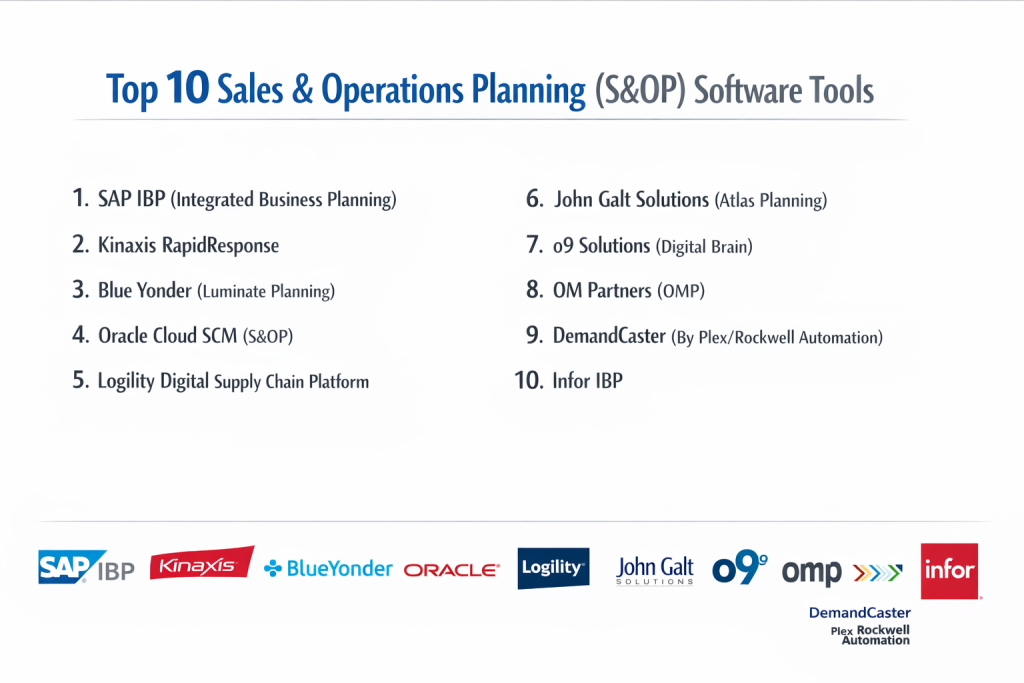
Top 10 Sales & Operations Planning (S&OP) Software Tools
1 — SAP IBP (Integrated Business Planning)
SAP IBP is an industry leader that combines S&OP, demand, supply, and inventory planning into one seamless cloud-based environment, designed primarily for large-scale enterprises.
- Key features:
- Real-time integration with SAP S/4HANA and legacy ERPs.
- Advanced social collaboration via SAP Jam.
- Real-time alerts and exception management.
- Multi-dimensional simulation of supply chain disruptions.
- Financial integration for “value-based” planning.
- Embedded AI and Machine Learning for predictive analytics.
- Pros:
- The most robust choice for organizations already deeply embedded in the SAP ecosystem.
- Powerful enough to handle the world’s most complex, multi-national supply chains.
- Cons:
- Implementation is a major project that requires significant time and budget.
- The user interface has a steep learning curve for non-technical planners.
- Security & compliance: SOC 1, SOC 2, ISO 27001, and GDPR compliant; utilizes SAP’s high-security cloud infrastructure.
- Support & community: Massive global network of certified consultants, comprehensive documentation, and a dedicated user community.
2 — Kinaxis RapidResponse
Kinaxis is famous for its “concurrent planning” engine, which removes the latency between different planning functions by updating the entire network the moment a change is made.
- Key features:
- Concurrent planning for demand, supply, inventory, and S&OP.
- “Always-on” scenario modeling with instant results.
- Automated root-cause analysis for supply gaps.
- Collaborative task management and scorecards.
- Multi-tier visibility across the supplier network.
- Integrated S&OP meeting management dashboards.
- Pros:
- Unrivaled speed; what takes other systems hours to calculate happens in seconds.
- Excellent at “breaking the silos” by ensuring everyone sees the same impact simultaneously.
- Cons:
- Pricing is at the premium end of the market.
- Requires high-quality data input to realize its full potential.
- Security & compliance: SOC 2 Type II, ISO 27001, and HIPAA compliant.
- Support & community: High-touch enterprise support and a robust training portal (Kinaxis Knowledge Network).
3 — Blue Yonder (Luminate Planning)
Blue Yonder offers an AI-driven S&OP solution that focuses on “cognitive” planning—using machine learning to sense disruptions and suggest autonomous resolutions.
- Key features:
- AI-powered demand sensing and shaping.
- Probabilistic forecasting for better risk management.
- Integrated S&OP and Sales & Operations Execution (S&OE).
- Dynamic scenario comparison with financial impact.
- End-to-end visibility across the “digital twin” of the supply chain.
- Collaborative mobile-ready dashboards.
- Pros:
- Extremely strong in the retail and consumer packaged goods (CPG) sectors.
- The AI features are highly effective at identifying subtle market trends.
- Cons:
- Merging legacy modules into the Luminate brand has created some UI inconsistencies.
- Long implementation cycles for large-scale deployments.
- Security & compliance: ISO 27001, SOC 2, and GDPR compliant.
- Support & community: Global 24/7 support and an extensive partner ecosystem for localized implementation.
4 — Oracle Cloud SCM (S&OP)
Oracle provides a modern, cloud-native S&OP module that is part of its larger Supply Chain Management suite, focusing on ease of use and visual analytics.
- Key features:
- Pre-built integration with Oracle Cloud ERP and PLM.
- Guided S&OP process workflows for step-by-step planning.
- Advanced data visualization and “infotiles” for quick status checks.
- Collaborative messaging integrated directly into the planning screen.
- Aggregate and granular level planning capabilities.
- Automated data cleansing and preparation.
- Pros:
- One of the most visually appealing and “user-friendly” enterprise tools.
- Very strong at linking product innovation (PLM) with the S&OP process.
- Cons:
- Best suited for those already in the Oracle ecosystem; third-party integrations can be tougher.
- Can feel a bit rigid if your company has a very non-standard S&OP process.
- Security & compliance: High-level FedRAMP, SOC, and ISO certifications; built on Oracle’s secure Gen 2 Cloud.
- Support & community: 24/7 global support and an extensive “Cloud Customer Connect” portal.
5 — Logility Digital Supply Chain Platform
Logility is a leader in using AI to drive “autonomous” planning, helping companies reduce the manual workload of their planners while increasing accuracy.
- Key features:
- AI-driven demand and supply optimization.
- Multi-enterprise collaboration (connecting with suppliers and customers).
- Attribute-based forecasting for new product launches.
- Integrated S&OP and IBP workflows.
- “Best-fit” statistical modeling for demand.
- Inventory optimization linked directly to service levels.
- Pros:
- Excellent at automating routine tasks so planners can focus on “exceptions.”
- Strong track record in the fashion, apparel, and retail industries.
- Cons:
- The advanced AI modules can have a steep learning curve to configure correctly.
- Integration with older, on-premise ERPs can be time-consuming.
- Security & compliance: SOC 2 Type II certified; strong data privacy and encryption standards.
- Support & community: High-quality onboarding services and a dedicated “Logility University” for users.
6 — John Galt Solutions (Atlas Planning)
John Galt Solutions focuses on helping companies climb the S&OP “maturity curve,” providing a platform that grows in complexity as the business does.
- Key features:
- Scalable Atlas Planning platform with modular design.
- Strong emphasis on the human side of S&OP (Consensus planning).
- AI and Machine Learning for forecast accuracy.
- Demand-driven material requirements planning (DDMRP).
- Collaborative portal for partners and suppliers.
- Financial integration for budget vs. plan analysis.
- Pros:
- Very flexible and often easier to implement than the “Big Three” (SAP, Oracle, Blue Yonder).
- Exceptional customer service—often cited as a “partner” rather than just a vendor.
- Cons:
- Lacks the massive global marketing presence of the largest ERP vendors.
- Some highly specific customizations may require manual workarounds.
- Security & compliance: SOC 2 compliant; follows industry-standard web security protocols.
- Support & community: Known for very high customer satisfaction and personalized implementation support.
7 — o9 Solutions (Digital Brain)
o9 Solutions has gained massive popularity recently due to its “Graph Cube” technology, which allows for incredibly flexible modeling of complex global networks.
- Key features:
- Knowledge Graph technology to map all internal and external dependencies.
- Integrated Business Planning (IBP) and S&OP.
- Advanced “Market Sensing” using external data (e.g., weather, social).
- Highly collaborative “Excel-like” interface but with cloud power.
- Automated gap analysis and resolution suggestions.
- Visual process flow tracking for the S&OP cycle.
- Pros:
- The most flexible modeling tool available; if you can think it, o9 can model it.
- Excellent for “What-If” analysis in very large, complex organizations.
- Cons:
- High cost of ownership.
- Because it is so flexible, the initial configuration can be overwhelming.
- Security & compliance: SOC 2 Type II, ISO 27001, and GDPR compliant.
- Support & community: Rapidly growing community and a strong focus on high-level executive training.
8 — OM Partners (OMP)
OMP is a specialist in the “Process” industries (Chemicals, Metals, Paper), where S&OP must account for complex production constraints like tank capacity and grade changes.
- Key features:
- Unrivaled constraint-based planning logic.
- Integrated S&OP, tactical planning, and scheduling.
- Multi-stage supply chain optimization.
- Detailed “Cost-to-Serve” analytics.
- Collaborative workflow for global demand consensus.
- Real-time visibility into production bottlenecks.
- Pros:
- The undisputed leader for process manufacturers with “hard” constraints.
- Very stable and reliable system for long-term tactical planning.
- Cons:
- The UI feels more functional/technical and less modern than o9 or Remix.
- Primarily focused on heavy industry; not ideal for simple retail.
- Security & compliance: ISO 27001 and GDPR compliant; uses secure data centers in Europe and North America.
- Support & community: Professional, engineer-led support with deep industry expertise.
9 — DemandCaster (By Plex/Rockwell Automation)
DemandCaster is a cloud-based solution that is particularly popular among mid-market manufacturers who need an S&OP tool that is powerful yet affordable.
- Key features:
- Seamless integration with mid-tier ERPs (NetSuite, Sage, Microsoft Dynamics).
- Requirements planning and inventory optimization.
- Direct link between S&OP and shop-floor execution.
- Capacity and resource planning.
- Automated replenishment suggestions.
- “What-If” scenario planning for budget and capacity.
- Pros:
- One of the best “value-for-money” options in the S&OP space.
- Faster implementation times compared to enterprise-grade suites.
- Cons:
- Lacks some of the advanced AI/Market Sensing found in o9 or Blue Yonder.
- Reporting capabilities are solid but not as customizable as top-tier tools.
- Security & compliance: SOC 2 compliant; benefits from Rockwell Automation’s enterprise security standards.
- Support & community: Responsive customer support and a helpful library of webinars and tutorials.
10 — Infor IBP
Infor provides a highly integrated IBP solution that is part of its “CloudSuite” strategy, offering industry-specific versions of S&OP for sectors like Food & Beverage and Distribution.
- Key features:
- Industry-specific S&OP templates.
- Financial and operational plan synchronization.
- Role-based dashboards and workbenches.
- Social collaboration tools built into the planning flow.
- Advanced statistical forecasting.
- Integrated supply chain visibility via Infor Nexus.
- Pros:
- Excellent if you are in one of Infor’s “micro-verticals” (like specialty chemicals).
- Good balance between enterprise power and user-specific design.
- Cons:
- Some users find the transition between different Infor modules to be slightly clunky.
- Customizations can sometimes be difficult to maintain during upgrades.
- Security & compliance: ISO 27001 and GDPR compliant; utilizes AWS (Amazon Web Services) security layers.
- Support & community: Extensive documentation and a dedicated global support portal (Infor Concierge).
Comparison Table
| Tool Name | Best For | Platform(s) Supported | Standout Feature | Rating |
| SAP IBP | SAP Enterprises | Cloud / Web | Financial-Supply Sync | 4.6 / 5 |
| Kinaxis | Rapid Disruption | Cloud / Web | Concurrent Planning | 4.8 / 5 |
| Blue Yonder | Retail & CPG | Cloud / Web | Cognitive AI Sensing | 4.5 / 5 |
| Oracle SCM | User Experience | Cloud / Web | Guided S&OP Workflow | 4.5 / 5 |
| Logility | Fashion & Apparel | Cloud / Web | Autonomous Planning | 4.4 / 5 |
| John Galt | Growing SMB/Mid | Cloud / Web | Customer Support | 4.7 / 5 |
| o9 Solutions | High Complexity | Cloud / Web | Graph Cube Modeling | 4.9 / 5 |
| OMP | Process Industry | Cloud / Desktop | Constraint Logic | N/A |
| DemandCaster | Mid-Market Mfg | Cloud / Web | Price to Value | 4.3 / 5 |
| Infor IBP | Food & Beverage | Cloud / Web | Industry Templates | 4.2 / 5 |
Evaluation & Scoring of S&OP Software
Choosing an S&OP tool is a long-term strategic decision. We have scored these tools based on the reality of implementing them in a modern business environment.
| Category | Weight | Average Score | Evaluation Logic |
| Core Features | 25% | 9.0 / 10 | Includes scenario modeling, demand/supply balancing, and financial sync. |
| Ease of Use | 15% | 7.0 / 10 | This remains the biggest hurdle for enterprise software. |
| Integrations | 15% | 8.5 / 10 | Vital for pulling “one version of the truth” from ERPs. |
| Security & Compliance | 10% | 9.5 / 10 | Critical for proprietary sales and financial data. |
| Performance | 10% | 8.0 / 10 | Speed of recalculating a global plan after a disruption. |
| Support | 10% | 8.5 / 10 | High-touch support is required for the 6-12 month rollout. |
| Price / Value | 15% | 7.5 / 10 | The ROI is huge, but the upfront cost is often a barrier. |
Which S&OP Software Tool Is Right for You?
Solo Users vs SMB vs Mid-Market vs Enterprise
There are virtually no “solo users” in S&OP, as the process requires a team. However, Small to Mid-Market companies should look at DemandCaster or John Galt. These tools offer the necessary math and collaboration without the multi-million dollar price tag of the “Big Three.” Large Enterprises ($1B+ revenue) almost always require the deep, multi-national capabilities of SAP IBP, Kinaxis, or o9 Solutions.
Budget and Value
If your budget is constrained, look for a tool that offers a “modular” approach. You can start with Demand Planning and move into full S&OP later. John Galt Solutions is excellent for this growth path. If budget is less of a concern than the cost of a stockout, Kinaxis provides the highest value by preventing expensive supply chain “surprises.”
Technical Depth vs. Simplicity
Do your planners enjoy deep-diving into data, or do they need a “green-is-good, red-is-bad” dashboard? For technical depth and complex constraints, OMP and o9 Solutions are unrivaled. For a cleaner, more intuitive experience that a Sales or Finance person can quickly understand, Oracle Cloud or Remix-style modern web platforms are superior.
Security and Compliance Requirements
If you are in a highly regulated industry like Defense or Pharmaceuticals, you cannot compromise on security. Ensure your vendor is SOC 2 Type II certified. SAP and Oracle are the gold standards here, as they have built their businesses on meeting the world’s strictest corporate and government security standards.
Frequently Asked Questions (FAQs)
1. What is the difference between S&OP and IBP?
S&OP focuses primarily on balancing physical supply and demand. Integrated Business Planning (IBP) is a more mature version that includes much tighter integration with the CFO’s financial plan and the product innovation roadmap.
2. Can S&OP software replace my ERP?
No. S&OP software is a “system of engagement” that sits on top of your ERP (the “system of record”). It takes data from the ERP, allows you to play with it and plan, and then sends the final plan back to the ERP for execution.
3. How long does it take to implement S&OP software?
For mid-market tools, expect 3–6 months. For enterprise-wide deployments at global companies, 12–18 months is a more realistic timeframe to ensure data cleanliness and team adoption.
4. Will S&OP software fix my “bad data”?
No. In fact, software often highlights how bad your data is. Most implementations involve a “data cleansing” phase where you fix your SKU lists and lead times before the software goes live.
5. How much does S&OP software cost?
Most are priced on a “subscription” basis per year. For mid-market companies, it can range from $30k–$80k per year. For enterprises, it can easily exceed $250k–$500k per year plus implementation fees.
6. Does it work for service industries?
While originally for manufacturing, S&OP is now used in services to balance “Labor” (Supply) with “Projects/Contracts” (Demand). However, the tools in this list are primarily focused on physical goods.
7. Can it handle “New Product Introduction” (NPI)?
Yes, tools like Oracle and Logility have specific features to forecast demand for a product that has no sales history by comparing it to similar “parent” products.
8. Is the software “cloud-based”?
Almost all modern S&OP tools are now “Cloud-First” or “Cloud-Only.” This allows for easier collaboration between global offices without needing a VPN or local servers.
9. What is “What-If” analysis?
This is the ability to create a “sandbox” plan. For example: “What if my main supplier in China closes for a month?” You can see the impact on your customer orders and your bank balance without changing the real data.
10. Do I need a team of data scientists to run this?
Not necessarily. Most modern tools use “Automated ML” (Machine Learning) which handles the math in the background, though you still need planners who understand the business logic.
Conclusion
S&OP software has transitioned from a “nice-to-have” luxury into a critical survival tool for any company dealing with physical products. The ability to see a disruption coming and simulate a response before it hits your balance sheet is worth the investment many times over.
When choosing a tool, remember that the “best” software is the one that your team will actually use. If you are a complex process manufacturer, OMP is your clear winner. If you are an SAP-centric global giant, SAP IBP is the logical choice. If you are a fast-moving consumer brand that needs to react to trends in seconds, Kinaxis or o9 are the leaders. Ultimately, the goal is to stop the internal “departmental wars” and start operating as one unified, profitable machine.