Introduction
Robotics Fleet Management Tools are centralized software platforms designed to orchestrate, monitor, and optimize a group of autonomous robots—often from different manufacturers—working within a single environment. These systems act as the “brain” of a robotic operation, providing a unified dashboard for real-time teleoperation, mission dispatching, and health diagnostics. By aggregating data from individual units, these tools allow human operators to manage hundreds of robots simultaneously, ensuring that battery levels are maintained, traffic congestion is avoided, and tasks are distributed based on the nearest available asset.
The importance of these tools has grown exponentially as companies transition from single-robot pilots to large-scale deployments. Without a fleet management layer, a warehouse with fifty robots would require dozens of individual monitors and manual interventions, leading to operational chaos. Fleet management software provides the necessary abstraction to treat a collection of robots as a single, cohesive workforce. It enables predictive maintenance by spotting anomalies in motor current or sensor drift before a failure occurs, and it facilitates “sim-to-real” transitions where digital twins help optimize routes in a virtual space before deployment.
Key Real-World Use Cases
- Warehouse & Logistics: Coordinating Autonomous Mobile Robots (AMRs) to move pallets, sort parcels, and manage inventory without colliding with human pickers.
- Last-Mile Delivery: Managing a fleet of sidewalk robots or drones, handling remote intervention if a unit gets stuck or encounters an unexpected obstacle.
- Agriculture & Outdoor Power: Overseeing autonomous tractors or weeding robots across thousands of acres, ensuring uniform coverage and automated docking for recharging.
- Healthcare & Hospitality: Directing robots that deliver linens, medication, or room service in hospitals and hotels, including automated elevator integration.
- Public Safety & Inspection: Deploying swarms of inspection robots in hazardous environments like nuclear plants or oil rigs for routine data collection.
What to Look For (Evaluation Criteria)
When evaluating a fleet management tool, start with Interoperability (VDA 5050 compliance); you don’t want to be locked into a single robot brand. Scalability is the next pillar—ensure the software can handle a 10x growth in fleet size without latency spikes. Remote Teleoperation capabilities are vital for handling the “5% of cases” where autonomy fails and a human must take the wheel. Finally, look for Cloud-to-Edge Synergy, which allows for real-time local processing for safety while leveraging the cloud for long-term data analytics and fleet-wide updates.
Best for: Operations managers, robotics engineers, and CTOs in e-commerce, manufacturing, and field services who need to scale from a few prototypes to an industrial-grade robot workforce.
Not ideal for: Hobbyists with a single robot or research labs focused purely on low-level algorithm development where high-level orchestration and business-level KPIs are not yet a priority.
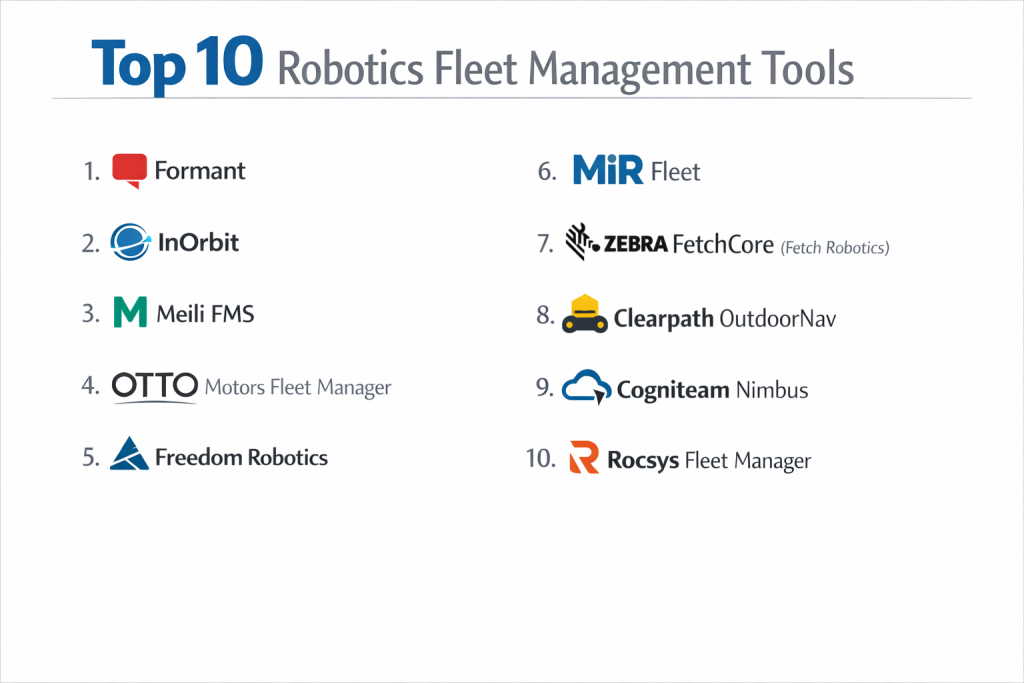
Top 10 Robotics Fleet Management Tools
1 — Formant
Formant is a cloud-based platform designed to help companies scale their robot fleets through high-fidelity data observability, teleoperation, and incident management.
- Key features:
- Real-time Teleoperation: Low-latency remote control over cellular or Wi-Fi networks.
- AI Insights (F3): Automated root-cause analysis and pattern recognition for fleet failures.
- Custom Dashboards: Drag-and-drop widgets for monitoring specific robot KPIs.
- Cloud-to-Device Commands: Push software updates or configuration changes across the entire fleet.
- Incident Triage: Automated alerting and mission replay to investigate anomalies.
- Pros:
- Highly flexible and “robot-agnostic,” working with ROS, ROS 2, and custom stacks.
- Excellent for remote-heavy operations where human-in-the-loop intervention is frequent.
- Cons:
- Can be overkill for small, purely autonomous fleets that don’t require teleop.
- Higher price point compared to basic monitoring-only tools.
- Security & compliance: SOC 2 Type II compliant, end-to-end encryption, and role-based access control (RBAC).
- Support & community: Dedicated enterprise support teams, extensive technical documentation, and an active developer community.
2 — InOrbit
InOrbit is a “Robot Operations” (RobOps) platform that focuses on data-driven optimization and seamless integration between different robot types.
- Key features:
- Adaptive Diagnostics: Adjusts data frequency based on robot health and network conditions.
- Multi-Robot Orchestration: Manages traffic and shared maps across mixed-vendor fleets.
- Time Capsule: Replay historical data to see exactly what a robot saw during an incident.
- One-Line Deployment: Simple agent installation that works across different hardware architectures.
- API-First Design: Easily connects to ERP, WMS, and other business logic systems.
- Pros:
- Exceptional at reducing “alert fatigue” through multivariate anomaly detection.
- Very strong integration ecosystem for warehouse management systems.
- Cons:
- The UI can be complex for non-technical warehouse floor managers.
- Focuses more on monitoring than on the creative “mission building” aspect.
- Security & compliance: ISO 27001 ready, secure messaging infrastructure, and Single Sign-On (SSO) integration.
- Support & community: High-quality onboarding, professional services for large deployments, and regular webinars.
3 — Meili Robots (Meili FMS)
Meili FMS is a universal fleet management system that prides itself on being one of the first truly VDA 5050-compatible platforms for mobile robots.
- Key features:
- VDA 5050 Compatibility: Standardized communication for mixed-brand robot interoperability.
- Task Allocation: Intelligently assigns missions to the most suitable robot based on location and battery.
- Real-time Traffic Control: Prevents bottlenecks in narrow corridors through “wait-and-go” logic.
- Map Merging: Combines data from different robots to create a unified site map.
- ERP Integration: Direct links to SAP, Oracle, and other enterprise resource planning tools.
- Pros:
- One of the best options for “mixed-vendor” environments where MiR, Fetch, and OTTO work together.
- Lightweight web interface that is easy to train staff on.
- Cons:
- Less advanced in “remote teleoperation” compared to Formant.
- Primarily focused on indoor AMRs, with fewer features for outdoor/drone fleets.
- Security & compliance: GDPR compliant, data encryption at rest and in transit, and secure API keys.
- Support & community: Strong European presence with localized support and clear documentation.
4 — OTTO Motors Fleet Manager
Specifically built for OTTO’s line of industrial AMRs, this tool is the gold standard for high-density, mission-critical manufacturing environments.
- Key features:
- High-Density Orchestration: Manages 100+ robots in a single facility without performance lag.
- Smart Notifications: Real-time alerts via Slack or email for job takt times and throughput.
- Intelligent Charging: Automatically rotates robots through charging stations to maintain 24/7 uptime.
- Custom Traffic Rules: Define one-way lanes and “no-go” zones within the software.
- Hardware Diagnostics: Deep-level access to motor, battery, and lidar health.
- Pros:
- Extremely reliable; designed for “Tier 1” automotive and industrial settings.
- Seamless hardware-software integration—it just works out of the box with OTTO robots.
- Cons:
- Proprietary; primarily designed for OTTO robots, offering limited support for other brands.
- Can be expensive for smaller operations with only a few units.
- Security & compliance: Enterprise-grade security, audit logs, and compliance with industrial safety standards.
- Support & community: 24/7 global support, on-site commissioning services, and a dedicated customer success manager.
5 — Freedom Robotics
Freedom Robotics provides a sleek, device-agnostic platform that emphasizes ease of implementation and rapid deployment for robotics startups.
- Key features:
- Smart Alerts: Proactive notifications based on custom-defined thresholds (e.g., “battery < 15%”).
- Remote SSH/Terminal: Direct secure access to the robot’s onboard computer for debugging.
- Shareable Insights: Create public or private URLs to share specific robot views with stakeholders.
- Traffic Management: Coordinates paths for fleets to avoid collisions.
- Data Logging: Stores and visualizes sensor data for post-mission analysis.
- Pros:
- Very fast time-to-value; you can see robot data in the cloud in under 15 minutes.
- Excellent “developer-first” tools like the remote terminal.
- Cons:
- UI can sometimes feel cluttered when managing very large fleets (500+ units).
- Recent innovation has slowed compared to AI-focused competitors.
- Security & compliance: End-to-end encryption, multi-factor authentication, and SOC 2 compliance.
- Support & community: Extensive API documentation and a helpful developer forum.
6 — MiR Fleet (Mobile Industrial Robots)
MiR Fleet is the centralized control system for Mobile Industrial Robots, focusing on scalability and industrial cybersecurity.
- Key features:
- Mission Prioritization: Automatically moves critical tasks to the front of the queue.
- IEC 62443 Standard: Built to meet the highest industrial cybersecurity requirements.
- Multi-floor Navigation: Manages elevator handshakes and multi-level facility maps.
- Event-Driven Architecture: Reduces network load by only communicating changes.
- Virtualization Support: Can run on Windows servers or modern cloud infrastructure.
- Pros:
- The most secure choice for “hardened” industrial environments.
- Very strong at handling the physics of multi-floor logistics.
- Cons:
- Like OTTO, it is heavily optimized for its own brand of robots.
- The REST API is powerful but requires significant development for custom integrations.
- Security & compliance: IEC 62443 Part 4-2 compliant, SSO, and granular user permissions.
- Support & community: Massive global distributor network providing local on-site support.
7 — Zebra FetchCore (Fetch Robotics)
Now part of the Zebra Technologies ecosystem, FetchCore is a cloud-first platform for managing AMRs in warehouse and fulfillment settings.
- Key features:
- Drag-and-Drop Workflows: Create complex robot tasks without writing a single line of code.
- Facility MapBuilder: Quickly map millions of square feet and define zones.
- Wi-Fi Heatmapping: Visualizes signal strength across the facility to find dead zones.
- Zebra Integration: Works seamlessly with Zebra handheld scanners and wearables.
- Robots as a Service (RaaS): Flexible pricing and management for scaling fleets.
- Pros:
- Best-in-class user experience for non-technical warehouse staff.
- Strong integration with the broader Zebra supply chain portfolio.
- Cons:
- Primarily a cloud-only solution, which may be a concern for high-security “offline” sites.
- Limited flexibility for highly custom robot hardware.
- Security & compliance: Cloud-native security updates, SOC 2, and secure Zebra-managed data centers.
- Support & community: Backed by Zebra’s massive global support infrastructure.
8 — Clearpath OutdoorNav
While most tools focus on warehouses, Clearpath’s OutdoorNav is specialized for the unique challenges of outdoor and off-road robot fleets.
- Key features:
- GPS-Based Navigation: Precise point-to-point outdoor path planning.
- Obstacle Avoidance: Proprietary sensor fusion for navigating rugged terrain.
- Web-Based Command & Control: Interactive maps and live position tracking.
- Remote Teleoperation: Joystick-style control via cellular link.
- API/ROS Compatibility: Built on top of the Robot Operating System for maximum extensibility.
- Pros:
- The undisputed leader for outdoor, mining, and agricultural robot management.
- Extremely rugged and reliable in harsh weather conditions.
- Cons:
- Lacks the “warehouse-specific” features like elevator control or WMS integration.
- High technical barrier to entry compared to simple AMR managers.
- Security & compliance: Varies; generally deployed on secure private networks with standard encryption.
- Support & community: World-class technical support from the pioneers of mobile robotics research.
9 — Cogniteam (Nimbus)
Cogniteam’s Nimbus platform is a modern cloud robotics solution that treats robots like “connected devices,” focusing on rapid development and OTA updates.
- Key features:
- Over-the-Air (OTA) Updates: Deploy new software to an entire fleet with one click.
- Component Library: Drag-and-drop pre-validated software blocks (e.g., SLAM, perception).
- Remote Access & Debug: Integrated teleoperation and terminal access.
- AI-Driven Fleet Management: Algorithms for route optimization and predictive maintenance.
- Deployment Tracking: Monitor the success or failure of software rollouts across units.
- Pros:
- Excellent for “Robotics-as-a-Service” companies that need to manage software versions.
- Lowers the barrier to entry for building a custom fleet manager.
- Cons:
- The platform is broad, which can make it feel less specialized for specific niches like “Logistics.”
- Relies heavily on cloud connectivity for its core value.
- Security & compliance: Advanced encryption, multi-factor authentication, and robust data protection frameworks.
- Support & community: Strong documentation and a focus on accelerating the “prototype-to-production” timeline.
10 — Rocsys Fleet Manager
Rocsys is a niche but essential player, focusing on the specialized “Fleet Management” of autonomous charging stations for electric robot fleets.
- Key features:
- Hands-Free Charging: Orchestrates the autonomous plugging in of robot taxis and AMRs.
- Uptime Optimization: Ensures robots are charged precisely when they are not needed.
- Computer Vision Tracking: Locates and identifies robots to initiate the charging sequence.
- Health Monitoring: Tracks the electrical health of both the station and the robot batteries.
- Remote Reset: Fix charging issues remotely without sending a technician.
- Pros:
- Solves the “last mile” of automation: autonomous power management.
- High ROI for fleets operating 24/7.
- Cons:
- Highly specialized; not a general-purpose mission management tool.
- Requires specific charging hardware to be installed.
- Security & compliance: Standard industrial encryption and secure communication protocols.
- Support & community: High-touch professional support for infrastructure installation and maintenance.
Comparison Table
| Tool Name | Best For | Platform(s) Supported | Standout Feature | Rating (TrueReview) |
| Formant | Data Observability | Linux / Cloud | AI Root Cause Analysis | 4.8 / 5 |
| InOrbit | RobOps / Multi-vendor | Linux / Cloud | Adaptive Diagnostics | 4.7 / 5 |
| Meili FMS | VDA 5050 / Mixed Fleet | Web / Cloud | Traffic Orchestration | 4.6 / 5 |
| OTTO Fleet | High-Density Manufacturing | On-Prem / Cloud | 100+ Robot Orchestration | 4.9 / 5 |
| Freedom Robotics | Startups / Rapid Dev | Linux / Cloud | Remote SSH / Shareable Links | 4.5 / 5 |
| MiR Fleet | Secure Industrial Sites | Windows / Cloud | IEC 62443 Cybersecurity | 4.7 / 5 |
| Zebra FetchCore | Warehousing / E-commerce | Cloud | No-Code Workflow Builder | 4.8 / 5 |
| Clearpath | Outdoor / Mining | Linux / On-Prem | GPS-Based Path Planning | N/A |
| Cogniteam | OTA Updates / RaaS | Cloud | Drag-and-Drop Dev Library | 4.4 / 5 |
| Rocsys | Autonomous Charging | Cloud / Hardware | Computer Vision Charging | N/A |
Evaluation & Scoring of Robotics Fleet Management Tools
| Criteria | Weight | Evaluation Logic |
| Core Features | 25% | Real-time monitoring, mission dispatch, and traffic control capabilities. |
| Ease of Use | 15% | Intuitiveness of the dashboard and complexity of agent installation. |
| Integrations | 15% | Compatibility with ROS, VDA 5050, and WMS/ERP systems. |
| Security & Compliance | 10% | Presence of SOC 2, ISO, or industrial cybersecurity standards. |
| Performance | 10% | Latency of teleoperation and ability to handle fleet scaling. |
| Support & Community | 10% | Quality of documentation and availability of enterprise support. |
| Price / Value | 15% | ROI for the cost per robot and flexibility of pricing models. |
Which Robotics Fleet Management Tool Is Right for You?
Small to Mid-Market vs. Enterprise
For Small to Mid-Market companies (1-20 robots), the priority is ease of setup and low overhead. Freedom Robotics or Cogniteam are ideal here as they don’t require massive IT infrastructure and offer “pay-as-you-grow” models. Enterprises (50+ robots) in heavy industry need the mathematical rigor and reliability of OTTO Motors or MiR Fleet. These platforms are designed for “six-nines” uptime and integrate deeply with existing corporate security and data governance.
Budget and Value
If you are Budget-Conscious, look toward tools with clear “per-robot” pricing or open-source integrations. InOrbit offers a “Free Edition” for small fleets to get started. If you are looking for Maximum Value through reduced labor costs, a premium tool like Zebra FetchCore or Formant justifies its cost by significantly reducing the human-to-robot ratio required for operations.
Technical Depth vs. Simplicity
If your team is composed of PhD-level Robotics Engineers, you will value the Technical Depth and ROS-native flexibility of Clearpath or Cogniteam. However, if your users are Warehouse Supervisors and floor staff, Simplicity is king. Tools like Zebra FetchCore and Meili FMS provide the most intuitive visual interfaces that require minimal training.
Integration and Scalability Needs
If you already have a mixed fleet, Interoperability is your non-negotiable. Meili FMS and InOrbit are built for the heterogeneous future. Regarding Scalability, OTTO Motors and Formant lead the pack in being able to handle data from hundreds of robots simultaneously without the dashboard becoming laggy or unreliable.
Security and Compliance Requirements
In the “hard” industrial sectors (Pharma, Automotive, Food), Compliance is the first gate. MiR Fleet stands out here with its specific adherence to IEC 62443. For cloud-focused companies, ensure your choice has SOC 2 Type II at a minimum, which is a standard provided by Formant and Freedom Robotics.
Frequently Asked Questions (FAQs)
1. What is VDA 5050?
It is a standardized communication protocol that allows robots from different manufacturers to communicate with a single fleet management system. It prevents “vendor lock-in.”
2. Can I manage robots across multiple facilities?
Yes, most cloud-based tools like Formant and InOrbit allow you to see fleets in multiple global locations from a single “pane of glass” dashboard.
3. Do these tools work with 5G?
Absolutely. In fact, many tools like Formant are optimized for the high bandwidth and low latency of 5G, which improves the quality of remote teleoperation.
4. What happens if the Wi-Fi goes down?
Most professional robots have “local autonomy,” meaning they will safely stop or continue their immediate task. The fleet manager will show them as “offline” until the connection is restored.
5. How much do these tools typically cost?
Pricing is usually a subscription model, ranging from $50 to $500 per robot per month, depending on the level of teleoperation and data storage required.
6. Can I build my own fleet manager?
You can, but it is rarely cost-effective. Building the secure data pipes, low-latency video streaming, and traffic logic takes years of engineering effort.
7. Is “teleoperation” the same as “remote control”?
Technically yes, but in fleet management, it often refers to “supervised autonomy” where a human only intervenes to help the robot past an obstacle.
8. Do I need to install hardware on the robot?
Usually no. Most tools are “software agents” that install on the robot’s existing Linux/ROS computer. Specialized tools like Rocsys do require hardware for charging.
9. How do these tools help with maintenance?
They track “odometry” (distance traveled) and motor health, sending alerts for preventive maintenance before a mechanical part actually breaks.
10. Can I integrate these tools with my Warehouse Management System (WMS)?
Yes, most lead-tier tools provide REST APIs or Webhooks that allow the WMS to automatically “order” a robot to move a pallet.
Conclusion
Scaling a robotics operation from a single unit to a fleet is the most difficult transition in automation. The Robotics Fleet Management Tool you choose will be the foundation upon which your operational efficiency is built. If you prioritize “Human-in-the-loop” flexibility and deep data insights, Formant is the industry leader. If you are operating a mixed-vendor warehouse in Europe, the VDA 5050 focus of Meili FMS provides the best future-proofing.
What matters most is choosing a tool that aligns with your specific “sim-to-real” journey. The best tool isn’t necessarily the one with the most features, but the one that your floor staff can use effectively and your IT department can approve securely. As robots become more ubiquitous, the ability to manage them like a software fleet rather than individual machines will be the ultimate competitive advantage.