Introduction
A ride-hailing app is a service on your phone that lets you book a car and driver to take you somewhere. You simply open the app, enter where you want to go, and a driver nearby accepts your request. The app handles the payment, navigation, and communication between you and the driver. It’s like a digital taxi service that’s often faster and more convenient.
These apps are important because they change how we get around cities. They solve problems like waiting for a taxi in the rain, not having cash, or needing a safe ride home late at night. They give people a reliable, on-demand way to travel without owning a car.
In real life, people use ride-hailing for many things: commuting to work, getting to the airport, a safe late-night ride after social events, or when their own car is in the shop. Travelers also use them in new cities instead of renting a car. When choosing an app, think about: price and how fares are calculated, wait times and driver availability in your area, safety features for riders and drivers, car type options (like economy or luxury), and the clarity of the app’s interface.
Best for: Ride-hailing apps are best for city dwellers, commuters, travelers, people who don’t own a car, and anyone needing a convenient, point-to-point ride. Businesses also use them for employee transport or client pickups.
Not ideal for: These apps are not ideal for very regular, fixed-route daily trips (where a monthly transit pass is cheaper), for very long inter-city travel (trains or planes are better), or in rural areas with very few drivers. They are also not a replacement for emergency services or professional medical transport.
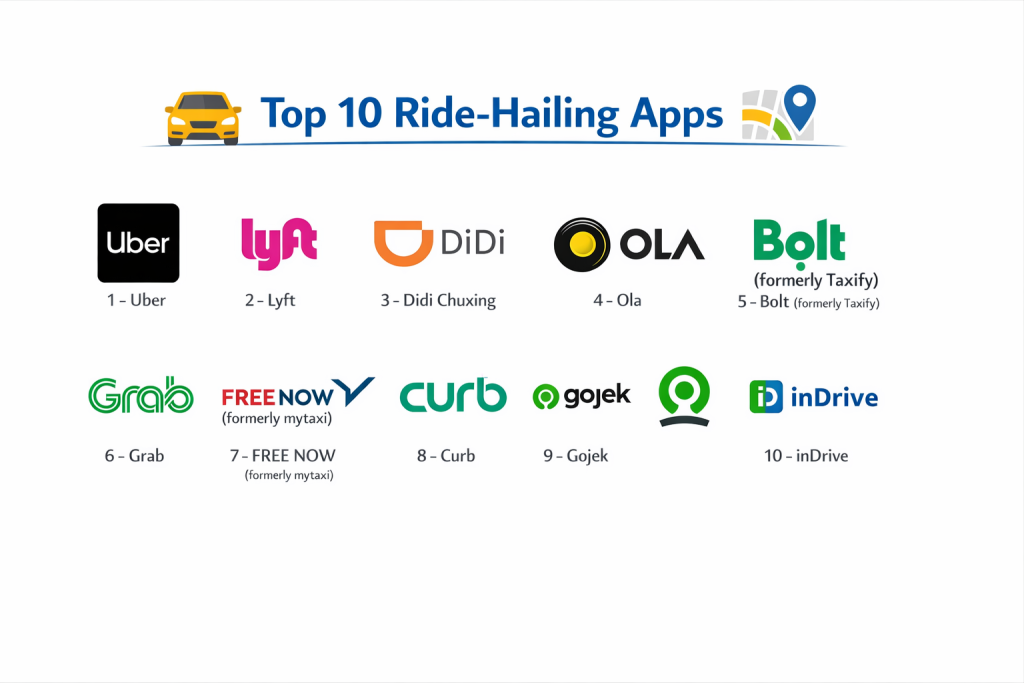
Top 10 Ride-Hailing Apps
Here is a detailed look at the most popular apps for getting a ride.
1 — Uber
Uber is the most well-known ride-hailing app in the world. It connects riders with drivers using their own cars for trips ranging from affordable everyday rides to premium luxury service.
Key features:
- Multiple ride options: UberX (standard), Comfort (newer cars), Uber Black (premium), and Uber Pool (shared).
- Upfront pricing: You see the total fare before you book, so no surprises.
- Live trip tracking: Share your ride’s live location with friends or family for safety.
- In-app payment: Seamless cashless payment via credit card, PayPal, or digital wallet.
- Ratings system: Both riders and drivers rate each other after each trip to maintain quality.
- Wide availability: Operates in thousands of cities worldwide.
Pros:
- The largest network means short wait times and high availability in most cities.
- Very user-friendly and reliable app that is easy for anyone to learn.
- Consistent experience and brand recognition globally.
Cons:
- “Surge pricing” during high demand can make rides very expensive.
- Driver quality and car condition can sometimes be inconsistent.
- Has faced regulatory and public relations challenges in many regions.
Security & compliance: Offers features like trip sharing, emergency assistance button, and driver background checks. Data practices and compliance vary by country.
Support & community: In-app help and support. Vast user and driver community, but direct support can sometimes be slow to resolve issues.
2 — Lyft
Lyft is Uber’s main competitor in the United States and Canada. It positions itself as a more community-focused and driver-friendly alternative, often with a slightly different user experience.
Key features:
- Similar ride tiers: Lyft (standard), Lyft XL (for groups), Lux (luxury), and Shared (carpool).
- Upfront pricing: Also shows the fare before you confirm the ride.
- Tip encouragement: The app strongly encourages tipping your driver, often with prompts.
- Round-up donations: “Lyft Round Up” feature donates your fare change to charity.
- Bike & scooter integration: In some cities, the app also shows nearby bikes and scooters for rent.
- Wait & Save: A cheaper option if you’re willing to wait a few extra minutes for your ride.
Pros:
- Often perceived as having friendlier drivers and a better company culture.
- Simple, colorful app design that many find appealing.
- Can sometimes be cheaper than Uber for the same route, depending on the city and time.
Cons:
- Much smaller global presence than Uber; primarily a North America app.
- Driver availability can be lower outside of major city centers.
- Features and promos change frequently, which can be confusing.
Security & compliance: Provides safety check-ins, emergency contact sharing, and driver screenings. Follows regional data privacy laws.
Support & community: In-app support and phone support for critical safety issues. Known for a strong driver community.
3 — Didi Chuxing
Didi is the dominant ride-hailing super-app in China and has a significant presence in other countries like Australia, Latin America, and parts of Africa. It offers a wide range of mobility services.
Key features:
- Extensive service range: Includes taxis, private cars, luxury cars, hitch (carpool), bus, bike-sharing, and even food delivery.
- Deep integration in China: Works seamlessly with Chinese payment systems (WeChat Pay, Alipay) and maps.
- AI-powered dispatch: Uses artificial intelligence to match drivers and riders efficiently.
- Safety features: Includes audio recording of trips, emergency sharing, and facial recognition for drivers.
- Car solutions: Also offers car rental, sales, and charging services through the app.
- International traveler support: Has an English-language app interface for travelers in China.
Pros:
- The absolute best and often only comprehensive choice for ride-hailing within China.
- Unmatched variety of transport options in a single app.
- Very advanced technology for matching and safety.
Cons:
- Complex for international travelers to set up (requires a Chinese phone number and payment method).
- Limited usefulness and brand recognition outside of its core markets.
- The sheer number of features can be overwhelming.
Security & compliance: Implements robust, government-influenced safety features in China. Compliance is tightly managed within its operating regions.
Support & community: Support is primarily in local languages. Has an enormous user base in Asia.
4 — Ola
Ola is India’s leading ride-hailing app and a major player in other countries like the UK, Australia, and New Zealand. It’s known for adapting to local markets with unique vehicle options.
Key features:
- Diverse vehicle types: Offers auto-rickshaws, motor scooters, and even rental cars alongside standard sedans.
- Ola Money: A built-in digital wallet for cashless payments within India.
- Ola Play: In-car entertainment with tablets in premium rides for music and videos.
- Ola Corporate: Dedicated service for business travel and employee commutes.
- Subscription plans: “Ola Select” offers benefits like priority booking and driver rewards.
- Strong regional focus: Tailored services for the Indian market and its diaspora.
Pros:
- Unbeatable for navigating Indian cities with its range of affordable vehicle types (like auto-rickshaws).
- Excellent for travelers in India who want a familiar app experience.
- Innovative features tailored to its home market.
Cons:
- Service quality and car conditions can vary widely, especially for the cheapest options.
- International expansion is still growing, so availability is spotty outside its key countries.
- Customer support can be challenging to access.
Security & compliance: Implements driver verification and in-app safety features. Compliance with local transport regulations is a constant focus.
Support & community: In-app support and a large user community in India. Support for international users is less developed.
5 — Bolt (formerly Taxify)
Bolt is a European-founded ride-hailing app that competes by offering lower prices for riders and taking a smaller commission from drivers. It’s a strong challenger in many European and African cities.
Key features:
- Lower commission model: Charges drivers less, which can lead to lower fares for riders.
- Bolt Business: Tools for companies to manage employee travel and expenses.
- Bolt Food: Integrated food delivery service in many markets.
- Bolt Scooters: Electric scooter rentals available in the same app.
- Safety features: Includes SOS button, trip sharing, and driver verification.
- Focus on affordability: Often positions itself as the budget-friendly choice.
Pros:
- Often provides the cheapest fares compared to Uber and Lyft in the same city.
- Popular with drivers, which can mean good availability.
- Expanding quickly as a multi-service “super-app” in its markets.
Cons:
- Brand awareness is lower, so some riders are less familiar with it.
- App interface and user experience can feel less polished than top rivals.
- Customer service responsiveness is frequently reported as an issue.
Security & compliance: Implements standard ride-hailing safety features. GDPR compliant in Europe. Specifics vary by operating country.
Support & community: Primarily in-app support. Gaining a community of price-conscious riders and drivers.
6 — Grab
Grab is the leading “everyday everything” app in Southeast Asia. It started as a ride-hailing service and has expanded into food delivery, payments, and financial services, dominating the region.
Key features:
- Super-app ecosystem: Combines ride-hailing, food delivery (GrabFood), package delivery, and digital payments (GrabPay).
- Localized transport: Offers cars, motorcycles, tuk-tuks, and even carpooling options suited to Southeast Asian cities.
- GrabRewards: Loyalty program that earns points across all Grab services.
- Grab for Business: Corporate travel and expense management tool.
- Insurance & loans: Offers micro-insurance and financing services through the app.
- Deep local knowledge: Navigation and services are fine-tuned for complex city traffic.
Pros:
- The most comprehensive and essential app for daily life in Southeast Asia.
- Unrivaled understanding of local transportation needs and challenges.
- Extremely convenient to handle multiple needs (transport, food, payments) in one place.
Cons:
- Functionality outside of Southeast Asia is very limited.
- Can feel bloated if you only want a simple ride-hailing service.
- Wait times for cars can be long in highly congested cities.
Security & compliance: Has a strong focus on safety with features like “GrabGuard.” Complies with the diverse regulations across Southeast Asian nations.
Support & community: In-app support. Has a massive, loyal user base across its operating region.
7 — FREE NOW (formerly mytaxi)
FREE NOW is a major ride-hailing app in Europe that uniquely focuses on connecting users with licensed taxi drivers. It’s a bridge between traditional taxis and modern app-based booking.
Key features:
- Taxi-focused network: Books official, licensed taxis, not private cars.
- Multiple transport modes: Also integrates e-scooters, e-bikes, and car rentals in some cities.
- Price comparison: Shows both metered fare estimate and a fixed price option before booking.
- City-specific services: Tailored options for different European cities.
- Business profiles: Separate accounts for work-related rides with receipt management.
- Ride now or later: Option to book a taxi for immediate pickup or schedule one in advance.
Pros:
- Often more available than private car services during peak times or at taxi stands.
- Drivers are professionally licensed, which can offer a sense of security and local knowledge.
- Good option in cities where private ride-hailing faces legal restrictions.
Cons:
- Fares can be higher than private car services like Uber or Bolt.
- The experience depends heavily on the individual taxi driver and vehicle.
- Service is mostly limited to major European cities.
Security & compliance: As it uses licensed taxi drivers, it adheres to strict local taxi regulations. GDPR compliant for user data.
Support & community: In-app and phone support. Used by both locals and tourists in Europe.
8 — Curb
Curb is a North American app designed specifically for booking real, licensed taxis. It works with existing taxi fleets, allowing you to hail, pay, and tip a taxi directly from your phone.
Key features:
- Hail a taxi: Use the app to hail the closest available taxi on the street, not just pre-book.
- Pay & tip in-app: Securely pay your metered fare and add a tip through the app, no cash or card needed.
- Ride receipts: Digital receipts are automatically stored in the app for expense tracking.
- Advance booking: Schedule a taxi pickup for a future time.
- Focus on taxis: Exclusively works with professional taxi drivers and fleets.
- Wide taxi network: Connected to thousands of taxis across the U.S.
Pros:
- Best app for people who prefer the traditional taxi model but want cashless convenience.
- Can be easier to find a ride during bad weather or in busy taxi zones.
- No surge pricing; you pay the standard metered fare.
Cons:
- Only available in select U.S. cities where Curb has partnerships with taxi fleets.
- App experience and taxi vehicle quality are not as consistent as the top private car apps.
- Less innovation in features compared to Uber and Lyft.
Security & compliance: Leverages the existing regulated taxi industry. Handles payment data securely.
Support & community: App-based support. Caters to a niche of taxi users who want app convenience.
9 — Gojek
Gojek is Indonesia’s first and leading super-app, similar to Grab. It started with motorcycle taxi services (ojek) and now offers over 20 services from payments to massages, dominating the daily life market.
Key features:
- Motorcycle taxis (GoRide): Fast, affordable bike rides to beat traffic, the core original service.
- Car rides (GoCar): Standard car ride-hailing.
- On-demand services: Includes food delivery (GoFood), shopping, cleaners, and beauty therapists.
- GoPay: A hugely popular digital wallet for cashless payments across services.
- Hyper-local focus: Services are finely tuned for the dense, mobile-first Indonesian population.
- Massive driver network: One of the world’s largest fleets of two-wheeled transporters.
Pros:
- The fastest way to navigate through the intense traffic of cities like Jakarta.
- Unbelievably wide range of daily needs met in one app.
- Deeply embedded in Indonesian culture and economy.
Cons:
- Primarily useful only in Indonesia (and a few expansion countries like Vietnam and Singapore).
- Motorcycle rides are not for everyone, especially those with luggage or safety concerns.
- The app can feel overwhelming to newcomers due to the sheer number of options.
Security & compliance: Implements safety features for bike rides. Adheres to complex Indonesian regulations.
Support & community: In-app support. Has a gigantic, loyal user and driver-partner community in Indonesia.
10 — inDrive
inDrive (formerly inDriver) has a unique model: it lets riders name their own price for a trip. Drivers nearby can then accept the offer, make a counter-offer, or ignore it. It’s a bargaining-based system.
Key features:
- Price negotiation: Riders suggest a fare, and drivers choose to accept or propose a new price.
- Transparent process: See driver profiles and ratings before you agree on a price.
- Fixed price after agreement: Once a price is agreed upon, it is locked in, even in traffic.
- Inter-city travel: Often used for longer trips between cities where fixed fares are less common.
- Focus on fairness: Markets itself as a fairer system for both riders and drivers.
- Global in emerging markets: Strong in countries like Russia, Central Asia, Latin America, and parts of Africa.
Pros:
- Can result in significantly lower fares than apps with algorithmic pricing, especially for long trips.
- Gives both riders and drivers more control and transparency.
- Popular in regions where fixed pricing is less common or trusted.
Cons:
- The bidding process takes longer than instantly booking a ride on Uber.
- You might get no drivers accepting your price, leading to delays.
- Safety and driver vetting standards may vary more widely by region.
Security & compliance: Basic safety features like trip sharing. Compliance depends heavily on local operations in each country.
Support & community: App-based support. Popular in price-sensitive and emerging markets.
Comparison Table
| Tool Name | Best For (Target User or Scenario) | Platform(s) Supported | Standout Feature | Rating |
|---|---|---|---|---|
| Uber | Global travelers & everyday rides in most cities | iOS, Android | Largest Global Network & Reliability | N/A |
| Lyft | Riders in the USA & Canada preferring an alternative to Uber | iOS, Android | Community Feel & Driver-Friendly Focus | N/A |
| Didi Chuxing | Anyone needing transport within China | iOS, Android | Dominant Super-App in China with All Transport Types | N/A |
| Ola | Travel in India & affordable vehicle options (autos, bikes) | iOS, Android | Best for Indian Cities with Local Vehicle Types | N/A |
| Bolt | Budget-conscious riders in Europe & Africa | iOS, Android | Often the Cheapest Fares & Lower Driver Commissions | N/A |
| Grab | Daily life & transport in Southeast Asia | iOS, Android | The “Everyday Everything” Super-App of Southeast Asia | N/A |
| FREE NOW | Booking licensed taxis in European cities | iOS, Android | Best App for Hailing & Paying for Licensed Taxis | N/A |
| Curb | Hailing & paying for taxis in the USA | iOS, Android | Cashless Payment for Traditional Taxis | N/A |
| Gojek | Beating traffic & daily services in Indonesia | iOS, Android | King of Motorcycle Taxis & Indonesian Super-App | N/A |
| inDrive | Price negotiators & travel in emerging markets | iOS, Android | Unique “Name Your Own Price” Negotiation Model | N/A |
Evaluation & Scoring of Ride-Hailing Apps
To choose the best app for you, score each one from 1 (Poor) to 5 (Excellent) based on what matters most for your rides.
| Evaluation Criteria | Weight | Score (1-5) | Weighted Score | Notes on What to Look For |
|---|---|---|---|---|
| Core Features | 25% | Does it have the ride types you need? Can you schedule? Is payment easy? | ||
| Ease of Use | 15% | Is the app simple to book a ride? Is the map clear? | ||
| Integrations & Ecosystem | 15% | Does it work with your payment methods (Apple Pay, Google Pay)? Does it connect to other apps? | ||
| Security & Compliance | 10% | What safety features does it have (trip sharing, emergency button)? Does it vet drivers? | ||
| Performance & Reliability | 10% | Are wait times short? Do drivers usually accept rides? Does the app crash? | ||
| Support & Community | 10% | Can you get help if something goes wrong? Is it easy to report an issue? | ||
| Price / Value | 15% | Are the fares fair and transparent? Are there hidden fees? | ||
| TOTAL SCORE | 100% | /100 |
Which Ride-Hailing App Is Right for You?
The best app depends completely on where you are and what kind of ride you need.
- In the United States or Canada: Your main choices are Uber and Lyft. Download both. Check which has a shorter wait time and better price for each trip. Curb is good if you specifically want a taxi.
- In Europe: Uber is widespread. Bolt is often cheaper. FREE NOW is best for official taxis. Have a couple of apps to compare.
- In Southeast Asia (e.g., Thailand, Singapore, Vietnam): Grab is the essential, all-in-one app. Gojek is key in Indonesia.
- In China: Didi is absolutely necessary. Set it up before you travel.
- In India: Ola is the leader, offering the unique auto-rickshaw and bike options you’ll need. Uber also operates there.
- In Africa & Latin America: Check local leaders like Bolt and inDrive, as well as Uber.
- For Budget-Conscious Riders: Always compare Bolt and inDrive (if available) for lower prices. Use carpool/shared options on any app.
- For Safety & Consistency: Uber and Lyft have the most developed safety features and consistent brand standards in their core markets.
- For Business/Corporate Use: Look for apps with business profiles (Uber for Business, Lyft Business, Bolt Business) that provide centralized billing and receipts.
- For Unique Local Transport: If you need a tuk-tuk, auto-rickshaw, or motorcycle taxi, you must use the local champion app like Ola, Grab, or Gojek.
Frequently Asked Questions (FAQs)
1. How does surge pricing work?
When lots of people want rides at the same time (like after a concert or in a rainstorm), the app increases prices to get more drivers on the road. The app will warn you and show the higher “surge” price before you book.
2. Should I tip the driver?
Yes, tipping is a good practice, especially for good service. Most apps make it easy to add a tip (usually 10-20%) after the ride ends through the app. It’s a major part of a driver’s income.
3. What if I leave something in the car?
Use the app! There is usually a “Lost Item” help section. You can contact the driver through the app (anonymously) to arrange to get your item back. There may be a fee for the driver’s time to return it.
4. Are ride-hailing apps safe?
They have many safety features like sharing your trip, driver background checks, and in-app emergency buttons. Always check the car’s license plate and driver’s photo before getting in. Trust your instincts.
5. Why is the estimated fare different from the final charge?
Upfront pricing is usually accurate. The final charge can change if you add a stop, change the destination, or get stuck in unexpected heavy traffic for a long time. Tolls and fees are also added.
6. Can I schedule a ride in advance?
Most major apps like Uber and Lyft let you schedule a ride hours or days ahead. This is great for early morning airport trips. The app will automatically book a driver for you at that time.
7. What’s the difference between a taxi app and a ride-hail app?
Taxi apps (like Curb, FREE NOW) connect you to licensed, regulated taxi drivers who use a meter. Ride-hail apps (like Uber, Lyft) connect you to private drivers using their own cars at an app-determined price.
8. How do I become a driver?
You apply through the app or the company’s website. You’ll need a valid driver’s license, a clean driving record, a qualifying car, and to pass a background check. Requirements vary by city.
9. What if my driver takes a wrong route or is rude?
You can report it in the app under “Help” with your trip details. You can also give the driver a low star rating, which affects their ability to get future rides.
10. What’s the best way to save money on rides?
Use shared/carpool options. Avoid peak surge times if you can. Compare prices between 2-3 different apps before booking. Look for promo codes when you first sign up.
Conclusion
Ride-hailing apps have made getting around cities easier than ever. The best app for you isn’t about which one is “the best” worldwide, but which one works best where you are and for what you need.
For most people, the smartest move is to have two or three apps on your phone. This lets you compare wait times and prices for every trip. In your home city, you might have a favorite. But when you travel, doing a little research to find the local favorite app can save you money and give you better service.
Remember, the perfect app gives you a safe, affordable, and reliable ride with as little fuss as possible. By understanding the different strengths of each major player—from Uber’s global network to Grab’s local super-app power—you can always find the right ride at the right time.