Introduction
Reverse ETL is a modern data process that moves information in a direction that was previously ignored by most businesses. For many years, companies spent all their time moving data from their apps into a central “Data Warehouse” to look at reports. Reverse ETL does the exact opposite. It takes the useful information sitting in your data warehouse—like a customer’s lifetime spend or their risk of leaving—and pushes it back into the daily tools your team uses, such as Salesforce, Slack, or Zendesk. Instead of data just sitting in a warehouse for managers to look at, it goes back to the “front lines” where employees can act on it immediately.
This process is important because it makes data actionable. It is no longer enough to just have data; you need to use it. When your customer support team can see a customer’s health score directly in their help desk software, they can provide better service. When your sales team gets an automatic alert in Slack that a big user is active, they can reach out at the perfect time. Reverse ETL turns your data warehouse into a powerful engine that drives the entire company, ensuring everyone is working with the most updated and accurate facts available.
Key Real-World Use Cases
- Personalized Marketing: Taking a list of “high-spenders” from your warehouse and automatically syncing it to Facebook Ads or Google Ads to show them special offers.
- Proactive Customer Support: Sending a list of users who had a technical error today into Zendesk so the support team can email them before they even complain.
- Sales Intelligence: Pushing “Product Qualified Lead” scores from the database into Salesforce so sales reps know exactly which trial users are most likely to buy.
- Internal Alerts: Sending a message to a Slack channel the moment a “VIP” customer signs up or makes a massive purchase.
What to Look For (Evaluation Criteria)
When selecting a Reverse ETL platform, keep these four standards in mind:
- Visual Mapper: Does the tool have a simple “drag and drop” way to match your warehouse data to your app’s fields?
- Sync Speed: How fast can it move the data? Some businesses need updates every minute, while others are fine with once a day.
- Observability: If a sync fails, does the tool tell you exactly why, or do you have to hunt for the error?
- Connector Library: Does it support the specific apps your company uses, like HubSpot, Braze, or Intercom?
Best for: Data engineers who want to save time, marketing managers who need better targeting, and sales operations teams at mid-sized to enterprise companies. It is the perfect fit for any business that has already built a central data warehouse and now wants to make that data useful for the rest of the team.
Not ideal for: Very small startups that don’t have a data warehouse yet, or companies that only use one or two apps that are already connected to each other. If you don’t have a central place where you organize your data, you aren’t ready for Reverse ETL.
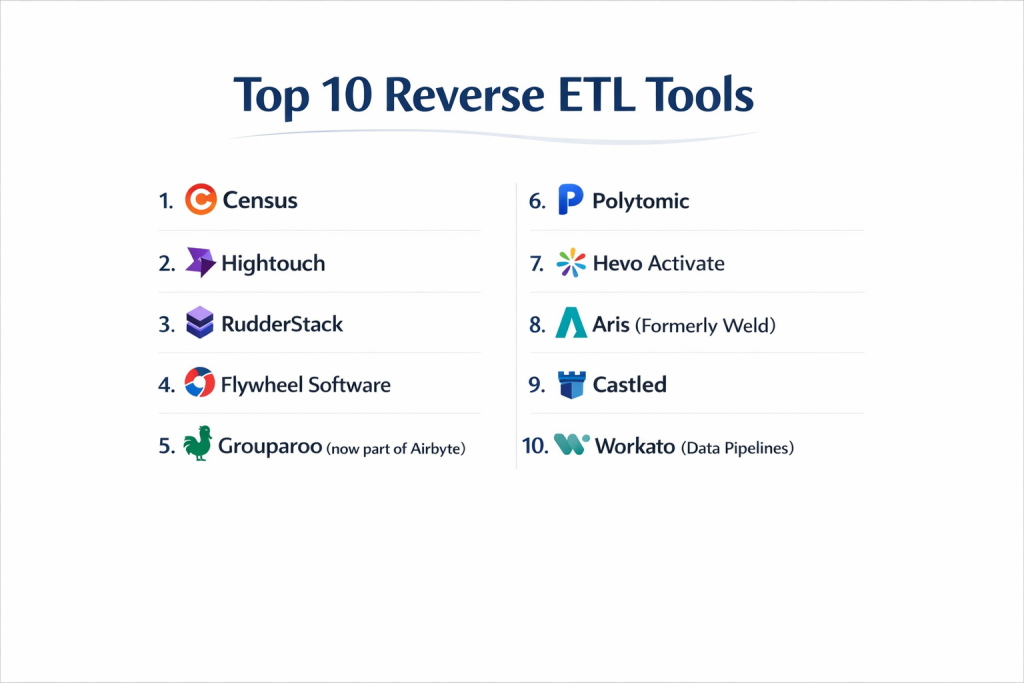
Top 10 Reverse ETL Tools
1 — Census
Census is widely considered a leader in the Reverse ETL space. It is designed to be the “bridge” between your data warehouse and your business apps, focusing heavily on being easy for data teams to trust.
- Key features:
- No-code visual mapper for easy field matching.
- Support for “Entities” which helps organize data logic.
- Advanced sync logs to track every single record.
- Segment builder that lets non-technical users create lists.
- Deep integration with dbt (data build tool).
- Pros:
- Very reliable; it handles errors and API limits better than most tools.
- Easy enough for a marketing person to use once the data is ready.
- Cons:
- The pricing can get high as you add more destinations.
- Some advanced features have a bit of a learning curve.
- Security & compliance: SOC 2 Type II compliant, HIPAA support, and GDPR ready with full data encryption.
- Support & community: High-quality documentation, very responsive Slack community, and dedicated support for enterprise clients.
2 — Hightouch
Hightouch is the main rival to Census and is famous for its “Data Activation” approach. They focus on speed and giving users many different ways to trigger a data sync.
- Key features:
- “Live Debugger” to see exactly what is happening during a sync.
- Supports SQL, dbt, and visual models to define data.
- “Extensions” that allow for custom coding if needed.
- Change Data Capture (CDC) to move only what has changed.
- A massive library of over 100 connectors.
- Pros:
- Offers a very generous “Free Forever” tier for small teams.
- The user interface is modern, fast, and very easy to navigate.
- Cons:
- Large, complex syncs can sometimes be difficult to manage without help.
- Pricing can scale quickly if you have many users.
- Security & compliance: SOC 2 Type II, HIPAA, and GDPR compliant. They do not store your data, they just move it.
- Support & community: Excellent onboarding, active community, and very helpful YouTube tutorials.
3 — RudderStack
RudderStack is an “all-in-one” data tool. While it does Reverse ETL, it also handles tracking data from your website (Event Stream) and moving data into your warehouse (ETL).
- Key features:
- Reverse ETL is just one part of a larger data platform.
- “Warehouse-first” architecture that keeps you in control.
- Real-time event streaming capabilities.
- Developer-friendly with strong API and CLI tools.
- Supports custom “Transformations” using JavaScript.
- Pros:
- Great value because you get three tools in one platform.
- Very strong privacy features since you can run it on your own servers.
- Cons:
- Much more technical than Census or Hightouch.
- Can be “overkill” if you only need the Reverse ETL part.
- Security & compliance: SOC 2 compliant, HIPAA ready, and strong privacy controls for data residency.
- Support & community: Very strong Slack community and deep technical documentation for engineers.
4 — Flywheel Software
Flywheel is a Reverse ETL tool built specifically for Marketing and Growth teams. It focuses less on the “plumbing” and more on helping companies grow their revenue through data.
- Key features:
- Audience builder designed for marketers, not engineers.
- Built-in “A/B Testing” to see if your data syncs actually help.
- Focuses on the “Customer 360” view.
- Automatic measurement of how data affects sales.
- Direct syncs to major ad platforms like Google and Meta.
- Pros:
- The best choice for teams that want to prove the “Value” of their data.
- Very easy for non-technical managers to use.
- Cons:
- Not as many “general purpose” connectors (like for HR or Finance).
- Can be more expensive because it is a “premium” growth tool.
- Security & compliance: Enterprise-grade security with SOC 2 compliance.
- Support & community: Strong focus on customer success and strategic partnership.
5 — Grouparoo (now part of Airbyte)
Grouparoo started as an open-source Reverse ETL tool. It was recently bought by Airbyte, which is one of the world’s most famous data integration companies.
- Key features:
- Open-source version that is free to use on your own hardware.
- Declarative configuration (easy for developers to manage).
- Real-time “Group” and “Property” definitions.
- Integrates with Airbyte’s massive list of sources.
- No-code UI for team members to manage audiences.
- Pros:
- Great for companies that want to stay “Open Source” and avoid vendor lock-in.
- Very fast setup for developers who like using the terminal.
- Cons:
- As it merges with Airbyte, some features are still changing.
- Fewer “polished” features compared to dedicated tools like Census.
- Security & compliance: Varies based on whether you use the cloud version or host it yourself.
- Support & community: Massive Airbyte community and helpful Slack channels.
6 — Polytomic
Polytomic is a newer player that focuses on simplicity and “Self-Service.” They want to make it so that any business person can move data without asking a developer for help.
- Key features:
- Support for “Live” databases, not just warehouses.
- Spreadsheet-like interface for mapping data.
- Can pull data from one app and push it directly to another.
- Bulk data loading and continuous syncing.
- Simple “Identity” management.
- Pros:
- Unique ability to connect apps directly without a warehouse in the middle.
- Very clean and simple price structure.
- Cons:
- Fewer “advanced” engineering features than Hightouch.
- The library of connectors is still growing.
- Security & compliance: SOC 2 compliant and follows standard data privacy rules.
- Support & community: Personalized onboarding and fast email support.
7 — Hevo Activate
Hevo Data is a famous ETL company that added “Activate” to handle Reverse ETL. It is a great choice for companies that want to manage all their data movement in one place.
- Key features:
- Visual workflow builder.
- Automatic “Schema Mapping.”
- Real-time monitoring of all data tasks.
- Pre-built templates for common use cases.
- Integrates with major warehouses like Snowflake and BigQuery.
- Pros:
- If you already use Hevo for ETL, adding Activate is very simple.
- Very competitive pricing for smaller companies.
- Cons:
- The Reverse ETL part is not as deep as the competition yet.
- Support for complex data transformations is limited.
- Security & compliance: SOC 2, GDPR, and HIPAA compliant.
- Support & community: 24/7 live chat support which is very helpful for beginners.
8 — Aris (Formerly Weld)
Aris is an “All-in-One” data platform from Europe. It provides the warehouse, the ETL to fill it, and the Reverse ETL to send data back to your apps.
- Key features:
- Built-in “Data Modeling” layer.
- High-speed syncs to marketing and sales tools.
- Clean dashboard to see the “health” of your data.
- Focus on “No-Code” for the entire data journey.
- Deep support for European privacy laws.
- Pros:
- Great for companies that don’t want to buy 5 different data tools.
- Strong focus on “Clean” data before it is synced.
- Cons:
- Not as flexible if you already have your own warehouse set up.
- Smaller community than the US-based tools.
- Security & compliance: Highly focused on GDPR and European data safety.
- Support & community: Direct support and personalized onboarding.
9 — Castled
Castled is a “Warehouse-Native” Reverse ETL tool that focuses on making it extremely easy to move data into marketing automation platforms.
- Key features:
- Query-based data selection.
- Strong focus on “Failure Recovery” (retrying if an app is down).
- Simple visual mapping for custom fields.
- Support for major cloud warehouses.
- Lightweight and fast.
- Pros:
- Very easy to set up for simple marketing syncs.
- The price is very fair for mid-sized teams.
- Cons:
- Fewer connectors for niche business tools.
- Limited features for very complex data engineering.
- Security & compliance: SOC 2 compliant and encryption in transit.
- Support & community: Helpful email support and clear documentation.
10 — Workato (Data Pipelines)
Workato is a giant in the “Automation” world. While they are known for connecting apps, they have added powerful Reverse ETL features to move big chunks of data from warehouses.
- Key features:
- “Recipes” that can do both simple moves and complex logic.
- Over 1,000 different connectors.
- Enterprise-grade security and governance.
- Can trigger syncs based on almost anything.
- Handles “big data” volumes very well.
- Pros:
- If your company already uses Workato for automation, this is a natural add-on.
- Incredible power to build complex business logic.
- Cons:
- Can be very expensive for small companies.
- The interface can be overwhelming because it does so many things.
- Security & compliance: Top-tier enterprise security, SOC 2, HIPAA, and ISO compliant.
- Support & community: Massive library of shared “recipes” and global enterprise support.
Comparison Table
| Tool Name | Best For | Platform(s) Supported | Standout Feature | Rating |
| Census | Data Teams | Cloud Warehouse | dbt Integration | 4.7 / 5 |
| Hightouch | Marketing Speed | Cloud Warehouse | Live Debugger | 4.8 / 5 |
| RudderStack | All-in-One Needs | Cloud & Self-Host | Warehouse-First | 4.6 / 5 |
| Flywheel | Growth Teams | Cloud Warehouse | A/B Test Syncs | 4.5 / 5 |
| Airbyte/Grouparoo | Open Source | Cloud & Self-Host | Open Source Core | 4.3 / 5 |
| Polytomic | Simple Direct Syncs | Cloud & DBs | No Warehouse Needed | 4.4 / 5 |
| Hevo Activate | Hevo Users | Cloud Warehouse | 24/7 Live Chat | 4.2 / 5 |
| Aris | Startups | All-in-One | Full Data Stack | 4.1 / 5 |
| Castled | Marketing Syncs | Cloud Warehouse | Fast Setup | 4.0 / 5 |
| Workato | Enterprise Logic | Multi-Cloud | 1,000+ Connectors | 4.5 / 5 |
Evaluation & Scoring of Reverse ETL Tools
| Criteria | Weight | What we look for |
| Core Features | 25% | Can it move data reliably without losing records? |
| Ease of Use | 15% | Can a non-technical person map the fields? |
| Integrations | 15% | Does it connect to all the popular business apps? |
| Security & Compliance | 10% | Is the data encrypted and compliant with laws? |
| Performance | 10% | How fast can it sync large amounts of data? |
| Support & Community | 10% | Is there a Slack channel or fast support? |
| Price / Value | 15% | Is there a free tier or a fair price for growth? |
Which Reverse ETL Tool Is Right for You?
Solo users vs SMB vs mid-market vs enterprise
If you are a solo user or a very small business, you probably don’t need a Reverse ETL tool yet—you can likely use simple automation tools like Zapier. For Small and Mid-sized Businesses (SMB), Hightouch or Polytomic are great because they are easy to start and have lower prices. Enterprise companies usually need the power and security of Census or Workato, as these tools can handle millions of rows and strict company rules.
Budget-conscious vs premium solutions
If you are watching your budget, Airbyte (Grouparoo) is excellent because you can host it yourself for free. Hightouch also has a great free plan for one destination. If you want a “premium” experience where the tool does everything for you and gives you strategic advice, Flywheel Software or Census are worth the higher cost.
Feature depth vs ease of use
If you want something very simple that “just works,” Polytomic or Castled are the easiest to learn. However, if you have a team of data engineers who want to write code, use dbt, and have deep control over every sync, Census and RudderStack provide the “technical depth” they will want.
Integration and scalability needs
If your company uses 50 different apps and needs them all to be updated, Workato has the most connectors. If your data volume is growing very fast, you need a tool built for “scale” like Hightouch or RudderStack, which are designed to handle massive warehouses without crashing.
Security and compliance requirements
For companies in healthcare or finance, security is everything. Census and RudderStack are excellent because they offer features like VPC (Virtual Private Cloud) so your data never truly leaves your secure environment. Always check for SOC 2 and HIPAA logos before you sign up.
Frequently Asked Questions (FAQs)
1. What is Reverse ETL?
It is the process of moving data from a central warehouse (like Snowflake) back into your everyday business apps (like Salesforce or Mailchimp).
2. How is it different from normal ETL?
Normal ETL moves data to the warehouse for reports. Reverse ETL moves data from the warehouse to make it useful for teams.
3. Do I need a data warehouse to use these tools?
Most Reverse ETL tools require a warehouse like Snowflake, BigQuery, or Redshift. However, some tools like Polytomic can connect to databases directly.
4. Is Reverse ETL expensive?
Many tools have a free tier. Paid plans usually start around $100 to $500 per month and go up based on how many apps you connect or how much data you move.
5. Can I just use Zapier instead?
Zapier is great for “triggering” one thing at a time. Reverse ETL is better for moving thousands of records at once and keeping them in sync over time.
6. Does it require coding?
Most modern tools are “Low-Code” or “No-Code.” You might need a little SQL to find your data, but the mapping to apps is usually done with buttons.
7. Is my data safe while moving?
Yes. These tools use high-level encryption. Many “Warehouse-Native” tools don’t even store your data; they just act as a pipe.
8. How often does the data sync?
You can usually choose. Some people sync once a day at night, while others sync every 5 minutes so their teams always have fresh data.
9. What happens if a sync fails?
Good tools will send you an alert and show you exactly which row failed and why (e.g., “Email address was missing”).
10. Why is everyone talking about this now?
Because warehouses have become the “heart” of business data. Now that the data is all in one place, companies want to use it to make money, not just look at it.
Conclusion
Choosing a Reverse ETL tool is about making your data move. For too long, the best information was trapped inside dashboards that only managers looked at. By using one of these tools, you are giving that information back to the people who can use it to help customers and grow the business.
If you want the most “balanced” tool that is easy but powerful, Hightouch and Census are the top choices. If you want to keep things open and free, look at Airbyte. No matter which one you choose, the goal is the same: stop letting your data sit still and start putting it to work. The “best” tool is simply the one that fits into your current workflow and helps your team stay updated without any extra manual effort.