Introduction
Returns Management Software, often called Reverse Logistics software, is a specialized platform that automates and streamlines the entire process of handling product returns, exchanges, and refunds. It replaces manual, paper-based, or email-driven chaos with a centralized system that manages everything from the customer’s initial return request to inspecting the item, processing the refund, and deciding its final fate—whether to restock, refurbish, recycle, or resell.
This software is critically important because returns are a massive and costly reality of modern retail, especially e-commerce. A poorly managed returns process erodes profits through processing costs, lost inventory visibility, and customer frustration that leads to lost future sales. Effective returns management turns this cost center into a strategic advantage. It reduces processing time and cost, improves inventory accuracy, recovers more value from returned goods, and—most importantly—creates a positive post-purchase experience that can turn a disappointed customer into a loyal advocate.
Key real-world use cases include: An online apparel retailer providing instant, automated return labels and exchange options to reduce support calls. A consumer electronics company inspecting high-value returns, efficiently routing them to repair centers, and updating warranty status. A large retailer consolidating returns from stores and online into a central facility for efficient sorting and liquidation. A marketplace seller automating refunds upon carrier scan to speed up the customer’s money return. A brand analyzing return reasons (size, defect, wrong item) to identify and fix product or operational issues.
When choosing a tool, users should prioritize several key criteria. Automation and Self-Service capabilities are essential—can customers initiate returns online without contacting support? Carrier and Shipping Integration streamlines label generation and tracking. Warehouse Operations Support features like Return Merchandise Authorization (RMA) management, inspection workflows, and disposition routing are crucial for efficiency. Analytics and Reporting should provide insights into return rates, reasons, and costs to drive preventive action. Finally, consider integration depth with your e-commerce platform, order management system (OMS), and warehouse management system (WMS), as well as the tool’s scalability and pricing model.
Best for: These tools deliver the most value to E-commerce Managers, Operations Directors, Customer Service Leaders, and Warehouse/Logistics Managers in retail and direct-to-consumer brands. They are essential for industries with higher return rates, such as apparel, footwear, electronics, cosmetics, and home goods. Mid-market to enterprise businesses processing a high volume of returns find the efficiency gains and cost savings to be transformative.
Not ideal for: Businesses with extremely low return volumes (e.g., under 20-50 per month) or those selling very low-cost, disposable items where the cost of processing a return exceeds the item’s value. A local service-based business or a manufacturer selling only through distributors (where returns are handled upstream) likely doesn’t need this specialized software. In these cases, manual processes or basic features within an existing e-commerce platform might suffice.
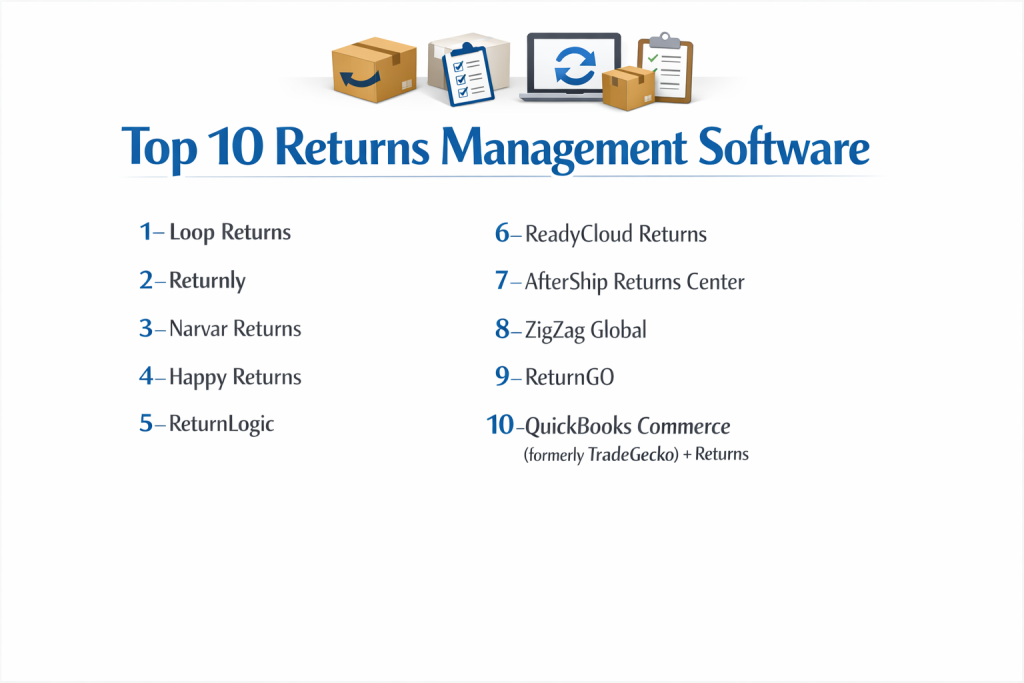
Top 10 Returns Management Software
1 — Loop Returns
Loop is a leading returns and exchanges platform built specifically for modern, brand-focused e-commerce companies. It emphasizes turning returns into exchanges and retaining customer loyalty through a beautiful, branded post-purchase experience.
Key features:
- Exchange-First Platform: Actively encourages and facilitates exchanges over refunds by offering instant exchange options, store credit, and gift cards during the return flow.
- Branded Customer Portal: A fully customizable, white-labeled returns portal that matches the merchant’s website branding, maintaining a seamless customer experience.
- Intelligent Recommendations: Suggests alternative products during the return process to drive exchange uptake.
- Automated Workflows & Rules: Automate return approvals, label generation, refunds, and restocking based on custom rules (e.g., auto-approve returns under $50).
- Advanced Analytics: Deep insights into return reasons, exchange rates, and the financial impact of returns.
- Deep E-commerce Integrations: Native, two-way sync with Shopify, Shopify Plus, and other major platforms.
Pros:
- Unmatched for Customer Experience & Exchanges: The best platform for brands that view returns as a loyalty opportunity, significantly increasing exchange rates and preserving revenue.
- Beautiful, Brand-Conscious Design: The white-labeled portal and communication templates make the returns experience feel like an extension of the brand, not a generic utility.
Cons:
- Premium Pricing: Can be more expensive than some generic solutions, positioning it as a premium tool for growing and established brands.
- Focused on Direct-to-Consumer E-commerce: Its deepest strengths are in the DTC e-commerce space; it may be less tailored for complex B2B or heavy brick-and-mortar returns.
Security & compliance: A modern cloud platform with strong security practices, SOC 2 Type II compliance, and tools to help with data privacy regulations.
Support & community: Known for excellent, responsive customer support and a strong knowledge base. Popular among Shopify merchants and digital-native brands.
2 — Returnly
Returnly (now part of Affirm) is a returns experience platform that focuses on financial flexibility and instant gratification for the customer. Its hallmark feature is offering immediate shopping credit before the return is physically received.
Key features:
- Instant Merchandise Credit: Issues immediate, conditional store credit to customers as soon as they initiate a return, allowing them to re-shop immediately.
- Flexible Return Options: Provides a suite of return solutions, including at-home pickups, drop-off locations, and smart labels.
- Returns as a Marketing Channel: Uses the returns portal to promote new products and collections to a captive, high-intent audience.
- Predictive Analytics: Uses data to assess return risk and manage the financial exposure of instant credit.
- Seamless Integrations: Deep integrations with e-commerce platforms and payment processors to handle the financial flow.
- Automated Returns & Exchanges: Streamlines the backend process for merchants after the item is received.
Pros:
- Powerful for Sales Recovery: The instant credit model is incredibly effective at recapturing revenue that would otherwise be lost during the return waiting period.
- Enhances Customer Trust and Loyalty: Removing the financial friction of waiting for a refund builds tremendous goodwill and encourages repeat purchases.
Cons:
- Financial Risk Model: The merchant assumes the risk for issuing credit before the return is verified, though this is managed by Returnly’s predictive algorithms.
- Acquisition Integration: As part of Affirm, its long-term roadmap and integration as a standalone returns tool are evolving within a broader financial services suite.
Security & compliance: As a financial technology tool, it adheres to high security and compliance standards, handling sensitive customer and transaction data.
Support & community: Provides customer support and resources. Its model is particularly popular with apparel and lifestyle e-commerce brands.
3 — Narvar Returns
Narvar is a comprehensive post-purchase experience platform, with returns management being a core component. It is designed for larger retailers and brands that want to unify the entire post-order journey—tracking, returns, and proactive communications—in one system.
Key features:
- Unified Post-Purchase Platform: Manages tracking, returns, and customer communications from a single dashboard.
- Extensive Carrier Network & Drop-Off Options: Integrates with a vast network of carriers and third-party drop-off locations (e.g., UPS Store, Kohl’s) for convenient customer returns.
- Proactive Communication Engine: Automates multi-channel (SMS, email) updates throughout the return process.
- Advanced Returns Logic: Supports complex rules for returns windows, restocking fees, and item conditions.
- Returns Analytics: Tracks key metrics and provides insights into the post-purchase journey.
- Enterprise Scalability: Built to handle high volumes and complex operational models for global brands.
Pros:
- Holistic Post-Purchase Focus: Ideal for companies that want to manage the entire customer journey after checkout, not just isolate returns.
- Superior Convenience via Drop-Off Network: Offers one of the most extensive and convenient return drop-off networks, which can reduce carrier costs and improve customer satisfaction.
Cons:
- Broader Platform, Less Returns-Only Focus: As part of a larger suite, it may have more features than a company needs if they only want a dedicated returns solution.
- Can Be Complex for Smaller Brands: The enterprise focus and breadth of features can mean higher cost and implementation scope than simpler tools.
Security & compliance: Enterprise-grade security with relevant compliance certifications, trusted by large global retailers.
Support & community: Offers enterprise-level support and strategic customer success management.
4 — Happy Returns
Happy Returns, a PayPal company, is a returns solution famous for its network of physical “Return Bar” locations and its model of consolidated, box-free returns. It focuses on making returns incredibly easy for the customer and more efficient and sustainable for the merchant.
Key features:
- Physical Return Bar Network: Hundreds of in-person drop-off locations in malls and stores where customers can return items without a box or label.
- Box-Free, Consolidated Returns: Items are aggregated in reusable totes at Return Bars, drastically reducing packaging waste and shipping costs for the merchant.
- Instant Verification & Refund: At the Return Bar, items are visually verified, and the merchant can be triggered to issue an immediate refund.
- Software for Returns Management: Provides the online portal, rules engine, and analytics to manage the process.
- Turnkey Service: Handles the entire reverse logistics process from drop-off to consolidation to return-to-warehouse.
- Strong Sustainability Angle: The consolidated, packaging-free model is a major selling point for eco-conscious brands and consumers.
Pros:
- Unbeatable Customer Convenience: The in-person, box-free return is arguably the simplest customer experience available, leading to high satisfaction.
- Significant Cost and Sustainability Savings: Consolidation reduces return shipping costs by up to 30-40%, and eliminates packaging waste.
Cons:
- Geographic Limitation: The Return Bar network is primarily in the United States, limiting its utility for international or regional retailers elsewhere.
- Service Model vs. Software-Only: It is a hybrid software-and-logistics service. Companies wanting only software to manage their own warehouse process may prefer a different tool.
Security & compliance: As part of PayPal, it operates with robust financial and data security standards.
Support & community: Provides support as a service provider. Its model is a favorite among digitally-native vertical brands (DNVBs).
5 — ReturnLogic
ReturnLogic is a robust returns management platform built for e-commerce merchants on platforms like Shopify and BigCommerce. It focuses on operational control, automation, and deep data to turn returns into a profit recovery center.
Key features:
- Advanced Rule Engine: Highly configurable rules to automate every decision: approval, refund amount, restocking fees, return label type, and final disposition.
- Detailed Return Reason Tracking: Granular tracking of return reasons to identify product or operational issues.
- Warehouse Operations Tools: Features like RMA barcode scanning, inspection checklists, and graded restocking (e.g., “Like New,” “Open Box”).
- Vendor Return Management: Helps manage returns sent back to suppliers or manufacturers for credit.
- Comprehensive Analytics & Reporting: Profit-focused reporting that shows the true cost of returns and recovery value.
- Developer-Friendly API: Strong API for custom integrations and workflows.
Pros:
- Operational Powerhouse for Merchants: Offers the deepest level of control and automation for merchants who want to fine-tune their internal returns process and maximize recovery value.
- Excellent Data for Problem Solving: The detailed reason and condition tracking provides actionable data to reduce future returns.
Cons:
- Less Focus on Flashy Customer UX: While functional, its customer portal is less focused on branded marketing and exchanges compared to Loop or Returnly.
- Steeper Learning Curve: The power and configurability require more setup and understanding to leverage fully.
Security & compliance: A secure SaaS platform with standard data protection measures.
Support & community: Known for strong customer support and an active user base among mid-market e-commerce operators.
6 — ReadyCloud Returns
ReadyCloud is a suite of shipping, fulfillment, and returns solutions. Its returns product is a solid, affordable option for small to mid-sized businesses looking for a capable tool that integrates with its other shipping services or stands alone.
Key features:
- Integrated Returns & Shipping: Returns management is part of a broader platform that includes multicarrier shipping software, which can simplify workflows.
- Automated Returns Center: Provides a self-service portal for customers and automates RMA generation and label creation.
- Rules and Workflow Automation: Set basic rules for auto-approval, return windows, and fees.
- Reporting Dashboard: Tracks return rates, reasons, and costs.
- Marketplace Returns Handling: Can help manage returns from channels like Amazon, Walmart, and eBay.
- Affordable Pricing: Often positioned as a cost-effective solution for growing businesses.
Pros:
- Good Value & Integration with Shipping: A practical choice for businesses that also need shipping software, offering a unified workflow.
- Ease of Use and Setup: Generally considered straightforward to implement and use for core returns automation.
Cons:
- Less Specialized Depth: May not have the advanced exchange logic, branded experience, or deep operational tools of best-of-breed returns-only platforms.
- Part of a Broader Suite: Its identity is split between returns and shipping; companies needing extreme depth in one area might look elsewhere.
Security & compliance: Implements standard cloud security practices. Specific enterprise certifications should be verified.
Support & community: Provides customer support typical for a mid-market SaaS company.
7 — AfterShip Returns Center
AfterShip, known for its order tracking platform, offers a Returns Center module. It’s a logical choice for businesses already using AfterShip for tracking, wanting to add a returns capability that integrates seamlessly with the post-purchase timeline.
Key features:
- Tight Integration with Tracking: Returns are presented to the customer in the context of their order tracking page, creating a unified post-purchase hub.
- Automated Returns Portal: Customers can initiate returns and exchanges from the tracking page; merchants get a management dashboard.
- Rules and Customization: Set return policies, windows, and automate approvals.
- Carrier Integrations: Connect with major carriers for prepaid return labels.
- Basic Analytics: Insights into return performance.
- Part of AfterShip Ecosystem: Fits neatly with other AfterShip products for tracking, notifications, and shipping.
Pros:
- Seamless for AfterShip Users: If you already use and love AfterShip for tracking, adding returns is a natural, low-friction extension of that ecosystem.
- Unified Customer Journey: Links the delivery and return experience together logically from the customer’s perspective.
Cons:
- Module vs. Standalone Powerhouse: As a module, it may lack the depth of features, operational tools, and strategic focus of dedicated returns platforms.
- Ecosystem Lock-in: Its value is most apparent within the AfterShip suite.
Security & compliance: Follows standard security practices for a SaaS company of its size. Compliance features align with its global customer base.
Support & community: Supported by AfterShip’s customer service team and resources.
8 — ZigZag Global
ZigZag Global is an enterprise returns management platform with a strong international focus. It specializes in helping large retailers manage complex cross-border returns, consolidations, and intelligent routing to recover maximum value.
Key features:
- Global Returns Network: A platform connecting retailers, carriers, and recovery partners worldwide to simplify international returns.
- Intelligent Disposition Routing: Uses algorithms to decide the most profitable destination for a return: local consolidation, return to origin country, or direct to liquidation/resale market.
- Carbon Emission Tracking: Measures and reports on the environmental impact of return logistics, supporting sustainability goals.
- Marketplace Re-listings: Automatically re-lists suitable returned items on secondary marketplaces (e.g., eBay, Amazon Outlet) to recover value.
- Analytics & Reporting: Provides data on global return trends, recovery rates, and costs.
- Enterprise-Grade: Built for large retailers with complex international supply chains.
Pros:
- Leader in Global & Cross-Border Returns: Uniquely powerful for retailers selling internationally, solving the high cost and complexity of cross-border reverse logistics.
- Maximizes Value Recovery: Its focus on finding the most profitable endpoint for returned goods (resale, refurbishment, recycling) goes beyond basic refund processing.
Cons:
- Overkill for Domestic-Only SMBs: The complexity and cost are justified for international operations but unnecessary for small businesses selling only domestically.
- Niche Complexity: The global network and routing logic introduce complexity that requires understanding and management.
Security & compliance: Handles complex international data and logistics, requiring robust security and compliance with various regional regulations.
Support & community: Provides enterprise support and services tailored to global retail operations.
9 — ReturnGO
ReturnGO is a returns, exchanges, and warranty management platform. It positions itself as an all-in-one solution for the post-purchase experience with a strong emphasis on customizable workflows and preventing returns before they happen.
Key features:
- Pre-Return Resolution: Tools like troubleshooting guides and video chat support to help customers solve issues without returning the product.
- Flexible Returns & Exchange Portal: Offers exchanges, store credit, and refunds. Supports bundle returns and partial returns.
- Warranty & Repair Management: Can handle warranty claims and manage repair logistics within the same system.
- Customizable Workflows: Allows merchants to design their own return and exchange logic.
- Restocking & Inspection Management: Tools for warehouse teams to process returns.
- Integration with Major Platforms: Connects with Shopify, Magento, and others.
Pros:
- Prevention-Focused Approach: The tools to resolve issues pre-return can significantly reduce return rates for certain product types (like electronics).
- Warranty Integration: The combination of returns and warranty management in one platform is efficient for brands that deal with both.
Cons:
- Broad Feature Set, Less Singular Focus: Tries to cover a lot (returns, exchanges, warranties, support), which can mean it doesn’t lead in any one category compared to a specialist.
- Brand Awareness: A smaller player compared to some of the more well-known platforms in the space.
Security & compliance: A standard cloud SaaS platform with data security measures in place.
Support & community: Provides customer support and resources to its user base.
10 — QuickBooks Commerce (formerly TradeGecko) + Returns
For businesses using QuickBooks Commerce for inventory and order management, its built-in Returns capability offers basic but integrated functionality. It’s a practical choice for SMBs that centralize operations in this platform.
Key features:
- Native Integration with OMS/Inventory: Returns are processed as negative orders within the same system that manages sales, inventory, and purchasing.
- Basic Returns Management: Create RMAs, generate credit memos, and update inventory levels upon return receipt.
- Inventory Accuracy: Automatically adjusts inventory counts and cost of goods sold (COGS) when returns are finalized.
- Simple Workflow: Tied directly to the sales order, making it easy for staff to understand the context.
- Part of a Core Business Suite: Avoids needing a separate system for a basic returns process.
- Reporting: Included in the broader financial and inventory reports.
Pros:
- Unified System for SMBs: For a small business running on QuickBooks Commerce, having returns managed in the same place as everything else is simple and efficient.
- Maintains Financial & Inventory Integrity: Ensures returns are automatically reflected in accounting and stock levels correctly.
Cons:
- Very Basic Features: Lacks customer self-service portals, advanced automation, branded experiences, and deep analytics of dedicated tools.
- Only Makes Sense for Users of the Platform: Not a viable standalone returns solution; its value is entirely dependent on using QuickBooks Commerce as your core OMS.
Security & compliance: Security is part of the broader Intuit/QuickBooks platform, which has strong trust and compliance standards.
Support & community: Supported through QuickBooks Commerce channels and community.
Comparison Table
| Tool Name | Best For | Platform(s) Supported | Standout Feature |
|---|---|---|---|
| Loop Returns | Brand-focused DTC e-commerce prioritizing exchanges and a premium customer experience. | Cloud, SaaS | Exchange-first platform with beautiful, white-labeled customer portals. |
| Returnly | E-commerce brands wanting to recover sales instantly with pre-received credit and financial flexibility. | Cloud, SaaS | Instant merchandise credit issued to customers upon return initiation. |
| Narvar Returns | Large retailers seeking a unified platform for the entire post-purchase journey (tracking + returns). | Cloud, SaaS | Holistic post-purchase platform with extensive carrier/drop-off network convenience. |
| Happy Returns | Brands valuing extreme customer convenience, sustainability, and cost savings via in-person, box-free returns. | Cloud + Service | Physical “Return Bar” network for box-free, consolidated returns. |
| ReturnLogic | E-commerce operators needing deep control, automation, and data to optimize warehouse recovery and profits. | Cloud, SaaS | Advanced rule engine and operational tools for maximizing recovery value. |
| ReadyCloud Returns | SMBs looking for an affordable, capable returns tool, often integrated with shipping needs. | Cloud, SaaS | Good value and practical integration with shipping workflows. |
| AfterShip Returns | Businesses using AfterShip for tracking who want a simple, integrated returns add-on. | Cloud, SaaS | Tight integration with order tracking for a unified customer post-purchase page. |
| ZigZag Global | Large, international retailers optimizing complex cross-border returns and global value recovery. | Cloud, SaaS | Intelligent global returns network and disposition routing for international sales. |
| ReturnGO | Brands that want a combined platform for returns, exchanges, and warranty management with a prevention focus. | Cloud, SaaS | Pre-return resolution tools and combined returns/warranty workflows. |
| QuickBooks Commerce | Small businesses already using this OMS for basic, integrated returns within their core system. | Cloud, SaaS | Native returns as part of inventory and order management, ensuring financial accuracy. |
Evaluation & Scoring of Returns Management Software
To objectively compare tools, use this weighted scoring rubric. Score each option from 1 (Poor) to 5 (Excellent) for each criterion. Multiply the score by the weight to get the weighted score. The tool with the highest total is the best fit for your specific needs.
| Criteria | Weight | What to Look For | Score (1-5) | Weighted Score |
|---|---|---|---|---|
| Core Features | 25% | Self-service portal, rule automation, exchange facilitation, warehouse tools (inspection, RMA), analytics. | ||
| Ease of Use | 15% | Intuitiveness for customers and for internal staff (CSR, warehouse). Setup and configuration simplicity. | ||
| Integrations & Ecosystem | 15% | Connectors to your e-commerce platform, OMS/WMS, 3PLs, carriers, and accounting software. API strength. | ||
| Security & Compliance | 10% | Data security for customer PII and transaction data. Compliance with relevant regulations (GDPR, financial). | ||
| Performance & Reliability | 10% | Platform uptime, speed of the customer portal, and ability to handle your return volume during peak seasons. | ||
| Support & Community | 10% | Quality of onboarding, customer support responsiveness, and availability of best practice resources. | ||
| Price / Value | 15% | Total cost relative to the cost savings, revenue recovery, and customer satisfaction improvements delivered. | ||
| TOTAL | 100% | FINAL SCORE |
Which Returns Management Software Tool Is Right for You?
Your choice depends on your business model, priorities, and operational scale. Follow this guide to find your match.
- By Primary Business Goal:
- Maximize Customer Loyalty & Exchanges: Your goal is retention. Choose Loop Returns for its branded, exchange-first experience.
- Recapture Revenue Immediately: You want to turn returns into new sales fast. Returnly’s instant credit is powerful.
- Reduce Costs & Improve Sustainability: You need operational efficiency. Happy Returns (for consolidation) or ZigZag (for global routing) save significant shipping costs.
- Gain Operational Control & Data: You need to optimize internal processes. ReturnLogic offers the deepest control and analytics.
- Simplify for the Customer: Convenience is key. Happy Returns (in-person) or Narvar (extensive drop-off network) excel.
- By Company Size & Channel:
- SMB / Growing E-commerce: Start with ReadyCloud Returns or ReturnLogic for good value and control. If on Shopify, Loop is a top-tier choice.
- Mid-Market / DTC Brand: Loop, Returnly, and Happy Returns are the leaders for brand-centric, scalable solutions.
- Enterprise / Omnichannel Retailer: Narvar (for post-purchase suite) or ZigZag Global (for international complexity) are enterprise-grade.
- Marketplace-Heavy Seller: Ensure the tool has specific integrations for Amazon/Walmart returns. ReadyCloud and ReturnLogic handle these.
- By Integration Needs:
- Shopify/Magento/BigCommerce Native: Check for deep, native integrations. Loop is famously good for Shopify.
- Already Use AfterShip for Tracking: AfterShip Returns is the logical, integrated add-on.
- Use QuickBooks Commerce as your OMS: Its built-in returns might suffice for basic needs.
- Complex Tech Stack (ERP, WMS): Prioritize tools with strong APIs (ReturnLogic, ZigZag) or proven enterprise integrations (Narvar).
- By Budget Priority:
- Budget-Conscious SMB: ReadyCloud Returns offers solid features at a lower price point. Basic features in your e-commerce platform are free but limited.
- Value-Oriented Mid-Market: ReturnLogic and Loop provide strong ROI for their cost in saved time and recovered revenue.
- Enterprise/Strategic Investment: Narvar, ZigZag, and Happy Returns (as a service) involve higher costs justified by large-scale savings and strategic benefits.
- By Geographic Focus:
- Primarily US-Based: All tools work, but Happy Returns’ physical network is a US advantage.
- Selling Internationally: ZigZag Global is the specialist. Ensure any other tool supports your target countries’ carriers and regulations.
Frequently Asked Questions (FAQs)
1. How do returns software tools charge?
Common models: Per-return transaction fee (e.g., $0.50 – $3.00 per processed return), monthly subscription based on order volume or features, or a hybrid of both. Enterprise deals are often custom.
2. Can I still offer free returns with this software?
Yes. The software gives you control. You can set rules to offer free returns (you absorb the label cost), charge the customer, or deduct a restocking fee. It automates the policy you define.
3. How does it handle exchanges?
Advanced tools (Loop, Returnly) make exchanges a primary option. The customer selects a new item during the return process. The system can hold inventory, generate a new order, and manage the shipping—often before the original item is returned.
4. What’s an RMA, and how is it managed?
A Return Merchandise Authorization (RMA) is a unique number issued for each return. The software generates it automatically, links it to the order, and provides it on the return label. It’s scanned at the warehouse to instantly identify the return and trigger the next step (inspection, refund).
5. How does it help reduce return rates?
Through data (identifying top return reasons like “size runs small”) and prevention tools (like ReturnGO’s troubleshooting guides or Loop’s exchange incentives). You can then fix product descriptions, size charts, or quality issues.
6. What happens to the data from returns?
It flows into the tool’s analytics dashboard. You can see return rates by product, reason, size, etc. This data should be shared with merchandising, product development, and marketing teams to make informed decisions.
7. Do I need a separate warehouse system?
For basic receiving and restocking, no. But for complex warehousing with multiple locations, cycle counts, and advanced put-away logic, you’ll need a WMS. The returns software should integrate with your WMS to send receipt confirmations and disposition instructions.
8. How long does implementation take?
For a cloud-based tool with standard integrations: 2-8 weeks. It involves connecting your store, configuring rules and policies, setting up carrier accounts, and testing. Enterprise deployments with custom work take longer.
9. What’s the biggest mistake when implementing?
Not defining clear internal rules and processes first. The software automates decisions. If you haven’t decided on your rules for approvals, refund amounts, restocking fees, and disposition, you can’t configure the tool effectively.
10. Can it handle returns from marketplaces (Amazon, eBay)?
Yes, most robust tools can. You may need to import orders or connect via API. They help you manage the different policies and labels required by each marketplace from one central dashboard.
Conclusion
Selecting the right returns management software is a strategic decision that redefines a traditional cost center into an area of efficiency, customer satisfaction, and even profit recovery. The landscape offers specialized solutions for every philosophy—from the loyalty-focused exchange engine and the instant-credit revenue recapturer to the global logistics optimizer and the cost-saving consolidator.
The essential takeaway is that the “best” tool aligns with your brand’s promise and operational reality. A luxury brand needs a seamless, branded experience. A global retailer needs intelligent routing. A fast-growing DTC brand needs to balance customer delight with unit economics. Your choice must be guided by a clear understanding of the specific friction points in your current returns process and the strategic outcome you desire.
Ultimately, modern returns software is an investment in the complete customer lifecycle. It protects your margins, empowers your operations team with data and automation, and transforms a potentially negative experience into a moment that reinforces trust and encourages the next purchase. By carefully evaluating options against your specific customer profile, product mix, and operational footprint, you can select a platform that doesn’t just process returns—it optimizes them for the health of your business and the happiness of your customers.