Introduction
A Retail Pricing Optimization Tool is specialized software that uses data science, artificial intelligence, and economic modeling to help retailers set the best possible prices. It moves beyond gut feeling and simple cost-plus markup by analyzing mountains of data—including competitor prices, customer demand, inventory levels, seasonality, and promotional history—to recommend prices that maximize revenue, profit, or specific strategic goals.
This software is critically important because pricing is the most powerful and immediate lever a retailer has to impact profitability. In a fast-moving, competitive market, manual pricing is slow, inconsistent, and leaves money on the table. These tools automate and enhance decision-making, allowing retailers to respond to market changes in real-time, protect margins during promotions, clear excess stock intelligently, and craft personalized prices that drive customer loyalty. In essence, they turn pricing from an administrative task into a strategic competitive advantage.
Key real-world use cases include: A grocery chain dynamically adjusting the price of thousands of SKUs daily to match local competitors and manage perishable inventory. An electronics retailer using competitive data to price-match online giants while protecting margin on exclusive bundles. A fashion retailer implementing markdown optimization to clear end-of-season stock at the best possible pace and profit. An e-commerce brand using AI to test different price points and personalize offers for different customer segments. A big-box retailer aligning online and in-store pricing strategies across hundreds of locations.
When choosing a tool, users should prioritize several key criteria. Core Algorithm Strength is the engine—does it use advanced AI/ML and proven economic models (like price elasticity)? Data Integration and Management is the fuel; it must seamlessly ingest data from your POS, e-commerce platform, competitor sources, and inventory systems. Scenario Modeling and “What-If” Analysis allows you to forecast the impact of price changes before executing them. Automation and Rule Engine flexibility lets you set business guardrails (e.g., never go below cost). Finally, consider the user interface for merchants, scalability for your SKU count, and the vendor’s industry-specific expertise.
Best for: These tools deliver immense value to Pricing Managers, Revenue Management leaders, Merchandisers, and Category Managers in retail organizations. They are essential for businesses with large and complex catalogs (groceries, electronics, apparel), those in highly competitive markets (e-commerce, DIY), and any retailer where pricing directly dictates inventory turnover and profitability. Mid-market to enterprise retailers with multiple channels (online, in-store, marketplace) see the greatest return on investment.
Not ideal for: Very small retailers with a handful of unique, handmade, or highly differentiated products where cost-plus or value-based pricing is straightforward and stable. A solo artisan or boutique shop with low stock turnover may not generate enough data or face enough competitive pressure to justify the cost. Businesses with legally fixed prices or those in purely relationship-based B2B sales also have less need. In these cases, basic repricing software or manual competitive analysis might suffice.
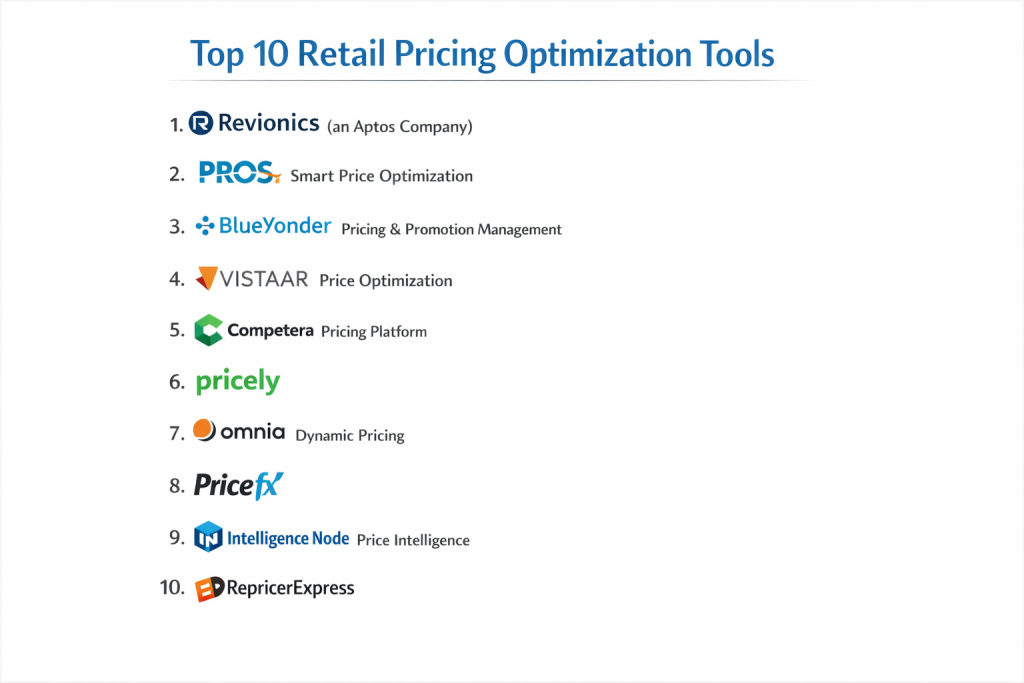
Top 10 Retail Pricing Optimization Tools
1 — Revionics (an Aptos Company)
Revionics is a leading AI-powered price optimization and competitive intelligence platform built for large, complex retailers and distributors. It is known for its sophisticated science, scalability, and deep retail domain expertise.
Key features:
- AI-Driven Price Elasticity Modeling: Uses advanced machine learning to understand how customer demand for each product responds to price changes at a granular level (by location, channel, season).
- Competitive Price Intelligence: Automated competitive data collection, matching, and analysis to inform pricing strategies.
- Lifecycle Pricing: Holistic strategies for new items, everyday core items, promotional pricing, and markdowns.
- Prescriptive Analytics & Action Management: Doesn’t just forecast; recommends specific price changes with expected impact and provides workflow tools to approve/execute.
- Integrated Promotional Optimization: Optimizes both base price and promotional tactics (e.g., BOGO, percent-off) together for maximum impact.
- Enterprise-Grade Scalability: Handles millions of SKUs across thousands of locations and multiple currencies.
Pros:
- Retail-Specific Science Depth: Its algorithms are built specifically for retail pricing challenges and are trusted by some of the world’s largest retailers.
- Comprehensive End-to-End Solution: Covers the entire pricing lifecycle from everyday to promotions to markdowns in one integrated platform.
Cons:
- Enterprise Price Point: A significant investment, placing it out of reach for small and many mid-market businesses.
- Implementation Complexity: Requires clean data, organizational alignment, and can be a substantial project to deploy fully.
Security & compliance: Enterprise-grade security with SOC 2 Type II certification and adherence to data privacy standards. Designed for secure handling of sensitive pricing and competitive data.
Support & community: Offers strong professional services, dedicated customer success management, and an active user community of large retailers.
2 — PROS Smart Price Optimization
PROS provides a B2C and B2B price optimization and management platform leveraging AI that originated in the airline and travel industry. It brings that scientific rigor to retail, particularly for businesses with complex pricing models and diverse channels.
Key features:
- PROS AI Platform: A unified AI platform that powers pricing, quoting, and revenue management solutions across industries.
- Demand Forecasting & Elasticity: Predicts demand at the SKU-location level and models price sensitivity to recommend optimal prices.
- Dynamic Pricing Capabilities: Enables real-time or frequent price adjustments based on changes in demand, competition, and inventory.
- Price Execution & Management: Ensures recommended prices are accurately implemented across all sales channels and systems.
- Scenario Simulation: “What-if” analysis to model the financial and competitive impact of different pricing strategies.
- Strong B2B Retail Capabilities: Also excels in B2B scenarios like distributor or wholesale pricing.
Pros:
- Proven AI and Scientific Heritage: Brings decades of revenue science experience from high-stakes industries like travel, applied to retail.
- Excellent for Omnichannel & Dynamic Pricing: Strong capabilities for retailers needing to manage fast-changing prices across digital and physical touchpoints.
Cons:
- Can Be Highly Complex: The depth of science and configuration options require skilled internal or partner resources to manage.
- Cost Structure: Like other enterprise leaders, it represents a premium investment.
Security & compliance: A longstanding public company with robust enterprise security, compliance certifications, and a focus on data integrity.
Support & community: Global professional services and support organization. Strong presence in Fortune 500 retail and manufacturing.
3 — Blue Yonder (formerly JDA) Pricing & Promotion Management
Blue Yonder offers a comprehensive retail and supply chain platform, with its Pricing & Promotion Management module being a core component. It is designed for large retailers who want pricing tightly integrated with inventory, supply chain, and demand forecasting.
Key features:
- Integrated Supply Chain Intelligence: Pricing recommendations are informed by real-time inventory levels, supply constraints, and upstream demand forecasts from the broader Blue Yonder platform.
- Promotion Optimization & Planning: Advanced tools for planning, funding, and optimizing promotional events, factoring in halo effects on other products.
- Price Zone Optimization: Automatically defines optimal price zones (groups of stores with similar pricing characteristics) to simplify management.
- Competitive Benchmarking: Integrates competitive data to inform pricing strategies.
- Vendor Fund Management: Helps manage and optimize funding from suppliers for joint promotional activities.
- Luminate Platform: Leverages the broader Blue Yonder Luminate AI platform for continuous learning.
Pros:
- Unmatched Supply Chain Integration: The key differentiator. Pricing decisions are made with full visibility into inventory flow and constraints, preventing stockouts or excessive markdowns.
- Holistic Promotion Management: Goes beyond simple price cuts to manage the entire complex promotion lifecycle.
Cons:
- Part of a Massive Suite: Often sold as part of a larger (and very expensive) supply chain transformation, which can be a barrier to entry.
- Suite Complexity: The breadth of the platform can lead to lengthy implementations and require broad organizational buy-in.
Security & compliance: Enterprise-level security and compliance as expected from a major global technology provider.
Support & community: Supported by Blue Yonder’s extensive global services and partner network. Large user base in grocery, fashion, and hardlines retail.
4 — Vistaar Price Optimization
Vistaar, by SymphonyAI, is an AI-driven retail platform focused on price, promotion, and markdown optimization. It is known for its strong data science and user-friendly interface designed for category managers and merchants.
Key features:
- Predictive AI Models: Uses machine learning to forecast sales and optimize prices for everyday, promotional, and markdown scenarios.
- Competitive Price Indexing: Tracks competitor prices and calculates a market price index to guide positioning.
- Assortment & Space Integration: Can integrate with planogram data to understand the impact of product placement on price sensitivity.
- Actionable Workbench: Provides category managers with a clear dashboard of recommended price changes, competitive gaps, and performance alerts.
- Clearance & Markdown Optimization: Specialized algorithms to maximize revenue from seasonal or excess inventory.
- Scalable Cloud Platform: Built as a modern, scalable SaaS application.
Pros:
- Merchant-Centric Usability: Designed to be used directly by category managers and merchandisers, not just data scientists, promoting adoption.
- Strong Predictive Accuracy: Often praised for the accuracy of its demand forecasts and pricing recommendations.
Cons:
- Evolving Brand Identity: As part of SymphonyAI, it is integrating with other retail applications, which is a strength but can mean evolving product boundaries.
- Mid-Market to Enterprise Focus: May still be more tool than a very small retailer needs, though it targets a broad range.
Security & compliance: A modern SaaS platform with standard enterprise security protocols and data privacy compliance.
Support & community: Offers customer success and support services. Growing community within the SymphonyAI retail ecosystem.
5 — Competera Pricing Platform
Competera is a cloud-native pricing platform that emphasizes competitive data intelligence and agile price management. It is popular among mid-market and enterprise e-commerce and omnichannel retailers who compete aggressively on price.
Key features:
- Core Competitive Intelligence Engine: Strong capabilities in scraping, matching, and analyzing competitor prices across the web.
- Price Grid Management: Visual tools to set and manage complex pricing rules and strategies across categories and competitor sets.
- Automated Repricing Rules: Set rules to automatically adjust prices based on competitor movements (e.g., match the lowest, stay 5% below).
- Price Tracking & Alerts: Monitor specific competitor items and receive alerts on significant price changes.
- Basic Elasticity & Margin Optimization: Incorporates margin goals and simple demand sensing into price recommendations.
- E-commerce & Marketplace Focus: Integrates well with major e-commerce platforms and marketplaces like Amazon and Shopify.
Pros:
- Excellent Competitive Data & Agility: Ideal for retailers in price-transparent, fast-moving online markets where monitoring and reacting to competitors is a daily necessity.
- Intuitive Rule-Based Management: The visual rule builder makes it accessible for teams to implement sophisticated, automated pricing strategies without deep data science.
Cons:
- Less Emphasis on Advanced Predictive Science: While it has optimization features, its core strength is competitive reaction and rule execution, not deep predictive elasticity modeling.
- Brand Recognition: Less of a household name than some legacy enterprise vendors, though it is a established player.
Security & compliance: A secure cloud platform with data protection measures in place. Specific certifications like SOC 2 should be confirmed.
Support & community: Known for responsive customer support and success management. Popular in the e-commerce and digital retail space.
6 — pricely
pricely is a dynamic pricing and repricing tool focused on small to medium-sized e-commerce businesses, particularly those selling on marketplaces like Amazon, eBay, and Walmart. It automates the process of staying competitive.
Key features:
- Multi-Channel Repricing: Automatically adjusts prices on Amazon, eBay, Walmart, and Shopify based on configured rules.
- Competitor Tracking: Monitors key competitors’ prices and stock levels.
- Rule-Based Automation: Set rules to be the buy box winner, match the lowest price, or protect a minimum profit margin.
- Price Floor/Ceiling Controls: Set absolute minimum and maximum prices to maintain margin or brand positioning.
- Dashboard & Reporting: Basic dashboard to view performance and repricing activity.
- Simple Setup & Affordable Pricing: Designed for ease of use with straightforward, tiered subscription plans.
Pros:
- Affordable & Simple for E-commerce/Marketplaces: Provides exactly what a small online seller needs: automated, rule-based repricing to win sales on competitive marketplaces.
- Fast Time-to-Value: Can be set up and driving automated price changes within hours, not months.
Cons:
- Limited Strategic Optimization: It is a tactical repricing engine, not a strategic profit optimization platform. Lacks deep demand forecasting and elasticity modeling.
- Niche Focus: Primarily for marketplace and direct e-commerce sellers; not suited for complex brick-and-mortar or omnichannel retail.
Security & compliance: As a SaaS tool handling seller account API keys, it employs standard security practices. Sellers should review its specific data handling policies.
Support & community: Offers support primarily to its SMB customer base. Community is centered around e-commerce sellers.
7 — Omnia Dynamic Pricing
Omnia is a dynamic pricing software provider with a strong presence in Europe, serving retailers across grocery, DIY, electronics, and more. It offers a balance of competitive intelligence and price optimization science.
Key features:
- Competitor Price Monitoring: Extensive data collection on competitor prices, promotions, and assortment.
- Price Optimization Engine: AI-driven recommendations for base prices, promotions, and markdowns based on commercial goals (profit, revenue, volume).
- Promotion Recommendation: Suggests optimal promotional mechanics (discount depth, duration) and forecasts uplift.
- Price Image Management: Tools to monitor and steer the overall price perception of the retailer versus competitors.
- Assortment Price Analysis: Insights into how pricing affects category performance and market positioning.
- Retail Segment Specialization: Offers tailored solutions for different retail verticals.
Pros:
- Strong European Market Expertise: Deep understanding of European retail landscapes, competitors, and regulations.
- Balanced Approach: Effectively combines robust competitive data with actionable optimization science.
Cons:
- Geographic Focus: While it serves global clients, its deepest strengths and references are in Europe.
- Market Profile: Has a lower profile in North America compared to some US-centric leaders.
Security & compliance: Adheres to European data privacy standards (GDPR) and employs enterprise security measures.
Support & community: Provides customer support and professional services from its European headquarters and global offices.
8 — Pricefx
Pricefx is a cloud-native SaaS platform for pricing, focusing on both B2B and B2C use cases. It is highly configurable and known for its flexibility in managing complex pricing scenarios, including configure-price-quote (CPQ) for retailers with custom or bundled products.
Key features:
- Modular SaaS Platform: Offers separate modules for Price Optimization, Price Management, and CPQ that can be used together or independently.
- Advanced Scenario Management: Powerful “what-if” simulation to model pricing strategies before launch.
- Flexible Rule Engine: Design and manage complex pricing logic, discounts, and approvals without coding.
- Strong CPQ & Quoting: For retailers selling complex bundles, services, or B2B, the CPQ module streamlines proposal and contract pricing.
- AI & Machine Learning Insights: Provides AI-driven insights and recommendations for price setting.
- API-First Architecture: Built for easy integration with surrounding ERP, CRM, and e-commerce systems.
Pros:
- Extreme Flexibility & Configurability: Can model virtually any pricing structure, making it great for retailers with unique, complex, or highly negotiated pricing.
- Unified B2B & B2C: A strong choice for retailers that operate in both spaces (e.g., selling both retail and wholesale).
Cons:
- Configuration Complexity: The flexibility means it requires careful setup and configuration to match business processes, which can be resource-intensive.
- Broad Focus: As a general pricing platform, it may lack some of the deep, out-of-the-box retail-specific workflows of vertical specialists.
Security & compliance: A modern cloud platform with strong security, SOC 2 compliance, and data privacy controls.
Support & community: Strong customer success and partner network. Growing community across multiple industries.
9 — Intelligence Node Price Intelligence
Intelligence Node is primarily a competitive intelligence and market data platform used by retailers for pricing, assortment, and promotion insights. Its pricing module leverages this rich data to provide recommendations.
Key features:
- Global Product Matching Database: A vast, normalized database of products across retailers worldwide, enabling accurate competitive matching.
- Real-Time Price Tracking: Monitors competitor prices, stock status, and promotions at a global scale.
- Pricing Insights & Recommendations: Analyzes competitive positioning and suggests price adjustments to hit market benchmarks.
- Assortment & Gap Analysis: Helps identify pricing opportunities by comparing your assortment and prices to competitors’.
- Promotion Tracking: Monitors the promotional strategies and discounting patterns of competitors.
- Data-Driven, Less Prescriptive: Provides rich insights and data visualizations to inform human-led pricing decisions.
Pros:
- Unrivaled Data Coverage & Accuracy: Known for the quality, breadth, and accuracy of its global retail data, which is the foundation for good pricing decisions.
- Excellent for Market Intelligence: Goes beyond pure price optimization to provide a holistic view of the competitive landscape.
Cons:
- More Insight than Automated Optimization: Leans more towards being a powerful data and insight tool rather than a fully automated prescriptive pricing engine.
- Requires Analytical Interpretation: Teams need the analytical capability to translate the rich data into specific pricing actions.
Security & compliance: Handles large amounts of public and private data with appropriate security measures in place.
Support & community: Provides data services and customer support. Used by many large retailers and brands for market intelligence.
10 — RepricerExpress
RepricerExpress is a dedicated repricing tool for Amazon and eBay sellers. It’s a straightforward, affordable solution for small to medium-sized marketplace sellers who need to automate price competition to win the Buy Box and increase sales velocity.
Key features:
- Amazon & eBay Focus: Specialized algorithms and rules designed for the dynamics of these specific marketplaces.
- Buy Box Winning Strategies: Rules specifically tailored to increase the chances of winning the Amazon Buy Box.
- Customizable Repricing Rules: Set rules based on competitor prices, feedback scores, shipping costs, and desired profit margins.
- Inventory & Profit Protection: Prevents repricing when stock is low or if a price would dip below a set minimum profit.
- Performance Dashboard: Tracks sales, profits, and Buy Box percentage changes over time.
- Simple Per-Marketplace Pricing: Easy-to-understand pricing based on the number of SKUs you need to reprice.
Pros:
- Marketplace Specialist & Affordable: Extremely cost-effective for Amazon/eBay sellers who need a reliable, no-frills repricing workhorse.
- Easy to Set Up and Use: Very low barrier to entry, with a simple interface and clear rules.
Cons:
- Extremely Narrow Focus: Only for marketplace repricing. No broader retail pricing, promotion, or markdown capabilities.
- Limited Strategic Depth: A tactical tool for winning the immediate sale, not for long-term portfolio or brand pricing strategy.
Security & compliance: As a tool connecting to seller accounts, it uses standard API security. Sellers should ensure they are comfortable with the access granted.
Support & community: Customer support geared towards individual sellers and small businesses.
Comparison Table
| Tool Name | Best For | Platform(s) Supported | Standout Feature |
|---|---|---|---|
| Revionics | Large, complex retailers needing deep AI science for full lifecycle pricing. | Cloud, SaaS | Retail-specific AI for elasticity, promotions, and markdowns in one platform. |
| PROS | Enterprises wanting scientific, AI-driven pricing with strong omnichannel/dynamic capabilities. | Cloud, SaaS | Proven revenue science AI platform with heritage in high-stakes industries. |
| Blue Yonder | Large retailers seeking pricing fully integrated with supply chain & inventory intelligence. | Cloud, On-Premise | Unique integration of pricing recommendations with real-time supply chain data. |
| Vistaar | Category managers & merchandisers wanting an AI-powered, user-friendly optimization tool. | Cloud, SaaS | Merchant-centric interface with strong predictive models for everyday & promo pricing. |
| Competera | Mid-market/enterprise e-commerce retailers competing aggressively on price. | Cloud, SaaS | Strong competitive intelligence engine and agile, rule-based price management. |
| pricely | Small to medium e-commerce/marketplace sellers needing simple, automated repricing. | Cloud, SaaS | Affordable, multi-channel (Amazon, eBay, Walmart) rule-based repricing. |
| Omnia | European retailers or those needing strong regional competitive data & optimization. | Cloud, SaaS | Deep European market expertise and balanced data/optimization approach. |
| Pricefx | Retailers with complex, configurable, or B2B/B2C hybrid pricing models. | Cloud, SaaS | Extreme flexibility and configurability for unique pricing scenarios & CPQ. |
| Intelligence Node | Retailers prioritizing world-class competitive data and market intelligence for pricing decisions. | Cloud, SaaS | Unrivaled global product matching and competitive data coverage. |
| RepricerExpress | Amazon and eBay sellers focused purely on winning the Buy Box through automated repricing. | Cloud, SaaS | Affordable, dedicated marketplace repricing with Buy Box-focused rules. |
Evaluation & Scoring of Retail Pricing Optimization Tools
To make an objective decision, use this weighted scoring rubric. Score each tool from 1 (Poor) to 5 (Excellent) for each criterion. Multiply the score by the weight to get the weighted score. The tool with the highest total represents the best strategic fit.
| Criteria | Weight | What to Look For | Score (1-5) | Weighted Score |
|---|---|---|---|---|
| Core Features | 25% | AI/ML model strength, price elasticity modeling, promo & markdown optimization, competitive intelligence depth. | ||
| Ease of Use | 15% | Interface clarity for category managers, simplicity of setting rules/goals, quality of dashboards and reports. | ||
| Integrations & Ecosystem | 15% | Connectors to your POS, e-commerce platform, ERP, competitor data feeds, and inventory management systems. | ||
| Security & Compliance | 10% | Data security for sensitive pricing/competitive info, SOC 2 compliance, adherence to data privacy laws (GDPR, CCPA). | ||
| Performance & Reliability | 10% | Platform uptime, speed of data processing and recommendation generation, scalability for your SKU/location count. | ||
| Support & Community | 10% | Quality of implementation help, customer success management, and existence of a user community for best practices. | ||
| Price / Value | 15% | Total cost relative to the revenue lift, margin improvement, and efficiency gains the tool can deliver for your business size. | ||
| TOTAL | 100% | FINAL SCORE |
Which Retail Pricing Optimization Tool Is Right for You?
Your ideal tool depends on your business model, competitive landscape, and operational maturity. Follow this decision guide.
- By Business Model & Primary Goal:
- Large Omnichannel Retailer (Grocery, General Merchandise): You need full lifecycle optimization. Prioritize Revionics, Blue Yonder, or PROS.
- E-commerce / Digital-First Retailer: Competitive agility is key. Competera is strong. For deep AI, consider Revionics or PROS.
- Marketplace Seller (Amazon, eBay): You need tactical repricing. pricely or RepricerExpress are purpose-built.
- Retailer with Complex/B2B Pricing: You need flexibility. Pricefx is the leader here.
- Focused on Competitive Data & Insights: If your team makes decisions based on rich data, Intelligence Node or Omnia are excellent.
- By Company Size & Complexity:
- SMB / Marketplace Seller: Start with pricely or RepricerExpress. They solve the immediate need affordably.
- Mid-Market / Growing Retailer: You need more strategy. Competera, Vistaar, and Omnia offer strong capabilities without enterprise-scale complexity and cost.
- Enterprise / Large Chain: You need depth, scale, and integration. Revionics, PROS, Blue Yonder, and Pricefx are the enterprise contenders.
- By Geographic Focus:
- Strong in North America: Revionics, PROS, Blue Yonder, Competera.
- Strong in Europe: Omnia, Vistaar, Pricefx have deep roots.
- Global: Most enterprise players operate globally, but check for local data and support.
- By Need for Integration:
- Integrated with Supply Chain: Blue Yonder is unique in its deep native integration.
- Integrated with E-commerce Platform: Check for pre-built connectors to your specific platform (Shopify, Magento, etc.). Competera and pricely are strong here.
- API-Centric / Best-of-Breed: Pricefx and Intelligence Node are built for integration.
- By Budget Priority:
- Low Cost / Tactical: pricely, RepricerExpress (under $100/month).
- Value-Oriented Mid-Market: Competera, Vistaar, Omnia (thousands per month).
- Enterprise Investment: Revionics, PROS, Blue Yonder, Pricefx (significant annual contracts, often six or seven figures).
- By Security & Compliance Needs: For large enterprises handling sensitive data, vendors with SOC 2 Type II certification and strong data governance (Revionics, PROS, Blue Yonder, Pricefx) are essential.
Frequently Asked Questions (FAQs)
1. How do these tools get competitor price data?
They use a combination of web scraping (bots that read public websites), data feeds from third-party aggregators, and sometimes official API partnerships. The quality of matching (ensuring they compare the exact same product) is a key differentiator.
2. Will AI pricing make my prices too high and drive customers away?
A good AI model understands price elasticity—it knows when a small price increase will significantly hurt demand. Its goal is to find the optimal price for your goal (max profit, max revenue, etc.), which is rarely the highest possible price. You set business rules to prevent unacceptable outcomes.
3. How much profit improvement can I expect?
Case studies typically show a 2-10% gross margin improvement and a 1-5% revenue uplift, but it varies widely. It depends on your starting point, competitive intensity, and how well you implement and adopt the tool’s recommendations.
4. How long does implementation take?
For a full enterprise suite (Revionics, PROS), expect 6-12 months. It involves data integration, model training, process redesign, and change management. For a marketplace repricer (pricely), it can be hours. For a mid-market SaaS tool (Competera), 4-12 weeks is common.
5. Do I still need a pricing team?
Yes, but their role changes. They move from manual data gathering and guesswork to interpreting AI recommendations, setting strategic goals and rules, managing exceptions, and focusing on deeper category strategy. The tool augments and empowers them.
6. Can it handle promotions and markdowns?
Leading platforms (Revionics, Blue Yonder, Vistaar) have specialized modules for this. They optimize discount depth, timing, and mechanics to maximize the goal (e.g., clear stock while protecting margin). Basic repricers cannot do this.
7. What’s the difference between dynamic pricing and optimization?
Dynamic Pricing is the capability to change prices frequently (e.g., hourly) based on rules or algorithms. Price Optimization is the science of determining what that price should be to achieve a business objective. Optimization engines often power dynamic pricing systems.
8. How do we handle products with no competitive data (new items, exclusives)?
Advanced tools use analogous modeling. They find similar products in your catalog or the market and use their price elasticity as a starting point, refining it as sales data comes in.
9. What’s the biggest mistake companies make?
“Set it and forget it.” Implementing the tool without ongoing governance, regular review of rules and goals, and a feedback loop from the merchants and category experts. The tool provides recommendations; humans provide context and strategy.
10. Can we start with just competitive intelligence?
Absolutely. Many retailers begin with a tool like Intelligence Node or Competera’s data layer to get visibility and clean data. This builds a foundation of trust and process before layering on automated optimization.
Conclusion
Selecting the right retail pricing optimization tool is a strategic investment that directly translates to margin points and competitive resilience. The landscape offers solutions for every tier, from the marketplace seller fighting for the Buy Box to the global retailer orchestrating a complex omnichannel strategy. The essential insight is that the “best” tool is defined by your specific battlefield—your sales channels, your competitors, your operational data, and your strategic ambition.
For the enterprise, the choice is about depth of science and integration. For the digital-native brand, it’s about agility and competitive reaction. For the growing retailer, it’s about finding a capable partner that can scale with you. Your decision must be rooted in a clear understanding of the specific pricing problems you need to solve and the capabilities of your team to act on the insights provided.
Ultimately, a modern pricing platform transforms pricing from a reactive, administrative function into a proactive, data-driven profit center. It empowers teams to make confident decisions, protects margins in a race to the bottom, and unlocks value hidden in your catalog. By carefully matching a tool’s strengths to your business model and ambitions, you can choose a system that doesn’t just set prices, but actively optimizes your most powerful commercial lever for sustainable growth.