Introduction
Retail merchandising tools are specialized software solutions designed to optimize how products are presented, priced, and stocked in a retail environment. These platforms act as the bridge between raw inventory and the final customer experience. They encompass a wide range of functions, including planogramming (visual shelf layouts), assortment planning, price optimization, and real-time inventory tracking. By using these tools, retailers can move away from manual “gut-feeling” decisions to a data-driven approach that ensures the right product is in the right place, at the right price, and at the right time.
The importance of these tools has skyrocketed as retail becomes increasingly omnichannel. Maintaining consistency between a physical shelf and a digital storefront is nearly impossible without automation. Key real-world use cases include a grocery chain using heatmaps to determine the most profitable placement for new snacks, a fashion retailer adjusting prices across 500 stores based on local weather trends, and a visual merchandiser using mobile apps to ensure store managers have implemented a new display correctly. When evaluating these tools, users should look for ease of integration with POS systems, mobile accessibility for field teams, advanced AI forecasting capabilities, and robust visual reporting.
Key Real-World Use Cases
- Planogram Compliance: A regional manager uses a merchandising tool to send 3D shelf layouts to 50 store managers, who then upload photos of their completed displays for AI-driven verification.
- Dynamic Pricing: An electronics retailer uses a tool to monitor competitor pricing in real-time, automatically adjusting their own digital price tags to stay competitive while protecting margins.
- Assortment Localization: A clothing brand analyzes local purchase data to ensure their Miami stores stock more swimwear while their Chicago stores prioritize heavy coats during the same season.
- Inventory Forecasting: Using historical sales data and upcoming promotion calendars, a tool predicts a surge in demand for a specific beverage, triggering an early purchase order to avoid stockouts.
- Store Cluster Management: Merchandisers group stores by size and performance metrics, applying specific display strategies to “High-Traffic” stores differently than “Boutique” outlets.
What to Look For (Evaluation Criteria)
- Visual Planning Capabilities: The ability to create 2D or 3D planograms that are easy for store-level employees to understand and execute.
- AI and Machine Learning: Advanced algorithms that can predict demand, suggest optimal pricing, and identify slow-moving inventory before it becomes a liability.
- Mobile Functionality: High-quality mobile apps that allow field reps and store staff to audit displays, scan barcodes, and report issues on the go.
- Data Integration: Seamless connectivity with existing ERP (Enterprise Resource Planning) and POS (Point of Sale) systems to ensure data accuracy.
- Real-time Analytics: Dashboards that provide immediate insights into sell-through rates, margin performance, and compliance levels.
Best for: Category Managers, Visual Merchandisers, Inventory Planners, and Retail Executives at mid-sized to enterprise-level retail chains. It is essential for industries with high SKU counts, such as grocery, fashion, electronics, and home improvement.
Not ideal for: Single-location “mom and pop” shops with limited inventory or service-based businesses that do not sell physical products. For very small retailers, a basic POS system with simple inventory tracking is usually sufficient.
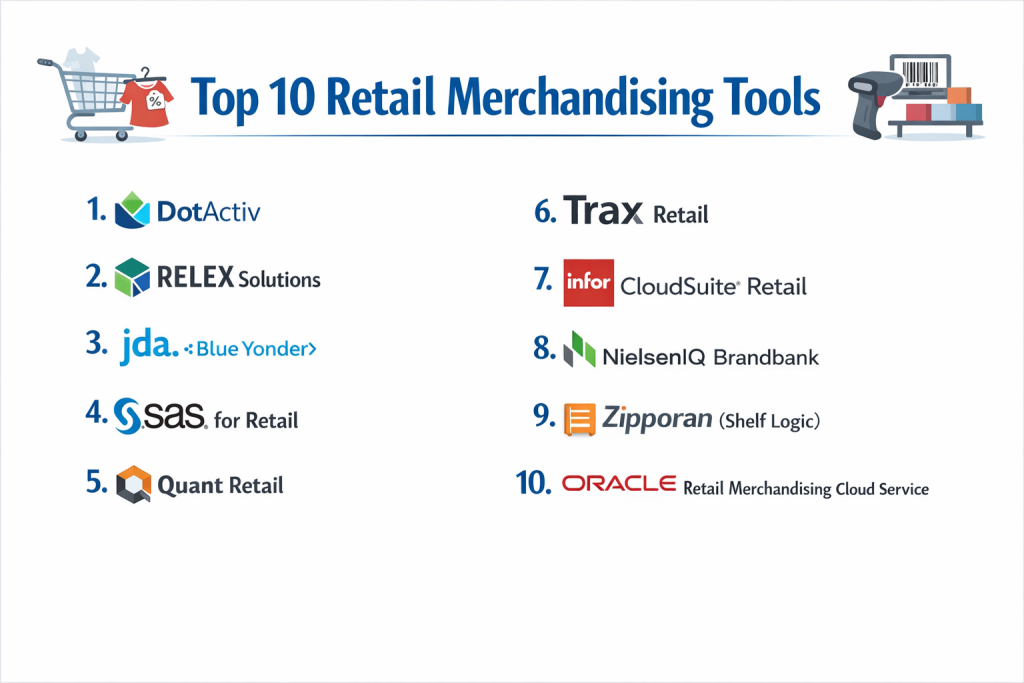
Top 10 Retail Merchandising Tools
1 — DotActiv
DotActiv is a comprehensive category management and planogramming software that provides an end-to-end solution for retailers looking to optimize their shelf space and assortment.
- Key features:
- Data-driven planogram generation based on sales and space.
- Integrated assortment planning to identify the best product mix.
- Floor planning to optimize the entire store layout.
- Clustering tools to group similar stores for localized planning.
- Category reporting and performance analytics.
- High-fidelity 3D renderings of shelf layouts.
- Pros:
- Extremely strong analytical capabilities that link sales data directly to shelf space.
- Offers a free version (DotActiv Free) for basic planogramming needs.
- Cons:
- The advanced versions have a steep learning curve for non-analysts.
- The interface can feel a bit technical and “spreadsheet-heavy.”
- Security & compliance: GDPR compliant, data encryption, and secure cloud or on-premise hosting options.
- Support & community: Extensive online academy, technical support, and professional consulting services.
2 — RELEX Solutions
RELEX is an AI-driven “Living Retail” platform that specializes in unified supply chain and merchandising planning for large-scale grocery and retail chains.
- Key features:
- AI-powered demand forecasting and automated replenishment.
- Space and planogram optimization integrated with supply chain data.
- Promotion planning and markdown optimization.
- Workforce optimization based on delivery and foot traffic patterns.
- Fresh food optimization (critical for reducing grocery waste).
- Scenario testing to predict the impact of layout changes.
- Pros:
- Unrivaled at handling the complexities of fresh food and high-frequency grocery.
- The “Unified” approach means inventory and shelf space are never planned in silos.
- Cons:
- Implementation is a major undertaking that can take several months.
- Pricing is strictly enterprise-level and can be quite high.
- Security & compliance: SOC 2 Type II, ISO 27001, GDPR, and robust SSO integrations.
- Support & community: Dedicated customer success managers, global 24/7 support, and an annual user summit.
3 — JDA (Blue Yonder)
Blue Yonder (formerly JDA) is a legacy powerhouse in the retail space, offering a massive suite of tools for category management, planogramming, and floor planning.
- Key features:
- Category Knowledge Base (CKB) for centralized data management.
- Automated planogramming at scale for thousands of stores.
- Assortment optimization based on local market demand.
- Strategic floor planning to manage customer flow.
- Space automation to reduce manual labor in layout design.
- Deep integration with warehouse and transportation management.
- Pros:
- The industry standard for massive global retailers; if you can dream it, the software can do it.
- Highly scalable and capable of managing millions of SKUs across thousands of locations.
- Cons:
- The user interface is notoriously complex and feels dated compared to newer SaaS tools.
- Requires a significant IT team or consultants to maintain and configure.
- Security & compliance: SOC 1 & 2, ISO 27001, GDPR, and HIPAA compliant.
- Support & community: Global support network, extensive certification programs, and a massive user community.
4 — SAS for Retail
SAS leverages its world-class analytics background to provide retailers with deep insights into pricing, merchandising, and customer behavior.
- Key features:
- Machine learning-based demand forecasting.
- Size profiling and pack optimization for fashion retail.
- Dynamic pricing and markdown optimization.
- Customer intelligence and personalized offer management.
- Assortment planning integrated with financial targets.
- Visual analytics for real-time performance monitoring.
- Pros:
- Best-in-class data science and predictive modeling capabilities.
- Excellent for fashion retailers dealing with “size curves” and seasonal trends.
- Cons:
- Requires “clean” data to work effectively, which can be a hurdle for some retailers.
- Can be expensive due to the high-level analytical horsepower provided.
- Security & compliance: SOC 2, ISO 27001, GDPR, and FedRAMP (for government retail).
- Support & community: SAS Global Forum, world-class technical support, and extensive training libraries.
5 — Quant Retail
Quant is a modern, cloud-based solution that excels at integrated store management, combining planograms, floor plans, and shelf label management.
- Key features:
- Unified management of floor plans and planograms in one tool.
- Automatic generation of planograms based on customizable templates.
- Photo documentation for store compliance audits.
- Shelf label management and automatic price tag generation.
- Sales analysis integrated with space utilization.
- Task management for store-level execution.
- Pros:
- Very user-friendly and modern interface that is easy for store teams to adopt.
- The integration between floor plans and shelf-level planograms is exceptionally smooth.
- Cons:
- Lacks some of the “heavy” supply chain features found in RELEX or Blue Yonder.
- Smaller integration ecosystem compared to the legacy giants.
- Security & compliance: GDPR compliant, secure cloud hosting (AWS), and regular audit logs.
- Support & community: Responsive chat and email support, video tutorials, and a detailed knowledge base.
6 — Trax Retail
Trax is a pioneer in using Computer Vision and Image Recognition to help retailers and CPG brands monitor shelf health and merchandising compliance.
- Key features:
- Shelf monitoring via mobile photos or “robot” cameras.
- Real-time “Out of Stock” (OOS) detection.
- Share of Shelf (SoS) analysis for competitive benchmarking.
- Automated planogram compliance verification.
- Dynamic merchandising for field sales teams.
- AI-driven insights on product performance and placement.
- Pros:
- Eliminates manual auditing; the AI “sees” the shelf exactly as a customer does.
- Incredible data accuracy for identifying gaps in shelf execution.
- Cons:
- Requires a high level of image quality and consistency from store staff.
- Can be an expensive “add-on” to traditional planogramming tools.
- Security & compliance: SOC 2 Type II, GDPR, and secure data processing.
- Support & community: High-touch enterprise support, global field teams, and detailed case studies.
7 — Infor CloudSuite Retail
Infor provides an enterprise-level, cloud-native suite that focuses on modernizing the merchandising and supply chain workflows for global retailers.
- Key features:
- Hierarchical assortment planning.
- Financial and merchandise planning integration.
- Attribute-based planning for high-fashion needs.
- Inventory management across all channels (Online, In-store).
- Pricing and promotion management.
- Real-time visibility into the global supply chain.
- Pros:
- The “Cloud-First” architecture makes it much easier to update than legacy on-premise tools.
- Beautiful, modern user interface that improves planner productivity.
- Cons:
- The “Suite” approach can be rigid if you only want specific merchandising features.
- Implementation requires specialized Infor consultants.
- Security & compliance: ISO 27001, SOC 2, GDPR, and HIPAA.
- Support & community: Infor Concierge portal, active user groups, and comprehensive training.
8 — NielsenIQ Brandbank
Brandbank is a critical tool for digital merchandising, focusing on the “Content” side of merchandising—ensuring product images and data are accurate across all platforms.
- Key features:
- Professional product photography and image hosting.
- GDSN (Global Data Synchronization Network) compliance.
- Digital asset management for e-commerce sites.
- Mobile-ready hero images for better small-screen shopping.
- Product data syndication to global retailers.
- Rich content management (videos, 360-degree views).
- Pros:
- Essential for ensuring that the “Digital Shelf” looks as good as the physical one.
- Simplifies the process of getting product data from manufacturers to retailers.
- Cons:
- Does not handle physical planogramming or space optimization.
- Pricing is based on SKU counts and can add up for large assortments.
- Security & compliance: GDPR compliant and industry-standard data security.
- Support & community: Global account management and technical integration support.
9 — Zipporan (Shelf Logic)
Shelf Logic is a dedicated, specialized tool for planogramming that is highly popular among smaller retailers and distributors who need a focused, easy-to-use solution.
- Key features:
- Rapid 2D and 3D planogram creation.
- Drag-and-drop interface for shelf design.
- Automatic product spacing and orientation.
- Reporting on shelf profit and space utilization.
- Integration with existing product image libraries.
- Simplified “Master Product” list management.
- Pros:
- One of the easiest tools to learn; you can be productive in hours, not weeks.
- Extremely affordable compared to enterprise-grade ALM or ERP suites.
- Cons:
- Lacks the advanced AI forecasting and supply chain integration of larger tools.
- The interface looks a bit like Windows 95, focusing on function over form.
- Security & compliance: Varies / N/A (mostly local desktop installation).
- Support & community: Direct phone support and a library of training videos.
10 — Oracle Retail Merchandising Cloud Service
Oracle’s retail suite is a comprehensive, enterprise-level platform that manages everything from purchasing and inventory to pricing and sales audit.
- Key features:
- Unified inventory management across the enterprise.
- Sophisticated pricing, promotion, and deal management.
- Automated purchase order generation.
- Sales audit to ensure transaction data integrity.
- Financial integration with Oracle ERP.
- Advanced analytics for category performance.
- Pros:
- Unbeatable for data integrity and “One version of the truth” in large organizations.
- Highly secure and compliant with global financial and data laws.
- Cons:
- Extremely high total cost of ownership (TCO).
- Implementation is notoriously slow and requires significant resources.
- Security & compliance: SOC 2, ISO 27001, GDPR, HIPAA, and FedRAMP.
- Support & community: Oracle MySupport, global consulting network, and massive annual “Oracle CloudWorld” event.
Comparison Table
| Tool Name | Best For | Platform(s) Supported | Standout Feature | Rating |
| DotActiv | Category Analysts | Windows | Space vs. Sales Analytics | 4.6 / 5 |
| RELEX | Grocery / High Volume | Web / Cloud | AI Fresh Food Optimization | 4.8 / 5 |
| Blue Yonder | Global Enterprises | Web / Windows | Space Automation at Scale | 4.3 / 5 |
| SAS for Retail | Fashion / Pricing | Web / Cloud | Size Curve Prediction | 4.5 / 5 |
| Quant Retail | Integrated Layouts | Web / Cloud | Floor + Planogram Sync | 4.7 / 5 |
| Trax Retail | Shelf Compliance | Mobile / Cloud | Image Recognition AI | 4.6 / 5 |
| Infor Retail | Modern Planners | Web / Cloud | Attribute-Based Planning | 4.4 / 5 |
| Brandbank | E-commerce Content | Web / Cloud | Digital Asset Syndication | 4.2 / 5 |
| Shelf Logic | Small Biz / Distrib. | Windows | Extreme Ease of Use | 4.1 / 5 |
| Oracle Retail | Financial Integrity | Web / Cloud | Comprehensive Sales Audit | 4.2 / 5 |
Evaluation & Scoring of Retail Merchandising Tools
| Criteria | Weight | Evaluation Rationale |
| Core Features | 25% | Planogramming quality, assortment planning, and forecasting depth. |
| Ease of Use | 15% | Intuitiveness for planners and accessibility for store staff. |
| Integrations | 15% | Ability to “talk” to existing ERP, POS, and e-com stacks. |
| Security & Compliance | 10% | Data privacy certifications and SSO capabilities. |
| Performance | 10% | Handling of high SKU counts and real-time data processing. |
| Support & Community | 10% | Training resources, documentation, and user help networks. |
| Price / Value | 15% | Scalability of the pricing model relative to traffic/SKUs. |
Which Retail Merchandising Tool Is Right for You?
Small to Mid-Market vs. Enterprise
For small retailers or distributors, the priority is usually speed and affordability. Shelf Logic or DotActiv Free allow you to create professional planograms without a massive investment. Mid-market retailers who need to sync their store floor with their shelves will find Quant Retail to be the sweet spot of features and usability. Enterprises (multi-billion dollar chains) require the heavy-duty data governance of Blue Yonder, Oracle, or RELEX, as they must manage complex supply chains alongside their merchandising.
Budget and Value
If you are strictly budget-conscious, look for tools that offer local installations or tiered SaaS pricing. DotActiv and Quant provide excellent value for their price. If you have a premium budget, the value shifted from “feature count” to “automation.” RELEX and Trax are expensive, but they pay for themselves by reducing manual labor and eliminating costly out-of-stock situations through AI.
Technical Depth vs. Simplicity
If your team consists of Data Scientists and Category Analysts, you want the technical depth of SAS or DotActiv Enterprise. They allow for granular manipulation of shelf data. If your team is mostly Store Managers and Field Reps, you need the simplicity of Quant or Trax, where the focus is on visual execution and simple mobile tasks.
Security and Compliance Requirements
Retailers dealing with international data or publicly traded companies must prioritize SOC 2 and GDPR. Oracle and Blue Yonder have the most rigorous security frameworks. If you are a European retailer, RELEX and Quant are built with GDPR at their core. For those who need to keep data local for security reasons, Shelf Logic and DotActiv (on-premise) are the best choices.
Frequently Asked Questions (FAQs)
What is a planogram?
It is a visual diagram that provides a detailed map of where every product in a retail store should be placed on a shelf to maximize sales and efficiency.
Does merchandising software integrate with my POS?
Most modern tools (like Quant, DotActiv, and RELEX) have APIs that allow them to pull real-time sales data from your POS to inform space decisions.
What is “Category Management”?
It is a retail concept where a range of products purchased by a business is broken down into discrete groups of similar or related products (e.g., “Salty Snacks” or “Oral Care”).
Can these tools help with my online store?
Yes. Tools like Brandbank manage digital assets for e-commerce, while others like Infor manage unified inventory for both physical and online channels.
What is “Share of Shelf”?
It is a metric (often tracked by Trax) that measures what percentage of the total shelf space is occupied by your brand versus your competitors.
How long does it take to create a planogram?
In a manual tool, it can take hours. With automation features in Blue Yonder or DotActiv, you can generate hundreds of planograms for different store sizes in minutes.
Do I need special hardware?
Most planogram tools run on standard PCs or via the web. However, image recognition tools like Trax may require high-quality mobile phones or specific shelf-mounted cameras.
What is “markdown optimization”?
It is the use of algorithms (found in SAS or RELEX) to determine the exact date and percentage of a discount to clear inventory while maximizing remaining profit.
Can I manage floor plans as well?
Some tools, like Quant and Blue Yonder, offer integrated floor planning. Others are strictly focused on the shelf level (planogram-only).
What is a “hero image”?
A hero image is a digitally enhanced product photo (often managed via Brandbank) designed to make the product clearly identifiable on small mobile screens.
Conclusion
The “best” retail merchandising tool isn’t necessarily the one with the most buttons—it’s the one that your team will actually use to improve the shelf experience. Retail is a game of margins, and even a 2% improvement in shelf availability or a 5% reduction in waste can translate into millions of dollars for a large chain.
If you are just starting your category management journey, DotActiv or Shelf Logic offer a low-barrier entry. If you are a massive grocer battling waste and complex demand, RELEX is the modern gold standard. For those who want to bridge the gap between digital content and physical shelves, a combination of Brandbank and Quant can be incredibly effective. Ultimately, merchandising is both an art and a science; these tools provide the science so that your team can focus on the art of selling.