Introduction
Retail Category Management Tools are sophisticated software solutions that empower retailers to manage product categories as strategic business units. Unlike basic inventory tracking, category management delves deep into understanding consumer behavior within specific product groupings (e.g., “salty snacks,” “oral care,” or “men’s casual wear”). These tools provide the analytical horsepower to define categories, assess their performance, develop optimal strategies, and implement assortment, pricing, promotion, and merchandising decisions. By adopting a “category captain” approach, retailers can optimize shelf space, negotiate better terms with suppliers, and ultimately drive higher sales and profitability.
The importance of category management tools lies in their ability to translate raw sales data into actionable strategies. In a world of infinite choices, these tools help retailers curate the perfect selection. Key real-world use cases include a supermarket chain analyzing basket data to place related items next to each other (e.g., chips next to salsa), a drug store optimizing its cold and flu aisle based on seasonal demand spikes, and an electronics retailer identifying underperforming brands within a category to replace them with higher-margin alternatives. When evaluating these platforms, users should look for advanced analytics, integrated planogramming, supplier collaboration features, and robust forecasting capabilities to stay ahead of market trends.
Key Real-World Use Cases
- Optimal Assortment Planning: A category manager uses the tool to analyze sales data across all stores, identifying that a particular brand of organic yogurt is underperforming in urban locations but excelling in suburban stores, leading to a localized assortment change.
- Supplier Collaboration: The tool provides a shared platform for a retailer and a beverage supplier to co-create promotional plans and track their effectiveness, ensuring both parties benefit from optimal product placement and pricing.
- Price Optimization: During a holiday season, the system dynamically adjusts the price of a popular toy category, increasing it slightly when demand is high and lowering it to clear inventory before the next season.
- Space Management Integration: The category manager uses data from the tool to instruct the merchandising team on how much linear shelf space to allocate to “premium coffee” versus “budget coffee,” maximizing profit per square foot.
- New Product Introduction (NPI): Before launching a new brand of health supplements, the tool helps the category manager analyze market trends and competitor performance to determine the optimal shelf placement and pricing strategy.
What to Look For (Evaluation Criteria)
- Advanced Analytics & Reporting: The ability to dissect sales, margin, and velocity data at a granular level, generating insights into category performance and consumer behavior.
- Assortment & Space Optimization: Features for creating optimal product mixes and integrating with planogramming tools to visualize shelf layouts and allocate space effectively.
- Pricing & Promotion Management: Tools to analyze price elasticity, conduct promotional planning, and execute dynamic pricing strategies across categories.
- Supplier Collaboration Features: Secure portals or workflows that allow retailers to share data and collaborate with vendors on category strategies, improving trade terms.
- Forecasting & Demand Planning: Predictive analytics to anticipate future sales, manage inventory levels, and reduce out-of-stocks or overstock situations.
Best for: Category Managers, Buyers, Merchandising Teams, Retail Planners, and Senior Retail Executives in grocery, mass merchandise, specialty retail, fashion, and consumer packaged goods (CPG) industries. It is particularly crucial for multi-location retailers with diverse product categories.
Not ideal for: Single-location independent retailers, service-only businesses (e.g., salons, repair shops), or very small e-commerce stores with limited SKUs. For these, a robust POS system with good inventory management or basic analytics might suffice.
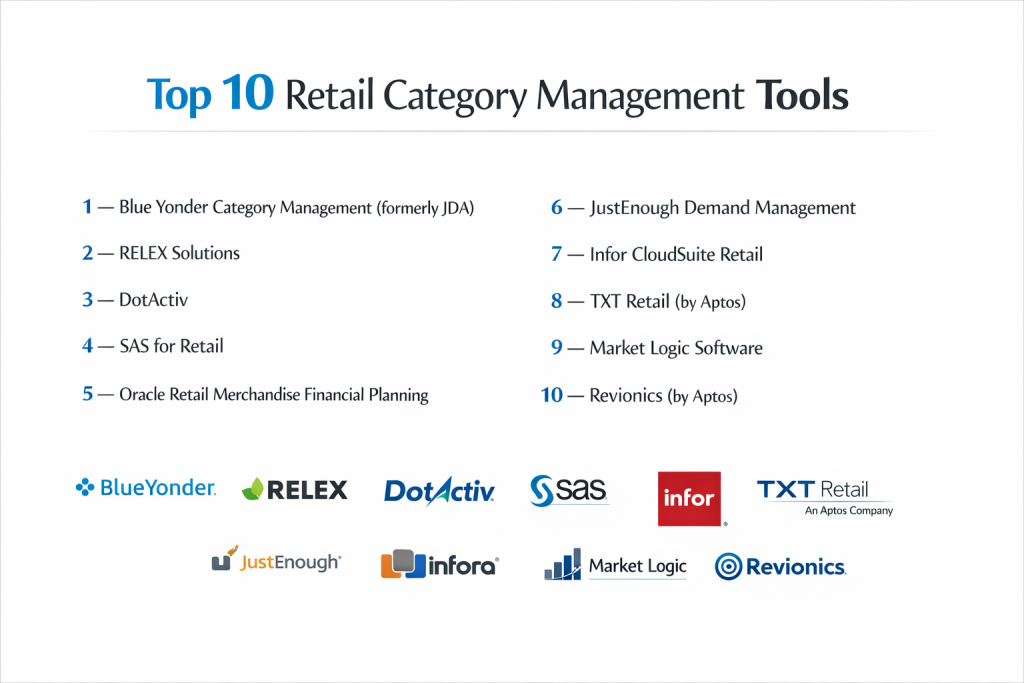
Top 10 Retail Category Management Tools
1 — Blue Yonder Category Management (formerly JDA)
Blue Yonder is an industry titan, offering a comprehensive suite that allows retailers to automate and optimize every aspect of category management, from assortment to space and pricing.
- Key features:
- Category Knowledge Base (CKB) for centralized product, customer, and market data.
- Automated assortment optimization driven by consumer demand and market trends.
- Advanced planogramming and space automation tools.
- Localized merchandising strategies via store clustering.
- Price optimization and promotion planning.
- Supplier collaboration portal for joint business planning.
- Pros:
- The most robust and scalable solution for large, global retail enterprises.
- Deep integration across supply chain, merchandising, and workforce management.
- Cons:
- High cost of ownership and requires significant IT resources for implementation and maintenance.
- The user interface can be complex and feel dated compared to newer SaaS solutions.
- Security & compliance: SOC 1 & 2, ISO 27001, GDPR, and HIPAA compliant.
- Support & community: Extensive global support network, partner ecosystem, and large user community.
2 — RELEX Solutions
RELEX provides a unified “Living Retail Platform” with strong category management capabilities, emphasizing AI-driven forecasting and intelligent automation across the supply chain.
- Key features:
- AI-powered demand forecasting and automated replenishment.
- Integrated space, assortment, and planogram optimization.
- Promotion and markdown management with profitability analysis.
- Fresh food optimization capabilities to minimize waste.
- Unified view of inventory across all channels (stores, DCs, online).
- Advanced analytics and reporting for category performance.
- Pros:
- Excellent for reducing waste and optimizing freshness, particularly in grocery retail.
- The AI capabilities are very advanced, leading to highly accurate forecasts.
- Cons:
- Implementation can be complex and lengthy due to the unified nature of the platform.
- Primarily targets large retail and grocery chains, with corresponding pricing.
- Security & compliance: SOC 2 Type II, ISO 27001, GDPR, and robust SSO integrations.
- Support & community: Dedicated customer success teams, 24/7 global support, and regular user events.
3 — DotActiv
DotActiv offers a complete category management solution, from space planning and planogramming to assortment optimization and category analytics, making it a strong contender for various retail sizes.
- Key features:
- Data-driven planogram generation and optimization.
- Integrated assortment planning to define optimal product mixes.
- Store clustering and localization for tailored strategies.
- Detailed category performance reporting and insights.
- Floor planning functionality to optimize store layouts.
- User-friendly interface for visual merchandising tasks.
- Pros:
- Offers a free version for basic planogramming, making it accessible for smaller teams.
- Strong analytical depth for linking sales data to shelf space efficiency.
- Cons:
- The full suite can have a learning curve, especially for new users.
- Some advanced features require a higher-tier subscription.
- Security & compliance: GDPR compliant, data encryption, and flexible hosting options (cloud/on-premise).
- Support & community: Extensive online learning resources (DotActiv Academy), technical support, and consulting services.
4 — SAS for Retail
SAS leverages its renowned analytics engine to provide powerful category management and optimization capabilities, focusing on data-driven decision-making for complex retail environments.
- Key features:
- Advanced AI and machine learning for demand forecasting and optimization.
- Merchandise assortment planning with deep customer segmentation.
- Dynamic pricing and promotion optimization for specific categories.
- Size profiling and pack optimization, especially for fashion and apparel.
- Customer intelligence and personalized offer management.
- Robust reporting and visual analytics dashboards.
- Pros:
- Unparalleled analytical power for complex data sets and predictive modeling.
- Excellent for retailers who need to deeply understand customer behavior and price elasticity.
- Cons:
- Requires a strong data infrastructure and skilled analysts to leverage its full potential.
- Higher cost associated with its advanced analytical capabilities.
- Security & compliance: SOC 2, ISO 27001, GDPR, and FedRAMP certification.
- Support & community: World-class technical support, extensive training programs, and a large global user community.
5 — Oracle Retail Merchandise Financial Planning
Oracle’s comprehensive suite includes robust tools for merchandise financial planning, linking strategic goals with tactical assortment and inventory decisions at a category level.
- Key features:
- Top-down and bottom-up financial planning at category and sub-category levels.
- Demand-driven merchandise planning and optimization.
- Integrated open-to-buy management.
- What-if scenario analysis for planning adjustments.
- Real-time visibility into inventory, sales, and profit.
- Seamless integration with other Oracle Retail modules (e.g., pricing, inventory).
- Pros:
- Exceptional for large enterprises that need to align financial targets with merchandising plans.
- Provides a single source of truth for all retail financial data.
- Cons:
- High total cost of ownership and lengthy implementation cycles.
- Can be overly complex for small to mid-sized retailers.
- Security & compliance: SOC 2, ISO 27001, GDPR, HIPAA, and FedRAMP.
- Support & community: Oracle MySupport, extensive consulting network, and large user conferences.
6 — JustEnough Demand Management
JustEnough (now part of Mi9 Retail) specializes in demand forecasting and inventory optimization, which are critical components of effective category management.
- Key features:
- Advanced demand forecasting algorithms (including seasonality, trends, promotions).
- Automated inventory planning and replenishment optimization.
- Assortment planning and optimization based on sales velocity.
- Pricing and markdown optimization capabilities.
- Supplier collaboration for accurate lead times and order fulfillment.
- Exception-based management to highlight critical issues.
- Pros:
- Very strong in reducing inventory holding costs and improving stock availability.
- Provides excellent accuracy in demand prediction, even with complex variables.
- Cons:
- Primarily focused on demand and inventory; less emphasis on visual planogramming.
- Integration with non-Mi9 Retail systems might require custom development.
- Security & compliance: SOC 2, GDPR, and cloud security best practices.
- Support & community: Dedicated account management and responsive technical support.
7 — Infor CloudSuite Retail
Infor offers a cloud-native, end-to-end retail platform that includes strong category management capabilities designed for modern, agile retailers.
- Key features:
- Hierarchical merchandise planning and assortment optimization.
- Attribute-based planning for fashion and complex product lines.
- Integrated pricing, promotion, and markdown management.
- Unified inventory visibility across all channels.
- Advanced analytics and reporting for category performance.
- Modern, intuitive user interface for planners.
- Pros:
- Cloud-first architecture provides flexibility and easier updates compared to legacy systems.
- Excellent for fashion retailers needing to manage product attributes effectively.
- Cons:
- Requires investment in the broader Infor suite to maximize value.
- Implementation can still be significant for large enterprises.
- Security & compliance: ISO 27001, SOC 2, GDPR, and HIPAA.
- Support & community: Infor Concierge, active user groups, and comprehensive training.
8 — TXT Retail (by Aptos)
TXT Retail, now part of Aptos, provides a modular platform for merchandise lifecycle management, with robust capabilities for planning, assortment, and allocation.
- Key features:
- Integrated merchandise planning and budgeting.
- Open-to-buy management and control.
- Assortment and collection planning with visual tools.
- Intelligent allocation and replenishment.
- Pricing and promotion optimization.
- User-friendly interface for planners and buyers.
- Pros:
- Highly modular, allowing retailers to implement only the components they need.
- Strong focus on supporting fashion and apparel planning processes.
- Cons:
- Can be expensive when multiple modules are combined.
- Integration with non-Aptos platforms might require custom APIs.
- Security & compliance: SOC 2, GDPR, and cloud security best practices.
- Support & community: Dedicated client support and a global partner network.
9 — Market Logic Software
Market Logic is a marketing intelligence platform that supports category management by centralizing consumer insights, competitive intelligence, and market research.
- Key features:
- Centralized repository for all market research and insights.
- AI-powered search to quickly find relevant consumer data.
- Competitive intelligence tracking and analysis.
- Trend spotting and market forecasting.
- Shared workspaces for collaboration between category managers and marketing teams.
- Integration with various data sources (POS, panels, social media).
- Pros:
- Excellent for ensuring category strategies are truly consumer-centric and data-backed.
- Helps avoid “gut-feeling” decisions by providing instant access to validated insights.
- Cons:
- Not a traditional planning or planogramming tool; it’s an insights platform.
- Requires integration with other merchandising tools for execution.
- Security & compliance: ISO 27001, GDPR, and robust data privacy features.
- Support & community: Dedicated client support and a knowledge center.
10 — Revionics (by Aptos)
Revionics is a specialized price optimization and lifecycle pricing solution that is crucial for category managers looking to maximize profitability through strategic pricing.
- Key features:
- AI-powered base price optimization.
- Markdown optimization to clear inventory efficiently.
- Promotional planning and optimization.
- Competitive price monitoring and response.
- Pricing analytics and dashboards.
- Integration with various POS and ERP systems.
- Pros:
- World-class pricing algorithms that deliver measurable ROI.
- Helps category managers avoid “leaving money on the table” or damaging brand perception.
- Cons:
- Highly specialized; does not cover assortment, space, or inventory planning directly.
- Requires high-quality sales data to feed its algorithms effectively.
- Security & compliance: SOC 2, GDPR, and cloud security best practices.
- Support & community: Dedicated data scientists and pricing experts for client support.
Comparison Table
| Tool Name | Best For | Platform(s) Supported | Standout Feature | Rating |
| Blue Yonder | Global Enterprises | Web / Windows | Comprehensive CKB | 4.3 / 5 |
| RELEX Solutions | Grocery / Unified Planning | Web / Cloud | AI Fresh Food Optimization | 4.8 / 5 |
| DotActiv | Data-Driven Planograms | Windows / Web | Free Planogram Creator | 4.6 / 5 |
| SAS for Retail | Advanced Analytics | Web / Cloud | AI-Driven Demand Modeling | 4.5 / 5 |
| Oracle Retail MFP | Financial Integration | Web / Cloud | Top-down Financial Planning | 4.2 / 5 |
| JustEnough | Demand & Inventory | Web / Cloud | Accurate Demand Forecasting | 4.4 / 5 |
| Infor Retail | Modern Retail Chains | Web / Cloud | Attribute-Based Planning | 4.4 / 5 |
| TXT Retail (Aptos) | Fashion & Apparel | Web / Cloud | Modular Planning Suite | 4.3 / 5 |
| Market Logic SW | Consumer Insights | Web / Cloud | Centralized Market Research | 4.1 / 5 |
| Revionics (Aptos) | Price Optimization | Web / Cloud | AI-Powered Dynamic Pricing | 4.7 / 5 |
Evaluation & Scoring of Retail Category Management Tools
| Criteria | Weight | Evaluation Rationale |
| Core Features | 25% | Assortment, space, pricing, promotion, and forecasting capabilities. |
| Ease of Use | 15% | Intuitiveness for category managers and integration with daily workflow. |
| Integrations | 15% | Connectivity with POS, ERP, PIM, and external data sources. |
| Security & Compliance | 10% | Data privacy, SSO, and industry-specific certifications. |
| Performance | 10% | Speed and scalability when handling large data volumes and complex calculations. |
| Support & Community | 10% | Quality of documentation, training, and customer service. |
| Price / Value | 15% | ROI potential from optimized categories vs. subscription/implementation costs. |
Which Retail Category Management Tool Is Right for You?
Small to Mid-Market vs. Enterprise
For SMBs and smaller chains, DotActiv offers a fantastic entry point with strong analytical capabilities without the overwhelming complexity of enterprise suites. Mid-market retailers seeking robust demand planning may find JustEnough to be a great fit. Enterprises with global operations and complex supply chains will need the full power of Blue Yonder, RELEX Solutions, or Oracle Retail, which are designed for massive scale and deep integration.
Budget-conscious vs Premium Solutions
If you are budget-conscious, DotActiv’s tiered pricing (including a free version for planogramming) offers excellent value. However, the true ROI in category management comes from premium solutions like RELEX Solutions or SAS for Retail, where the advanced AI and forecasting capabilities can yield significant increases in sales and reductions in waste that far outweigh the software cost.
Feature Depth vs Ease of Use
If ease of use is paramount, especially for less technical teams, DotActiv strikes a good balance between powerful features and an accessible interface. If feature depth is your primary concern, particularly for intricate demand modeling, financial planning, or specific pricing strategies, then SAS for Retail, Oracle Retail, or Revionics will provide the necessary granular control and analytical power.
Integration and Scalability Needs
For seamless integration with existing ERP systems, Oracle Retail (if you’re already on Oracle) and Blue Yonder offer some of the most comprehensive connectors. For scalability across hundreds or thousands of stores, RELEX Solutions and Blue Yonder are purpose-built to handle massive data volumes and complex global operations.
Security and Compliance Requirements
Given the sensitive nature of sales and customer data, SOC 2 and GDPR compliance are standard for most cloud-based tools. For the highest levels of security and regulatory compliance (e.g., in pharmaceutical retail or government contracts), Blue Yonder, SAS for Retail, and Oracle Retail provide the most extensive certifications and audit capabilities.
Frequently Asked Questions (FAQs)
What is category management in retail?
It’s a strategy where a retailer manages groups of products (categories) as individual business units, optimizing assortment, pricing, promotion, and merchandising to maximize sales and profit.
How does it differ from traditional buying?
Traditional buying focuses on individual products. Category management takes a holistic view of the entire category, considering consumer behavior and market trends.
What is a “category captain”?
It is a vendor appointed by a retailer to help manage an entire product category. Category management tools often facilitate collaboration between the retailer and the captain.
Can these tools help with fresh food?
Yes, RELEX Solutions is particularly strong in fresh food optimization, helping retailers reduce waste and improve availability for highly perishable items.
What is “assortment optimization”?
It’s the process of determining the optimal mix of products within a category to meet consumer demand and achieve financial goals, often leveraging sales data and market trends.
Do these tools integrate with planogram software?
Yes, many (like DotActiv and Blue Yonder) have integrated planogramming capabilities, or they offer seamless integrations with dedicated planogram tools.
What is “price elasticity”?
It is a measure of how sensitive customer demand is to changes in price. Category management tools use this to inform optimal pricing strategies.
How do these tools handle promotions?
They allow retailers to plan, execute, and analyze the effectiveness of promotions at a category level, helping to optimize timing, discounts, and product bundles.
Are these tools suitable for e-commerce?
While many focus on brick-and-mortar, their data and planning capabilities are critical for e-commerce assortment and pricing. Tools like Market Logic also help integrate digital insights.
What kind of data do I need to feed these tools?
You’ll typically need POS sales data, inventory levels, customer loyalty data, market research, competitive pricing, and supplier information.
Conclusion
Effective category management is no longer a luxury but a necessity for retailers aiming to thrive in a competitive and rapidly evolving market. The shift from managing individual items to strategically managing entire categories requires robust data, advanced analytics, and seamless collaboration.
Whether you’re a burgeoning mid-market chain seeking intelligent assortment, or a global enterprise demanding unparalleled supply chain and merchandising integration, there’s a tool tailored to your needs. RELEX Solutions stands out for its cutting-edge AI in demand forecasting, while Blue Yonder continues to serve as the scalable backbone for the world’s largest retailers. By investing in the right category management tool, you’re not just buying software; you’re investing in a more profitable, data-driven future for your retail business.