Introduction
Reinsurance Management Tools are specialized software systems designed to handle the unique and complex processes of reinsurance. Reinsurance is essentially “insurance for insurance companies.” When an insurer takes on a large risk, they often transfer part of it to a reinsurer to protect their own financial stability. This software manages the entire lifecycle of these contracts, from treaty negotiation and placement to accounting, claims recovery, and reporting. Think of it as the mission control for managing the critical, behind-the-scenes relationships and financial flows that keep the global insurance market stable.
This software is critically important because reinsurance deals are high-value, contractually complex, and span multiple years. Manual management with spreadsheets is error-prone, slow, and lacks transparency. These tools bring precision, automation, and clarity to a process that directly impacts an insurer’s solvency and a reinsurer’s profitability. Real-world use includes a property insurer calculating how much of a hurricane loss to cede to its reinsurers, a life reinsurer managing thousands of treaty portfolios, or a broker placing a complex $500 million excess-of-loss treaty for a client.
When choosing a tool, you should look for: treaty and facultative contract administration, premium and loss cession calculations, automated bordereaux processing (detailed reports of ceded business), cash and accounting management, robust reporting for regulatory compliance (like Solvency II), and secure document and communication portals for brokers and counterparties.
Best for: This software is essential for Reinsurance Managers, Ceded Re Analysts, Treaty Underwriters, Reinsurance Accountants, and Reinsurance Brokers. It benefits insurance companies (cedents), reinsurance companies, Lloyd’s syndicates, and reinsurance intermediary firms. Any entity that buys, sells, or brokers reinsurance protection needs a dedicated management system.
Not ideal for: A very small insurance agency or a standard consumer-facing insurer that does not purchase reinsurance directly (relying instead on their carrier’s program) would not need this. Similarly, a company outside the insurance industry would have no use for it. It is a highly specialized tool for a niche but massive financial market.
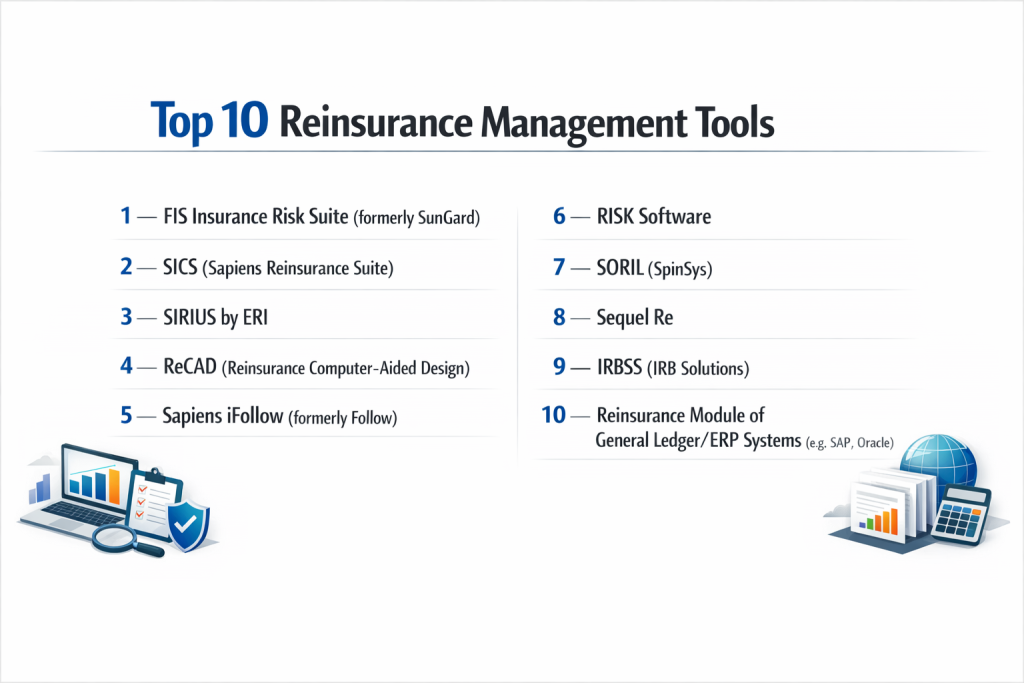
Top 10 Reinsurance Management Tools
1 — FIS Insurance Risk Suite (formerly SunGard)
FIS Insurance Risk Suite is a comprehensive, enterprise-level platform for reinsurance and risk finance. It’s a heavyweight system used by many of the world’s largest insurers and reinsurers for complex global programs.
Key features:
- End-to-End Reinsurance Administration: Manages the full lifecycle for treaty, facultative, and retrocession contracts.
- Advanced Financial Accounting: Handles complex multi-currency premium, loss, and commission calculations and settlements.
- Bordereaux & Data Exchange: Automated processing of ceded business reports from cedents or to reinsurers.
- Claims Recovery & Collection: Tracks outstanding recoverables and facilitates the collection process.
- Regulatory & Management Reporting: Robust tools for Solvency II, US GAAP, IFRS 17, and internal performance dashboards.
- Reinsurance Contract Wordings Repository: Central storage and clause library for contract management.
Pros:
- Unmatched depth and scalability for large, multinational reinsurance operations.
- Handles the most complex contract structures and financial transactions with precision.
- A trusted, proven system in the market for decades.
Cons:
- Extremely expensive with long, resource-intensive implementation cycles.
- Can be perceived as less modern and agile than newer cloud-native platforms.
- Requires significant internal expertise or costly consulting support to maintain.
Security & compliance: Enterprise-grade security, data encryption, and compliance with global financial and insurance regulations.
Support & community: Supported by FIS’s global professional services and support organization, with a large existing client base.
2 — SICS (Sapiens Reinsurance Suite)
Sapiens Reinsurance Suite (often referred to by its core component, SICS) is a leading, modern platform known for its comprehensive functionality and strong focus on the reinsurance value chain.
Key features:
- Unified Platform for Cedents & Reinsurers: Offers specific modules for both sides of a reinsurance transaction.
- Proactive Cash Management: Forecasts and manages cash flows, reducing Days Sales Outstanding (DSO) for recoverables.
- Integrated Document Management: Links contracts, endorsements, and communications directly to financial transactions.
- Portfolio Analysis & Exposure Management: Tools to analyze accumulated risk across treaties and zones.
- Straight-Through Processing (STP): Automates routine transactions like premium bookings and loss recoveries.
- Cloud-Native Option: Available as a modern SaaS deployment for increased agility.
Pros:
- A strong, all-in-one suite that covers the needs of both insurers and reinsurers effectively.
- Good balance of power and a more modern architecture than some legacy systems.
- Strong reputation and market share in the global reinsurance software space.
Cons:
- As a comprehensive system, it can be complex to configure and implement fully.
- The cost can be significant, though often less than the largest legacy alternatives.
- May have a steeper learning curve than simpler, more focused tools.
Security & compliance: High security standards with compliance features for Solvency II, IFRS 17, and other regulations.
Support & community: Backed by Sapiens’ global insurance software services and support network.
3 — SIRIUS by ERI
SIRIUS by ERI is a robust, actuarial-focused software suite widely used in life and non-life insurance. Its reinsurance module is tightly integrated with its financial modeling and valuation engines, making it powerful for risk and capital management.
Key features:
- Deep Actuarial Integration: Reinsurance calculations are directly tied to asset-liability management (ALM) and economic capital models.
- IFRS 17 & Solvency II Ready: Built to handle the complex data and calculation requirements of modern accounting and regulatory standards.
- Treaty Simulation & Optimization: Models the impact of different reinsurance structures on financial statements and capital requirements.
- Cash Flow Projection: Projects future reinsurance premiums, losses, and commissions under various scenarios.
- Data Management Hub: Centralizes data from policy admin systems for clean reinsurance processing.
Pros:
- Ideal for companies where reinsurance strategy is deeply connected to actuarial modeling and capital management.
- Exceptionally strong for life reinsurance and for meeting IFRS 17 reporting demands.
- Provides a single source of truth for financial, actuarial, and reinsurance data.
Cons:
- Its actuarial strength means it may be less optimized for the pure operational processing of high-volume P&C treaties.
- Can be complex and require specialized actuarial and technical skills to utilize fully.
- The broader suite focus may include more than a pure reinsurance operations team needs.
Security & compliance: Enterprise-level security with a focus on data integrity for financial and regulatory reporting.
Support & community: Supported by ERI’s actuarial and technical experts, with a strong user community in the life insurance and actuarial fields.
4 — ReCAD (Reinsurance Computer-Aided Design)
ReCAD is a specialized, Windows-based reinsurance administration system known for its flexibility and detailed contract modeling capabilities. It’s popular with reinsurers, MGAs, and companies with unique or complex treaty structures.
Key features:
- Highly Flexible Contract Modeling: Can model virtually any reinsurance structure, including complex layered and swing-rated contracts.
- Detailed Transaction Processing: Manages premiums, losses, commissions, and adjustments at a granular level.
- Bordereaux Management: Tools for creating, receiving, and validating bordereaux data.
- Reinsurance Accounting: General ledger integration and specialized reinsurance financial reporting.
- Retrocession Management: Handles the reinsurance of reinsurance seamlessly.
- Client-Server Architecture: Can be deployed on-premise for specific control needs.
Pros:
- Unparalleled flexibility for modeling non-standard and bespoke reinsurance contracts.
- Deep, granular control over the financial and operational details of each treaty.
- A long-standing, trusted tool in the reinsurance market, especially in London and Bermuda.
Cons:
- The interface is functional but not modern or web-based, which can impact user experience.
- Being on-premise/Windows-based may not align with all companies’ cloud-first IT strategies.
- Requires knowledgeable configuration to leverage its full power.
Security & compliance: Security is managed through the client’s own IT infrastructure. Compliance features are built into the financial reporting.
Support & community: Has a dedicated, knowledgeable support team and a loyal user base of reinsurance experts.
5 — Sapiens iFollow (formerly Follow)
Sapiens iFollow is a modern, data-driven reinsurance platform focused on automation, analytics, and user experience. It aims to transform reinsurance operations from manual to digital.
Key features:
- Data-Powered Automation: Uses AI and rules to automate bordereaux validation, cash matching, and recovery tracking.
- Interactive Dashboard & Workflow: Modern, visual interface that guides users through tasks and shows process status.
- Broker & Counterparty Portal: Secure portal for document exchange, data submission, and communication.
- Predictive Analytics: Identifies potential disputes or delays in recoveries before they happen.
- Cloud-Native SaaS Platform: Offers quick deployment, scalability, and reduced IT overhead.
- API-First Architecture: Easy to connect with upstream policy admin systems and downstream general ledgers.
Pros:
- Focuses on reducing manual work and inefficiency in reinsurance operations.
- Excellent, modern user experience that can improve adoption and productivity.
- Faster and potentially lower-cost implementation than monolithic legacy systems.
Cons:
- As a newer, more agile platform, it may not yet have the extreme depth of some 30-year-old systems for every edge case.
- Its value is maximized when there is clean data flowing from core systems.
- May be seen as more of an operational efficiency tool than a financial modeling engine.
Security & compliance: Cloud security with SOC 2 compliance and adherence to data privacy standards (GDPR).
Support & community: Customer-success oriented support model focused on achieving operational improvements.
6 — RISK Software
RISK Software provides a suite of reinsurance and risk management solutions. Its platform is known for being configurable and scalable, serving a range from midsize insurers to large reinsurers.
Key features:
- Modular Suite: Offers separate but integrated modules for treaty administration, facultative oversight, claims recovery, and accounting.
- Bordereaux Workbench: A dedicated environment for managing the complexities of bordereaux processing.
- Comprehensive Reporting Engine: Creates ad-hoc and standard reports for internal and external stakeholders.
- Workflow & Task Management: Orchestrates the reinsurance process across departments.
- Secure Document Repository: Centralizes all contracts, statements, and correspondence.
- Web-Based Platform: Accessible from anywhere, facilitating better collaboration.
Pros:
- Good balance of comprehensive features and a more modern, web-based architecture.
- The modular approach allows companies to start with what they need and expand.
- Scalable to grow with an organization’s reinsurance program.
Cons:
- May not have the same market dominance or name recognition as the very largest players.
- Implementation and configuration still require a significant project commitment.
- Some users may find certain modules more developed than others.
Security & compliance: Provides enterprise-level security features and supports compliance reporting needs.
Support & community: Offers implementation services and ongoing customer support.
7 — SORIL (SpinSys)
SORIL is a comprehensive reinsurance operations platform that emphasizes real-time processing and information sharing across the reinsurance chain (cedent, broker, reinsurer).
Key features:
- Real-Time Data Exchange: Facilitates immediate sharing of premium, loss, and contract data between connected parties.
- End-to-End Workflow: Manages the process from placement and binding to claims and commutations.
- Dispute & Query Resolution: Tracks and manages disagreements over statements or recoveries within the system.
- Extensive Reinsurance Accounting: Handles all financial aspects, including multi-currency and inter-company transactions.
- Regulatory Reporting: Prepares data for Solvency II, Schedule F, and other regulatory filings.
- On-Premise or Cloud Deployment: Offers deployment flexibility.
Pros:
- Strong focus on improving transparency and collaboration between reinsurance trading partners.
- Real-time capabilities can significantly speed up the settlement cycle.
- A full-featured system that covers both operational and financial needs.
Cons:
- Its benefits are maximized when trading partners also use the system or are connected to its network.
- Can be a substantial system to implement and integrate.
- User interface may feel more traditional compared to the newest cloud-native apps.
Security & compliance: Implements robust security controls for sensitive financial data exchange.
Support & community: Supported by the vendor’s professional services team.
8 — Sequel Re
Sequel Re is a reinsurance solution built on the powerful Microsoft SQL Server and .NET platform. It is known for its strong data management, reporting capabilities, and integration potential within a Microsoft-centric IT environment.
Key features:
- Microsoft Technology Stack: Leverages SQL Server for data management, Reporting Services (SSRS) for reporting, and a .NET user interface.
- Integrated Data Warehouse: Structures reinsurance data optimally for analysis and business intelligence.
- Flexible Reporting & BI: Easy creation of custom reports and dashboards using familiar Microsoft tools.
- Treaty & Facultative Management: Administers both main types of reinsurance contracts.
- Cash & Accounting: Manages reinsurance financials and settlements.
- Web Portal for Brokers: Facilitates secure document and data exchange.
Pros:
- Excellent for companies that want deep control over their data and reporting using standard Microsoft tools.
- Potentially easier to integrate with other Microsoft-based corporate systems (ERP, CRM).
- Strong, reliable database foundation.
Cons:
- May appeal more to IT departments comfortable with the Microsoft ecosystem than to pure business users.
- The user experience may be less tailored and modern than purpose-built reinsurance UX.
- May require more internal IT development resources for customization and upkeep.
Security & compliance: Security leverages Microsoft’s enterprise security features. Compliance reporting capabilities are built-in.
Support & community: Vendor support plus the vast ecosystem of Microsoft developers and resources.
9 — IRBSS (IRB Solutions)
IRBSS is a specialized reinsurance platform with a strong focus on the London Market and Lloyd’s syndicates. It handles the unique processes and contract types common in this major reinsurance hub.
Key features:
- Lloyd’s & London Market Compliance: Built to handle Bureau, Lineage, and other market-specific processes and reporting.
- Direct & Brokerage Accounting: Manages both direct reinsurance and brokered placements.
- Slip & Endorsement Management: Digitally manages the core London Market contract documents.
- Premium & Loss Coding: Aligns with London Market standards for risk coding and allocation.
- Syndicate Portfolio Management: Tools for managing a syndicate’s book of reinsurance business.
- Claims & Recovery Processing: Streamlines the claims notification and collection process in the market context.
Pros:
- A specialist tool for the unique and complex world of the London reinsurance market.
- Can significantly improve efficiency for companies operating at Lloyd’s or placing business there.
- Addresses specific regulatory and procedural requirements of the market.
Cons:
- Highly specialized; its features may be less relevant for companies operating solely in other global markets (e.g., US domestic).
- Niche focus means a smaller pool of expertise and support compared to global giants.
- The interface and processes are deeply tied to London Market conventions.
Security & compliance: Meets the security and data handling requirements of the Lloyd’s market and other regulators.
Support & community: Support is specialized for the London Market user base.
10 — Reinsurance Module of General Ledger/ERP Systems (e.g., SAP, Oracle)
Many large insurers and reinsurers use the reinsurance modules within their massive Enterprise Resource Planning (ERP) systems, like SAP FS-RI & SAP FS-CD or Oracle Insurance Reinsurance.
Key features:
- Deep Financial Integration: Reinsurance transactions post directly to the general ledger, ensuring a single, unified financial truth.
- Enterprise Process Integration: Links reinsurance with procurement, treasury, and corporate reporting.
- High-Volume Transaction Processing: Can handle the scale of the largest global entities.
- Global Regulatory Compliance: Built-in features for international accounting standards (IFRS 17) and tax reporting.
- Part of a Mega-Suite: Avoids integration issues between reinsurance and other core corporate functions.
Pros:
- Provides unparalleled financial control and integration at the corporate level.
- Preferred by very large organizations that standardize on a single ERP for all operations.
- Supported by the vast global resources of SAP or Oracle.
Cons:
- Extremely expensive, complex, and lengthy to implement—often considered “overkill” for pure reinsurance operations.
- Can be inflexible and slow to adapt to the unique nuances of reinsurance compared to best-of-breed tools.
- Requires highly specialized and expensive ERP configuration consultants.
Security & compliance: The gold standard for enterprise security and financial compliance, but within the ERP framework.
Support & community: Supported by the global consulting armies (Accenture, Deloitte, etc.) and the vendor’s own massive support organization.
Comparison Table
| Tool Name | Best For (target user or scenario) | Platform(s) Supported | Standout Feature | Rating |
|---|---|---|---|---|
| FIS Insurance Risk Suite | Very large global insurers/reinsurers needing maximum depth and control. | On-premise, Cloud | Enterprise Scale & Comprehensive Financials | High (Enterprise Leader) |
| Sapiens Reinsurance Suite (SICS) | Insurers & reinsurers wanting a strong, modern, all-in-one platform. | Cloud, On-premise | Balanced Cedent/Reinsurer Functionality & Proactive Cash Mgmt | High |
| SIRIUS by ERI | Life insurers & reinsurers with deep actuarial and IFRS 17 integration needs. | On-premise, Cloud | Actuarial & Financial Modeling Integration | High (Life/Actuarial) |
| ReCAD | Reinsurers & MGAs with highly complex, non-standard treaty structures. | Windows (On-premise) | Ultimate Contract Modeling Flexibility | High (Niche Power) |
| Sapiens iFollow | Companies prioritizing operational automation, modern UX, and cloud agility. | Cloud (SaaS) | Data-Powered Automation & Modern User Experience | Medium/High |
| RISK Software | Midsize to large organizations seeking a configurable, web-based suite. | Cloud, Web | Modular, Configurable & Scalable Suite | Medium/High |
| SORIL | Organizations valuing real-time data exchange with brokers and counterparties. | Cloud, On-premise | Real-Time Processing & Chain Collaboration | Medium/High |
| Sequel Re | Microsoft-centric IT shops wanting deep data control and reporting flexibility. | Windows, SQL Server | Microsoft Stack Integration & BI Reporting | Medium |
| IRBSS | Lloyd’s syndicates and companies heavily active in the London Market. | On-premise, Web | London Market & Lloyd’s Specialization | Medium/High (Niche) |
| ERP Modules (SAP/Oracle) | Mega-corporations needing reinsurance fully integrated into corporate ERP/Finance. | On-premise, Cloud | Deep Corporate Financial & Process Integration | High (ERP Context) |
Evaluation & Scoring of Reinsurance Management Tools
Score tools (1-10) using this rubric. Multiply by the weight to get a total score out of 100.
| Evaluation Category | Weight | What to Look For |
|---|---|---|
| Core Features | 25% | Treaty/facultative administration, bordereaux processing, premium/loss accounting, cash management, claims recovery, contract repository. |
| Ease of Use | 15% | Intuitive interface for analysts, clarity of financial displays, efficiency of common tasks (cash matching, bordereaux upload), quality of dashboards. |
| Integrations & Ecosystem | 15% | APIs for policy admin systems, data lakes, and general ledger; ease of connecting to broker networks; support for common data formats (ACORD, etc.). |
| Security & Compliance | 10% | Data encryption, audit trails, access controls, and features supporting compliance with Solvency II, IFRS 17, US statutory reporting. |
| Performance & Reliability | 10% | Speed of processing large bordereaux, system uptime, scalability during peak periods (e.g., quarter-end closing). |
| Support & Community | 10% | Expertise of vendor support in reinsurance, quality of implementation partners, user community for sharing market practices. |
| Price / Value | 15% | Total cost relative to gains in operational efficiency, reduced DSO, improved data quality, and risk insight. |
Which Reinsurance Management Tool Is Right for You?
Find the best fit based on your organization’s profile:
- By Organization Type & Size:
- Large Global Reinsurer or Primary Insurer: FIS, Sapiens SICS, or an ERP module are the top-tier choices for scale and control.
- Midsize Insurer or Reinsurer: Sapiens SICS, RISK Software, Sapiens iFollow, or SORIL offer a great balance of power and manageability.
- Life Insurance / Reinsurance Company: SIRIUS by ERI is the standout for actuarial integration.
- Reinsurer or MGA with Complex Contracts: ReCAD is the specialist for unrivaled modeling flexibility.
- Lloyd’s Syndicate or London Market Firm: IRBSS is the niche expert.
- Company Seeking Modern Automation & UX: Sapiens iFollow leads in this area.
- Budget-Conscious vs Premium Solutions:
- Budget-Conscious: True budget options are scarce in this complex domain. Cloud-native SaaS solutions like iFollow can offer a better operational expenditure (OpEx) model than massive capital projects.
- Premium Solutions: FIS, ERP implementations, and Sapiens SICS represent major investments justified by the scale and financial criticality of the operations they support.
- Feature Depth vs Ease of Use & Agility:
- Prioritize Feature Depth/Control: FIS, ReCAD, and SIRIUS offer extreme depth in their respective strengths (scale, contract modeling, actuarial).
- Prioritize Ease of Use & Operational Agility: Sapiens iFollow and the RISK Software web platform focus on user experience and streamlining workflows.
- Integration and Scalability Needs:
- If you are a “Microsoft shop,” Sequel Re aligns naturally.
- If real-time data exchange with partners is a goal, evaluate SORIL.
- For seamless integration with a corporate SAP/Oracle backbone, the ERP modules are the path, despite the cost.
- For cloud scalability and easy updates, Sapiens iFollow and the cloud versions of SICS are built for this.
- Security and Compliance Requirements:
- All systems must have strong security. For Solvency II and IFRS 17, ensure the tool has proven capabilities and generates the necessary audit trails and data granularity.
- SOC 2 Type II certification is a key trust indicator for cloud vendors.
Frequently Asked Questions (FAQs)
1. What is the difference between treaty and facultative reinsurance?
Treaty reinsurance automatically covers a whole portfolio or class of business (e.g., all auto policies in Florida). Facultative reinsurance is negotiated for a single, specific risk (e.g., one large factory). Management tools must handle both.
2. What is a bordereaux?
A bordereaux (plural: bordereaux) is a detailed report sent by an insurer (cedent) to a reinsurer. It lists all the individual policies or claims covered under a treaty during a period, with premiums and losses. Processing these is a core, often manual, function that software automates.
3. What are “recoverables” and why are they important?
Recoverables are the amounts of money a company is owed from its reinsurers for claims paid. Managing and collecting these is crucial for cash flow. Good software tracks aging recoverables and helps streamline collection.
4. How does IFRS 17 impact reinsurance systems?
IFRS 17, the new global insurance accounting standard, requires much more granular data and complex calculations for reinsurance contracts held. Systems must be able to store data at the required level and perform the new measurement models.
5. Can these systems help with reinsurance strategy and purchase decisions?
Advanced systems, especially those like SIRIUS, include simulation and modeling tools. They allow you to model different reinsurance structures to see their impact on financial statements, volatility, and capital requirements before you buy.
6. How long does implementation typically take?
For a full suite at a large company, 12-24 months is common. For a more focused cloud solution targeting operational efficiency, it can be 6-12 months. ERP implementations are multi-year endeavors.
7. Do these tools integrate with catastrophe modeling software?
Yes, critical integration. Exposure data from the reinsurance system feeds into cat models (like AIR, RMS) to assess accumulation risk, and the results feed back in to inform risk selection and pricing.
8. What is retrocession?
Retrocession is when a reinsurer buys reinsurance for itself, passing on part of the risk it has assumed. Sophisticated tools like ReCAD and FIS manage these layered “reinsurance of reinsurance” structures.
9. What is a common mistake when selecting a reinsurance system?
Choosing a system that only automates your current, inefficient processes rather than one that enables industry best practices and provides the data quality needed for modern finance and regulation (IFRS 17).
10. Is the London Market really that different?
Yes. It operates on unique documentation (slips), processes (brokerage accounting, bureau settlement), and regulations. Tools like IRBSS are built specifically for this ecosystem, which is a major hub for global reinsurance.
Conclusion
Selecting the right Reinsurance Management Tool is a strategic imperative for any company operating in this complex, high-stakes field. It is not merely an administrative system but the central engine for financial protection, regulatory compliance, and strategic risk transfer. From the enterprise scale of FIS and the balanced power of Sapiens SICS to the specialized modeling of ReCAD and the modern automation of iFollow, the market offers sophisticated solutions tailored to different facets of the reinsurance world.
The crucial insight is that the “best” system must align with your company’s specific role (cedent, reinsurer, broker), geographic market, product complexity, and strategic ambition around data and efficiency. It must provide not just transaction processing, but also the transparency and insight needed to manage reinsurance as a strategic portfolio. Involve stakeholders from reinsurance operations, finance, actuarial, and IT in the selection to ensure the tool meets multifaceted needs. In an industry built on the meticulous transfer of risk, the platform you choose to manage that process is itself a critical risk management decision. Investing in the right one creates a foundation of clarity, control, and confidence in your reinsurance program.