Introduction
RegTech Monitoring Tools (Regulatory Technology) are specialized software solutions designed to help organizations, particularly in the financial sector, manage and automate the complex processes of regulatory compliance. These tools act as a sophisticated “digital watchdog,” continuously scanning internal data, transactions, and external regulatory changes to ensure a firm remains within legal boundaries. By leveraging advanced technologies such as Artificial Intelligence (AI), Machine Learning (ML), and Big Data analytics, RegTech monitoring tools can identify suspicious activities, flag non-compliant behavior, and generate audit-ready reports far faster and more accurately than manual systems.
The importance of these tools has skyrocketed as global regulations like GDPR, MiFID II, and the Bank Secrecy Act have become more stringent and data-heavy. In the modern financial landscape, non-compliance is not just a legal risk; it is a significant financial and reputational threat. Fines for money laundering or data breaches can reach billions of dollars, and a single lapse can destroy customer trust. RegTech monitoring provides the real-time oversight necessary to catch issues before they escalate, transforming compliance from a reactive, “check-the-box” activity into a proactive strategic advantage.
Key Real-World Use Cases
RegTech monitoring tools are deployed across various high-stakes scenarios:
- Anti-Money Laundering (AML): Automatically analyzing transaction patterns in real-time to detect “smurfing,” layering, or other complex laundering schemes.
- Know Your Customer (KYC): Streamlining the onboarding process by instantly verifying identities against global sanctions lists, PEP (Politically Exposed Persons) databases, and adverse media.
- Transaction Monitoring: Monitoring high-frequency payment flows to identify anomalies that may indicate fraud or unauthorized financial activity.
- Regulatory Change Management: Scanning thousands of pages of global regulatory updates and automatically mapping them to internal policies and controls.
- Market Surveillance: Detecting insider trading, market manipulation, or front-running by monitoring employee communications and trading patterns.
What to Look For (Evaluation Criteria)
When choosing a RegTech monitoring solution, compliance officers and IT leads should evaluate the following:
- AI and Machine Learning Depth: Does the tool rely on static, easily-fooled rules, or does it use dynamic ML models that learn and adapt to new threats?
- Ease of Integration: Can the software plug directly into your existing core banking, CRM, or ERP systems via robust APIs?
- False Positive Rates: A tool that flags every minor anomaly creates “alert fatigue.” Look for solutions with advanced tuning to minimize false alarms.
- Reporting and Audit Trails: Does the system provide a clear, “click-to-bottom” audit trail that shows exactly why a decision was made for regulatory examiners?
Best for:
- Financial Institutions and Banks: Managing massive volumes of global transactions and complex reporting requirements.
- Fintechs and Crypto Exchanges: Who need to scale rapidly while meeting high-growth regulatory hurdles.
- Compliance and Risk Officers: Professional roles tasked with protecting the firm from legal and financial penalties.
- Enterprise Legal Departments: Large organizations in highly regulated industries like healthcare, energy, and insurance.
Not ideal for:
- Small Startups in Unregulated Sectors: Where the high cost of enterprise RegTech would not provide a significant ROI compared to simpler internal controls.
- Firms with Static Regulatory Needs: Organizations that operate in a single jurisdiction with very few changes to their legal requirements.
- Purely Manual Operations: These tools require a digital data foundation; if your records are mostly paper-based, the software cannot function.
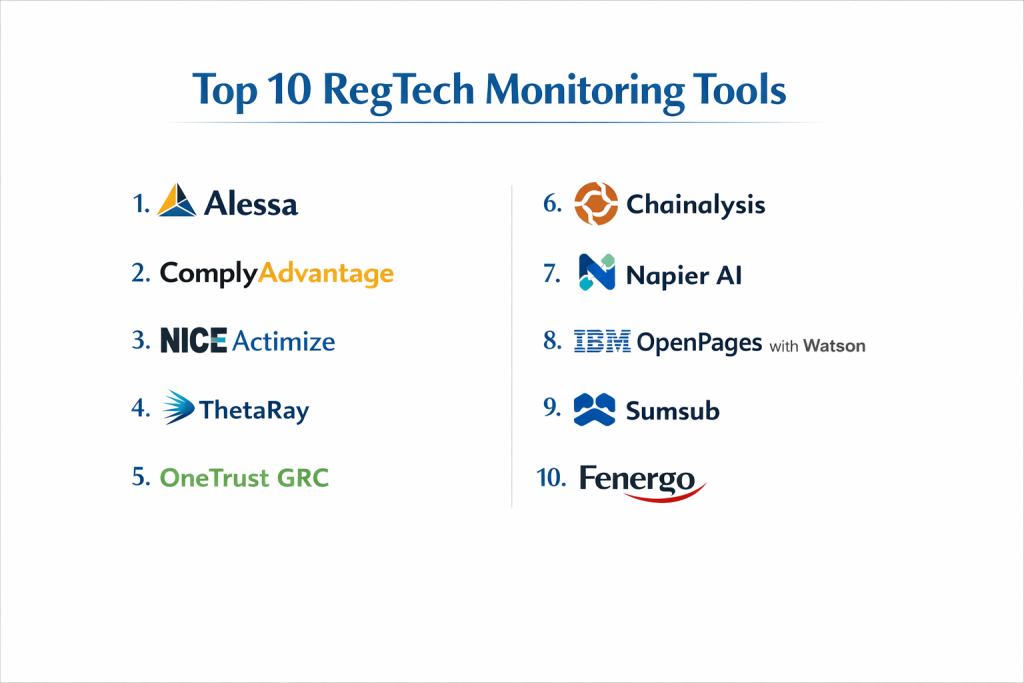
Top 10 RegTech Monitoring Tools
1 — Alessa
Alessa is a unified AML compliance and fraud management platform designed to help organizations act quickly, streamline investigations, and protect their business with real-time intelligence.
Key features:
- Unified AML Compliance: Combines transaction monitoring, sanctions screening, and regulatory reporting in one interface.
- Dynamic Risk Scoring: Automatically updates customer risk profiles based on ongoing behavior and external data.
- Real-Time Transaction Monitoring: Monitors traditional and digital transactions for suspicious patterns as they happen.
- Automated SAR Filing: Streamlines the preparation and submission of Suspicious Activity Reports (SARs).
- Advanced Analytics: Uses a combination of rules-based and machine-learning analytics to detect anomalies.
Pros:
- Highly flexible and configurable to specific organizational risk thresholds.
- Exceptional at reducing the manual burden of reporting through automation.
Cons:
- The initial configuration can be complex due to the high level of customization.
- Requires a solid internal data structure to perform at its peak.
Security & compliance: SOC 2 Type II, GDPR compliant, and features advanced AES-256 encryption.
Support & community: Dedicated technical account managers, 24/7 global support, and a robust user knowledge base.
2 — ComplyAdvantage
ComplyAdvantage is a leading AI-driven RegTech provider that offers a real-time database of people and companies to help firms manage their financial crime risks.
Key features:
- Hyperscale Compliance Data: Provides a proprietary, real-time database of sanctions, PEPs, and adverse media.
- AI-Powered Onboarding: Automates KYC/KYB checks with high-speed document and identity verification.
- Dynamic Risk Monitoring: Continuous monitoring that alerts you the moment a client’s risk status changes.
- Transaction Screening: Screens payments in milliseconds to prevent sanctioned transfers.
- Developer-First APIs: Designed for easy integration into modern fintech and bank tech stacks.
Pros:
- The real-time nature of the data reduces the window of risk compared to periodic batch updates.
- Sleek, modern UI that is significantly more intuitive than legacy compliance systems.
Cons:
- The API-first approach may require more technical resources for implementation in older institutions.
- Pricing can scale quickly for high-volume digital-first businesses.
Security & compliance: ISO 27001, SOC 2, and compliant with global AML/CTF regulations.
Support & community: Extensive API documentation, responsive developer support, and regular industry insights reports.
3 — NICE Actimize
NICE Actimize is an enterprise-scale powerhouse, often the first choice for the world’s largest banks for financial crime, risk, and compliance.
Key features:
- Autonomous Financial Crime: Uses AI and automation to manage the end-to-end financial crime lifecycle.
- ActOne Investigation Management: A unified platform for managing alerts, cases, and investigations across the enterprise.
- X-Sight Cloud: A cloud-native platform that allows firms to leverage collective intelligence to fight fraud.
- Surveillance Solutions: Deep monitoring of trade and communication to prevent market abuse.
- Advanced Entity Resolution: Connects disparate data points to uncover the true identity of suspicious actors.
Pros:
- Incredible scalability, capable of handling the transaction volumes of the world’s largest financial institutions.
- Offers one of the most comprehensive suites of compliance tools under a single brand.
Cons:
- The system is “heavy” and can be slow to update or customize compared to nimbler SaaS tools.
- Pricing is at the top tier of the market, making it inaccessible for most mid-market firms.
Security & compliance: Bank-grade security, SOC 1/2, ISO 27001, and global regulatory alignment.
Support & community: Professional services for implementation, a global user community, and 24/7 mission-critical support.
4 — ThetaRay
ThetaRay specializes in “Inuitive AI” for transaction monitoring, particularly focusing on the complex world of cross-border payments and correspondent banking.
Key features:
- SONAR Platform: An AI-driven transaction monitoring solution that detects unknown patterns of financial crime.
- Unsupervised Machine Learning: Identifies “unknown unknowns”—new laundering schemes that have no historical rules.
- Cross-Border Focus: Specifically optimized for the nuances and high risks of international payment corridors.
- Reduced False Positives: Claims to reduce false alarms by up to 90% through more intelligent detection.
- Cloud-Native Deployment: Offers fast implementation via major cloud providers.
Pros:
- Superior at uncovering sophisticated, modern financial crimes that bypass traditional rule-based systems.
- Greatly improves the efficiency of compliance teams by cutting through the “noise” of false alerts.
Cons:
- The “black box” nature of unsupervised ML can sometimes be challenging to explain to conservative regulators.
- Niche focus means it might not be a “total” solution for firms looking for broad GRC features.
Security & compliance: SOC 2 Type II, GDPR, and rigorous data privacy protocols for cross-border data flows.
Support & community: High-touch onboarding and expert consulting on market-specific risk patterns.
5 — OneTrust GRC
OneTrust is a leader in trust and privacy, with its GRC (Governance, Risk, and Compliance) module providing an integrated platform for managing internal and external regulatory risks.
Key features:
- Regulatory Intelligence: Integrated feeds from hundreds of jurisdictions to track legal changes.
- Third-Party Risk Management: Automates the assessment and monitoring of vendors and partners.
- Policy Management: Centralizes the creation, distribution, and attestation of company policies.
- Audit Management: Streamlines the internal audit process with automated evidence collection.
- Shared Evidence Framework: Allows firms to “assess once, comply many” across different frameworks (SOC 2, ISO, etc.).
Pros:
- The gold standard for firms where data privacy (GDPR/CCPA) is the primary regulatory concern.
- Massive ecosystem of integrations with other enterprise software.
Cons:
- Can feel like a “jack of all trades, master of none” for those needing hyper-specific AML features.
- The platform is massive and can be overwhelming for users who only need a small slice of its features.
Security & compliance: ISO 27001, SOC 2, GDPR, and FedRAMP authorized.
Support & community: OneTrust University training, a massive global community, and extensive self-service documentation.
6 — Chainalysis
Chainalysis is the premier RegTech monitoring tool for the cryptocurrency world, providing data and software to government agencies, exchanges, and banks.
Key features:
- Reactor: An investigative tool that maps out the movement of funds across the blockchain.
- Know Your Transaction (KYT): Real-time transaction monitoring for crypto-assets to flag high-risk activity.
- Kryptos: A directory for financial institutions to vet the risk profile of various crypto services.
- Market Intel: Provides on-chain data for institutional-grade market research.
- Incident Response: Professional services to help recover stolen funds or investigate breaches.
Pros:
- The industry standard for crypto compliance; if you deal with digital assets, this is the tool regulators expect.
- Unrivaled database of “tagged” crypto addresses linked to illicit activity.
Cons:
- Extremely expensive for smaller crypto startups.
- Almost entirely focused on on-chain data, requiring other tools for traditional fiat compliance.
Security & compliance: SOC 2, and specialized for FATF (Financial Action Task Force) crypto-standards.
Support & community: Highly specialized support from former law enforcement and blockchain experts.
7 — Napier AI
Napier AI is a modern, agile compliance platform that emphasizes “Human-Centered AI” to make compliance teams more effective.
Key features:
- Intelligent Compliance Platform: A central hub for AML, transaction monitoring, and screening.
- Sandbox Environment: Allows compliance teams to test new monitoring rules against historical data before going live.
- Interactive Case Management: A visual, intuitive workspace for investigating flagged activities.
- Multi-Org Capabilities: Ideal for groups managing compliance across multiple sub-brands or regions.
- Low-Code Rule Builder: Allows non-technical staff to create and adjust monitoring logic.
Pros:
- The “Sandbox” feature is a game-changer for tuning out false positives without risking live operations.
- One of the cleanest and most user-friendly interfaces in the RegTech market.
Cons:
- Being a newer entrant, it may lack the depth of historical data found in NICE Actimize or SAS.
- Implementation times can vary depending on the complexity of legacy data migration.
Security & compliance: ISO 27001, SOC 2, and compliant with major global financial crime mandates.
Support & community: Excellent onboarding program and highly responsive customer success team.
8 — IBM OpenPages with Watson
IBM OpenPages is an AI-powered GRC platform that uses the power of Watson to surface insights and automate compliance workflows across the enterprise.
Key features:
- Watson AI Integration: AI-driven virtual assistants to help users navigate complex regulations.
- Operational Risk Management: Tools to identify and mitigate risks across all business units.
- Regulatory Change Management: Automatically ingests and analyzes regulatory updates.
- Model Risk Governance: Specialized monitoring for firms using complex financial models.
- Centralized Single Data Model: Ensures a “single version of the truth” for all risk and compliance data.
Pros:
- Exceptional at managing “Model Risk,” which is critical for large investment banks.
- Deep integration with the broader IBM technology and security ecosystem.
Cons:
- Implementation often requires expensive external consulting or IBM professional services.
- The user interface is very traditional and may feel “corporate” compared to modern SaaS.
Security & compliance: SOC 2, ISO 27001, and leverages IBM’s enterprise-grade cloud security.
Support & community: 24/7 global IBM support, extensive certification programs, and a worldwide partner network.
9 — Sumsub
Sumsub is an “all-in-one” verification platform that focuses on orchestrating the entire user journey, from KYC to ongoing transaction monitoring.
Key features:
- Workflow Builder: A no-code tool to create custom onboarding and monitoring flows.
- KYC/KYB/AML: Comprehensive verification of both individual people and corporate entities.
- Liveness and Biometrics: Advanced AI to detect forged documents or “deepfake” identities during onboarding.
- Travel Rule Compliance: Specifically designed to help crypto firms meet international reporting rules.
- Transaction Monitoring: Real-time analysis of user behavior post-onboarding.
Pros:
- Extremely fast verification times, often completing a full KYC check in under 50 seconds.
- Very affordable and transparent pricing compared to institutional-grade platforms.
Cons:
- More of a “verification” tool than a deep “financial crime investigation” platform.
- May not handle the complex internal risk governance needs of a multi-national bank.
Security & compliance: GDPR, SOC 2, and localized compliance for 200+ jurisdictions.
Support & community: Solid digital documentation, 24/7 technical support, and a growing community of fintech users.
10 — Fenergo
Fenergo specializes in “Client Lifecycle Management” (CLM), providing the backbone for how financial institutions interact with their clients from a regulatory perspective.
Key features:
- End-to-End CLM: Manages everything from initial onboarding to periodic review and offboarding.
- Regulatory Rules Engine: A global database of rules that ensures compliance in over 100 jurisdictions.
- ESG Monitoring: Tools to track and report on the environmental and social governance profiles of clients.
- Investor Protection (MiFID II): Specifically handles the suitability and appropriateness tests required for investors.
- Entity Data Management: A robust system for tracking complex corporate hierarchies and UBOs.
Pros:
- The absolute specialist in handling the “Long-Tail” of client relationships in private banking and asset management.
- Strong focus on “Institutional” KYC/KYB, which is much more complex than retail onboarding.
Cons:
- The platform is highly specialized; it’s not an “all-purpose” GRC or IT security tool.
- Costs are high, reflecting its status as a premium institutional solution.
Security & compliance: SOC 2, ISO 27001, and fully aligned with global CLM regulatory standards.
Support & community: High-touch enterprise support, dedicated account managers, and an annual global user summit.
Comparison Table
| Tool Name | Best For | Platform(s) Supported | Standout Feature | Rating |
| Alessa | Unified AML/Fraud | Cloud / Hybrid | Automated SAR Filing | 4.7 |
| ComplyAdvantage | Real-Time Screening | SaaS (API-First) | Proprietary Risk Database | 4.6 |
| NICE Actimize | Large Global Banks | On-Prem / Cloud | Scale & Global Detection | 4.4 |
| ThetaRay | Cross-Border Payments | Cloud (SaaS) | Unsupervised ML Models | N/A |
| OneTrust GRC | Data Privacy & Trust | Cloud (SaaS) | Shared Evidence Framework | 4.8 |
| Chainalysis | Crypto Compliance | Cloud (SaaS) | Reactor Investigation Tool | 4.7 |
| Napier AI | Agile Compliance | Cloud / Hybrid | Sandbox Rule Testing | N/A |
| IBM OpenPages | Enterprise GRC | Cloud / On-Prem | Watson AI Insights | 4.5 |
| Sumsub | High-Growth Fintech | SaaS (Cloud) | 50-Second Onboarding | 4.8 |
| Fenergo | Client Lifecycle (CLM) | Cloud (SaaS) | Global Rules Engine | 4.6 |
Evaluation & Scoring of RegTech Monitoring Tools
| Criterion | Weight | Evaluation Focus |
| Core Features | 25% | AML/KYC depth, transaction monitoring, and rule building. |
| Ease of Use | 15% | UI/UX, no-code capabilities, and dashboard clarity. |
| Integrations | 15% | API reliability and connectivity to existing bank/tech stacks. |
| Security & Compliance | 10% | SOC 2/ISO status, encryption, and audit trail quality. |
| Performance | 10% | Real-time processing speed and system uptime. |
| Support | 10% | Technical help availability and onboarding quality. |
| Price / Value | 15% | ROI in terms of reduced fines and manual labor savings. |
Which RegTech Monitoring Tool Is Right for You?
Solo Users vs SMB vs Mid-Market vs Enterprise
There are no “Solo Users” for RegTech, as these tools are designed for organizations. SMBs and Early-Stage Fintechs should look toward Sumsub or ComplyAdvantage; these tools offer “plug-and-play” APIs that scale as the business grows. Mid-Market Firms with more complex internal risks will find Napier AI or Alessa to be the sweet spot. Large Enterprises and Global Banks almost exclusively require the depth of NICE Actimize, Fenergo, or IBM OpenPages.
Budget-Conscious vs Premium Solutions
If you are on a Budget, Sumsub and ComplyAdvantage provide the best “compliance-per-dollar” with transparent pricing. If you are a Premium institution where a single compliance failure is an existential threat, the high cost of Fenergo or Chainalysis is an essential insurance policy.
Feature Depth vs Ease of Use
For Ease of Use, Napier AI and Sumsub are the clear winners with modern, intuitive interfaces that don’t require a technical degree to navigate. If you require Feature Depth—specifically for niche areas like cross-border payments or market surveillance—ThetaRay or NICE Actimize offer the deep, technical “engine room” features that simpler tools lack.
Integration and Scalability Needs
If your business is a digital-first platform, ComplyAdvantage and Sumsub offer the best Integration capabilities with their modern REST APIs. If you are an older institution with a mix of legacy on-premise servers and new cloud apps, Alessa or Linedata provide the Scalability and hybrid support needed to bridge the gap.
Security and Compliance Requirements
For firms with the highest Security requirements (e.g., government-linked institutions), IBM OpenPages and NICE Actimize provide the long-term stability and “bank-grade” track record that regulators trust most. For Crypto specifically, Chainalysis is the only tool that truly satisfies global regulatory expectations for on-chain monitoring.
Frequently Asked Questions (FAQs)
What is the difference between FinTech and RegTech?
FinTech uses technology to improve financial services (e.g., banking apps). RegTech uses technology to improve the compliance and risk management of those services.
Can these tools help reduce “False Positives”?
Yes. Tools like Napier AI and ThetaRay use Machine Learning to understand “normal” behavior, which can reduce false alarms by up to 90% compared to old, static rules.
Do I still need a Compliance Officer if I have RegTech?
Absolutely. RegTech doesn’t replace people; it automates the “boring” work (data gathering, screening) so your Compliance Officer can focus on high-level strategy and investigations.
How long does it take to implement a RegTech tool?
For SaaS tools like Sumsub, it can take days or weeks. For enterprise-scale tools like NICE Actimize or Fenergo, implementation can take 6–12 months.
Is my client data safe in the cloud?
Yes, provided you choose a SOC 2 and ISO 27001 compliant vendor. Most RegTech providers use high-level encryption and private cloud environments.
What is “PEP” screening?
PEP (Politically Exposed Person) screening is checking if a client holds a prominent public position, which makes them a higher risk for bribery or corruption.
Can RegTech help with GDPR?
Yes. Tools like OneTrust are specifically designed to automate the data discovery, consent management, and reporting required by GDPR.
What is the “Travel Rule” in crypto?
It is a regulation requiring crypto firms to share identifying information about the senders and receivers of digital assets for transactions over a certain amount.
What happens if a tool misses a suspicious transaction?
No tool is 100% perfect. However, having a professional RegTech system shows regulators that you have a “defensible” process, which can significantly reduce the severity of any fines.
How much do these tools cost?
Pricing varies wildly. Small tools can start at $500/month, while enterprise solutions for global banks can cost millions per year in licensing and support.
Conclusion
The selection of a RegTech Monitoring Tool is a pivotal moment in any firm’s risk management journey. We have moved past the era where compliance was a manual, spreadsheet-based exercise. Today, the speed and volume of global finance require a digital partner that can think and act in real-time. Whether you are a high-growth fintech leveraging the speed of Sumsub or a global tier-one bank relying on the institutional weight of NICE Actimize, the objective is the same: to build a “wall of trust” around your operations.
The “best” tool isn’t necessarily the one with the most features; it’s the one that aligns with your specific risk profile, budget, and technical ecosystem. As regulations continue to evolve, particularly in the realms of AI and ESG, having a scalable, intelligent RegTech foundation will be what separates the resilient firms from those that struggle to keep up.