Introduction
Recruiting Platforms are comprehensive software solutions designed to streamline the end-to-end process of identifying, attracting, screening, and hiring new employees. Unlike a simple job site, a recruiting platform serves as a centralized hub where talent acquisition teams can manage their employer brand, source passive candidates, coordinate interviews, and track the efficiency of their hiring funnel. These platforms bridge the gap between a company’s open requisition and the final signed offer letter.
The importance of these tools lies in their ability to automate repetitive tasks, allowing HR professionals to focus on the human element of hiring. Real-world use cases range from a hyper-growth tech startup needing to source specialized engineers globally, to a healthcare provider managing high-volume hiring for nursing staff across multiple facilities. When choosing a platform, users should prioritize AI-driven candidate matching, user experience (UX) for hiring managers, native integrations with HRIS systems, and diversity and inclusion (DEI) tracking features.
Best for: Talent acquisition specialists, HR directors, and corporate recruiters in organizations ranging from mid-market to global enterprise. It is essential for industries with high-growth targets or those facing specialized talent shortages, such as technology, finance, and engineering.
Not ideal for: Solopreneurs or very small businesses with only one or two hires per year. For these users, a basic “pay-per-post” job board or a shared spreadsheet is usually sufficient and more cost-effective than a full-scale recruitment platform.
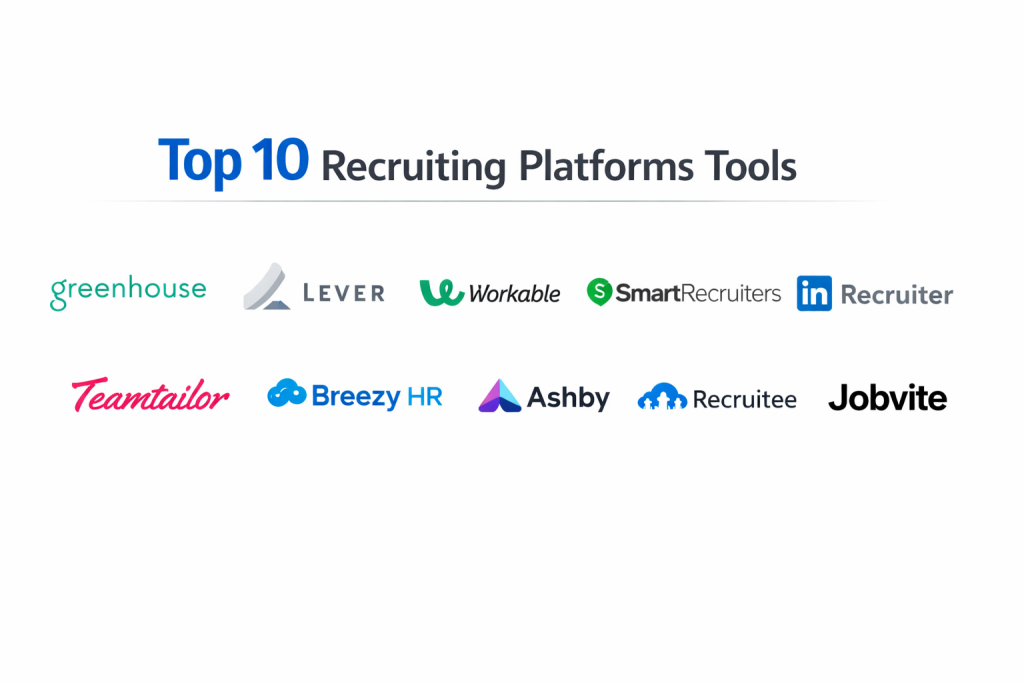
Top 10 Recruiting Platforms Tools
1 — Greenhouse
Greenhouse is widely considered the industry leader for structured hiring. It is designed to help companies build a fair, consistent, and data-driven recruiting culture that scales.
- Key features:
- Structured Hiring Rubrics: Ensures every candidate is evaluated against the same criteria to eliminate bias.
- Automated Interview Kits: Provides interviewers with specific questions and scorecards.
- Diversity, Equity, & Inclusion (DEI) Suite: Built-in nudges and reports to track and improve diversity goals.
- Greenhouse Sourcing Automation: Helps find and engage passive talent through automated outreach.
- Extensive Integration Marketplace: Over 400+ native integrations with tools like Slack, Zoom, and ADP.
- Predictive Analytics: Analyzes past hiring data to predict future hiring success and bottlenecks.
- Pros:
- Unrivaled for data-driven organizations that want deep insights into their hiring funnel.
- Excellent candidate experience tools, including branded career pages and clear communication paths.
- Cons:
- High learning curve; it requires significant training for hiring managers to use properly.
- Pricing is at the top of the market and often out of reach for smaller startups.
- Security & compliance: SOC 2 Type II, GDPR, HIPAA, and ISO 27001 compliant.
- Support & community: Dedicated account managers for larger tiers, a massive “Greenhouse Open” community, and a highly detailed knowledge base.
2 — Lever
Lever is known for its “Talent Relationship Management” (TRM) approach, treating recruitment more like a sales funnel. It is the go-to for companies that rely heavily on sourcing passive talent.
- Key features:
- Unified Pipeline: Combines both active applicants and sourced passive candidates in a single view.
- Lever Nurture: Automated email sequences to keep potential candidates engaged over months or years.
- Lever Chrome Extension: Allows recruiters to “clip” candidates directly from LinkedIn into the platform.
- Real-time Collaboration: @mentions and internal notes that allow hiring teams to discuss candidates instantly.
- Advanced Referrals: A dedicated portal that makes it easy for employees to submit and track referrals.
- Visual Impact Dashboards: Clean, high-level visualizations of recruitment health.
- Pros:
- The most intuitive and “fast” user interface in the industry; it feels like a modern productivity tool.
- Exceptionally strong for companies that “headhunt” rather than just wait for applicants.
- Cons:
- Customization of the workflow can be more limited compared to Greenhouse.
- Reporting, while beautiful, sometimes lacks the deep “drill-down” capabilities of enterprise rivals.
- Security & compliance: SOC 2 Type II, GDPR, and CCPA compliant.
- Support & community: 24/5 global support, robust onboarding programs, and an active user forum.
3 — Workable
Workable is an AI-powered recruiting platform that excels at finding candidates. It is particularly popular with SMBs and mid-market companies that need an “out-of-the-box” solution.
- Key features:
- AI Recruiter: Automatically suggests candidates based on the job description from a database of 400M profiles.
- One-Click Job Posting: Distributes roles to over 200 job boards worldwide.
- Native Video Interviews: Built-in asynchronous video screening tools.
- Mobile App: A full-featured app for managers to review resumes and move candidates on the go.
- Assessments: Built-in cognitive and personality tests to screen for fit early.
- Anonymized Screening: Hides candidate photos and names to promote unbiased hiring.
- Pros:
- The fastest setup time—a company can be hiring within hours of signing up.
- The AI sourcing tool is a game-changer for teams without a massive sourcing budget.
- Cons:
- Pricing has become more complex in recent years, with many features locked in higher tiers.
- Not as suitable for massive enterprises with complex internal mobility needs.
- Security & compliance: SOC 2, GDPR, and ISO 27001 compliant.
- Support & community: 24/7 email support and a massive library of job description templates and HR resources.
4 — SmartRecruiters
SmartRecruiters is a high-end “Hiring Success” platform built for global enterprises. It focuses on large-scale collaboration and high-volume recruitment.
- Key features:
- SmartAssistant: AI that ranks and scores candidates based on fit and potential.
- Global Compliance: Handles complex international labor laws and data residency requirements.
- Native CRM: Tools to build and manage talent communities for future roles.
- Collaborative Hiring App: Designed specifically for hiring managers who are not in HR.
- Open Marketplace: Over 600+ pre-integrated vendors for background checks and assessments.
- Budget Tracking: Manage recruitment spend and agency fees directly in the platform.
- Pros:
- Unmatched for large, decentralized organizations with thousands of employees.
- The “Candidate Portal” is one of the most professional in the market.
- Cons:
- Can be overly complex for smaller teams; the feature set is overwhelming for simple needs.
- Implementation typically requires professional services and a multi-month timeline.
- Security & compliance: ISO 27001, SOC 2, HIPAA, and GDPR compliant.
- Support & community: Global enterprise support, dedicated customer success managers, and a large annual conference.
5 — LinkedIn Recruiter
While often used alongside an ATS, LinkedIn Recruiter is the world’s most powerful candidate search engine. For many, it is the primary recruiting platform for active sourcing.
- Key features:
- Access to 1B+ Members: The most comprehensive professional database on earth.
- InMail: Direct, high-conversion messaging to anyone on the platform.
- Advanced Search Filters: Filter by “Open to Work,” skills, seniority, and past companies.
- Recommended Matches: AI-driven suggestions based on your search behavior.
- Spotlights: Focuses on candidates who are more likely to respond to your outreach.
- Project Folders: Organize candidates for current and future roles with shared team access.
- Pros:
- Essential for specialized, high-level, or niche roles where candidates aren’t applying.
- The “Open to Work” signals provide recruiters with a massive advantage in timing.
- Cons:
- Extremely expensive; the per-seat cost is significantly higher than most ATS platforms.
- Not a full-service hiring platform—it lacks the deep workflow and interview management of Greenhouse.
- Security & compliance: GDPR compliant, SSO support, and enterprise-grade data encryption.
- Support & community: Extensive video training (LinkedIn Learning), dedicated sales reps, and a massive global user base.
6 — Teamtailor
Teamtailor is the “marketing-first” recruiting platform. It focuses heavily on employer branding, turning your career site into a high-conversion landing page.
- Key features:
- Drag-and-Drop Career Site Builder: No coding required to build beautiful, branded pages.
- Candidate NPS: Measures applicant satisfaction with your hiring process.
- Audience Messaging: Segment your talent pool and send tailored updates.
- Referral Portal: Social-media-style tools for employees to share jobs.
- Co-pilot (AI): AI that helps write job descriptions and screen candidates.
- Internal Recruitment: A dedicated space for current employees to find new opportunities.
- Pros:
- The best tool for companies that want to lead with their brand and “culture.”
- The user interface is incredibly modern and feels like a consumer app.
- Cons:
- Lacks some of the “heavy-duty” sourcing features found in Lever or Workable.
- Reporting is good for marketing metrics but less so for deep operational analysis.
- Security & compliance: GDPR compliant and secure data hosting.
- Support & community: Very responsive chat support and a high-energy community of modern recruiters.
7 — Breezy HR
Breezy HR is a visual, kanban-style platform that prioritizes speed and automation. It is a favorite among startups and small businesses.
- Key features:
- Visual Pipeline: Drag-and-drop candidates through stages like a Trello board.
- Automated Stage Actions: Send emails or move candidates based on automated triggers.
- Candidate Self-Scheduling: Integration with Google/Outlook calendars for easy booking.
- Built-in Video Interviews: No need for Zoom; screen candidates directly in the browser.
- Background Check Integration: One-click checks through partners like Checkr.
- Free Tier: One of the only professional platforms to offer a truly free version for single roles.
- Pros:
- The learning curve is virtually non-existent; managers can master it in 30 minutes.
- The visual nature makes it very easy to see where bottlenecks are occurring.
- Cons:
- Can feel “messy” if you are managing more than 20-30 active roles simultaneously.
- Reporting is basic compared to enterprise-grade suites.
- Security & compliance: GDPR compliant and uses standard industry encryption.
- Support & community: Great documentation and responsive email support.
8 — Ashby
Ashby is the “all-in-one” platform that has gained massive traction among high-growth tech companies for its high-performance reporting and speed.
- Key features:
- High-Performance ATS: Designed for speed, with keyboard shortcuts for power users.
- Native CRM: Built-in sourcing and nurture tools that rival specialized CRM software.
- Best-in-Class Analytics: Built-in business intelligence that replaces the need for spreadsheets.
- Scheduling Automation: Handles complex panel interviews and time zone differences seamlessly.
- Career Site Builder: Modern, fast-loading, and SEO-optimized career pages.
- Collaboration Tools: Deep integrations with Slack and email.
- Pros:
- Provides the depth of Greenhouse with the modern speed and UX of Lever.
- The reporting is widely considered the best in the SaaS recruiting world today.
- Cons:
- It is a newer player, so the integration ecosystem is still growing.
- Primarily focused on the tech industry; might not fit traditional retail or manufacturing.
- Security & compliance: SOC 2 Type II, GDPR, and HIPAA compliant.
- Support & community: High-touch support for growth-stage companies and an active Slack community.
9 — Recruitee
Recruitee is a collaborative hiring platform that emphasizes team involvement. It is a balanced tool for mid-market companies that want to scale efficiently.
- Key features:
- Multi-Posting: Reach thousands of job boards with a single click.
- Smart Campaigns: Automated ad buying for job boards to maximize reach.
- Scheduler: One of the most reliable calendar sync and scheduling tools.
- Pipeline Automations: Set up “auto-disqualify” rules for specific knockout questions.
- Custom Dashboards: Different views for recruiters, managers, and executives.
- Mobile App: Full functionality for reviewing candidates on the fly.
- Pros:
- A very “clean” middle-ground tool; not too simple, not too complex.
- Excellent for teams that want every hiring manager involved in the process.
- Cons:
- AI features are not as advanced as Workable or SmartRecruiters.
- Customer support is primarily digital, which may not suit all enterprise needs.
- Security & compliance: GDPR compliant and ISO 27001 certified.
- Support & community: Strong academy for training and a very fast chat support team.
10 — Jobvite
Jobvite is an enterprise-level recruiting suite that specializes in “continuous candidate engagement” and large-scale talent acquisition.
- Key features:
- Evolve Talent Acquisition Suite: A comprehensive bundle of ATS, CRM, and onboarding.
- AI Sourcing: Intelligent matching and ranking of candidates from internal and external sources.
- Referral Engine: Social-first referral tracking that incentivizes employees.
- Video Interviewing: Integrated live and on-demand video screening.
- Internal Mobility: Specific tools to help current employees move into new roles.
- Campaign Management: Run and track recruitment marketing campaigns across social media.
- Pros:
- Extremely robust for companies with complex internal hierarchies and large talent pools.
- Strong emphasis on the “marketing” side of recruitment to build a long-term brand.
- Cons:
- The interface can feel a bit dated and slower than modern alternatives like Ashby or Lever.
- Implementation is complex and requires significant administrative overhead.
- Security & compliance: SOC 2 Type II, HIPAA, and GDPR compliant.
- Support & community: Enterprise customer success programs and a large library of webinars and whitepapers.
Comparison Table
| Tool Name | Best For | Platform(s) Supported | Standout Feature | Rating (Gartner) |
| Greenhouse | Structured Hiring | Web, iOS, Android | Structured Rubrics | 4.6 / 5 |
| Lever | Passive Sourcing | Web, iOS, Android | Talent CRM Sync | 4.5 / 5 |
| Workable | All-in-one SMB | Web, iOS, Android | AI Recruiter Tool | 4.6 / 5 |
| SmartRecruiters | Global Enterprise | Web, iOS, Android | Hiring Success Dashboards | 4.4 / 5 |
| LinkedIn Recruiter | Specialized Sourcing | Web, iOS, Android | 1B+ Member Database | 4.6 / 5 |
| Teamtailor | Employer Branding | Web, iOS, Android | Career Site Builder | 4.8 / 5 |
| Breezy HR | Small Biz / Startups | Web, iOS, Android | Kanban Visual Pipeline | 4.7 / 5 |
| Ashby | High-Growth Tech | Web, Desktop | Advanced Analytics | 4.8 / 5 |
| Recruitee | Team Collaboration | Web, iOS, Android | Smart Ad Campaigns | 4.5 / 5 |
| Jobvite | Large Scaled Hiring | Web, iOS, Android | Social Referral Engine | 4.1 / 5 |
Evaluation & Scoring of Recruiting Platforms
Selecting a recruiting platform is a major investment. We evaluate these platforms using the following weighted scoring rubric to ensure objectivity:
| Category | Weight | Evaluation Focus |
| Core Features | 25% | ATS functionality, CRM, AI sourcing, and interview management. |
| Ease of Use | 15% | Intuitiveness for hiring managers and candidate application speed. |
| Integrations | 15% | Native connectivity to HRIS, Payroll, Slack, and Calendars. |
| Security & Compliance | 10% | GDPR status, SOC 2 Type II, and bias-reduction features. |
| Performance | 10% | System uptime and mobile app responsiveness. |
| Support & Community | 10% | Quality of onboarding, support speed, and user forums. |
| Price / Value | 15% | Transparent pricing relative to the feature set and ROI. |
Which Recruiting Platforms Tool Is Right for You?
Solo Users vs. SMB vs. Mid-market vs. Enterprise
Solo users and micro-businesses should check out Breezy HR or Workable‘s lower tiers—they provide the most “bang for your buck” without complexity. Small Businesses (SMB) looking to build a brand will find the most success with Teamtailor. Mid-market companies scaling rapidly should look at Lever or Ashby for their automation. Enterprises with 1,000+ employees require the strategic power of Greenhouse or SmartRecruiters.
Budget-conscious vs. Premium Solutions
If budget is your primary driver, Breezy HR and Recruitee offer the most competitive entry-level pricing. If you are a premium buyer who views recruitment as a top-tier competitive advantage, Greenhouse and Ashby provide the advanced data and sourcing capabilities that justify their higher price tags.
Feature Depth vs. Ease of Use
For Ease of Use, Breezy HR and Teamtailor are the clear winners—they look and feel like modern consumer apps. For Feature Depth, Greenhouse and Jobvite provide the most granular control, though they require more time to master.
Integration and Scalability Needs
If you plan to scale from 20 to 500 employees in two years, start with Ashby or Lever. They are built to handle rapid scaling and massive candidate pools without becoming sluggish. If you are a global firm needing to hire in 20 countries, SmartRecruiters and Workable have the best localized compliance tools.
Frequently Asked Questions (FAQs)
1. What is the difference between an ATS and a Recruiting Platform?
An ATS (Applicant Tracking System) is essentially a database for managing applications. A Recruiting Platform is a broader term that includes an ATS plus sourcing tools, CRM, employer branding, and advanced analytics to proactively find talent.
2. Is a recruiting platform hard to implement?
For SMB tools like Breezy HR, you can be up and running in a few hours. For enterprise suites like Greenhouse or SmartRecruiters, implementation involves data migration and manager training, usually taking 4 to 12 weeks.
3. Do I still need LinkedIn Recruiter if I have a recruiting platform?
Usually, yes. While many platforms have “sourcing” tools, LinkedIn Recruiter remains the primary database for professionals. Most platforms offer an integration to sync your LinkedIn search results directly into the platform.
4. How do these tools help with Diversity and Inclusion (DEI)?
Top platforms like Greenhouse and Ashby offer “blind” resume screening (hiding names/photos) and specific reports that show if a particular demographic is being unfairly filtered out at a certain interview stage.
5. Are these platforms safe for sensitive employee data?
Yes, but you must look for SOC 2 Type II and GDPR compliance. These certifications ensure that the vendor follows the highest standards of data privacy and cybersecurity.
6. Can recruiting platforms help with remote hiring?
Absolutely. Platforms like Workable and Recruitee have built-in video interviewing and digital offer letter features that allow you to hire a candidate without ever meeting them in person.
7. How much do recruiting platforms cost?
Pricing varies widely. Some charge “Per Active Job” (starting at $150/mo), while others charge “Per Employee” or “Per Recruiter Seat.” Enterprise solutions typically range from $10,000 to $100,000+ per year.
8. What is “Resume Parsing”?
It is the technology that “reads” a PDF resume and automatically fills in the name, contact info, skills, and work history in your database so you can search for candidates by keyword.
9. Can I manage internal hiring with these tools?
Yes. Modern platforms like Teamtailor and SuccessFactors (SAP) have specific portals for internal employees to see and apply for new roles before they are posted publicly.
10. What is the biggest mistake companies make when buying a recruiting platform?
Buying a tool that is too complex for their hiring managers. If the system is difficult to use, managers will go back to using email and spreadsheets, defeating the whole purpose of the investment.
Conclusion
Choosing a Recruiting Platform is one of the most significant operational decisions an HR leader can make. It is the choice between “reactive” hiring (waiting for resumes) and “proactive” talent acquisition (building a pipeline). If you are a small business focused on speed, Breezy HR is an incredible asset. If you are a brand-conscious company, Teamtailor will help you stand out. For those who want data-driven hiring success, Greenhouse remains the gold standard.
Ultimately, a recruiting platform is a partner in your company’s growth. By choosing the right tool, you aren’t just buying software—you are building the foundation of your future workforce.