Introduction
Recommendation System Toolkits are specialized software frameworks and libraries designed to build, deploy, and manage algorithms that suggest relevant items to users. These toolkits provide the mathematical foundation for “collaborative filtering” (predicting interests based on similar users) and “content-based filtering” (suggesting items similar to what a user liked before). By providing pre-built modules for data ingestion, model training, and real-time inference, these toolkits allow developers to move beyond simple “people who bought this also bought that” logic into sophisticated, deep-learning-driven personalization.
The importance of these toolkits is driven by the “paradox of choice.” In a digital landscape with millions of products, movies, or articles, a high-quality recommendation engine acts as a digital concierge, increasing user engagement and average order value (AOV). For businesses, these toolkits are the engine of discovery; they surface “long-tail” content that might otherwise remain hidden, ensuring that every user sees a version of the platform tailored specifically to their tastes and behaviors.
Key Real-World Use Cases
- E-commerce Product Discovery: Showing “frequently bought together” items or personalized homepages based on browsing history.
- Streaming & Media: Powering the “Next Up” queue on video platforms or personalized playlists on music services.
- Content & News Personalization: Delivering a curated feed of articles that match a reader’s political or professional interests.
- Social Media Discovery: Suggesting new users to follow or group communities to join based on shared connections.
- Job Boards & Marketplaces: Matching candidates with job postings or buyers with specific service providers.
What to Look For (Evaluation Criteria)
When choosing a toolkit, prioritize Algorithm Diversity—the ability to switch between matrix factorization, deep learning, and hybrid models. Latency is critical; the system must provide recommendations in milliseconds during a live session. Look for Cold Start Support, which determines how well the tool handles new users or items with no previous data. Finally, evaluate Scalability, ensuring the toolkit can handle a jump from thousands to millions of users without a total architectural overhaul.
Best for: Machine learning engineers, data scientists, and growth product managers in mid-market to enterprise companies, specifically in retail, media, and SaaS.
Not ideal for: Small personal blogs or very early-stage startups where a simple “Recently Added” list is sufficient and the overhead of data collection outweighs the benefits.
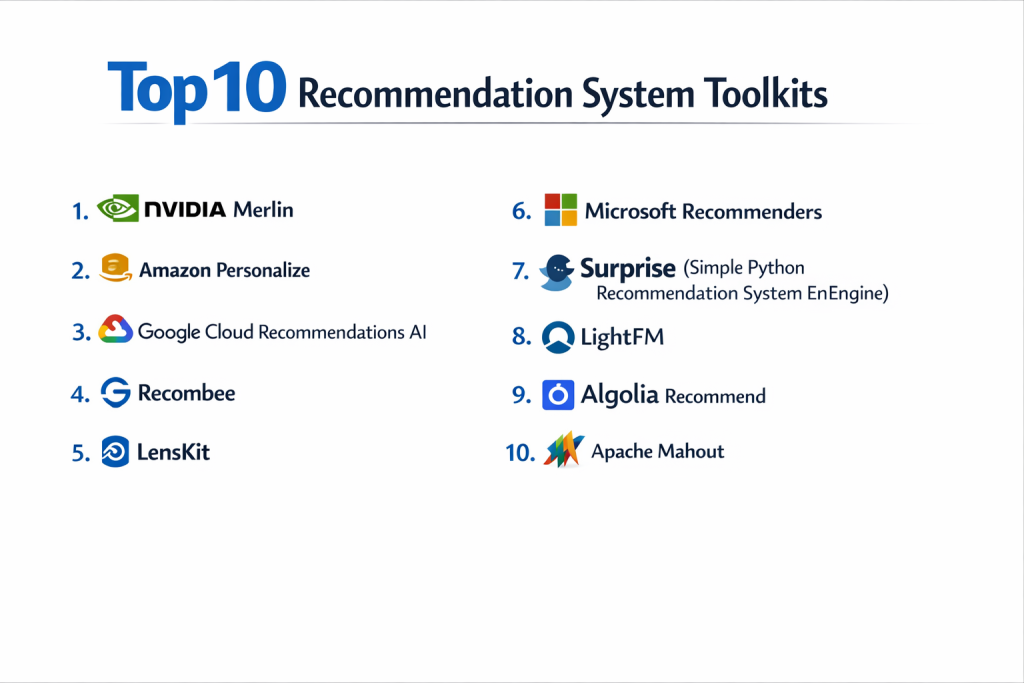
Top 10 Recommendation System Toolkits
1 — NVIDIA Merlin
NVIDIA Merlin is an open-source framework designed to accelerate the entire recommendation system pipeline on GPUs, from data preprocessing to model deployment.
- Key features:
- NVTabular: High-performance data manipulation for tabular data at the terabyte scale.
- HugeCTR: A GPU-accelerated training framework for large-scale click-through rate (CTR) prediction.
- Merlin Models: Pre-built high-level implementations of popular architectures like DLRM and Two-Tower.
- Triton Inference Server: Optimized serving of recommendation models with low latency.
- End-to-End GPU Acceleration: Minimizes data transfer bottlenecks between CPU and GPU.
- Pros:
- Unmatched speed and efficiency for massive datasets that would choke traditional CPU-based frameworks.
- Highly modular; you can use the preprocessing components even if you use a different training framework.
- Cons:
- Requires specific NVIDIA hardware (GPUs) to realize its full performance benefits.
- Steeper learning curve compared to simple Python libraries.
- Security & compliance: Supports standard enterprise security protocols; compliance depends on the deployment environment (e.g., AWS, GCP, or On-Prem).
- Support & community: backed by NVIDIA’s deep technical resources; active GitHub community and professional enterprise support.
2 — Amazon Personalize
Amazon Personalize is a fully managed service that allows developers to build applications with the same machine learning technology used by Amazon.com.
- Key features:
- Automated Machine Learning (AutoML): Automatically chooses the best algorithm and tunes hyperparameters.
- Real-Time Suggestions: Updates recommendations based on a user’s most recent clicks within seconds.
- Batch Recommendations: Generate millions of suggestions at once for email marketing campaigns.
- Metadata Integration: Uses item and user attributes to solve the “cold start” problem.
- Recipe-Based Modeling: Pre-configured “recipes” for specific use cases like “User Personalization” or “Similar Items.”
- Pros:
- “Zero-Infrastructure” approach; you don’t need to manage servers or clusters.
- Extremely fast time-to-market for teams without deep PhD-level machine learning expertise.
- Cons:
- Pricing is based on data ingestion and throughput, which can become expensive at high volumes.
- “Black box” nature—you have less control over the underlying model architecture than open-source tools.
- Security & compliance: SOC, ISO, HIPAA, and GDPR compliant; integrated with AWS IAM for granular access control.
- Support & community: Supported by AWS global infrastructure and premium support plans; vast documentation.
3 — Google Cloud Recommendations AI
Recommendations AI is a managed service from Google Cloud that leverages Google’s decades of experience in search and discovery.
- Key features:
- Contextual Awareness: Adjusts recommendations based on device type, location, and time of day.
- Optimization Objectives: Choose to optimize for “Click-Through Rate,” “Conversion Rate,” or “Revenue.”
- Model Continuous Training: Automatically retrains models daily to adapt to changing catalogs and trends.
- Vertex AI Integration: Seamlessly connects with Google’s broader AI and data ecosystem.
- Omnichannel Support: Consistent recommendations across web, mobile, and physical point-of-sale.
- Pros:
- Exceptional at “Revenue Optimization,” making it a favorite for high-volume retailers.
- Handles very large catalogs (millions of SKUs) with ease.
- Cons:
- Deeply tied to the Google Cloud Platform (GCP) ecosystem.
- Initial data requirements can be high to achieve optimal accuracy.
- Security & compliance: Part of Google Cloud’s global compliance portfolio (HIPAA, SOC 2, ISO 27001).
- Support & community: Enterprise-grade support through GCP; extensive cloud architecture guides.
4 — Recombee
Recombee is a specialized, “Search + Recommendation” engine as a service that offers a highly intuitive API for developers.
- Key features:
- Hybrid Filtering: Combines collaborative and content-based filtering out of the box.
- Real-Time Machine Learning: Every user interaction is immediately reflected in their next recommendation.
- Visual UI: A sophisticated dashboard for product managers to monitor performance and set business rules.
- Multilingual Support: Handles item descriptions and metadata in dozens of languages.
- Scenario-Based Logic: Set different rules for the “Home Page” versus the “Product Page.”
- Pros:
- One of the best user interfaces for non-technical stakeholders to “tweak” the AI.
- Very easy integration via REST API and SDKs for all major programming languages.
- Cons:
- As a SaaS provider, your data resides on their servers (though they offer regional hosting).
- Less flexibility for building highly custom, proprietary model architectures from scratch.
- Security & compliance: GDPR compliant; offers data encryption and SSO for the dashboard.
- Support & community: High-touch customer support and excellent technical documentation for developers.
5 — LensKit
LensKit is a classic, open-source Python library designed for researchers and educators, but often used for building production-grade baseline systems.
- Key features:
- Modular Architecture: Swap out components for data loading, scoring, and ranking easily.
- Evaluation Toolkit: Built-in tools for measuring precision, recall, and NDCG (Normalized Discounted Cumulative Gain).
- Cross-Validation: Automated split-testing for training and testing datasets.
- Scikit-Learn Integration: Works seamlessly with the standard Python data science stack.
- Algorithm Support: Native support for Matrix Factorization, k-NN, and more.
- Pros:
- Completely free and open-source with no vendor lock-in.
- Excellent for “Explainable AI”—it is much easier to see why a recommendation was made.
- Cons:
- Not designed for high-concurrency, real-time production serving without significant additional engineering.
- Performance lags behind GPU-accelerated frameworks like Merlin for massive datasets.
- Security & compliance: Varies (Local/Self-hosted); security is the responsibility of the implementing team.
- Support & community: Strong academic community; documentation is technically rigorous and thorough.
6 — Microsoft Recommenders
Microsoft Recommenders is a comprehensive collection of best practices and tools for building recommendation systems, provided as a set of GitHub repositories.
- Key features:
- Multi-Framework Support: Includes examples and utilities for PyTorch, TensorFlow, and Spark.
- Operationalization Scripts: Templates for deploying models on Azure Kubernetes Service (AKS).
- SAR (Simple Algorithm for Recommendations): A fast, scalable algorithm for common retail scenarios.
- Utility Functions: Pre-built code for common tasks like data splitting and metric calculation.
- Deep Learning Models: Templates for NCF (Neural Collaborative Filtering) and more.
- Pros:
- The most comprehensive “Learning Resource” on the market; great for building custom systems.
- Flexible enough to be used on any cloud, even though it’s hosted by Microsoft.
- Cons:
- It is a “repository of tools,” not a single cohesive software platform; requires assembly.
- Maintenance of the code over time is left to the user.
- Security & compliance: Depends on deployment; Azure-hosted versions inherit Microsoft’s cloud compliance.
- Support & community: Large community of contributors; heavily used by data scientists globally.
7 — Surprise (Simple Python Recommendation System Engine)
Surprise is a Python scikit for building and analyzing recommender systems that deal with explicit rating data.
- Key features:
- Prediction Algorithms: Includes SVD, SVD++, NMF, and Slope One.
- Dataset Handling: Built-in support for Movielens and Jester datasets for benchmarking.
- Accuracy Metrics: Easily compute RMSE (Root Mean Squared Error) and MAE (Mean Absolute Error).
- Easy Extension: Simple API for users to define and test their own custom algorithms.
- Parameter Tuning: Tools for finding the best hyperparameters for a model.
- Pros:
- Extremely lightweight and easy to install for quick experiments.
- Perfect for developers who are comfortable with the Scikit-Learn style of coding.
- Cons:
- Focused almost entirely on “Rating Prediction” (Explicit feedback); less support for “Click Tracking” (Implicit feedback).
- Not designed for large-scale, distributed production environments.
- Security & compliance: Varies (Local/Self-hosted).
- Support & community: Very popular among students and researchers; active GitHub and StackOverflow community.
8 — LightFM
LightFM is a popular Python implementation of a number of popular recommendation algorithms, specializing in hybrid models.
- Key features:
- Hybrid Representation: Incorporates both item and user metadata into a collaborative filtering model.
- Learning to Rank: Uses WARP (Weighted Approximate-Rank Pairwise) loss for superior ranking results.
- Sparse Data Support: Highly efficient at handling large, sparse matrices (lots of items, few ratings).
- Fast C Extensions: Core algorithms are written in C for high performance.
- Flexible Embeddings: Creates latent representations of users and items for downstream tasks.
- Pros:
- The “go-to” tool for solving the cold-start problem via its hybrid approach.
- Exceptional performance-to-complexity ratio; hits the “sweet spot” for many SMBs.
- Cons:
- Development has slowed down in recent years; fewer new feature updates.
- Requires manual engineering to build a real-time serving API around the library.
- Security & compliance: N/A (Runs as a local library).
- Support & community: Large legacy community; hundreds of blog posts and tutorials available online.
9 — Algolia Recommend
Algolia Recommend is an extension of the popular Algolia search platform, focusing on high-speed, front-end-driven recommendations.
- Key features:
- Frequently Bought Together: Automatically analyzes purchase history to suggest pairings.
- Related Products: Uses semantic search logic to find items with similar attributes.
- Instant Results: Optimized for front-end performance with sub-50ms response times.
- Visual Rule Builder: Merchandisers can manually “pin” specific products to recommendations.
- Trend-Based Logic: Surfaces items that are currently trending in a specific category.
- Pros:
- Extremely easy to implement for teams already using Algolia for search.
- Exceptional performance for the end-user; feels instantaneous.
- Cons:
- Not a “deep” machine learning toolkit; less customization for complex data science needs.
- Tied to the Algolia ecosystem and data structures.
- Security & compliance: SOC 3, ISO 27001, and HIPAA compliant; enterprise-grade data security.
- Support & community: High-quality documentation; responsive support and a large partner network.
10 — Apache Mahout
Apache Mahout is a distributed linear algebra framework and mathematically expressive Scala DSL designed to let mathematicians quickly create their own algorithms.
- Key features:
- Distributed Processing: Runs on top of Apache Spark for handling massive datasets.
- Samsara: A vector math experimentation environment with R-like syntax.
- Co-occurrence Analysis: Specialized for “correlated” item recommendations.
- Matrix Factorization: High-scale implementations of ALS (Alternating Least Squares).
- Legacy Support: Still supports many traditional machine learning algorithms for clustering and classification.
- Pros:
- Designed for the “Big Data” era; if your data is already in a Hadoop/Spark cluster, Mahout is a natural fit.
- Highly resilient and designed for heavy-duty, long-running batch jobs.
- Cons:
- Extremely steep learning curve; requires knowledge of Scala and Spark.
- Has lost ground to more modern, deep-learning-focused frameworks like Merlin or TensorFlow.
- Security & compliance: Inherits the security of the underlying Hadoop/Spark cluster (Kerberos, etc.).
- Support & community: An established Apache Software Foundation project with deep corporate roots.
Comparison Table
| Tool Name | Best For | Platform(s) Supported | Standout Feature | Rating (TrueReview) |
| NVIDIA Merlin | High-Performance Enterprise | Linux (GPU-based) | End-to-End GPU Acceleration | 4.8 / 5 |
| Amazon Personalize | Rapid AWS Integration | AWS (SaaS) | Recipe-based AutoML | 4.7 / 5 |
| Google Recs AI | E-commerce Revenue | GCP (SaaS) | Optimization for conversion | 4.7 / 5 |
| Recombee | SMB Ease of Use | SaaS / API | Visual Dashboard for Merch | 4.9 / 5 |
| LensKit | Researchers & Baseline | Python | Robust Evaluation Tools | N/A |
| Microsoft Recs | Custom Cloud Systems | GitHub / Azure | Multi-framework Templates | 4.6 / 5 |
| Surprise | Explicit Rating Math | Python | Scikit-learn style API | 4.5 / 5 |
| LightFM | Cold-Start Problems | Python | Hybrid Metadata Models | 4.7 / 5 |
| Algolia Recommend | Front-end Performance | SaaS / API | Sub-50ms Response Time | 4.8 / 5 |
| Apache Mahout | Big Data / Spark | Spark / Hadoop | Distributed Matrix Math | 4.2 / 5 |
Evaluation & Scoring of Recommendation System Toolkits
| Tool Name | Core Features (25%) | Ease of Use (15%) | Integrations (15%) | Security (10%) | Performance (10%) | Community (10%) | Value (15%) | Total Score |
| NVIDIA Merlin | 10 | 5 | 8 | 9 | 10 | 8 | 9 | 8.6 |
| Amazon Personalize | 9 | 10 | 10 | 10 | 9 | 9 | 7 | 8.9 |
| Recombee | 8 | 10 | 9 | 9 | 9 | 8 | 9 | 8.8 |
| LightFM | 7 | 8 | 7 | 8 | 8 | 9 | 10 | 8.1 |
| Microsoft Recs | 9 | 6 | 9 | 9 | 9 | 9 | 9 | 8.5 |
Which Recommendation System Toolkit Is Right for You?
Small to Mid-Market vs. Enterprise
For Solo Users and SMBs, the primary hurdle is usually the complexity of data science. Tools like Recombee or Algolia Recommend are the best choice here because they offer an API-first approach that doesn’t require a dedicated DevOps team. Mid-Market companies often find LightFM to be the perfect balance of customizability and performance. Enterprises with massive datasets and strict latency requirements should look toward NVIDIA Merlin or the managed services of AWS/Google, which can scale to handle billions of interactions across global markets.
Budget and Value
If you are Budget-Conscious, the open-source route is unbeatable. LensKit, Surprise, and LightFM allow you to build world-class engines for $0 in licensing fees. However, the true cost is the engineering time. If you have a larger budget but less time, a Premium Solution like Amazon Personalize provides immense value by automating the infrastructure and maintenance, allowing your team to focus on business logic rather than server patching.
Technical Depth vs. Simplicity
If your team wants Technical Depth and wants to experiment with novel deep learning architectures, NVIDIA Merlin and the Microsoft Recommenders templates are your best bet. If you value Simplicity and want a “drag-and-drop” experience for your marketing team to manage recommendations, Recombee and Algolia provide the best visual tools that bridge the gap between engineering and merchandising.
Integration and Scalability Needs
For those with High Scalability needs (e.g., millions of users), Apache Mahout or NVIDIA Merlin are built for distributed/GPU environments. For Integration needs, consider your current cloud provider; staying within the AWS or GCP ecosystem significantly simplifies the data pipeline, as your storage (S3/BigQuery) and your recommendation engine will sit on the same backbone.
Frequently Asked Questions (FAQs)
1. What is the difference between Collaborative and Content-Based filtering?
Collaborative filtering suggests items based on what “similar users” liked. Content-based filtering suggests items that “look like” items you liked in the past (e.g., suggesting a horror movie because you watched a horror movie).
2. What is the “Cold Start” problem?
The cold start problem happens when a new user joins or a new item is added, and there is no historical data to base recommendations on. Toolkits like LightFM solve this by using metadata (category, tags, etc.) to make initial guesses.
3. Do I need a GPU to run a recommendation system?
No, most SMB-scale systems run perfectly on CPUs. However, for deep learning models or massive datasets (terabytes), a GPU-accelerated toolkit like NVIDIA Merlin will be significantly faster and more cost-effective.
4. How do I measure if my recommendations are working?
The industry standard is to look at Click-Through Rate (CTR), Conversion Rate (CVR), and NDCG. Most toolkits like LensKit have built-in modules to calculate these for you.
5. Can I use these toolkits for things other than products?
Absolutely. These toolkits are used for job matching, dating profiles, news feeds, social media “friend” suggestions, and even suggesting technical components in manufacturing.
6. Is my data safe with a SaaS recommender?
Most reputable SaaS providers like Amazon, Google, and Recombee offer SOC 2 compliance and data encryption. However, for extremely sensitive data, a self-hosted toolkit like Surprise or LightFM is safer.
7. What is “Explicit” vs “Implicit” feedback?
Explicit feedback is a direct rating (e.g., 5 stars). Implicit feedback is a behavior (e.g., a user clicked a link or watched a video). Most modern systems rely heavily on implicit feedback because it’s more abundant.
8. How much data do I need to start?
While more is better, most systems can start showing value with a few thousand interactions. If you have less than that, a “Content-Based” approach is better than a “Collaborative” one.
9. What is “Real-Time” recommendation?
This means the system updates its suggestions during a user’s session. If you click on a “Running Shoe,” the very next page should show “Running Socks.” Amazon Personalize and Recombee excel at this.
10. Why use a toolkit instead of writing my own code?
A toolkit provides the mathematical optimizations and edge-case handling (like data sparsity) that would take months to write from scratch. It’s about not “reinventing the wheel.”
Conclusion
Selecting the right Recommendation System Toolkit is a balance of your data scale, your team’s technical expertise, and your desired “time-to-market.” For the data scientist who wants total control and academic rigor, LensKit and Surprise are fantastic starting points. For the enterprise that needs to maximize revenue at a massive scale, NVIDIA Merlin and Google Recommendations AI offer the power required to move the needle on a global level.
Ultimately, the “best” tool is the one that fits into your existing workflow. If you are an AWS shop, Amazon Personalize is a natural choice. If you need a front-end speed boost, Algolia Recommend is hard to beat. By focusing on a toolkit that solves your primary pain point—whether that’s the “cold start” problem or infrastructure scaling—you ensure that your users find exactly what they’re looking for, even if they didn’t know they were looking for it.