Introduction
Quality Management Systems (QMS) are formalized software frameworks that document processes, procedures, and responsibilities for achieving quality policies and objectives. A QMS acts as the “connective tissue” between a company’s intentions and its actual output, ensuring that every product or service meets both internal standards and external regulatory requirements. By centralizing document control, risk management, and corrective actions, these systems move organizations away from scattered spreadsheets and paper trails toward a unified, “audit-ready” digital environment.
The importance of a QMS has skyrocketed as global supply chains become more complex and regulatory scrutiny intensifies. For industries like medical devices, aerospace, and pharmaceuticals, a QMS is not just a productivity tool—it is a legal necessity. Beyond compliance, a robust system helps companies reduce waste, lower the cost of poor quality, and foster a culture of continuous improvement. By providing real-time visibility into non-conformances and CAPA (Corrective and Preventive Action) trends, an MES allows leadership to make data-driven decisions that protect the brand’s reputation and ensure customer safety.
Key Real-World Use Cases
- Medical Device Manufacturing: Managing Design History Files (DHF) and ensuring strict adherence to ISO 13485 and FDA 21 CFR Part 820.
- Automotive Engineering: Implementing IATF 16949 standards and managing APQP (Advanced Product Quality Planning) across thousands of suppliers.
- Pharmaceutical Labs: Maintaining rigorous GxP compliance and ensuring that every batch record is electronically signed and timestamped.
- Food & Beverage: Tracking allergens, managing HACCP plans, and ensuring full traceability in the event of a product recall.
- Aerospace & Defense: Managing AS9100 certifications and ensuring that every technician is trained and certified for specific assembly tasks.
What to Look For (Evaluation Criteria)
When choosing a QMS, the most critical factor is Regulatory Alignment; the tool must natively support the specific standards of your industry (e.g., ISO 9001, AS9100, or HIPAA). Document Control & Versioning is the backbone of any system—look for automated workflows that handle approvals and archiving. Ease of Integration is also paramount; your QMS should talk to your ERP and PLM systems to pull data automatically. Finally, evaluate the Audit Management module; a high-quality tool should allow you to “summon” any piece of evidence during a surprise inspection within seconds.
Best for: Quality Directors, Compliance Officers, and Operations Managers in regulated industries (Life Sciences, Automotive, Aerospace) and mid-to-large-scale manufacturing firms aiming for ISO certification.
Not ideal for: Very small startups with fewer than five employees who have no regulatory requirements, or pure service companies where “quality” is purely subjective and doesn’t require formalized document control.
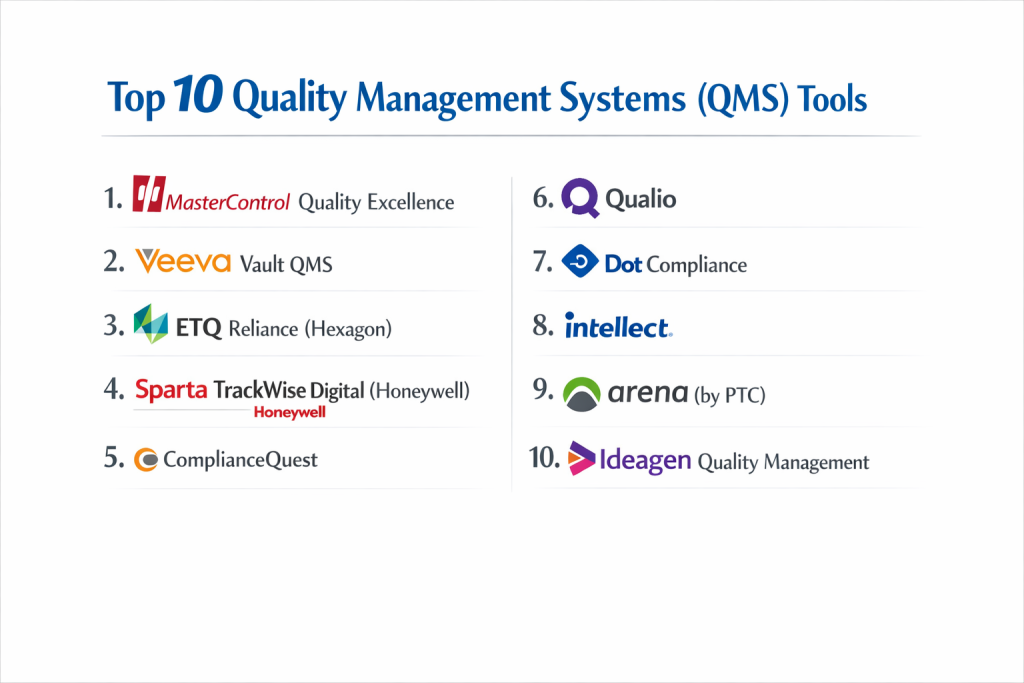
Top 10 Quality Management Systems (QMS) Tools
1 — MasterControl Quality Excellence
MasterControl is a market leader in the Life Sciences sector, known for its deep focus on regulatory compliance and automated document workflows.
- Key features:
- Connected Quality: Links CAPA, Deviations, and Non-conformances in a single ecosystem.
- Audit Management: Streamlines the entire audit lifecycle, from scheduling to finding resolution.
- Training Control: Automatically triggers training tasks when a standard operating procedure (SOP) is updated.
- Supplier Management: Centralized portal for tracking supplier quality and scorecards.
- Risk Management: Integrated tools for FMEA (Failure Mode and Effects Analysis).
- Pros:
- Unrivaled for FDA and ISO compliance in pharmaceutical and medical device sectors.
- Highly automated; it significantly reduces the “human error” factor in documentation.
- Cons:
- High cost of ownership makes it less accessible for small businesses.
- The interface can feel overly complex for teams not used to heavy regulation.
- Security & compliance: 21 CFR Part 11 compliant, SOC 2 Type II, GDPR, HIPAA, and ISO 27001.
- Support & community: Extensive “MasterControl University,” global user groups, and 24/7 enterprise-grade support.
2 — Veeva Vault QMS
Veeva Vault is a cloud-native platform specifically built for the global Life Sciences industry, emphasizing speed and unified data.
- Key features:
- Unified Platform: Integrates Quality, Clinical, and Regulatory data in one place.
- Quality Records: Real-time tracking of deviations, complaints, and lab investigations.
- Supplier Quality: Real-time collaboration tools for external manufacturing partners.
- Mobile Accessibility: Fully responsive design for quality checks on the move.
- Automated Reporting: Pre-built dashboards for executive quality reviews.
- Pros:
- Best-in-class for global pharmaceutical firms requiring multi-region compliance.
- Very high performance with a modern, “clean” web interface.
- Cons:
- Very narrow industry focus (almost exclusively Life Sciences).
- Can be difficult to customize for non-standard manufacturing processes.
- Security & compliance: HIPAA, GDPR, 21 CFR Part 11, and Annex 11 compliant.
- Support & community: Strong professional services, localized global support, and a robust community forum.
3 — ETQ Reliance (Hexagon)
ETQ Reliance is a highly flexible, platform-based QMS used by major brands across automotive, food and beverage, and electronics.
- Key features:
- Modular App Store: Over 40 pre-built applications (CAPA, Change Management, etc.).
- Automated Workflows: Highly customizable drag-and-drop workflow designer.
- Corrective Action (CAPA): Sophisticated root-cause analysis tools integrated into the flow.
- Risk Register: Centralized tracking of enterprise-wide quality risks.
- Data Analytics: Powerful “Insights” engine for predicting quality trends.
- Pros:
- Incredible flexibility; you can build almost any quality process you can imagine.
- Strong cross-industry utility (equally good for a car plant or a soda factory).
- Cons:
- Implementation time can be lengthy due to the high level of customization.
- Requires a dedicated “Admin” to manage the complexity of the platform.
- Security & compliance: ISO 27001, SOC 2, and supports 21 CFR Part 11 and various ISO standards.
- Support & community: Extensive partner network, “ETQ Academy,” and strong annual user conferences.
4 — Sparta TrackWise Digital (Honeywell)
TrackWise is one of the most established names in QMS, now offering a digital, Salesforce-based cloud solution for enterprise quality.
- Key features:
- Quality Events: Streamlined handling of out-of-specification (OOS) results.
- Complaints Management: Direct integration between customer service and quality teams.
- AI-Powered Insights: Uses Honeywell’s data engine to spot quality trends.
- Audit Readiness: Continuous compliance monitoring for “always-on” audit prep.
- Scalability: Built on the Salesforce Lightning platform for massive global scale.
- Pros:
- Proven track record with the world’s largest Fortune 500 manufacturers.
- Benefit from the Salesforce ecosystem’s uptime and security.
- Cons:
- Pricing is at the highest end of the market.
- The UI, while modern, carries the “baggage” of Salesforce’s dense navigation.
- Security & compliance: SOC 2, HIPAA, GDPR, and FedRAMP authorized.
- Support & community: Global enterprise support, extensive certification programs, and a massive user base.
5 — ComplianceQuest
ComplianceQuest is a modern, native Salesforce QMS that focuses on high-growth companies looking for a scalable, easy-to-deploy solution.
- Key features:
- Change Management: Detailed tracking of engineering and process changes.
- Health & Safety (EHS): Unique integration of safety and quality in one tool.
- Inspection Management: Mobile-first tool for floor-level quality checks.
- Environmental Tracking: Supports ESG initiatives alongside quality.
- AI Integration: “Social” features for team collaboration on quality issues.
- Pros:
- Very fast implementation compared to legacy systems like MasterControl.
- Excellent value for mid-market companies that are already on Salesforce.
- Cons:
- Being “Salesforce native” means you are locked into that ecosystem.
- Less specialized for ultra-niche chemical or pharma processes than Veeva.
- Security & compliance: ISO 9001, AS9100, IATF 16949, and 21 CFR Part 11.
- Support & community: Active LinkedIn community, strong webinars, and 24/5 support.
6 — Qualio
Qualio is the leading QMS for startups and scaling companies in the life sciences, known for its “simplicity-first” philosophy.
- Key features:
- Rapid Onboarding: Can be live in as little as 60 days.
- Document Control: Simplified approval cycles and version history.
- Training Management: Automated email notifications for overdue training.
- Cloud-Native Design: Zero hardware or server maintenance required.
- Compliance Guardrails: Pre-built templates for FDA and ISO requirements.
- Pros:
- The most user-friendly interface in the QMS world; requires almost zero training.
- Transparent pricing and “Startup friendly” packages.
- Cons:
- Lacks the deep customization features of ETQ Reliance or TrackWise.
- Not ideal for massive conglomerates with 50+ manufacturing sites.
- Security & compliance: SOC 2 Type II, GDPR, and 21 CFR Part 11.
- Support & community: Excellent “Qualio Plus” consulting services and a vibrant startup community.
7 — Dot Compliance
Dot Compliance provides a “QMS in a Box,” leveraging the Salesforce platform to offer pre-configured solutions for small and mid-sized pharma.
- Key features:
- Ready-to-Use: Comes with pre-validated modules for immediate use.
- Asset Management: Track calibration and maintenance of lab equipment.
- CAPA & Deviations: Standardized flows for fast incident resolution.
- Cost-Effective Validation: Significantly reduces the cost of software validation.
- Batch Release: Tools for streamlining the final release of products.
- Pros:
- Eliminates the “blank page” problem—everything is pre-configured.
- Very strong for companies that need to meet FDA requirements on a budget.
- Cons:
- Limited flexibility to change the “standard” workflows.
- Customer support can be slower than the “Big Three” providers.
- Security & compliance: 21 CFR Part 11, EU Annex 11, and GDPR.
- Support & community: Good documentation and personalized onboarding for new clients.
8 — Intellect
Intellect is a highly flexible QMS that differentiates itself with a “No-Code” platform, allowing quality managers to build their own apps.
- Key features:
- Intellect No-Code Platform: Drag-and-drop tool for creating custom quality forms.
- Document Control: Robust management of policies, procedures, and work instructions.
- Corrective Actions: Link quality data to specific employee performance.
- Audit Management: Offline mobile auditing for remote sites.
- Supplier Management: Comprehensive tracking of external quality levels.
- Pros:
- You aren’t “stuck” with the vendor’s vision; you can build exactly what you need.
- Mobile app is one of the best for field-based quality inspections.
- Cons:
- Requires a “tinkerer” mindset to get the most out of the no-code features.
- Initial setup of the custom apps can be time-consuming.
- Security & compliance: ISO 9001, 13485, 14001, and 21 CFR Part 11.
- Support & community: Strong professional services team and helpful online community forum.
9 — Arena QMS (by PTC)
Arena is a combined PLM and QMS solution, making it the top choice for companies that want quality deeply integrated into the product design phase.
- Key features:
- Unified Product/Quality Record: Quality data is linked directly to the BOM (Bill of Materials).
- Change Control: Seamless flow between engineering changes and quality updates.
- Training Records: Links training requirements to specific product versions.
- Design History File (DHF): Automated generation for medical device firms.
- Collaborative Quality: Direct access for suppliers to view quality standards.
- Pros:
- Eliminates the silo between Engineering and Quality.
- Excellent for high-tech and electronic manufacturers.
- Cons:
- If you don’t need the PLM features, the system may be overkill.
- Not as “process-focused” as a standalone tool like ETQ.
- Security & compliance: SOC 2 Type II, 21 CFR Part 11, and GDPR.
- Support & community: Part of the PTC ecosystem; excellent enterprise support and training.
10 — Ideagen Quality Management
Ideagen (formerly Coruson/GRC) is a global leader in “Safety and Quality,” particularly strong in aviation, rail, and heavy manufacturing.
- Key features:
- Incident Reporting: Simplified tools for staff to report quality or safety issues.
- Risk Management: High-end heat maps and risk visualization.
- Document Control: Secure, centralized repository with deep audit trails.
- Competency Tracking: Ensures all staff are qualified for their specific roles.
- Mobile Auditing: High-performance app for conducting inspections in the field.
- Pros:
- The best choice for “Safety-Critical” industries where quality and life-safety overlap.
- Extremely robust audit trails that stand up to the toughest regulators.
- Cons:
- The interface can feel a bit “corporate” and heavy.
- Less focus on the “Life Sciences” specific features like eBR.
- Security & compliance: ISO 9001, 27001, AS9100, and GDPR.
- Support & community: 24/7 global support, dedicated account managers, and regional user groups.
Comparison Table
| Tool Name | Best For | Platform(s) Supported | Standout Feature | Rating (TrueReview) |
| MasterControl | Pharma & Med-Tech | Cloud (SaaS) | Integrated Training Control | 4.6 / 5 |
| Veeva Vault | Global Life Sciences | Cloud (SaaS) | Unified Regulatory/Quality | 4.8 / 5 |
| ETQ Reliance | General Manufacturing | Cloud, On-Prem | 40+ Modular Apps | 4.7 / 5 |
| Sparta TrackWise | Fortune 500 Enterprise | Cloud (Salesforce) | AI Quality Insights | 4.5 / 5 |
| ComplianceQuest | High-Growth Mid-Market | Cloud (Salesforce) | Integrated EHS & Quality | 4.7 / 5 |
| Qualio | Scale-ups & Startups | Cloud (SaaS) | Fastest Implementation | 4.9 / 5 |
| Dot Compliance | Small Pharma/Biotech | Cloud (Salesforce) | Pre-validated “In a Box” | 4.4 / 5 |
| Intellect | Custom Workflows | Cloud (No-Code) | Full No-Code Customization | 4.6 / 5 |
| Arena QMS | Electronics / High-Tech | Cloud (SaaS) | BOM-Linked Quality | 4.5 / 5 |
| Ideagen | Aviation & Heavy Ind. | Cloud, On-Prem | Safety-Quality Synergy | 4.3 / 5 |
Evaluation & Scoring of Quality Management Systems (QMS)
| Criteria | Weight | Evaluation Logic |
| Core Features | 25% | Presence of CAPA, Doc Control, Training, Audit, and Risk modules. |
| Ease of Use | 15% | Intuitiveness for shop-floor operators and admin configuration simplicity. |
| Integrations | 15% | Strength of API and native links to ERP, MES, and PLM systems. |
| Security & Compliance | 10% | Support for 21 CFR Part 11, GDPR, SOC 2, and ISO standards. |
| Performance | 10% | Software uptime, search speed for documents, and mobile performance. |
| Support & Community | 10% | Quality of documentation, forums, and consultant availability. |
| Price / Value | 15% | Total Cost of Ownership relative to features and compliance risk reduction. |
Which Quality Management System Is Right for You?
Solo Users vs SMB vs Mid-Market vs Enterprise
If you are a Small Business (SMB) or a startup in the medical space, Qualio or Dot Compliance are the clear winners. They allow you to get “audit ready” without hiring a dedicated IT team. Mid-Market firms with growing complexity should look at ComplianceQuest or Intellect, which offer more flexibility to handle varied product lines. For Global Enterprises, the choice usually falls between MasterControl, Veeva, or TrackWise, as these are the only tools capable of managing quality across thousands of employees and dozens of international regulatory bodies.
Budget-Conscious vs Premium Solutions
If you are Budget-Conscious, starting with Qualio or Odoo (with its quality module) is a great way to build a foundation. If you have a Premium Budget, investing in MasterControl or ETQ Reliance pays for itself by preventing just one failed FDA audit or product recall, which could cost a company millions in fines and lost revenue.
Feature Depth vs Ease of Use
If you need Feature Depth—especially for complex risk modeling and multi-site supplier management—ETQ Reliance and TrackWise are unrivaled. However, if your primary goal is Ease of Use to ensure that employees actually follow the procedures, Qualio and ComplianceQuest offer the most modern, “frictionless” experience.
Integration and Scalability Needs
For companies where the product design changes frequently, Arena QMS is the best because of its native PLM integration. Regarding Scalability, the Salesforce-based systems (ComplianceQuest, Dot Compliance, TrackWise) have a natural advantage because they leverage a world-class infrastructure that can handle millions of records without slowing down.
Security and Compliance Requirements
If your product is regulated by the FDA, you must ensure the vendor provides a “Validation Package.” MasterControl, Veeva, and Qualio are specifically built for this and will handle the 21 CFR Part 11 requirements out of the box. For Aviation or Automotive, ensure the tool (like Ideagen or ETQ) has specific templates for AS9100 or IATF 16949.
Frequently Asked Questions (FAQs)
1. What is the difference between QMS and ERP?
An ERP manages the business resources (money, inventory, orders), while a QMS manages the quality and processes (SOPs, CAPA, compliance). Most companies use both and integrate them.
2. Can I use SharePoint as a QMS?
Technically, yes, for document storage. However, SharePoint lacks the native “Quality Logic” like automated CAPA workflows, training tracking, and 21 CFR Part 11 electronic signatures that a dedicated QMS provides.
3. What is “Software Validation” in QMS?
In regulated industries (like Pharma), you must prove that your software consistently does what it claims to do. QMS vendors often provide “Validation Packages” to help you pass this regulatory requirement.
4. How long does a QMS implementation take?
A “Lite” system like Qualio can be up in 1-2 months. An enterprise-wide rollout of MasterControl or TrackWise can take 6-12 months.
5. What is a “Non-conformance”?
It is any time a product or process does not meet its specified requirements. The QMS tracks these incidents and triggers a CAPA to ensure the problem doesn’t happen again.
6. Does a QMS help with ISO 9001 certification?
Yes. It centralizes all the evidence, document control, and internal audits required for the certification, making the auditor’s job much easier.
7. Can I use these tools on a mobile phone?
Most modern systems like Intellect, ComplianceQuest, and Ideagen have native mobile apps for on-the-spot inspections and incident reporting.
8. What is CAPA?
It stands for Corrective and Preventive Action. It is a process used to investigate a quality failure, correct it, and implement steps to prevent its recurrence.
9. Is my data safe in a cloud QMS?
Yes. Top-tier vendors use encrypted data centers (AWS/Azure/Salesforce) that meet higher security standards (SOC 2, ISO 27001) than most private corporate servers.
10. What is the “Cost of Quality”?
It is the total cost associated with preventing, detecting, and fixing quality issues. A good QMS reduces this cost by preventing expensive defects and recalls.
Conclusion
Choosing the right Quality Management System (QMS) is a defining moment for any organization that values its brand and its customers. The software you select will become the “Central Nervous System” for your operations, governing how your team reacts to mistakes and how they strive for improvement. If you are in the high-stakes world of pharmaceuticals, the rigor of MasterControl or Veeva is indispensable. If you are an agile manufacturer looking for efficiency, ETQ Reliance or ComplianceQuest will provide the flexibility you need.
Ultimately, the “best” QMS is the one that your employees will actually use. Quality is not a department—it is a mindset. By choosing a system that balances compliance with a great user experience, you turn “Quality” from a chore into a competitive advantage.