Introduction
Public Transit Scheduling Tools are specialized software platforms designed to plan, optimize, and manage the complex timetables of buses, trains, trams, and ferries. At its heart, this technology takes the “puzzle” of city movement—drivers, vehicles, routes, and passenger demand—and solves it using high-powered math and logic. These systems allow transit agencies to build efficient paths for their fleets, ensuring that vehicles arrive on time while minimizing the number of “deadhead” miles (miles driven without passengers). In a world where urban populations are growing rapidly, these tools act as the digital architect for a city’s mobility.
The importance of these tools cannot be overstated. Without them, transit planners would have to manually calculate thousands of variables, leading to inefficient routes, driver burnout, and wasted tax dollars. Modern scheduling software does more than just make a timetable; it optimizes the “run cutting” process (dividing routes into daily shifts for drivers) and the “rostering” process (assigning those shifts to specific people based on labor laws and union rules). By making transit more reliable and frequent, these tools encourage people to leave their cars at home, which directly reduces traffic congestion and urban air pollution.
Key Real-World Use Cases
- Timetable Creation: Building minute-by-minute schedules that account for peak hour traffic and passenger boarding times.
- Driver Rostering: Managing complex shift rotations while ensuring every driver gets their mandatory rest breaks.
- Disruption Management: Quickly rerouting buses and notifying the public during road closures or emergencies.
- Cost Modeling: Simulating a new route to see exactly how much it will cost in fuel and wages before it is launched.
What to Look For (Evaluation Criteria)
When evaluating a scheduling tool, you must prioritize optimization power. The best tools use advanced algorithms to find the most efficient schedules in seconds. Ease of use is also vital, as planners need to be able to make quick changes without needing a computer science degree. Look for GTFS (General Transit Feed Specification) support, which ensures your schedules can be read by Google Maps and Apple Maps. Finally, ensure the tool has robust labor law compliance features to prevent scheduling errors that could lead to legal issues or union disputes.
Best for: Municipal transit authorities, private bus operators, city planners, and regional transport departments. It is essential for organizations managing 10 or more vehicles that need to balance fuel costs, driver satisfaction, and passenger reliability.
Not ideal for: Individual taxi drivers or very small shuttle services that operate on-demand without a fixed schedule. For those users, a simple GPS app or a basic dispatching tool is often more appropriate and significantly cheaper.
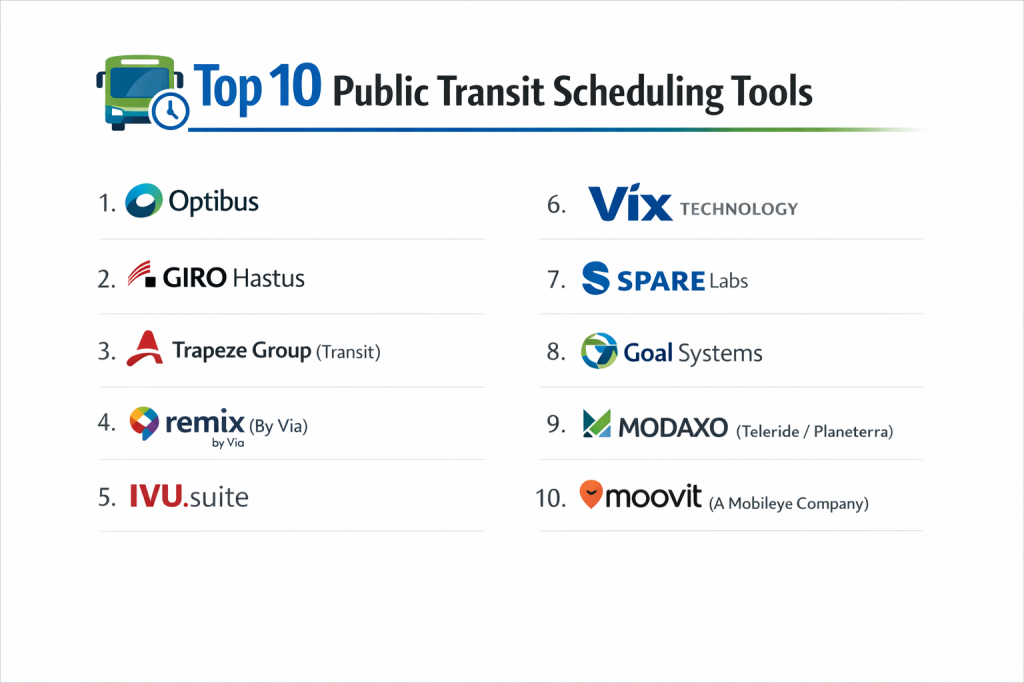
Top 10 Public Transit Scheduling Tools
1 — Optibus
Optibus is a modern, cloud-native platform that has taken the industry by storm. It uses artificial intelligence and high-speed “optimization-as-a-service” to create schedules in minutes that used to take weeks.
- Key features:
- Rapid cloud-based optimization for scheduling and dispatching.
- Interactive map-based interface for route planning.
- Real-time “what-if” simulations for scenario planning.
- Automated driver rostering with labor rule compliance.
- Electric vehicle (EV) fleet optimization including charging schedules.
- GTFS and GTFS-Realtime export capabilities.
- Pros:
- The speed of the optimization engine is significantly faster than legacy tools.
- The user interface is clean, modern, and very easy for new planners to learn.
- Cons:
- Being a premium cloud solution, the subscription cost can be high.
- Requires a high-quality internet connection to perform complex optimizations.
- Security & compliance: SOC 2 Type II certified, GDPR compliant, and utilizes high-level data encryption and SSO.
- Support & community: Offers a comprehensive online academy, 24/7 technical support, and a very active user community globally.
2 — GIRO Hastus
Hastus is one of the most respected and long-standing names in the transit world. It is the powerhouse behind some of the largest transit agencies in the world, including those in New York, London, and Paris.
- Key features:
- Deep, industrial-strength algorithms for massive-scale scheduling.
- Sophisticated workforce management and daily operations tools.
- Integrated modules for rail, bus, and light rail.
- Detailed analytics for operational and financial performance.
- Highly customizable rule engines for complex union contracts.
- Long-term strategic planning and bid management.
- Pros:
- Unmatched ability to handle the extreme complexity of mega-cities.
- Extremely reliable with a 40-year track record in the industry.
- Cons:
- The interface can feel dated and “engineer-heavy.”
- Implementation is a massive undertaking that can take over a year.
- Security & compliance: ISO 27001 certified and provides extensive audit logs for all system changes.
- Support & community: High-touch enterprise support and an elite network of specialized consultants.
3 — Trapeze Group (Transit)
Trapeze Group offers a massive ecosystem of transit tools. Their scheduling module is designed to be the central “brain” of a transit agency, connecting everything from the depot to the passenger’s phone.
- Key features:
- Comprehensive enterprise asset management integration.
- Advanced “Run Cutting” to create the most efficient shifts.
- Integrated paratransit and fixed-route scheduling.
- Real-time passenger information system (PIS) feeds.
- Driver self-service portals for shift bidding.
- Robust reporting for government funding and compliance.
- Pros:
- It is part of a giant ecosystem, making it great if you use other Trapeze products.
- Excellent at managing both fixed routes and flexible “on-demand” services.
- Cons:
- The system is famously complex and requires significant training.
- Can be very expensive when adding multiple modules.
- Security & compliance: Adheres to SOC standards and features enterprise-grade encryption for personnel data.
- Support & community: Massive global presence with dedicated support teams in almost every region.
4 — Remix (By Via)
Remix started as a route-planning tool and has expanded into a full scheduling suite. It is widely praised for its beautiful, easy-to-use maps that help planners visualize their city.
- Key features:
- Collaborative map-based route design.
- Instant demographic impact analysis (Equity analysis).
- Simple “block” and “shift” creation.
- Cost estimation based on live route edits.
- Integrated data from various city sources (e.g., population density).
- Easy export to GTFS for public viewing.
- Pros:
- Best-in-class visualization makes it easy to present plans to city councils.
- Very fast to learn; planners can start building routes in an afternoon.
- Cons:
- Not as “mathematically deep” for massive-scale rostering as Hastus.
- Primarily focused on planning; operational day-of features are lighter.
- Security & compliance: GDPR compliant and uses secure cloud hosting with standard encryption.
- Support & community: Excellent onboarding and a very helpful library of “best practice” webinars.
5 — IVU.suite
Based in Germany, IVU offers a highly integrated system that covers the entire “door-to-door” transit process. It is the standard for many European national rail and bus operators.
- Key features:
- Seamless integration between planning and dispatch.
- Highly optimized personnel dispatching based on skill sets.
- Native support for multi-modal transit (bus, train, boat).
- Integrated ticketing and fare management connections.
- Advanced mobile app for drivers to receive their schedules.
- Real-time fleet monitoring and delay management.
- Pros:
- Exceptional integration—there is no “gap” between the plan and the operation.
- Strongest choice for agencies that manage both trains and buses in one system.
- Cons:
- Implementation is complex and usually requires significant professional services.
- The workflow is very structured, which may feel rigid for smaller agencies.
- Security & compliance: Complies with German and EU data safety laws, including GDPR and ISO 27001.
- Support & community: Strong European user base and professional enterprise support.
6 — Vix Technology
Vix focuses on the data side of transit, providing scheduling tools that are heavily integrated with real-time passenger information and automated fare collection.
- Key features:
- Real-time service management and schedule adjustment.
- Integrated passenger information for websites and bus stops.
- Performance monitoring against planned timetables.
- Support for contactless payment and fare data analysis.
- Centralized fleet management dashboard.
- Flexible API for connecting to third-party apps.
- Pros:
- Great for agencies that want to focus on “Real-Time” accuracy for passengers.
- Highly scalable for cities that are rapidly expanding their fleets.
- Cons:
- The scheduling engine itself is not as “algorithm-heavy” as Optibus.
- Can require proprietary hardware for the best experience.
- Security & compliance: PCI-DSS compliant for payments and features secure cloud architecture.
- Support & community: Reliable global support with a focus on high-traffic transit hubs.
7 — Spare Labs
Spare focuses on “New Mobility,” specifically helping agencies merge their fixed-route buses with “on-demand” micro-transit (like city-run Uber-style vans).
- Key features:
- Unified platform for fixed-route and on-demand scheduling.
- Automated trip matching for micro-transit.
- Real-time driver apps and passenger apps.
- Advanced data analytics for “zone-based” demand.
- Seamless integration with paratransit workflows.
- Easy setup for “flex” routes that change based on demand.
- Pros:
- The best tool for cities trying to innovate with on-demand shuttles.
- Very modern, app-first design that passengers and drivers love.
- Cons:
- Not a replacement for a heavy-duty subway or tram scheduling system.
- Focused more on smaller vehicles rather than 60-foot articulated buses.
- Security & compliance: GDPR and HIPAA compliant (important for paratransit), using modern web security.
- Support & community: Fast-growing company with very responsive chat and email support.
8 — Goal Systems
Goal Systems is a Spanish provider that specializes in high-end optimization for complex rail and bus environments. They are known for their “World Class” mathematical solvers.
- Key features:
- GoalBus and GoalRail specialized modules.
- High-level optimization of shifts and duties.
- Long-term strategic fleet and personnel planning.
- Conflict resolution for rail slot management.
- Integrated cost and budget control.
- Advanced scenarios for “Green” fleet transitions (EVs).
- Pros:
- Some of the best mathematical “solvers” in the industry.
- Very strong in the rail sector where timing must be perfect to the second.
- Cons:
- The software requires a high level of training to master.
- Not as visually intuitive as Remix or Optibus.
- Security & compliance: ISO 27001 and ISO 9001 certified with standard data protection.
- Support & community: Strong presence in Latin America and Europe with specialized engineering support.
9 — Modaxo (Teleride / Planeterra)
Modaxo is a collective of transit technology companies. They offer several scheduling brands (like Planeterra) that are designed for different market segments.
- Key features:
- Proven scheduling and rostering engines.
- Strong focus on community transit and paratransit.
- Integrated maintenance and workshop scheduling.
- Automated dispatching for non-emergency medical transport.
- Scalable from 5 vehicles to 5,000.
- Localized compliance for different country labor laws.
- Pros:
- Very reliable “meat and potatoes” software that gets the job done.
- Excellent local knowledge in many different global markets.
- Cons:
- Can feel a bit fragmented since they own many different brands.
- Some of their legacy tools have a steep learning curve.
- Security & compliance: Varies by specific brand; generally meets enterprise SOC and GDPR standards.
- Support & community: Large global network with significant resources for long-term maintenance.
10 — Moovit (A Mobileye Company)
While mostly known as a passenger app, Moovit (owned by Intel/Mobileye) provides a powerful “Transit On-Demand” and scheduling suite for cities.
- Key features:
- Massive data sets of passenger movement used to plan routes.
- Integrated “Urban Mobility” dashboard.
- Dynamic on-demand scheduling.
- Real-time fleet tracking and schedule adherence.
- Direct connection to the world’s most popular transit app.
- Simple, web-based planning interface.
- Pros:
- Uses “Big Data” from millions of users to help you decide where to put new routes.
- Extremely high visibility for your schedules to the public.
- Cons:
- More focused on the “data” and “on-demand” side than heavy-duty driver rostering.
- Being part of a giant corporation can mean less “personal” support for small agencies.
- Security & compliance: Benefits from Intel-level cybersecurity and international privacy compliance.
- Support & community: Strong digital support and a massive global network of “Mooviters” who map cities.
Comparison Table
| Tool Name | Best For | Platform(s) Supported | Standout Feature | Rating |
| Optibus | Modern Cloud Scheduling | Web-based | AI Optimization Speed | 4.8 / 5 |
| GIRO Hastus | Global Mega-Cities | Windows / Web | Industrial-Scale Logic | 4.9 / 5 |
| Trapeze | All-in-One Agencies | Web / Desktop | Enterprise Ecosystem | 4.6 / 5 |
| Remix | Visual Route Planning | Web-based | Map Visualization | 4.7 / 5 |
| IVU.suite | Rail/Bus Integration | Windows / Web | End-to-End Operation | N/A |
| Vix Tech | Real-Time Info focus | Web / Cloud | Fare/Schedule Sync | N/A |
| Spare Labs | On-Demand/Micro-transit | Web / Mobile | Fixed/On-Demand Hybrid | 4.8 / 5 |
| Goal Systems | Rail Optimization | Desktop / Web | High-End Math Solvers | N/A |
| Modaxo | Community Transit | Varies | Local Market Support | N/A |
| Moovit | Data-Driven Planning | Web / Cloud | Passenger Data Insights | 4.5 / 5 |
Evaluation & Scoring of Public Transit Scheduling Tools
We evaluate these tools based on how they solve the daily “pain points” of a transit agency.
| Category | Weight | Average Score | Evaluation Logic |
| Core Features | 25% | 9.0/10 | Includes run cutting, rostering, and GTFS export. |
| Ease of Use | 15% | 7.0/10 | Modern cloud tools score high; legacy tools score lower. |
| Integrations | 15% | 8.5/10 | Must connect to GPS, Payroll, and Passenger apps. |
| Security & Compliance | 10% | 9.5/10 | Critical for managing driver personal data and city info. |
| Performance | 10% | 9.0/10 | Ability to handle millions of schedule combinations fast. |
| Support | 10% | 8.0/10 | 24/7 support is vital during morning “roll-out.” |
| Price / Value | 15% | 7.5/10 | High cost is justified by fuel and labor savings. |
Which Public Transit Scheduling Tool Is Right for You?
Solo Users vs SMB vs Mid-Market vs Enterprise
In public transit, “solo users” are rare, but for Small Bus Operators with under 20 vehicles, Spare Labs or Remix are the best choices because they don’t require a dedicated IT department. Mid-Market regional agencies (50–200 vehicles) will find the perfect balance in Optibus, which offers enterprise power with a modern interface. For Global Enterprises (Subways, huge city fleets), GIRO Hastus or Trapeze are the only tools with the proven “muscle” to handle thousands of employees and millions of passengers.
Budget-Conscious vs Premium Solutions
If you are on a tight municipal budget, Remix offers excellent value for the planning stage, and Moovit can help with data. However, for a full operational system, Optibus is often seen as a “Premium” solution that pays for itself by finding 5% or 10% in efficiency savings—which in the transit world can equal millions of dollars in fuel and overtime.
Feature Depth vs Ease of Use
This is the classic trade-off. Hastus has incredible depth but requires months of training. Optibus and Remix prioritize ease of use, meaning you can train a new planner in a week. If your agency has high staff turnover or needs to be agile, choose Ease of Use. If you have a stable team of “master schedulers” who need to squeeze every penny of efficiency out of a complex rail system, choose Feature Depth.
Integration and Scalability Needs
Do you need the software to “talk” to the fare boxes? Do you need it to automatically send data to the bus stop displays? If so, look at integrated suites like IVU.suite or Vix Technology. If you want a standalone scheduling “brain” that connects to everything via API, Optibus is the most scalable modern choice.
Security and Compliance Requirements
Driver data is sensitive. Any tool you choose must be GDPR or SOC 2 compliant. More importantly, the tool must be able to handle Union Rules. If your contract says a driver must have a 42-minute break every 4 hours, and the software misses it, you face a strike or a lawsuit. Tools like Hastus and Goal Systems have the most robust “rule-checking” engines in the world.
Frequently Asked Questions (FAQs)
1. What is “Run Cutting” in transit scheduling?
Run cutting is the process of taking a full day of bus trips and “cutting” them into individual shifts that can be worked by drivers while following labor laws.
2. Can these tools help with Electric Vehicles (EVs)?
Yes. Modern tools like Optibus now include “EV Optimization,” which tells you when a bus needs to charge, for how long, and which charger it should use to avoid peak electricity rates.
3. Does the software include a driver mobile app?
Many premium tools (IVU, Optibus, Spare) include an app where drivers can see their schedules, request time off, and bid on new shifts.
4. How does the software handle traffic data?
Tools like Remix and Optibus can pull in historical traffic data to help planners create more realistic schedules that don’t result in buses being late during rush hour.
5. Is it hard to switch from paper scheduling to software?
It is a big change. It requires “cleaning” your data first. Most vendors provide specialized “onboarding” teams to help you move your old routes into the new system.
6. What is GTFS?
GTFS stands for General Transit Feed Specification. It is the global standard format that allows your schedules to appear on Google Maps, Apple Maps, and other trip-planning apps.
7. Can the software manage subway and rail as well as buses?
Yes, but rail scheduling is more complex due to “track slots.” Specialized tools like GoalRail or Hastus are the industry leaders for rail.
8. How much does this software cost?
Most use a “SaaS” model where you pay per vehicle, per month. It can range from $50 per bus for simple tools to hundreds per bus for high-end optimization suites.
9. Can I use these tools for paratransit (disabled access)?
Yes. Many suites (Trapeze, Spare, Modaxo) have dedicated modules for paratransit that handle the specific door-to-door needs of those passengers.
10. What is a “What-If” simulation?
This allows you to test changes—like “What if we closed this bridge?” or “What if fuel prices went up 20%?”—to see the impact on your budget and service without actually changing anything in the real world.
Conclusion
Selecting a Public Transit Scheduling Tool is a decision that defines the “rhythm” of a city. The right software does more than just move buses; it ensures that drivers are rested, budgets are respected, and passengers can rely on the service to get to work on time.
The “best” tool is not the one with the most features, but the one that solves your agency’s specific challenge. If you are struggling with a complex union contract, Hastus is your best friend. If you want to launch a modern, on-demand shuttle service, Spare Labs is the way to go. If you need to modernize your bus fleet and move to electric vehicles quickly, Optibus is the market leader.
Ultimately, the goal of all these tools is to make public transit a first-choice option for citizens. By using high-tech scheduling, you turn a chaotic city into a smoothly flowing network.