Introduction
Public Relations (PR) platforms are specialized software-as-a-service (SaaS) solutions designed to help organizations manage their reputation, media relationships, and brand communication from a centralized hub. These platforms consolidate several critical workflows: discovering relevant journalists and influencers, distributing press releases, monitoring media mentions across the web and social media, and analyzing the impact of earned media coverage. By providing massive databases of media contacts and sophisticated tracking tools, PR platforms transition the industry away from manual spreadsheets and “spray and pray” pitching toward data-driven strategic storytelling.
The importance of these platforms is found in their ability to cut through the digital noise. In a landscape where journalists receive hundreds of pitches daily, PR platforms offer “media intelligence” that tells a communicator exactly who is writing about a specific topic and how to reach them effectively. Key real-world use cases include managing a product launch across global markets, tracking brand sentiment during a corporate crisis, and measuring the ROI of a PR campaign against a competitor’s share of voice. When evaluating these tools, users should prioritize database accuracy, the breadth of media monitoring (online, print, broadcast, and social), and the depth of reporting analytics.
Best for: PR agencies, corporate communications departments, brand managers, and high-growth startups. These tools are essential for organizations that need to maintain a consistent public image and scale their media outreach across regional or global markets.
Not ideal for: Very small local businesses or “solopreneurs” with limited news cycles who might find social media and direct local networking more cost-effective. They are also not a fit for pure SEO agencies that prioritize backlink quantity over journalistic relationship quality.
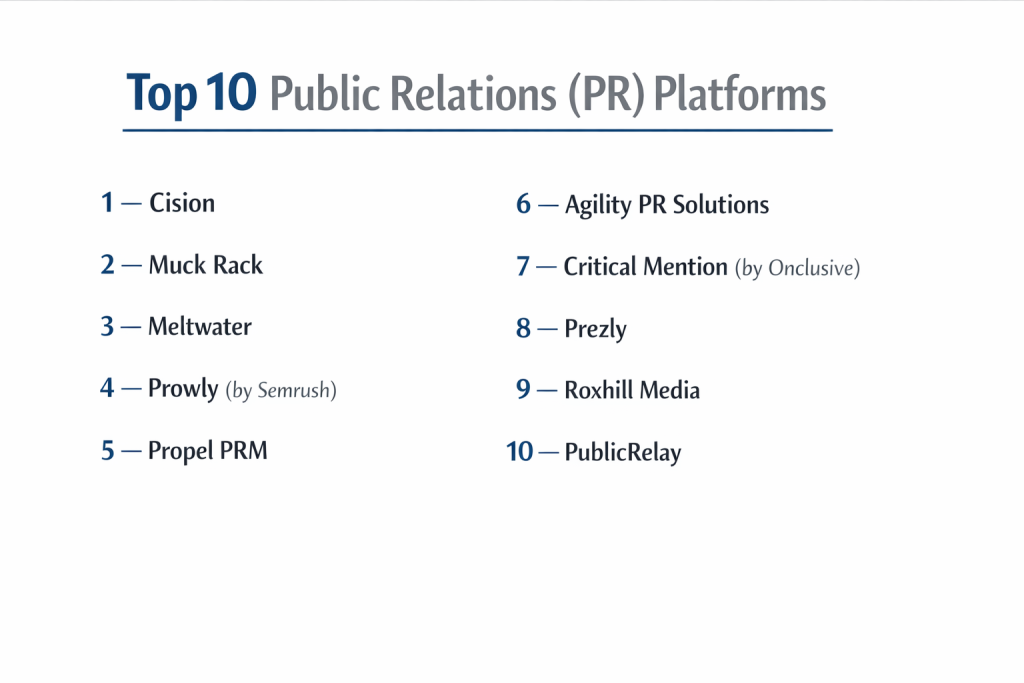
Top 10 Public Relations (PR) Platforms
1 — Cision
Cision is often considered the “gold standard” for enterprise PR. It provides a massive, end-to-end ecosystem that covers everything from wire distribution via PR Newswire to advanced “Impact” analytics that track how PR influences consumer behavior.
- Key features
- The world’s largest media database with over 1.1 million verified journalists and influencers.
- Integrated PR Newswire distribution for guaranteed reach to major news outlets.
- Advanced media monitoring across online, print, broadcast, and social media.
- “Cision Impact” data which uses ad-tech to track actual website conversions from earned media.
- Automated executive reporting and custom dashboards for boardroom presentations.
- Influencer discovery tools based on audience demographics and engagement.
- Robust CRM-style relationship management for tracking outreach history.
- Pros
- Unrivaled depth of data and distribution reach for global organizations.
- High-level attribution metrics that go far beyond simple “impressions.”
- Cons
- The platform is famously expensive and often out of reach for smaller agencies.
- The user interface can feel clunky and fragmented due to various acquisitions.
- Security & compliance: SOC 2 Type II, GDPR compliant, 2FA, and encrypted data transmission.
- Support & community: Dedicated account managers, “Cision University” training, and 24/7 global support.
2 — Muck Rack
Muck Rack has disrupted the industry with a modern, user-friendly interface and a “journalist-first” approach. It is highly regarded for its real-time database updates, which are often pulled directly from journalists’ social media activity.
- Key features
- A self-updating database that tracks what journalists are tweeting and writing in real-time.
- “Muck Rack Alerts” that notify you the second a specific keyword is mentioned.
- Portfolio hosting for journalists, which ensures high data accuracy for PR pros.
- Relationship management tools that show a shared history of team interactions with a reporter.
- Automated “Coverage Books” that compile press clippings into professional reports.
- Advanced search filters including location, beat, and even specific phrases used in articles.
- Integration with Google Analytics to see the traffic impact of earned media.
- Pros
- Known for having the most accurate and up-to-date contact information in the market.
- Extremely intuitive design that requires almost zero training for new users.
- Cons
- Smaller historical archive of print and broadcast compared to Cision.
- Pricing is premium and typically involves multi-year commitments.
- Security & compliance: GDPR compliant, SSO support, and SOC 2 Type II.
- Support & community: Highly responsive chat support and a very active community of PR professionals.
3 — Meltwater
Meltwater is a powerhouse in “Media Intelligence,” leveraging AI to analyze billions of data points. It is particularly strong in social listening and helping brands understand the broader conversation surrounding their industry.
- Key features
- AI-driven media monitoring across global online news, social media, and broadcast.
- Robust influencer marketing suite for finding and managing social creators.
- Competitive benchmarking tools to compare your brand’s “Share of Voice” against rivals.
- Newsletter and newsfeed tools to distribute internal briefings to executives.
- Advanced sentiment analysis available in over 100 languages.
- Integrated press release distribution and media pitching tools.
- API access for developers to pipe media data into custom business dashboards.
- Pros
- Exceptional social media listening and sentiment analysis capabilities.
- Global reach with localized support in dozens of countries.
- Cons
- Users sometimes report that the media database is not as frequently updated as Muck Rack.
- The vast array of features can lead to a steep learning curve for beginners.
- Security & compliance: ISO 27001, GDPR, and SOC 2 Type II compliant.
- Support & community: Large library of webinars, “Meltwater Academy,” and dedicated success managers.
4 — Prowly (by Semrush)
Prowly is a more accessible, modern PR tool that focuses on “Brand Newsrooms” and streamlined pitching. Now owned by Semrush, it integrates well with digital marketing workflows.
- Key features
- Interactive “Brand Newsrooms” that host your press releases, assets, and contact info.
- Smart media database with AI-driven suggestions based on your press release content.
- Email pitching tool that tracks opens, clicks, and bounces.
- “PR Reports” that automatically calculate the SEO value of your media mentions.
- Simple, clean contact management for organizing your own private media lists.
- Integration with the Semrush ecosystem for deeper keyword research.
- Discovery of over 1 million journalists across various beats and regions.
- Pros
- Much more affordable for SMBs and mid-market agencies than Cision or Meltwater.
- The “Brand Newsroom” feature is one of the best for making assets accessible to media.
- Cons
- Less robust broadcast and print monitoring than enterprise solutions.
- The global database, while good, may lack the depth of major enterprise rivals in niche regions.
- Security & compliance: GDPR compliant and uses standard SSL encryption.
- Support & community: Excellent customer service, helpful blog, and clear onboarding documentation.
5 — Propel PRM
Propel is unique because it positions itself as a “Public Relations Management” (PRM) tool, essentially a CRM built specifically for the workflows of a PR professional. It is designed to maximize the productivity of agency teams.
- Key features
- Native “Gmail” and “Outlook” integrations that allow you to pitch directly from your inbox.
- Advanced campaign management that tracks the progress of every pitch in the pipeline.
- Business outcomes analytics that show how PR activity correlates with traffic and goals.
- “Journalist database” with specialized AI that predicts the best time to send a pitch.
- Automated reporting that pulls in mentions and metrics without manual entry.
- Leaderboards for agency teams to track productivity and success rates.
- Integration with Slack for real-time notifications of media hits.
- Pros
- The best tool for agency “workflow” management and team collaboration.
- Focuses on ROI and business impact rather than just vanity metrics.
- Cons
- The interface can feel a bit “data-heavy” and complex initially.
- Requires users to be very disciplined with CRM-style logging for maximum value.
- Security & compliance: SOC 2 Type II and GDPR compliant.
- Support & community: Responsive account teams and a focus on “PR technology” thought leadership.
6 — Agility PR Solutions
Agility PR Solutions focuses on providing a high-value, easy-to-use alternative to the “Big Three.” It provides high-quality data and distribution services without the enterprise-level price tag.
- Key features
- Global media database with over 800,000 verified contacts.
- Targeted media list building using AI-assisted search filters.
- Integrated Newswire service for broad content distribution.
- Comprehensive media monitoring across all channels, including podcasts.
- Pre-built reporting templates for quick client updates.
- “Personalized Service” options where their team helps build your lists.
- Tracking of media sentiment and influencer engagement.
- Pros
- Often cited as having better customer service and “human touch” than larger rivals.
- Transparent pricing that offers a good balance of features and cost.
- Cons
- The software interface can feel slightly dated compared to Muck Rack or Prowly.
- Broadcast monitoring may occasionally have more latency than Cision.
- Security & compliance: GDPR compliant and SOC 2 (Varies).
- Support & community: Known for high-touch onboarding and personalized strategic support.
7 — Critical Mention (by Onclusive)
Critical Mention is the industry leader for “Broadcast Monitoring.” If your PR strategy relies heavily on TV and Radio coverage, this is the essential tool for your stack.
- Key features
- Real-time TV and Radio monitoring across 2,000+ stations globally.
- Instant “Speech-to-Text” searching for mentions of your brand on live air.
- Easy “Clip and Share” tools to send broadcast segments to clients or stakeholders.
- Online news and social media monitoring to round out the suite.
- Podcast monitoring—one of the few tools that tracks mentions in audio content.
- Comprehensive media contact database.
- Analytics on the “Publicity Value” and audience reach of broadcast hits.
- Pros
- Unrivaled speed and accuracy for TV and Radio alerts.
- Extremely simple tool for capturing and editing media clips.
- Cons
- The database and pitching tools are not as feature-rich as Muck Rack or Cision.
- The focus is heavily on monitoring rather than relationship management.
- Security & compliance: GDPR compliant and secure cloud hosting.
- Support & community: 24/7 client support and technical assistance for broadcast feeds.
8 — Prezly
Prezly is built around the philosophy of “Visual Storytelling.” It focuses on creating beautiful, multimedia-rich press releases and hosting them in sleek newsrooms to make a journalist’s life easier.
- Key features
- Multimedia “Stories” that allow for embedded video, high-res images, and audio.
- Private and public newsrooms with custom branding and domains.
- Integrated CRM that tracks which journalists are opening and engaging with your stories.
- Email pitching with “site-like” formatting that looks professional in any inbox.
- Multi-language newsrooms for global brand management.
- Analytics on story engagement and member activity.
- Simple “Member” management for keeping your internal press lists clean.
- Pros
- The best tool for brands that rely on visual assets (Fashion, Tech, Gaming).
- Very affordable pricing for startups and small-to-mid-sized agencies.
- Cons
- No built-in public media database (you must bring your own contacts).
- Monitoring capabilities are very limited compared to Meltwater or Cision.
- Security & compliance: GDPR compliant, encryption at rest, and SOC 2 (Varies).
- Support & community: Friendly chat support and excellent documentation on “PR best practices.”
9 — Roxhill Media
Roxhill is a specialized PR platform with a heavy focus on the UK and European media markets. It is known for its incredible “intel” on what journalists are actually looking for.
- Key features
- Deep intelligence on UK national, regional, and trade press.
- “Forward Features” database that shows upcoming editorial calendars.
- Real-time tracking of journalist job moves and beat changes.
- Integration with social media to see real-time journalist interests.
- Advanced pitching tool with tracking and analytics.
- Detailed “Journalist Profiles” that include likes/dislikes and pitching tips.
- Daily media briefings and morning “news alerts” for subscribers.
- Pros
- The highest quality data for the UK market; they often have info others miss.
- The “Forward Features” tool is invaluable for long-term editorial planning.
- Cons
- North American data is less comprehensive than US-based competitors.
- The interface is functional but can feel a bit “data-heavy” for some.
- Security & compliance: GDPR compliant and secure data storage.
- Support & community: Very active UK-based support and regular networking events.
10 — PublicRelay
PublicRelay focuses on “Human-Verified” media intelligence. Unlike tools that rely purely on AI for sentiment, PublicRelay uses human analysts to ensure the data you show your CEO is 100% accurate.
- Key features
- Human-in-the-loop analysis to verify sentiment and message pull-through.
- Custom dashboards that map media coverage to specific business goals.
- Competitive intelligence that goes deeper than simple mention counts.
- Executive-ready reporting that focuses on “quality over quantity.”
- Media database and pitching tools integrated into the analytics.
- Crisis monitoring with human alerts to filter out “false positives.”
- Deep-dive “Quarterly Reviews” conducted by their analyst team.
- Pros
- Provides the highest level of data integrity for C-suite reporting.
- Eliminates the “noise” and errors common in pure AI sentiment tools.
- Cons
- The service-heavy model makes it a very premium, high-cost solution.
- Not designed for high-volume, transactional PR pitching.
- Security & compliance: SOC 2 Type II, GDPR, and enterprise-grade encryption.
- Support & community: Dedicated analysts and a high-touch partnership model.
Comparison Table
| Tool Name | Best For | Platform(s) Supported | Standout Feature | Rating |
| Cision | Global Enterprise | Web / Mobile | PR Newswire Integration | 4.3/5 |
| Muck Rack | Modern PR Teams | Web / Mobile | Journalist-first Social Sync | 4.7/5 |
| Meltwater | Social Listening | Web / Mobile | AI-driven Media Intelligence | 4.4/5 |
| Prowly | SMB / Digital PR | Web | SEO-integrated Reporting | 4.5/5 |
| Propel PRM | Agency Workflow | Web / Outlook | CRM-style Pitch Pipeline | 4.6/5 |
| Agility PR | Mid-market Value | Web | Personalized List Building | 4.2/5 |
| Critical Mention | Broadcast Focus | Web | Real-time TV/Radio Clips | 4.1/5 |
| Prezly | Visual Brands | Web | Multimedia Newsrooms | 4.4/5 |
| Roxhill Media | UK/EU Markets | Web | Editorial Forward Features | 4.5/5 |
| PublicRelay | C-Suite Analytics | Web / Service | Human-Verified Insights | 4.6/5 |
Evaluation & Scoring of PR Platforms
We have evaluated these platforms based on a weighted rubric to help you identify which tool provides the most value for your specific operational needs.
| Category | Weight | Evaluation Highlights |
| Core Features | 25% | Database accuracy, monitoring breadth, and distribution reach. |
| Ease of Use | 15% | UI/UX design and the speed of daily task execution. |
| Integrations | 15% | Connectivity with Slack, Outlook, Gmail, and Google Analytics. |
| Security & Compliance | 10% | GDPR, SOC 2, and data encryption standards. |
| Performance | 10% | Speed of alerts and accuracy of sentiment AI. |
| Support & Community | 10% | Quality of documentation and access to dedicated support. |
| Price / Value | 15% | ROI of the platform relative to its annual subscription cost. |
Which PR Platform Is Right for You?
Solo Users vs SMB vs Mid-Market vs Enterprise
If you are a Solo User or a small startup, Prowly or Prezly offer the most affordable entry points without sacrificing professionalism. For Mid-Market agencies that need a bit of everything, Muck Rack and Agility PR Solutions offer the best balance of data and ease of use. Large Enterprises and global agencies with massive monitoring needs and a requirement for wire distribution will almost always find Cision or Meltwater to be the most comprehensive solutions.
Budget-Conscious vs Premium Solutions
If budget is the primary driver, be cautious of enterprise tools that have many “add-on” costs. Prowly is very transparent with its pricing. On the premium side, PublicRelay and Cision represent the high end of the market. These platforms are investments designed for teams where a single high-profile media hit or a correctly managed crisis can be worth millions in brand equity.
Feature Depth vs Ease of Use
If you want a tool that your interns can use with zero training, Muck Rack is the winner. Its design is as intuitive as any modern social network. If you need “Feature Depth”—meaning you want to track broadcast sentiment in 50 countries and measure the literal conversion rate of a press release—you will need the complexity of Cision or Meltwater, even if it takes a month to learn the system.
Integration and Scalability Needs
For agencies that need to manage dozens of clients and track “billable” time or productivity, Propel PRM is the most scalable because it treats PR as a managed pipeline. If your workflow relies heavily on external marketing data, look for tools like Prowly that integrate with SEO suites to show a holistic view of digital brand health.
Security and Compliance Requirements
Publicly traded companies and those in the financial sector must prioritize security. Cision and Meltwater provide the highest levels of enterprise governance, including SOC 2 Type II reports and robust audit logs. For European firms, Roxhill and Cognism-aligned tools ensure that the way you handle journalist data stays within the strict boundaries of GDPR.
Frequently Asked Questions (FAQs)
What is the difference between a PR platform and a Newswire?
A Newswire (like PR Newswire) is a distribution service that sends your release to a network of news sites. A PR platform is a management tool used to find journalists, send personalized pitches, and monitor the results of those pitches.
Do these platforms guarantee media coverage?
No tool can guarantee coverage; that depends on the “newsworthiness” of your story. However, these platforms significantly increase your chances by ensuring your story reaches the right person at the right time.
Is it okay to “blast” my press release to thousands of journalists?
No. Most modern PR platforms and journalists discourage this. Best practice is to use the platform’s filters to build a highly targeted list of 20–50 relevant reporters and send them personalized notes.
How often are the media databases updated?
Enterprise tools like Muck Rack and Cision update their databases daily using both AI and human research teams. However, because journalists move frequently, no database is 100% accurate.
Can I track social media mentions with a PR platform?
Yes, most platforms (especially Meltwater and Muck Rack) have robust social listening tools that track mentions of your brand across Twitter, Instagram, Reddit, and more.
What is “Share of Voice”?
Share of Voice (SOV) is a metric that shows what percentage of the total media conversation in your industry is about your brand compared to your competitors.
Do I need a PR platform if I have a small media list?
If you only talk to five local reporters, you probably don’t need one. If you want to expand into new markets or track what people are saying about you online, a platform becomes necessary.
How much do these tools cost?
Pricing is rarely public for enterprise tools, but they typically start around $3,000–$5,000 per year for basic packages and can exceed $50,000 for global enterprise suites.
What is a “Brand Newsroom”?
A Brand Newsroom is a webpage (hosted by your PR platform) that acts as a hub for your press releases, media kits, high-res images, and contact information for the press.
How do PR platforms measure ROI?
They use various metrics: “Earned Media Value” (what an equivalent ad would cost), audience reach, sentiment analysis, and sometimes direct website traffic and conversions.
Conclusion
Choosing a PR platform is a pivotal decision for any brand looking to take its reputation management seriously. Whether you prioritize the massive reach and wire integration of Cision, the modern and highly accurate data of Muck Rack, or the specialized broadcast tracking of Critical Mention, the right tool should act as a force multiplier for your communication strategy.
The “best” tool is ultimately the one that aligns with your specific goals. If your team is struggling with disorganized outreach, a PRM like Propel is your answer. If your board of directors is demanding proof of value, a high-touch analyst tool like PublicRelay is the way to go. In the end, PR is still about relationships—the platform just gives you the data and the time to build them.