Introduction
Product Information Management (PIM) is a specialized software category designed to provide a single, central place to collect, manage, and enrich your product information. It acts as the “master record” for everything a customer needs to know about a product: technical specifications, descriptions, localized translations, high-resolution images, and videos. By creating a unified “golden record,” PIM systems ensure that whether a customer sees your product on your website, an e-commerce marketplace like Amazon, or a printed catalog, the information is accurate, consistent, and up-to-date.
The importance of PIM has reached a critical point due to the explosion of omnichannel commerce. Managing thousands of SKUs across multiple languages and sales channels via spreadsheets is not only inefficient but prone to errors that lead to product returns and brand erosion. PIM tools provide the workflow automation needed to get products to market faster, often reducing the “time-to-market” by up to 50%. Key real-world use cases include managing complex product relationships (like upsells and cross-sells), automating the translation process for global expansion, and ensuring that digital assets (images/manuals) are correctly linked to the right product variants. When choosing a tool, users should evaluate data modeling flexibility, digital asset management (DAM) capabilities, syndication reach, and ease of integration with existing ERP or e-commerce platforms.
Best for: E-commerce managers, marketing teams, and catalog managers in retail, wholesale, and manufacturing. It is ideal for mid-market to enterprise companies managing large catalogs (500+ SKUs) across multiple channels and regions.
Not ideal for: Service-based businesses with no physical products, or small hobbyist sellers with a handful of items that can be easily managed within a basic e-commerce platform like Shopify or a simple spreadsheet.
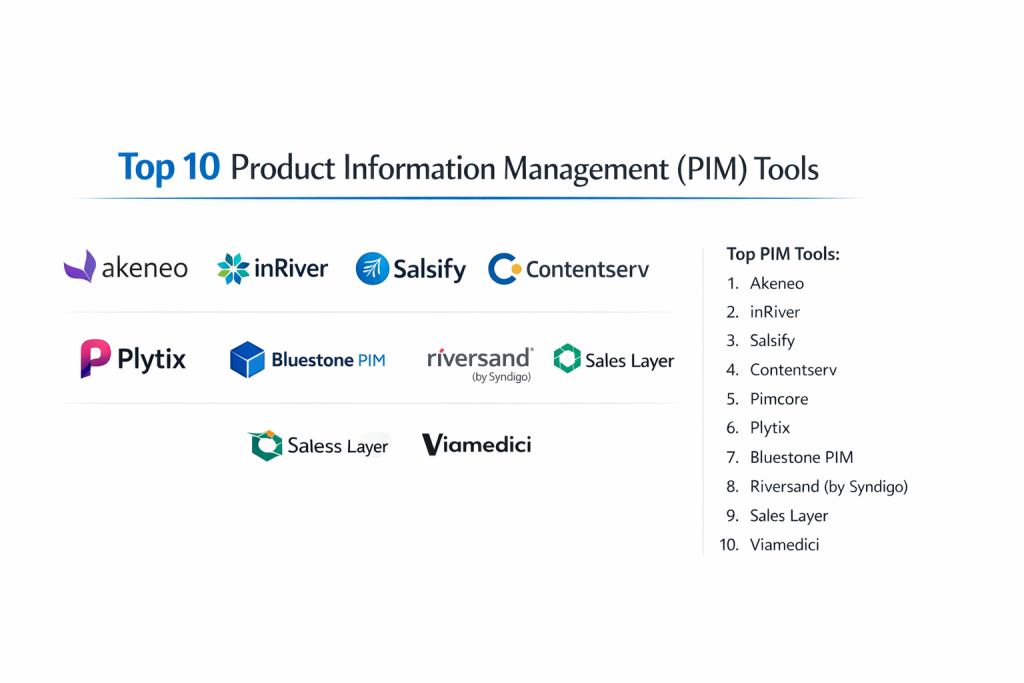
Top 10 Product Information Management (PIM) Tools
1 — Akeneo
Akeneo is an open-source-based PIM known for its highly intuitive user experience and its focus on helping marketers create compelling product experiences.
- Key features:
- Product Assistant: A built-in guide that suggests ways to improve data completeness.
- Localization Tools: Simplified workflows for translating content into hundreds of languages.
- Asset Manager: Advanced handling of images, videos, and documents linked to products.
- Rule Engine: Automation of data enrichment based on predefined business logic.
- Channel Management: Specialized exports for mobile apps, print, and e-commerce sites.
- Pros:
- Arguably the most user-friendly interface in the PIM market, which increases team adoption.
- Strong community version for companies that want to test the water before going enterprise.
- Cons:
- Advanced automation and the Rule Engine are locked behind the expensive “Enterprise” tier.
- Can require significant technical resources for complex, custom API integrations.
- Security & compliance: SOC 2 Type II, GDPR compliant, SSO integration, and role-based access control.
- Support & community: Large open-source community, Akeneo Academy for training, and dedicated enterprise support.
2 — inRiver
inRiver is a cloud-native PIM solution designed for large-scale enterprises, emphasizing the “Product Journey” and sophisticated digital marketing.
- Key features:
- Marketing Content Cockpit: A visual interface for managing how products appear across channels.
- Syndication Plus: Built-in capability to send data to thousands of global retailers automatically.
- Planner App: Collaborative tool for managing seasonal campaigns and product launches.
- Snapshot Comparisons: View changes in product data over time for audit and version control.
- Print Solution: Direct integration with Adobe InDesign for automated catalog creation.
- Pros:
- Exceptional at handling complex product relationships and multi-layered bundles.
- Very strong syndication network, especially for North American and European retailers.
- Cons:
- The system is highly complex and usually requires a certified implementation partner.
- The pricing model can be opaque and expensive for mid-sized businesses.
- Security & compliance: ISO 27001, GDPR, SOC 2, and data encryption at rest and in transit.
- Support & community: Extensive “inRiver Community” portal, professional certification programs, and global support.
3 — Salsify
Salsify is a “Commerce Experience Management” platform that combines PIM, DAM, and high-end syndication specifically for the modern e-commerce landscape.
- Key features:
- Direct Connections: Native integrations with retailers like Walmart, Amazon, and Target.
- GDSN Support: Specialized tools for the food and beverage industry to meet global standards.
- A/B Testing for Product Pages: Measure which product descriptions perform better.
- Inventory & Price Sync: Goes beyond PIM by syncing live stock levels to certain channels.
- Automated Feedback Loop: Alerts you if a retailer rejects a product listing due to data errors.
- Pros:
- The gold standard for brands selling heavily on third-party marketplaces.
- Combines PIM and Syndication into one seamless flow, reducing the need for extra software.
- Cons:
- Can be overkill for companies that primarily sell through their own direct-to-consumer (DTC) site.
- Implementation is intensive and requires high data quality from the start.
- Security & compliance: SOC 2 Type II, HIPAA (where applicable), GDPR, and SSO support.
- Support & community: Strong customer success focus, “Salsify Academy,” and an active user group network.
4 — Contentserv
Contentserv is an enterprise-level platform that integrates PIM with Digital Asset Management (DAM) and Marketing Experience Management (MXM).
- Key features:
- Contextual View: Show different product data based on the region, channel, or customer segment.
- AI-Based Enrichment: Automatically generates product descriptions using integrated AI.
- Work-on-Screen: A visual editor that allows users to see how data looks on a live page.
- Onboarding Portal: Allows suppliers to upload their own data directly into your PIM.
- Quality Gateways: Prevents incomplete product data from being published.
- Pros:
- Very powerful for global companies managing massive amounts of media assets.
- Highly flexible data modeling that can handle almost any industry’s requirements.
- Cons:
- The user interface can feel dense and “heavy” compared to Akeneo.
- Higher total cost of ownership (TCO) due to licensing and setup fees.
- Security & compliance: ISO 27001, GDPR, and robust internal audit logs.
- Support & community: Strong presence in Europe, dedicated training, and enterprise-level SLA support.
5 — Pimcore
Pimcore is a unique, open-source platform that combines PIM, MDM (Master Data Management), DAM, and CMS into a single unified stack.
- Key features:
- Consolidated Platform: Manage website content and product data in the same system.
- Multi-Domain MDM: Manage not just product data, but also customer and supplier data.
- Flexible Data Modeling: No limits on the number of attributes or product classes.
- Web-to-Print: Native tools for generating high-quality PDFs and catalogs.
- Open Source Flexibility: Complete access to source code for deep customization.
- Pros:
- Incredible value; the “Community Edition” is free and extremely powerful.
- The most flexible tool on this list for developers and technical teams.
- Cons:
- Requires significant technical skill to set up and maintain.
- Not as “marketer-friendly” out of the box as specialized PIMs like Akeneo.
- Security & compliance: Varies by deployment (self-hosted), but Enterprise Cloud is SOC 2 and GDPR compliant.
- Support & community: Massive developer community, extensive documentation, and paid enterprise support.
6 — Plytix
Plytix is a PIM built specifically for Small to Medium-sized Businesses (SMBs) who need an affordable, easy-to-use solution.
- Key features:
- Product Feeds: Simplified tool for creating feeds for Google Shopping and Facebook.
- Brand Portals: Create password-protected sites for wholesalers to download product info.
- Direct Edit: Edit product data directly within the grid view (like a spreadsheet).
- Unlimited Users: Unlike many competitors, Plytix doesn’t charge per seat on most plans.
- Product Sheets: Automatically generate PDF spec sheets for sales teams.
- Pros:
- Extremely fast implementation; many teams go live in less than 30 days.
- One of the most affordable professional-grade PIMs on the market.
- Cons:
- Lacks the deep “Master Data Management” capabilities needed by giant conglomerates.
- Syndication features are not as deep as specialized tools like Salsify.
- Security & compliance: GDPR compliant, data encryption, and SSO availability.
- Support & community: High-touch customer support, extensive help center, and a focus on SMB growth.
7 — Bluestone PIM
Bluestone is a modern, API-first PIM that focuses on the “Composable Commerce” architecture, making it highly compatible with modern tech stacks.
- Key features:
- Microservices Architecture: Allows for high performance and easy scaling.
- Visual Category Management: Drag-and-drop hierarchy for organizing catalogs.
- Digital Asset Linking: Sophisticated linking of assets across different product variants.
- Collaboration Wall: Social-media style feed for team communication on specific SKUs.
- Open API: Designed to be the “center” of a best-of-breed software stack.
- Pros:
- Very easy to integrate with modern headless e-commerce platforms like Commercetools.
- Extremely fast performance when dealing with large-scale data updates.
- Cons:
- Smaller third-party integrator network compared to Akeneo or inRiver.
- May feel too “technical” for old-school marketing teams.
- Security & compliance: SOC 2 Type II, GDPR, and ISO 27001.
- Support & community: Responsive direct support and clear technical documentation.
8 — Riversand (by Syndigo)
Riversand is an enterprise-grade MDM and PIM solution that excels in high-volume, high-complexity environments.
- Key features:
- Data Governance: Sophisticated tools for ensuring data accuracy and compliance.
- Multi-Domain Capability: Handle product, customer, location, and employee data.
- AI-Driven Data Clean-up: Automatically identifies and merges duplicate records.
- Scalability: Built to handle millions of SKUs with complex attribute sets.
- Syndigo Integration: Deep native syndication through the Syndigo retailer network.
- Pros:
- One of the most powerful engines for large retailers and distributors.
- Excellent at “Master Data” challenges that go beyond just e-commerce descriptions.
- Cons:
- Steep learning curve and complex administrative interface.
- Implementation is a major, multi-month (or year) project.
- Security & compliance: HIPAA, GDPR, SOC 1/2/3, and ISO 27001.
- Support & community: Enterprise-grade global support and dedicated account management.
9 — Sales Layer
Sales Layer is an agile PIM with a focus on simplicity and a “user-first” approach, particularly strong in the B2B sector.
- Key features:
- Smart Quality Score: Shows you exactly which products are missing data for specific channels.
- Amazon Connector: One of the most stable Amazon integrations in the mid-market.
- Cloud-Native: No installation required; fully managed SaaS environment.
- Supplier Onboarding: Tools to help manufacturers pull data from their vendors.
- Reporting Dashboards: Track team productivity and catalog health.
- Pros:
- Excellent value for money; hits the “sweet spot” between Plytix and Akeneo.
- Very proactive customer success team that helps with initial data mapping.
- Cons:
- Customization options are more limited than open-source alternatives.
- Not as well-known in the North American market compared to Europe.
- Security & compliance: GDPR, ISO 27001, and secure AWS hosting.
- Support & community: Top-rated customer support and a very helpful onboarding process.
10 — Viamedici
Viamedici is an enterprise PIM/MDM suite with a heavy focus on complex manufacturing and B2B requirements.
- Key features:
- Configuration Management: Handle highly customizable products with many variants.
- Cross-Media Publishing: Powerful tools for automated print and digital catalogs.
- Data Maintenance: Bulk editing tools designed for technical product managers.
- High-End Security: Designed for industries with strict IP protection needs.
- Integrated DAM: Full-featured asset management within the same interface.
- Pros:
- Exceptional for industrial manufacturing where products have thousands of technical attributes.
- Extremely stable and reliable for long-term enterprise use.
- Cons:
- UI feels more traditional and “technical” rather than modern/sleek.
- Smaller community of third-party developers compared to Akeneo.
- Security & compliance: ISO 27001, GDPR, and enterprise-grade SSO/Audit logs.
- Support & community: Strong European presence, direct engineering support, and training.
Comparison Table
| Tool Name | Best For | Platform(s) Supported | Standout Feature | Rating (Gartner) |
| Akeneo | Marketer-Led Teams | Cloud / SaaS | Ease of Use / UX | 4.6 / 5 |
| inRiver | Enterprise Marketing | Cloud / SaaS | Marketing Content Cockpit | 4.3 / 5 |
| Salsify | Marketplace Brands | Cloud / SaaS | Market Integration/Syndication | 4.5 / 5 |
| Contentserv | Multi-Domain Enterprise | Cloud / On-Prem | Contextual View Engine | 4.4 / 5 |
| Pimcore | Technical / Developers | Cloud / Self-Host | All-in-One CMS/PIM/DAM | 4.7 / 5 |
| Plytix | SMBs / Startups | Cloud / SaaS | Affordability / Unlimited Users | 4.8 / 5 |
| Bluestone | Headless Commerce | Cloud / SaaS | Microservices Architecture | N/A |
| Riversand | High-Volume Retail | Cloud / SaaS | MDM Governance Power | 4.2 / 5 |
| Sales Layer | B2B / Mid-Market | Cloud / SaaS | Data Quality Scoring | 4.7 / 5 |
| Viamedici | Industrial Mfg | Cloud / On-Prem | Variant Configuration | N/A |
Evaluation & Scoring of Product Information Management (PIM)
| Category | Weight | Evaluation Logic |
| Core Features | 25% | Data modeling, DAM, localization, and workflow management. |
| Ease of Use | 15% | UI/UX, grid editing, and “marketer-friendliness.” |
| Integrations | 15% | Strength of API, native connectors to Shopify/Magento/Marketplaces. |
| Security & Compliance | 10% | SOC 2, ISO, GDPR, and granular user permissions. |
| Performance | 10% | Speed of bulk updates and platform uptime reliability. |
| Support & Community | 10% | Availability of training, forums, and responsive customer help. |
| Price / Value | 15% | Total cost (licenses + implementation) vs. feature set. |
Which Product Information Management (PIM) Tool Is Right for You?
Small to Mid-Market vs Enterprise
If you are an SMB (Small to Medium Business), your biggest challenge is often limited bandwidth. You need a tool that “just works” without a six-month setup. Plytix and Sales Layer are built for this. They offer intuitive interfaces that feel like a smarter version of Excel. Enterprises, on the other hand, need governance. They need to ensure that 50 different departments don’t mess up the “golden record.” Tools like inRiver, Contentserv, or Riversand provide the complex approval workflows and data governance required for large-scale operations.
Budget and Value
For those on a tight budget, Pimcore (Community Edition) and Akeneo (Community Edition) provide world-class software for free—provided you have the technical skills to host and configure them. If you want a managed solution that won’t break the bank, Plytix is the leader in transparent, affordable pricing. If budget is less of a concern than “market dominance,” Salsify and Veeva (for Life Sciences) offer premium features that can justify their high price tags through sheer revenue growth.
Technical Depth vs Simplicity
There is a clear divide in the PIM world: Tools built for marketers and tools built for data engineers. If you want your marketing team to love the software and use it daily to enrich descriptions, Akeneo is the front-runner. If your product data is highly technical (e.g., car parts, industrial valves) and requires complex mathematical relationships between attributes, Pimcore or Viamedici offer the “Technical Depth” that simpler PIMs lack.
Security and Compliance Requirements
If you are in a highly regulated industry (like food, pharma, or defense), your security requirements are non-negotiable. Look for ISO 27001 and SOC 2 Type II certifications. Riversand and Contentserv have long histories of serving the enterprise market and offer the most granular “Audit Logs”—crucial for showing regulators exactly who changed a product’s safety information and when.
Frequently Asked Questions (FAQs)
1. What is the difference between PIM and ERP?
An ERP (Enterprise Resource Planning) manages transactional data like prices, stock levels, and logistics. A PIM manages “enriched” data like descriptions, images, and emotional marketing copy. They work together but serve different purposes.
2. Can I use my e-commerce platform (like Shopify) as a PIM?
For 10-50 products, yes. But once you have hundreds of SKUs, Shopify’s data fields become too limiting. A PIM allows you to manage much more complex data and push it to many places at once, not just your Shopify store.
3. How long does a PIM implementation take?
For a mid-market tool like Plytix, 4-6 weeks. For an enterprise-wide inRiver or Riversand rollout, expect 6-12 months.
4. What is “Data Syndication”?
Syndication is the act of automatically formatting and sending your product data to various retailers (like Amazon, Walmart, or Zalando) so that it meets their specific requirements perfectly.
5. Does a PIM include image hosting?
Most professional PIMs include a “DAM” (Digital Asset Management) lite or full version, which hosts your images and links them to the correct products.
6. Why is PIM better than Excel?
Excel has no version control, no workflow approvals, and no native way to store images. PIM provides a structured, collaborative environment that prevents “data silos.”
7. Can PIM handle different languages?
Yes, localization is a core feature of PIM. It allows you to have one “Parent” product with many “Child” descriptions in different languages.
8. What is MDM and is it the same as PIM?
MDM (Master Data Management) is broader. It manages all company data (customers, employees, locations). PIM is a subset of MDM focused specifically on products.
9. How do I know if I need a PIM?
If you have more than 500 SKUs, sell on more than two channels, or are expanding into international markets, you almost certainly need a PIM.
10. Do PIM tools use AI?
Yes, modern PIMs like Contentserv and Sales Layer use AI to auto-generate descriptions, categorize products, and even translate content.
Conclusion
Choosing the right Product Information Management (PIM) tool is one of the most significant digital transformations a retail or manufacturing company can undergo. The “best” tool depends entirely on your specific pain points: Is it the difficulty of getting data onto Amazon (Salsify), the complexity of your industrial parts (Viamedici), or the simple need for an affordable central hub (Plytix)?
Ultimately, a PIM is more than just a database; it is a growth engine. By centralizing your data, you empower your marketing team to be more creative, your sales team to be more accurate, and your customers to have a better experience. As e-commerce continues to evolve into “social commerce” and “headless commerce,” a robust PIM remains the essential foundation for any brand that wants to scale.