Introduction
Procurement Software is a business application designed to automate, streamline, and manage the end-to-end purchasing cycle within an organization. It acts as a digital nerve center for the “Source-to-Pay” (S2P) or “Procure-to-Pay” (P2P) process, enabling companies to request, approve, order, and pay for goods and services with high efficiency. By digitizing these workflows, procurement platforms eliminate the friction of manual paper trails and siloed spreadsheets, providing real-time visibility into company spend. These tools serve as the gatekeeper of the corporate wallet, ensuring that every dollar spent is tracked, compliant with internal policy, and negotiated at the best possible rate.
The importance of modern procurement software has never been more evident than in 2026, as supply chain volatility and inflation drive businesses to seek granular control over their margins. Key real-world use cases include automating purchase requisition workflows to prevent “maverick spend,” managing complex vendor contracts, and conducting electronic sourcing (eSourcing) events like reverse auctions. When choosing a tool, users should evaluate spend analysis capabilities, supplier relationship management (SRM) features, user interface (UI) simplicity, and the depth of integration with existing ERP or accounting systems.
Best for: Procurement officers, CFOs, and operations managers in mid-market and enterprise organizations. It is essential for industries with high purchasing volumes, such as manufacturing, healthcare, retail, and construction, where cost savings directly impact the bottom line.
Not ideal for: Solopreneurs or very small teams with minimal monthly expenses who can manage their purchasing through standard business credit cards and simple accounting software without the need for complex approval hierarchies.
Key Real-World Use Cases
- Purchase Requisition & Approval: Digitizing the internal request process to ensure managers approve spend before it happens.
- Supplier Information Management: Maintaining a verified database of vendors, including their certifications, risk profiles, and performance history.
- Three-Way Matching: Automatically comparing the Purchase Order (PO), the receiving report, and the invoice to ensure payment accuracy.
- Spend Analytics: Using AI to categorize company-wide spending data to identify opportunities for bulk discounts or contract renegotiation.
What to Look For (Evaluation Criteria)
Selecting a procurement platform requires a look beneath the surface features. Consider these critical criteria:
- Automation Depth: Does the tool offer OCR (Optical Character Recognition) for invoice processing?
- Supplier Portal: Is there a dedicated space for vendors to update their own info and view payment statuses?
- Auditability: Can the system generate a full digital paper trail for every transaction to satisfy auditors?
- Mobile Accessibility: Can executives approve urgent purchase requests from their smartphones while on the move?
- Strategic Sourcing: Does it provide tools for RFPs (Request for Proposals) and RFQs (Request for Quotations)?
Best for: Enterprise companies that need an all-encompassing, highly scalable Source-to-Pay ecosystem.
Not ideal for: Small businesses that find enterprise-grade complexity overwhelming and unnecessary.
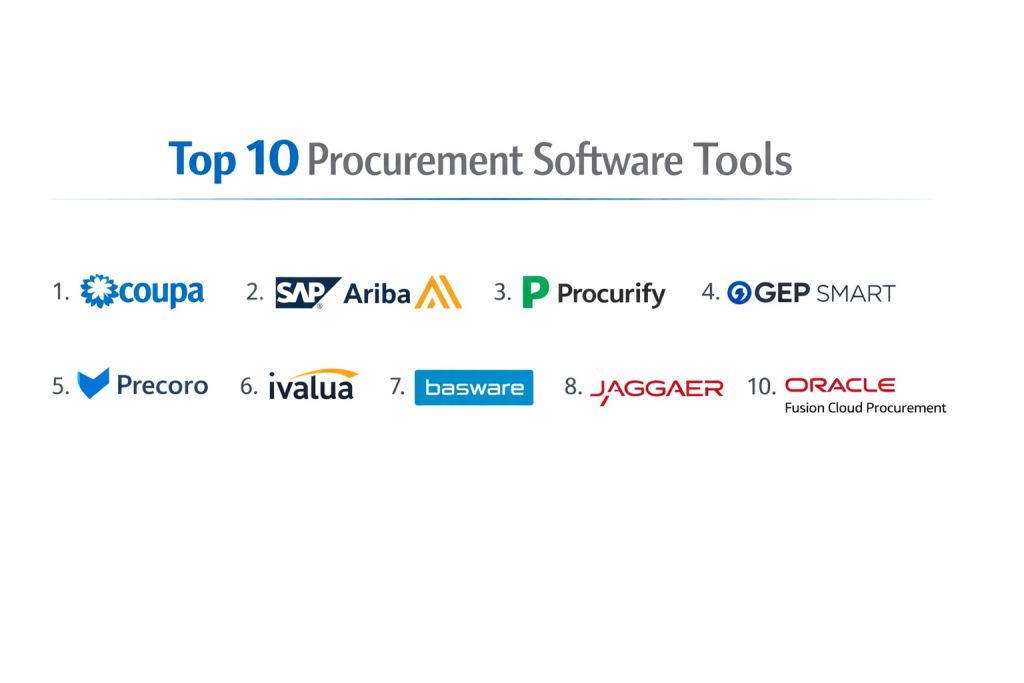
Top 10 Procurement Software Tools
1 — Coupa
Coupa is widely recognized as the market leader in Business Spend Management (BSM), offering a cloud-native platform that focuses on user adoption and community-powered data insights.
- Key features:
- Procure-to-Pay: A streamlined experience for requisitions, POs, and invoicing.
- Coupa Advantage: Pre-negotiated discounts with thousands of suppliers.
- Spend Analysis: AI-driven categorization of all corporate expenditures.
- Strategic Sourcing: Tools for managing complex RFP and auction events.
- Contingent Workforce: Specialized modules for managing temporary labor and contractors.
- Pros:
- Exceptionally high user adoption rates due to an “Amazon-like” shopping experience.
- Community Intelligence provides benchmarks to show how your spend compares to peers.
- Cons:
- Implementation is a significant undertaking, often requiring third-party consultants.
- Premium pricing makes it less accessible for smaller mid-market firms.
- Security & compliance: SOC 1 & 2, GDPR, HIPAA, ISO 27001, and FedRAMP authorized.
- Support & community: Extensive Coupa Community forums, 24/7 global support, and “Coupa University” for training.
2 — SAP Ariba
As part of the SAP ecosystem, Ariba provides the world’s largest B2B network, connecting millions of buyers and suppliers in a single digital marketplace.
- Key features:
- Ariba Network: Direct connection to over 5 million global suppliers.
- Guided Buying: Directs employees toward preferred suppliers and compliant items.
- Contract Management: Full lifecycle management with legal clause libraries.
- Supplier Risk: Monitors third-party risk based on financial and environmental data.
- Supply Chain Collaboration: Real-time visibility into inventory and production for manufacturing.
- Pros:
- Unrivaled for global companies already using SAP ERP software.
- The depth of the supplier network makes finding new vendors incredibly easy.
- Cons:
- The user interface can feel complex and “corporate” compared to newer startups.
- Supplier onboarding to the Ariba network can sometimes be a point of friction.
- Security & compliance: ISO 27001, SOC 2, GDPR, and HIPAA compliant.
- Support & community: Enterprise-grade support, local user groups, and extensive SAP documentation.
3 — Procurify
Procurify is a mid-market favorite that focuses on making the “request-to-approval” process as fast and mobile-friendly as possible.
- Key features:
- Mobile App: One of the best apps for submitting and approving requests on the go.
- Virtual Credit Cards: Issue trackable, limited-spend cards for specific projects.
- Budget Tracking: Real-time visualization of how much budget remains before spending.
- Catalog Management: Custom internal catalogs of approved items.
- Expense Management: Integrated travel and out-of-pocket expense tracking.
- Pros:
- Very fast implementation time, often getting companies live in weeks.
- Excellent visibility for non-finance managers into their departmental budgets.
- Cons:
- Lacks some of the heavy-duty strategic sourcing (RFP) tools found in Coupa.
- Not designed for massive global supply chains with complex manufacturing needs.
- Security & compliance: SOC 2 Type II, GDPR compliant, and data encryption.
- Support & community: Responsive chat support, dedicated success managers, and a clear help center.
4 — GEP SMART
GEP SMART is a unified procurement platform that utilizes advanced AI (GEP MINERVA) to automate the most tedious parts of the procurement process.
- Key features:
- Unified S2P: Source, procure, and pay in one seamless interface.
- AI Spend Classification: Automatically cleans and categorizes messy data.
- Savings Tracking: Validates that negotiated savings are actually appearing in the budget.
- Supplier Management: Comprehensive scorecarding and performance tracking.
- Mobile-First Design: Full functionality across all tablet and mobile devices.
- Pros:
- The AI-driven insights are top-tier for identifying hidden cost-saving opportunities.
- Very cohesive user experience because the entire platform was built on a single codebase.
- Cons:
- Can be “too much software” for mid-sized firms with simple needs.
- Customization can be complex and time-consuming.
- Security & compliance: ISO 27001, SOC 2, GDPR, and HIPAA.
- Support & community: Global 24/7 support with specialized procurement consultancy available.
5 — Precoro
Precoro is an agile procurement solution designed for small-to-midmarket businesses that want to eliminate manual paperwork and Excel sheets.
- Key features:
- Purchase Order Automation: Eliminates manual data entry for orders.
- Inventory Management: Tracks stock levels across multiple locations.
- Unlimited Users: Offers a flat-fee model that doesn’t punish company growth.
- Approval Workflows: Custom multi-level approval hierarchies.
- Integration Hub: Direct links to QuickBooks Online, Xero, and NetSuite.
- Pros:
- Transparent pricing and no hidden “per-user” fees in some tiers.
- Extremely intuitive UI that requires almost zero training for employees.
- Cons:
- Limited features for managing complex global sourcing events or reverse auctions.
- Not suitable for massive enterprises with over 5,000 employees.
- Security & compliance: SOC 2 Type II and GDPR compliant.
- Support & community: Strong email and chat support with a high reputation for friendliness.
6 — Ivalua
Ivalua is known for its extreme flexibility, allowing enterprises to customize the platform to fit unique or non-standard procurement processes.
- Key features:
- Modular Platform: Choose only the modules you need (Sourcing, Invoicing, etc.).
- Supplier Collaboration: Tools for co-innovation and joint projects with vendors.
- Direct Materials Focus: Specialized for manufacturing and Bill of Materials (BOM) management.
- Global Compliance: Handles complex tax and e-invoicing laws across 70+ countries.
- Contract Repository: Centralized storage with automated renewal alerts.
- Pros:
- The most customizable platform on the market; it can be bent to any business rule.
- High data quality and “single source of truth” for supplier information.
- Cons:
- High cost of ownership due to the complexity of configuration.
- Steep learning curve for administrators who need to manage the backend.
- Security & compliance: ISO 27001, SOC 2, FedRAMP, and GDPR.
- Support & community: Global support teams and a dedicated client success program.
7 — Tipalti
Tipalti specializes in “Payables Automation,” making it the go-to choice for companies with high volumes of global payments and multi-entity structures.
- Key features:
- Global Mass Payments: Pay vendors in 196 countries and 120 currencies.
- Self-Service Supplier Portal: Vendors manage their own tax and bank info.
- PO Matching: Automated sync between procurement and accounts payable.
- Tax Compliance: Collects and validates W-9/W-8 tax forms automatically.
- Fraud Detection: Built-in screenings against AML and OFAC lists.
- Pros:
- Significantly reduces the workload for the Accounts Payable team.
- Best-in-class for managing complex international payment regulations.
- Cons:
- The procurement/sourcing side is less robust than the payment/invoicing side.
- Transaction fees can add up for high-volume users.
- Security & compliance: SOC 2 Type II, GDPR, and Money Transmitter licenses across the US.
- Support & community: Strong onboarding specialists and proactive account management.
8 — Basware
Basware is a leader in networked e-invoicing and purchase-to-pay, with a strong focus on processing 100% of a company’s spend digitally.
- Key features:
- E-Invoicing Network: High-speed processing of digital invoices.
- Marketplace: Seamless “shop-from-contract” experience for employees.
- Predictive Analytics: Uses data to forecast cash flow and payment timing.
- AP Automation: OCR and AI-based matching with high accuracy rates.
- Smart Coding: Automatically suggests GL codes for non-PO invoices.
- Pros:
- Excellent at handling the “invoicing” end of procurement, especially in Europe.
- Strong ability to integrate with almost any legacy ERP system.
- Cons:
- The strategic sourcing (RFP) module is not as advanced as GEP or Coupa.
- Setup for complex multi-entity companies can be technically demanding.
- Security & compliance: ISO 27001, ISAE 3402, SOC 2, and GDPR.
- Support & community: 24/7 global support and an extensive online customer portal.
9 — Jaggaer
Jaggaer offers specialized procurement suites for specific industries like Higher Education, Life Sciences, and Manufacturing.
- Key features:
- Industry-Specific Content: Tailored workflows for lab supplies or university budgets.
- Direct Sourcing: Deep features for managing raw materials and production parts.
- Contract Lifecycle Management: Full redlining and version control.
- Supplier Quality: Specialized tools for tracking manufacturing defect rates.
- Digital Assistant: AI chat to help users find items and check order status.
- Pros:
- Unmatched for organizations with highly specific, non-retail needs (like research labs).
- Very strong on the “Source” side of Source-to-Pay.
- Cons:
- The general retail/shopping experience is less “modern” than Coupa or Procurify.
- Can feel fragmented if you are using multiple legacy Jaggaer modules.
- Security & compliance: SOC 2, GDPR, HIPAA, and ISO 27001.
- Support & community: Jaggaer Academy and a dedicated user group for Higher Ed.
10 — Oracle Fusion Cloud Procurement
Oracle’s procurement suite is a heavy-duty, integrated part of its Cloud ERP, designed for data-driven enterprises that need total control.
- Key features:
- Procurement Contracts: Social-media-style collaboration on contract terms.
- Supplier Portal: Robust workspace for vendors to manage their relationship.
- Sourcing: Built-in negotiation tools with team-based scoring.
- Purchasing: Highly automated order management and fulfillment tracking.
- Business Intelligence: Deep, customizable reporting using Oracle’s data engine.
- Pros:
- Native integration with Oracle’s finance, HR, and project management modules.
- Extreme scalability; handles the world’s largest data loads with ease.
- Cons:
- Very high learning curve; requires professional administrators.
- Implementation costs and timelines are significant.
- Security & compliance: ISO 27001, SOC 2, HIPAA, FedRAMP, and GDPR.
- Support & community: Global Oracle support, extensive user forums, and My Oracle Support portal.
Comparison Table
| Tool Name | Best For | Platform(s) Supported | Standout Feature | Rating (Gartner) |
| Coupa | Large Enterprise | Cloud / Mobile | Community Intelligence | 4.7 / 5 |
| SAP Ariba | Global Supply Chain | Cloud / Mobile | Ariba Supplier Network | 4.3 / 5 |
| Procurify | Growth SMB/Mid-Market | Cloud / Mobile | Mobile Approval App | 4.5 / 5 |
| GEP SMART | AI-Driven Insights | Cloud / Mobile | Minerva AI Engine | 4.6 / 5 |
| Precoro | Budget SMB | Cloud | Flat-fee Pricing Model | 4.7 / 5 |
| Ivalua | High Customization | Cloud / Hybrid | Deep Direct Materials | 4.4 / 5 |
| Tipalti | Global Payments | Cloud / Mobile | Global Mass Payments | 4.5 / 5 |
| Basware | E-Invoicing | Cloud | 100% Invoice Capture | 4.2 / 5 |
| Jaggaer | Higher Ed / Life Sci | Cloud | Industry-Specific Suites | 4.1 / 5 |
| Oracle Procurement | Oracle ERP Users | Cloud | Deep Financial Analytics | 4.3 / 5 |
Evaluation & Scoring of Procurement Software
| Category | Weight | Evaluation Logic |
| Core Features | 25% | S2P depth, RFP tools, Spend Analytics, and Invoicing. |
| Ease of Use | 15% | Intuitiveness for end-users and the mobile experience. |
| Integrations | 15% | Native connectors for ERPs like NetSuite, SAP, and Oracle. |
| Security & Compliance | 10% | SOC 2 status, GDPR adherence, and audit trail quality. |
| Performance | 10% | System uptime and speed of spend data processing. |
| Support & Community | 10% | Implementation help, documentation, and user groups. |
| Price / Value | 15% | ROI potential vs. total cost of ownership (TCO). |
Which Procurement Software Tool Is Right for You?
Solo Users vs SMB vs Mid-Market vs Enterprise
If you are an SMB with under 100 employees, you likely need speed and low cost over deep strategic features. Precoro or Procurify are perfect here because they focus on the “Procure-to-Pay” basics without requiring a year of setup. Mid-Market firms growing quickly will benefit from Tipalti if they have heavy international payments or GEP SMART for AI insights. Enterprises with thousands of users and complex global tax needs must look at Coupa, SAP Ariba, or Oracle, as these are the only systems capable of managing that level of scale.
Budget-conscious vs Premium Solutions
For Budget-conscious teams, Precoro offers a high-value entry point with clear pricing. If you have a larger budget, Coupa is the “Premium” choice. While the subscription is higher, Coupa often pays for itself by finding millions in “lost” savings through its Coupa Advantage pre-negotiated contracts.
Feature Depth vs Ease of Use
If your primary goal is to get employees to actually use the software (adoption), Procurify and Routific (for routing) or Coupa are the winners in Ease of Use. However, if you are a manufacturing giant that needs to track every nut and bolt in a Bill of Materials, you need Feature Depth. In that case, Ivalua or Jaggaer provide the specialized controls that a “simple” shopping tool cannot.
Integration and Scalability Needs
Never buy procurement software in a vacuum. If you use SAP for finance, SAP Ariba is the logical choice for Integration. If you use Oracle, go with Oracle Procurement. For companies using NetSuite or QuickBooks, Procurify and Tipalti offer the most seamless data sync. Regarding Scalability, cloud-native tools like Coupa and GEP are designed to grow with you from $10 million to $10 billion in annual spend.
Security and Compliance Requirements
If you operate in the government space, FedRAMP authorization is a must—OneTrust (for privacy) or Ivalua and Coupa are strong here. For companies with heavy EU operations, Basware and DPOrganizer (for privacy) or the major S2P players with strong GDPR and ISO 27001 certifications should be at the top of your list.
Frequently Asked Questions (FAQs)
1. What is the difference between Procurement and Purchasing?
Purchasing is a subset of procurement. Purchasing is the transactional act of buying goods, while procurement is the strategic process of sourcing, negotiating, and managing the entire supplier relationship.
2. How long does it take to implement procurement software?
For SMB tools like Precoro, it can take 2–4 weeks. For enterprise giants like SAP Ariba or Coupa, expect a 6–12 month timeline involving process redesign and technical integration.
3. Does procurement software integrate with my accounting software?
Yes, most top-tier tools have native connectors for NetSuite, QuickBooks, Xero, SAP, and Oracle to ensure that purchase data flows directly into the General Ledger.
4. What is “Maverick Spend”?
Maverick spend occurs when employees buy items outside of the approved procurement process or from non-preferred vendors, leading to higher costs and lost discount opportunities.
5. How does the software save me money?
It saves money by enforcing contract compliance, identifying bulk discount opportunities through spend analytics, and reducing the labor hours needed to process invoices and POs.
6. Is procurement software secure?
Yes, most reputable vendors are SOC 2 Type II compliant and use high-level encryption. They also provide audit logs to show exactly who approved every dollar spent.
7. Can I manage international vendors and currencies?
Yes, tools like Tipalti and SAP Ariba are specifically designed to handle multi-currency payments and international tax compliance (VAT, GST, etc.).
8. What is a “Three-Way Match”?
It is a safety check where the system confirms that the Purchase Order, the Receiving Report (packing slip), and the Invoice all match before a payment is released.
9. Do I need procurement software if I already have an ERP?
Often, yes. While ERPs have basic purchasing modules, they are usually difficult for average employees to use. Specialized procurement software acts as a “user-friendly front door” to the ERP.
10. What is “Source-to-Pay” (S2P)?
S2P refers to the entire process from identifying a need and finding a supplier (Sourcing) all the way through to issuing the payment (Pay).
Conclusion
Selecting the right Procurement Software is a high-stakes decision that impacts every department in your company. In 2026, the “best” tool isn’t just the one with the most buttons; it’s the one that your employees will actually use and that provides the data transparency your CFO needs.
For small teams, the simplicity of Precoro or Procurify is usually the right path. For global leaders, the robust networks of SAP Ariba or the AI-driven ecosystem of Coupa are the gold standards. Regardless of your choice, moving away from manual spreadsheets to an automated platform is the single most effective way to protect your margins and future-proof your supply chain.