Introduction
A Port Community System (PCS) is a neutral and open electronic platform that enables the intelligent and secure exchange of information between public and private stakeholders. Think of it as a “digital glue” that connects everyone involved in a sea port—customs, terminal operators, shipping lines, freight forwarders, and trucking companies. Instead of each person sending dozens of emails and faxes to move a single container, a PCS creates a single point where data is entered once and shared with everyone who needs it. This technology is the backbone of “smart ports,” turning physical hubs into efficient data-driven ecosystems.
The importance of a PCS lies in its ability to reduce congestion and speed up trade. When a ship arrives at a port, thousands of documents must be verified. Without a digital system, trucks wait in long lines, and cargo sits idle for days. A PCS automates these workflows, ensuring that customs clearances are processed in advance and that gates are ready for incoming drivers. This not only saves millions in logistics costs but also reduces the carbon footprint of the port by minimizing idling times. It is a vital tool for any country looking to improve its global trade ranking.
Key Real-World Use Cases
- Vessel Notification: Automatically notifying the port authority, pilots, and tugs about an incoming ship’s estimated arrival time.
- Customs Integration: Allowing freight forwarders to submit digital declarations that clear automatically if they meet safety rules.
- Container Tracking: Providing real-time updates to cargo owners so they know exactly when a box is unloaded from a ship and loaded onto a truck.
- Gate Management: Coordinating truck arrivals through a booking system to prevent traffic jams at the port entrance.
What to Look For (Evaluation Criteria)
When choosing a PCS, you must look for interoperability, meaning the system can talk to other international ports and shipping lines using standard languages. Automation is another major factor; the system should be able to handle routine approvals without a human clicking a button. You also need to check for scalability, as port volumes can grow rapidly over a decade. Finally, look for a system that offers a user-friendly mobile interface, so truck drivers and dock workers can update statuses directly from the field.
Best for: Port authorities, terminal operators, customs agencies, and large-scale logistics providers. It is essential for national governments and maritime hubs that manage high volumes of international trade and want to digitize their supply chain.
Not ideal for: Individual truck drivers or small independent couriers who do not manage port infrastructure. These users may use the PCS as participants, but they do not need to purchase or implement the system themselves. It is also not a replacement for a private company’s internal warehouse management software.
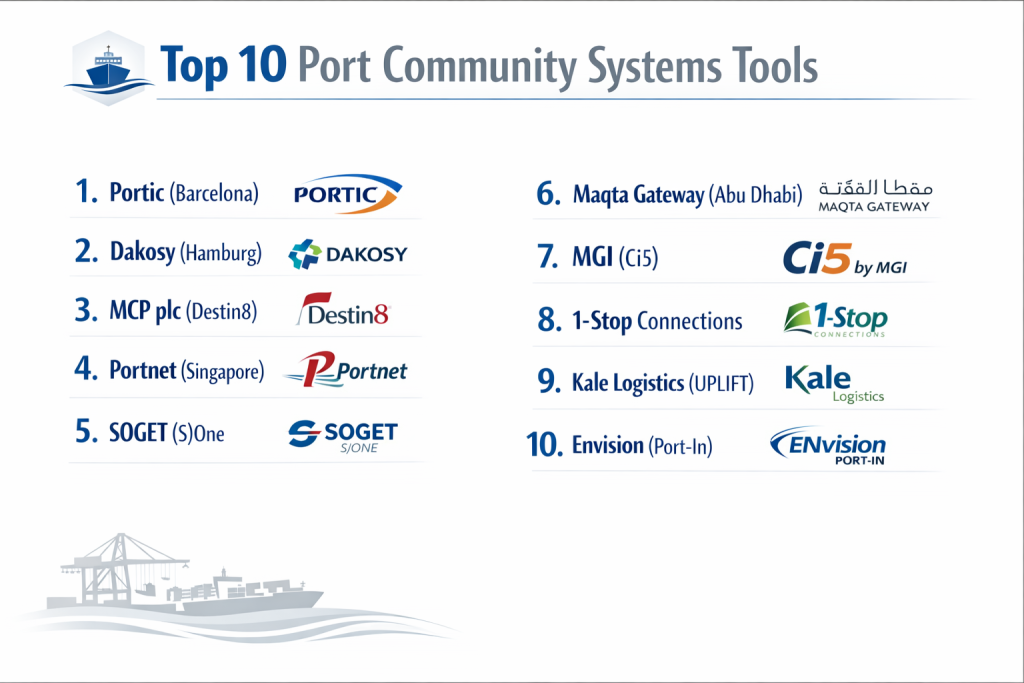
Top 10 Port Community Systems Tools
1 — Portic (Barcelona)
Portic is one of the most mature and successful PCS examples in the world, originating from the Port of Barcelona. it is designed to manage complex maritime and land-based logistics in a high-volume environment.
- Key features:
- Comprehensive telematics platform for all port users.
- Integration with European customs and maritime safety systems.
- Real-time tracking of goods from ship to rail or road.
- Digital management of dangerous goods declarations.
- Automated invoicing and electronic payment processing.
- Advanced analytics for port performance monitoring.
- Pros:
- Proven track record in one of the world’s busiest Mediterranean hubs.
- Excellent at handling the specific “short-sea shipping” needs of the European market.
- Cons:
- Can be highly specific to Spanish and European regulatory frameworks.
- Implementation for a new port can be a long-term project.
- Security & compliance: ISO 27001 certified, GDPR compliant, and uses heavy data encryption for trade secrets.
- Support & community: Strong user community in Europe and a dedicated professional services team for global implementation.
2 — Dakosy (Hamburg)
Dakosy provides a highly advanced PCS for the Port of Hamburg, focusing on transparency and extreme efficiency for all transport participants.
- Key features:
- Centralized import and export management modules.
- Direct interface with German and EU customs systems.
- Slot booking system for truck handling to reduce congestion.
- Integrated dangerous goods and hazardous material tracking.
- Specialized modules for air cargo and rail transport integration.
- Real-time status alerts via mobile and web.
- Pros:
- Incredible technical reliability with almost zero downtime recorded.
- One of the best systems for integrating rail and inland waterway transport.
- Cons:
- The system is very complex and requires significant user training.
- Higher cost of ownership compared to simpler, newer cloud systems.
- Security & compliance: Fully compliant with ISO 27001 and strictly adheres to EU data privacy laws.
- Support & community: Offers extensive technical documentation and 24/7 mission-critical support for port operators.
3 — MCP plc (Destin8)
The Destin8 system, managed by MCP plc, is the leading PCS in the United Kingdom. It is designed to facilitate the fast movement of cargo through diverse port environments.
- Key features:
- Real-time cargo tracking and inventory control.
- Automatic links to the UK’s customs and excise systems.
- Electronic release of cargo for importers and hauliers.
- Management of transshipments and exports.
- Support for both containerized and “roll-on/roll-off” (Ro-Ro) cargo.
- Secure messaging between all port community members.
- Pros:
- Extremely fast processing of customs clearances.
- Designed to be very resilient, even under high traffic loads.
- Cons:
- The user interface feels a bit traditional compared to newer “SaaS” platforms.
- Heavily focused on the UK market and its specific customs rules.
- Security & compliance: Meets all UK government security standards and features robust audit logs for every transaction.
- Support & community: Known for high-quality customer service and local expertise in the UK maritime sector.
4 — Portnet (Singapore)
Created by PSA Singapore, Portnet is widely considered the world’s first nationwide PCS. It is a highly sophisticated tool that manages the immense complexity of a global transshipment hub.
- Key features:
- Seamless integration with shipping lines and container terminals.
- Real-time vessel and container status updates.
- Automated document exchange for shipping and logistics.
- Powerful resource scheduling for terminal operations.
- Mobile app for on-the-go tracking and approvals.
- Integration with local financial and trade systems.
- Pros:
- Capable of handling millions of containers with high precision.
- Backed by the immense operational knowledge of the Port of Singapore.
- Cons:
- May be “overkill” for smaller regional ports.
- High barrier to entry for smaller organizations due to its enterprise scale.
- Security & compliance: Top-tier encryption and SOC 2 compliance; follows Singapore’s strict cybersecurity laws.
- Support & community: World-class enterprise support and a huge community of international shipping partners.
5 — SOGET (S)One
SOGET, based in France, offers (S)One, a next-generation PCS built on modern web technologies. It is designed to be a “single window” for all trade and logistics.
- Key features:
- Fully cloud-based architecture for easy accessibility.
- Compliant with the latest IMO and WCO standards.
- Integrated risk management for customs and security.
- Multi-modal support (Sea, Air, Road, Rail).
- Intuitive dashboard with visual KPIs.
- Scalable modules for ports of any size.
- Pros:
- The interface is modern, clean, and much easier to learn than legacy systems.
- Very flexible and can be adapted to different national laws quickly.
- Cons:
- As a cloud-heavy system, it requires a very stable internet backbone at the port.
- Smaller market share in some regions compared to established legacy players.
- Security & compliance: ISO 27001 certified and strictly follows GDPR and international maritime security codes.
- Support & community: Strong focus on onboarding and user training with a global support network.
6 — Maqta Gateway (Abu Dhabi)
Maqta Gateway is a subsidiary of AD Ports Group and offers one of the most tech-forward PCS solutions in the Middle East. It focuses on the “Smart Port” vision using AI and blockchain.
- Key features:
- Integration of all port services into a single digital window.
- Advanced slot booking for trucks and inland transport.
- Digital certificates of origin and trade permits.
- Mobile-first design for all field and gate operations.
- Real-time vessel traffic monitoring and scheduling.
- AI-driven predictive analytics for terminal congestion.
- Pros:
- Very innovative; often the first to implement new tech like blockchain for security.
- Exceptional support for digitalizing the entire government-to-business relationship.
- Cons:
- Integration with older, legacy systems in other ports can be tricky.
- Geographically focused on the Middle East and its trade routes.
- Security & compliance: High-level encryption, ISO certifications, and compliant with regional data protection laws.
- Support & community: Excellent local support and a strong push for digital literacy among its users.
7 — MGI (Ci5)
MGI, a French company, developed Ci5 to provide “Cargo Intelligence” for port communities. It is designed to track the “life of a container” from start to finish.
- Key features:
- Predictive tracking of cargo throughout the port stay.
- Collaborative platform for all supply chain actors.
- Automated alerts for customs blocks or health inspections.
- Smart gate integration for automated truck entry.
- Performance measurement and environmental reporting.
- User-centric design focusing on daily operational tasks.
- Pros:
- Excellent at “predicting” delays before they happen.
- Very strong focus on making life easier for the end-user (truckers and clerks).
- Cons:
- Smaller user base in Asia and North America.
- Requires high-quality data input from all participants to work perfectly.
- Security & compliance: ISO 27001 and GDPR compliant; uses secure API tunnels for data exchange.
- Support & community: Dedicated training center and a proactive support desk.
8 — 1-Stop Connections
1-Stop is a major player in the Oceania region, providing PCS solutions that optimize the entire supply chain beyond just the port gate.
- Key features:
- Vehicle Booking System (VBS) to manage truck arrivals.
- Integrated messaging between terminals and shipping lines.
- Automated invoicing and financial reconciliation.
- Real-time container availability and “ready for pickup” status.
- Data analytics for terminal efficiency.
- Comprehensive mobile suite for drivers.
- Pros:
- Proven to reduce truck turnaround times significantly.
- Very easy to integrate with existing terminal operating systems (TOS).
- Cons:
- The focus is more on land-side logistics than maritime ship management.
- Primarily designed for the Australian and New Zealand regulatory environments.
- Security & compliance: Meets regional data standards and features secure payment processing gateways.
- Support & community: Very strong in the Oceania region with a dedicated local help desk.
9 — Kale Logistics (UPLIFT)
Kale Logistics offers the UPLIFT platform, which is particularly strong in emerging markets. It is designed to be affordable and highly scalable for ports looking to modernize quickly.
- Key features:
- Cloud-based single window for trade and transport.
- Mobile app for real-time tracking and document uploads.
- Digital delivery orders and e-gate passes.
- Integrated air and sea cargo management.
- Regulatory compliance automation for customs.
- Collaborative platform for freight forwarders and agents.
- Pros:
- One of the most cost-effective solutions for developing ports.
- Very fast implementation times—can be up and running in months.
- Cons:
- May lack some of the deepest “extreme-volume” features of Singapore’s Portnet.
- The UI is functional but less polished than some of the premium European systems.
- Security & compliance: ISO 27001 certified and follows international trade data standards.
- Support & community: Growing global presence with strong support for users in Asia and Africa.
10 — Envision (Port-In)
Envision is a tech-centric provider that offers the Port-In system, focusing on IoT and real-time connectivity for “Smart Ports.”
- Key features:
- Integration with IoT sensors for real-time equipment monitoring.
- Automated berthing and vessel scheduling.
- Visual map interface for tracking all port assets.
- Integration with smart cameras for automated gate entry.
- Advanced reporting and sustainability tracking.
- Secure messaging and document vault.
- Pros:
- Excellent for ports that want to use “Internet of Things” (IoT) technology.
- Highly visual interface makes it easy to see where bottlenecks are.
- Cons:
- Requires a high level of physical infrastructure (sensors/cameras) to reach full potential.
- Younger product with a smaller historical track record than Dakar or Portic.
- Security & compliance: SOC 2 compliant and features high-level cybersecurity for connected devices.
- Support & community: Strong technical support team with expertise in hardware-software integration.
Comparison Table
| Tool Name | Best For | Platform(s) Supported | Standout Feature | Rating |
| Portic | European Trade Hubs | Web, Desktop | Short-Sea Logistics | N/A |
| Dakosy | High-Volume Rail/Sea | Web, Desktop | Slot Booking System | N/A |
| Destin8 | UK Port Networks | Web | Fast Customs Links | N/A |
| Portnet | Mega-Transshipment | Web, Mobile | PSA Global Expertise | N/A |
| (S)One | Cloud-First Needs | Cloud, Web, Mobile | Modern User Interface | N/A |
| Maqta Gateway | Smart City/Port AI | Web, Mobile | AI Predictive Tools | N/A |
| Ci5 | Cargo Intelligence | Web, Mobile | Predictive Tracking | N/A |
| 1-Stop | Oceania Logistics | Web, Mobile | Truck VBS Management | N/A |
| Kale UPLIFT | Emerging Markets | Cloud, Web | Cost-Effectiveness | N/A |
| Envision | IoT-Driven Ports | Web, Mobile | Asset Visualization | N/A |
Evaluation & Scoring of Port Community Systems
Selecting a PCS is a long-term commitment. We use the following rubric to help ports evaluate which system will serve them best over the next decade.
| Category | Weight | Average Score | Evaluation Logic |
| Core Features | 25% | 9/10 | Includes customs, vessel, and cargo management. |
| Ease of Use | 15% | 6.5/10 | Legacy systems are hard; modern cloud systems score high. |
| Integrations | 15% | 9.5/10 | Must talk to Terminal Systems, Customs, and AIS. |
| Security & Compliance | 10% | 10/10 | Ports are critical infrastructure; security is the top priority. |
| Performance | 10% | 9/10 | Systems must handle thousands of users without lag. |
| Support | 10% | 8/10 | Requires 24/7 mission-critical response teams. |
| Price / Value | 15% | 7/10 | Higher cost systems often offer higher automation savings. |
Which Port Community System Tool Is Right for You?
Solo Users vs SMB vs Mid-Market vs Enterprise
In the world of PCS, the “users” are usually organizations. Small Ports or private terminal operators should look for a modular, cloud-based solution like Kale UPLIFT or SOGET. These allow you to digitize your basic gate and customs workflows without a multi-million dollar investment. Mid-Market ports with significant regional traffic should consider 1-Stop or MGI Ci5. For Global Enterprise hubs like Singapore, Hamburg, or Abu Dhabi, only the top-tier systems like Portnet, Dakosy, or Maqta Gateway can provide the necessary horsepower and AI-driven automation.
Budget-Conscious vs Premium Solutions
If you are working with a limited government budget, Kale Logistics and Envision offer more modern, cloud-native pricing that avoids massive upfront server costs. However, Premium solutions like Dakosy or Portnet are worth the investment for high-volume hubs because the sheer amount of time they save in truck idling and customs delays pays for the software many times over.
Feature Depth vs Ease of Use
A common mistake is buying a system with 500 features when you only need 50. SOGET (S)One is highly praised for its clean interface, making it easier for local freight forwarders to adopt. On the other hand, if you need deep, specialized features for hazardous cargo and complex rail logistics, you may have to accept the steeper learning curve of a system like Dakosy.
Integration and Scalability Needs
If your port is part of a larger network, you must choose a system that follows international standards like UN/EDIFACT or PROTECT. This ensures that as your port grows, you can easily connect to shipping lines and other ports globally. Portic and Portnet are world leaders in this kind of global scalability.
Security and Compliance Requirements
Since a PCS handles national customs data and sensitive trade information, security is non-negotiable. Ensure the tool you pick is ISO 27001 certified. If you are in the European Union, GDPR compliance is a legal requirement for handling any passenger or crew information. For ports in the Middle East or Asia, ensure the system complies with national cybersecurity frameworks.
Frequently Asked Questions (FAQs)
1. What is the difference between a PCS and a TOS?
A Terminal Operating System (TOS) manages what happens inside the terminal (stacking containers). A Port Community System (PCS) manages the exchange of info between the terminal and the outside world (customs, trucks, shipping lines).
2. Does a PCS help with customs?
Yes. A major feature of any PCS is a direct link to the national customs system, allowing for electronic filing and automatic “green channel” clearances.
3. How long does a PCS implementation take?
It is a big project. A simple cloud setup can take 6 months, while a full-scale national system can take 2 to 3 years to fully integrate all stakeholders.
4. Can a PCS reduce truck congestion?
Absolutely. By using a Vehicle Booking System (VBS) module, the PCS ensures trucks only arrive when the terminal is ready for them, preventing long queues.
5. Is the data in a PCS private?
Yes. A PCS is a “neutral” platform. Shipping Line A cannot see Shipping Line B’s data. Each user only sees the information relevant to their specific cargo or vessel.
6. Can small ports afford a PCS?
Yes, thanks to cloud-based “SaaS” models. Ports no longer have to buy expensive servers; they can pay a monthly fee to use a shared cloud platform.
7. Does it handle “paperless” billing?
Most modern PCS tools include e-invoicing and e-payment, meaning no more physical checks or cash payments at the port gate.
8. What is a “Single Window”?
A Single Window is a broader concept where all government-related trade data (customs, health, agriculture) is submitted through one portal. A PCS often serves as the maritime part of a Single Window.
9. Can it track containers in real-time?
Yes, by integrating with the terminal’s sensors and the ship’s AIS (Automatic Identification System), it provides a live map of where your cargo is.
10. What happens if a user doesn’t want to use the system?
A PCS works best when everyone joins. Most ports make the use of certain digital modules mandatory for customs clearance or gate entry to ensure 100% participation.
Conclusion
A Port Community System is no longer a luxury; it is a requirement for survival in the modern maritime world. As global trade becomes faster and more digital, ports that rely on paper and phone calls will inevitably fall behind. The key to a successful PCS implementation is not just picking the “most expensive” software, but picking the one that your local community of truckers, clerks, and customs officers will actually use.
The “best” tool for your port depends on your volume and your goals. If you are a high-tech hub, look at Maqta Gateway or Portnet. If you are looking for a fast, modern cloud transition, SOGET or Kale are excellent choices. Ultimately, the goal is to create a seamless flow of data that matches the flow of cargo. When the data moves faster than the ship, the port stays clear, the trucks keep moving, and the economy thrives.