Introduction
Personalization engines are AI-powered software platforms that analyze user data, behavior, and preferences to deliver tailored experiences across digital channels like websites, apps, emails, and ads. These tools use machine learning algorithms to segment audiences, recommend content/products, customize interfaces, and automate dynamic interactions, often in real-time. By integrating with data sources like CDPs or analytics, they create individualized journeys that feel intuitive and relevant.
In today’s hyper-competitive digital landscape, personalization engines are crucial for boosting engagement, conversion rates, and customer loyalty. Research shows personalized experiences can increase sales by 20% and reduce acquisition costs by 50%, as users expect brands to anticipate their needs. With privacy regulations like GDPR and the decline of third-party cookies, these engines help deliver contextual relevance without invasive tracking. They empower data-driven decision-making, enabling A/B testing at scale and predictive modeling for future behaviors. Key real-world use cases include e-commerce sites recommending products based on browsing history, streaming services curating playlists from listening patterns, news apps prioritizing articles by reader interests, B2B platforms tailoring demos to company size/industry, and banking apps customizing financial advice from transaction data.
When choosing a personalization engine, evaluate data integration capabilities (CDPs, CRMs), AI sophistication (ML models, real-time processing), segmentation granularity (behavioral, demographic), testing features (A/B, multivariate), channel support (web, mobile, email), privacy compliance tools, analytics dashboards for ROI measurement, and scalability for user volume. Also consider ease of implementation (no-code vs. SDKs) and vendor support for custom models.
Best for: Marketers, product managers, e-commerce directors, data analysts, and CX specialists benefit most from personalization engines. They suit SMBs starting with basic recommendations, mid-market companies scaling multi-channel experiences, and enterprises in retail, media, finance, and SaaS requiring advanced, compliant personalization at massive scale.
Not ideal for: Small sites with low traffic—basic plugins suffice. Organizations without customer data infrastructure might struggle. Those focused solely on offline experiences could use CRM tools instead of full engines.
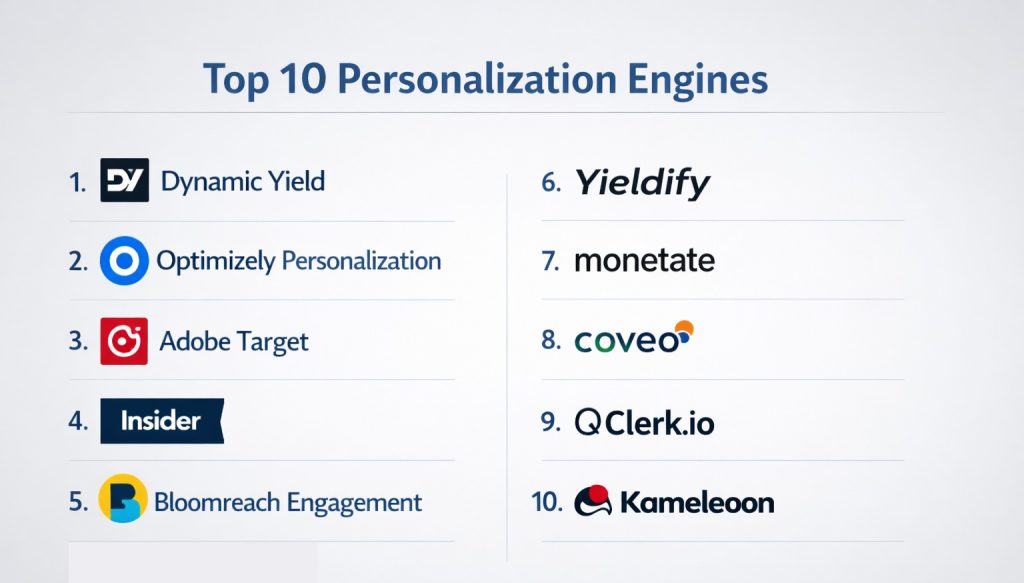
Top 10 Personalization Engines Tools
1 — Insider
Insider is a multi-channel personalization engine that aggregates customer data to automate tailored experiences across web, mobile, email, and messaging. It’s designed for mid-sized to enterprise e-commerce and marketing teams seeking unified, AI-driven engagement. Insider excels in cross-channel orchestration, making it ideal for brands building seamless customer journeys with predictive analytics and no-code tools.
Key features:
- Actionable CDP for 360-degree profiles.
- AI Smart Recommender for product suggestions.
- On-site personalization (banners, search).
- Journey orchestration with next-best channel AI.
- A/B testing auto-selection.
- Native integrations with CMS, APIs, POS.
- Mobile stories and push notifications.
Pros:
- Flexible, easy-to-use for non-tech teams.
- Scales to all touchpoints effectively.
- Top-ranked for ease and performance.
Cons:
- Can feel heavyweight for small teams.
- Requires data setup for full value.
- Premium for advanced features.
Security & compliance: SSO, encryption, audit logs; SOC 2, GDPR compliant.
Support & community: Free migration, chat support, academy; active user forums.
2 — Optimizely
Optimizely is an AI-powered personalization and experimentation engine focused on testing-driven optimizations for web and apps. It’s built for enterprise marketers and product teams in e-commerce and media. Optimizely uses ML for variant testing and content personalization, helping teams iterate on user experiences with robust analytics.
Key features:
- Experimentation framework for A/B testing.
- Customizable experience builder.
- Flexible audience targeting.
- Deep content and feature testing.
- Integration with analytics/CMS.
- AI recommendations.
- Real-time dashboards.
Pros:
- Strong for content/experience testing.
- Scalable for large audiences.
- Reliable results tracking.
Cons:
- Not as plug-and-play for e-commerce specifics.
- Requires technical setup.
- Premium pricing.
Security & compliance: SSO, encryption; SOC 2, GDPR compliant.
Support & community: Docs, enterprise support, user groups.
3 — Adobe Target
Adobe Target is a comprehensive personalization engine within Experience Cloud, using AI for A/B testing and tailored experiences at scale. It’s designed for large brands with data-rich environments. Adobe Target leverages Adobe Sensei AI for auto-allocation and recommendations, ideal for omnichannel personalization in enterprise settings.
Key features:
- AI personalization engine.
- Robust testing tools.
- Tight Adobe ecosystem integration.
- Multivariate experiences.
- Audience discovery.
- Mobile/app support.
- Reporting integration.
Pros:
- Powerful AI for predictive targeting.
- Seamless with Adobe suite.
- Enterprise-grade scale.
Cons:
- Expensive and complex setup.
- Best for Adobe users.
- Steep learning curve.
Security & compliance: SSO, encryption, audit logs; SOC 2, GDPR, HIPAA compliant.
Support & community: Extensive resources, enterprise support.
4 — Dynamic Yield
Dynamic Yield is a personalization platform acquired by Mastercard, specializing in tailored on-site, app, and email experiences. It’s geared toward e-commerce teams seeking real-time optimizations. Dynamic Yield connects data sources for customer segments, enabling behavioral personalization across channels.
Key features:
- Deep A/B testing.
- Customizable builder.
- Flexible targeting.
- Product recommendations.
- Integration with CRMs/POS.
- Behavioral data segments.
- Real-time adjustments.
Pros:
- Strong product suggestion engine.
- Quick to launch.
- Good for e-commerce.
Cons:
- Limited outside Shopify/ecosystem.
- Pricey for larger teams.
- Basic analytics.
Security & compliance: Encryption; GDPR compliant.
Support & community: Docs, chat support.
5 — Bloomreach
Bloomreach is an AI-driven personalization engine for e-commerce, combining CDP with engagement tools for recommendations and search. Bloomreach focuses on merchandising and predictive personalization, ideal for retail brands scaling customer interactions.
Key features:
- AI recommendations.
- Personalized search.
- Omnichannel support.
- CDP integration.
- A/B testing.
- Analytics dashboards.
- Custom segments.
Pros:
- Advanced merchandising.
- Seamless e-commerce fit.
- Strong AI.
Cons:
- Enterprise-focused pricing.
- Implementation effort.
- Less for non-retail.
Security & compliance: SSO, encryption; SOC 2, GDPR.
Support & community: Enterprise support, resources.
6 — Coveo
Coveo is an AI personalization engine for product recommendations, search, and customer segmentation in e-commerce. It uses ML for relevant experiences. Coveo provides AI-powered discovery and merchandising, suited for online stores optimizing user journeys.
Key features:
- AI personalization capabilities.
- Advanced merchandising.
- E-commerce platform integrations.
- Product discovery tools.
- A/B testing.
- Real-time processing.
- Robust multi-channel support.
Pros:
- Excellent product discovery.
- Seamless integrations.
- Scalable for growth.
Cons:
- Technical expertise needed.
- Higher pricing for small businesses.
- Focus on e-commerce limits versatility.
Security & compliance: Encryption; SOC 2, GDPR compliant.
Support & community: Docs, enterprise support.
7 — Klaviyo
Klaviyo is a marketing personalization tool specializing in email/SMS campaigns based on customer behavior. It’s designed for e-commerce teams recovering carts and nurturing leads. Klaviyo integrates with platforms for segmented messaging, ideal for automated, behavior-triggered communications.
Key features:
- E-commerce platform integration.
- Strong segmentation tools.
- Built-in SMS.
- Automation flows.
- A/B testing.
- Analytics.
- Product follow-ups.
Pros:
- Tight e-commerce ties.
- Powerful automation.
- Good for retention.
Cons:
- Expensive as lists grow.
- Limited non-email features.
- Steep for beginners.
Security & compliance: Encryption; GDPR compliant.
Support & community: Academy, support.
8 — Segment
Segment is a CDP-driven personalization tool that centralizes data for activation in marketing tools. It’s for teams unifying customer info for targeted experiences. Segment supports real-time segmentation, ideal for SaaS/mobile businesses personalizing based on events.
Key features:
- Huge integration library.
- Flexible data tracking.
- Real-time segmentation.
- Event-based triggers.
- Privacy controls.
- Analytics forwarding.
- API access.
Pros:
- Vast ecosystem.
- Real-time capabilities.
- Strong for data unification.
Cons:
- Developer involvement needed.
- Not standalone personalization.
- Usage-based pricing.
Security & compliance: Encryption; GDPR, SOC 2 compliant.
Support & community: Docs, enterprise.
9 — Mutiny
Mutiny is a content personalization tool that customizes landing pages for visitor segments without coding. It’s designed for B2B marketers optimizing web experiences. Mutiny uses audience targeting for tailored pages, ideal for lead generation and conversion lifts.
Key features:
- Easy visual editor.
- Strong audience targeting.
- CRM integrations like Salesforce.
- A/B testing.
- Dynamic content.
- Analytics.
- No-code setup.
Pros:
- Quick personalization.
- Good for B2B sites.
- Integrates well with CRMs.
Cons:
- Pricing high for startups.
- Limited to web content.
- Dependent on data quality.
Security & compliance: Encryption; GDPR compliant.
Support & community: Docs, support.
10 — Braze
Braze is a multi-channel personalization platform for real-time customer engagement across apps, web, and messaging. It’s for brands delivering contextual experiences. Braze uses AI for recommendations and automation, ideal for mobile-first businesses.
Key features:
- Advanced AI like Sage for recommendations.
- Real-time data processing.
- Multi-channel support.
- Segmentation.
- A/B testing.
- In-app messaging.
- Push notifications.
Pros:
- Real-time personalization.
- Robust channels.
- Good for SaaS/mobile.
Cons:
- Steep curve for advanced.
- Higher pricing.
- Focused on engagement over content.
Security & compliance: Encryption; SOC 2, GDPR compliant.
Support & community: Resources, support.
Comparison Table
| Tool Name | Best For | Platform(s) Supported | Standout Feature | Rating |
|---|---|---|---|---|
| Insider | Multi-channel e-commerce | Web, Mobile, Email | Journey orchestration | N/A |
| Optimizely | Testing-driven personalization | Web, App | Experimentation framework | N/A |
| Adobe Target | Enterprise AI experiences | Web, Mobile, App | Auto-allocation | N/A |
| Dynamic Yield | E-commerce recommendations | Web, App, Email | Behavioral segmentation | N/A |
| Bloomreach | Retail merchandising | Web, Mobile | Predictive personalization | N/A |
| Coveo | Product discovery | Web, E-commerce | AI search | N/A |
| Klaviyo | Email/SMS marketing | E-commerce | Automation flows | N/A |
| Segment | Data unification | All digital | Real-time segmentation | N/A |
| Mutiny | B2B web content | Web | No-code editor | N/A |
| Braze | Mobile engagement | App, Web, Messaging | Sage AI recommendations | N/A |
Evaluation & Scoring of Personalization Engines
| Tool Name | Core Features (25%) | Ease of Use (15%) | Integrations & Ecosystem (15%) | Security & Compliance (10%) | Performance & Reliability (10%) | Support & Community (10%) | Price / Value (15%) | Total Score |
|---|---|---|---|---|---|---|---|---|
| Insider | 9.5 (2.375) | 8.5 (1.275) | 9 (1.35) | 9 (0.9) | 9 (0.9) | 9 (0.9) | 9 (1.35) | 9.05 |
| Optimizely | 9 (2.25) | 8 (1.2) | 8.5 (1.275) | 9 (0.9) | 9 (0.9) | 8.5 (0.85) | 8.5 (1.275) | 8.65 |
| Adobe Target | 10 (2.5) | 7 (1.05) | 9.5 (1.425) | 9.5 (0.95) | 9.5 (0.95) | 9 (0.9) | 7.5 (1.125) | 8.9 |
| Dynamic Yield | 9 (2.25) | 8 (1.2) | 8.5 (1.275) | 8.5 (0.85) | 9 (0.9) | 8 (0.8) | 8 (1.2) | 8.48 |
| Bloomreach | 9 (2.25) | 8 (1.2) | 8.5 (1.275) | 9 (0.9) | 9 (0.9) | 8 (0.8) | 8 (1.2) | 8.53 |
| Coveo | 9 (2.25) | 8 (1.2) | 8 (1.2) | 9 (0.9) | 9 (0.9) | 8 (0.8) | 8 (1.2) | 8.45 |
| Klaviyo | 8.5 (2.125) | 9 (1.35) | 8.5 (1.275) | 8 (0.8) | 8.5 (0.85) | 8.5 (0.85) | 8.5 (1.275) | 8.55 |
| Segment | 8.5 (2.125) | 8 (1.2) | 9.5 (1.425) | 9 (0.9) | 9 (0.9) | 8.5 (0.85) | 8 (1.2) | 8.6 |
| Mutiny | 8 (2.0) | 9 (1.35) | 8 (1.2) | 8 (0.8) | 8 (0.8) | 8 (0.8) | 7.5 (1.125) | 8.08 |
| Braze | 9 (2.25) | 8 (1.2) | 8.5 (1.275) | 9 (0.9) | 9 (0.9) | 8 (0.8) | 8 (1.2) | 8.53 |
Which Personalization Engines Tool Is Right for You?
Personalization engines vary by scale and focus, so select based on your organization’s size, industry, and priorities.
For solo users or freelancers, tools like Mutiny or Klaviyo offer no-code ease for basic site/email personalization without heavy investment.
SMBs benefit from Dynamic Yield or Nosto for e-commerce recommendations, providing quick wins in conversions with affordable plans and simple integrations.
Mid-market companies often choose Optimizely or Bloomreach for testing-driven personalization, balancing feature depth with scalability for growing audiences.
Enterprises favor Adobe Target or Insider for AI at scale, with robust compliance, omnichannel support, and enterprise integrations for data-rich environments.
If you’re budget-conscious, start with Klaviyo or Mutiny’s entry plans, which deliver high value through automation without enterprise costs.
Premium solutions like Adobe Target or Coveo justify investment with advanced AI, predictive models, and analytics for ROI-focused teams.
Balance feature depth (Adobe Target for multivariate) vs. ease of use (Mutiny for no-code)—depth suits data teams, ease marketers.
For integration and scalability, Segment excels in data unification, while Insider handles multi-channel at high volumes.
Security and compliance requirements are key in regulated fields—tools like Adobe Target offer HIPAA/SOC 2 for healthcare/finance.
Assess your data maturity, channels, and goals—trial multiple to find the best fit for sustainable personalization.
Frequently Asked Questions (FAQs)
What is a personalization engine? It’s AI software that tailors digital experiences using user data for recommendations, content, and interfaces to boost engagement.
Why important for businesses? Increases conversions 10-20%, loyalty, reduces churn by delivering relevant experiences in competitive markets.
Pricing range? Free tiers limited; $100-1,000/month mid-tier; enterprise custom often $10k+ based on users/data volume.
Implementation time? Weeks for basic (Mutiny); months for enterprise (Adobe) with data integration/testing.
Common buyer concern: Data privacy? Top tools comply with GDPR/CCPA; choose with anonymization and consent features.
Typical mistake? Over-personalizing—creepy. Best: Start simple, test, respect privacy.
Scalability for growth? Enterprise like Insider handle millions; check API limits, data processing.
Alternatives to full engines? Basic plugins for CMS; for simple, A/B tools suffice.
AI in personalization? Predictive targeting/recommendations in Optimizely/Adobe save time, improve accuracy.
For e-commerce only? No—B2B like Mutiny for sites; Braze for apps/messaging.
Conclusion
This overview of top personalization engines showcases a diverse landscape, from AI powerhouses like Adobe Target and Optimizely for enterprises to user-friendly options like Mutiny and Klaviyo for smaller teams, and e-commerce specialists like Nosto and Dynamic Yield. Key insights include the integration of CDPs for unified data, real-time AI for dynamic experiences, and a shift toward privacy-first personalization amid cookie deprecation. These tools have evolved to not only recommend products but orchestrate entire customer journeys, driving measurable lifts in engagement and revenue.
What matters most is choosing based on your data ecosystem, channel needs, and technical resources—depth for sophisticated campaigns, ease for rapid deployment. Emphasize that the “best” tool depends on specific needs rather than one universal winner; a great fit for e-commerce may not suit B2B content. Take time to audit your data, define KPIs, and trial shortlisted options with real use cases to ensure the engine enhances user satisfaction while aligning with business goals. The right personalization engine turns generic interactions into meaningful connections, fostering loyalty in a crowded digital world.