Introduction
A Performance Management Platform is a specialized software system designed to create a structured, ongoing process for managing and improving employee performance. It provides a framework for activities that include goal setting, progress monitoring, feedback collection, formal performance reviews, and career development planning.
The purpose of these platforms is to bring clarity and consistency to performance management. They help managers provide more objective and data-driven feedback while helping employees understand their role within the company and how to grow in their careers. In practical use, these tools allow managers to align team objectives with company strategy, facilitate regular check-ins and feedback exchanges, and identify both high performers and areas where employees may need additional training or support.
When evaluating these systems, key criteria to consider include the flexibility of the goal-setting methodology (support for OKRs, SMART goals, etc.), the robustness of feedback and review tools, the quality and depth of reporting features, the ease of integration with existing software, and the overall simplicity of use for all involved parties.
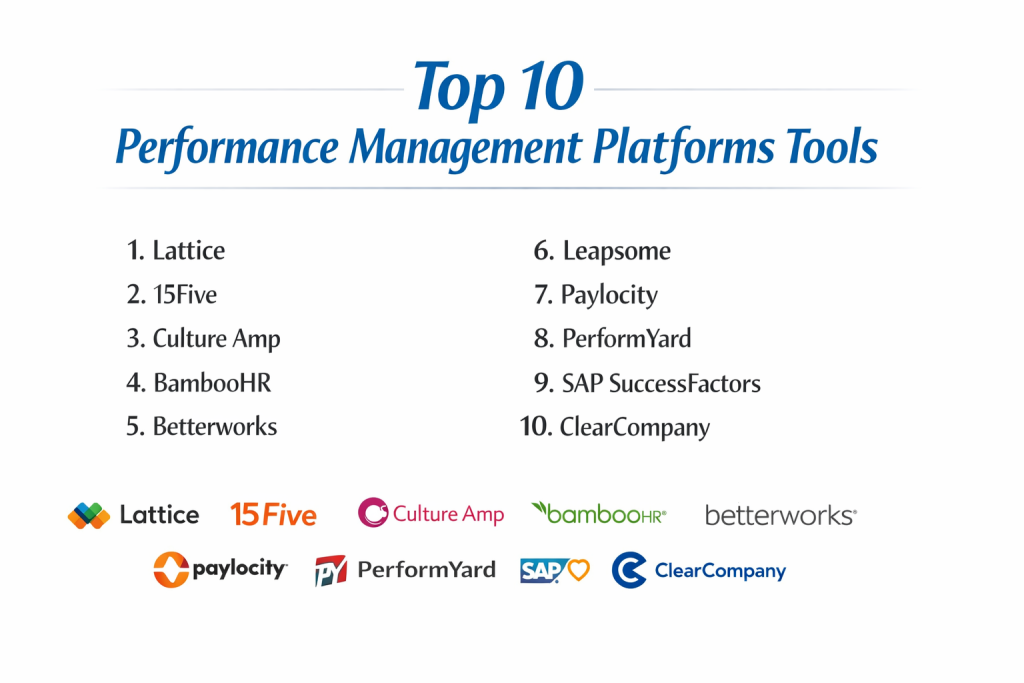
Top 10 Performance Management Platforms Tools
1 — Lattice
Lattice is a comprehensive platform that focuses on employee development, engagement, and performance. It combines tools for goal setting, performance reviews, and employee feedback into a single system.
Key features:
- A flexible goal-setting system for tracking company, team, and individual objectives.
- Tools for continuous feedback and recognition among peers and managers.
- Customizable performance review cycles.
- Features for planning and tracking one-on-one meetings.
- Detailed analytics on performance and engagement trends.
- Career development and growth planning tools.
- Integration with common workplace communication and HR software.
Pros
- Users report the interface is clean and easy to navigate.
- Effectively connects performance management with employee engagement and growth.
Cons
- Pricing is positioned in the higher tier of the market.
- Setting up highly complex review processes can require careful planning.
Security & compliance: SOC 2 Type II certified. Includes features for data encryption, single sign-on (SSO), detailed audit logs, and GDPR compliance support.
Support & community: Offers online documentation, email, chat, and phone support. Provides dedicated implementation help for larger customers and maintains a user community.
2 — 15Five
15Five is built around the concept of a structured weekly check-in. It has expanded into a full performance management solution designed to improve communication and alignment between employees and managers.
Key features:
- Weekly check-ins where employees summarize their work and challenges.
- Integrated Objectives and Key Results (OKRs) goal tracking.
- Performance reviews that incorporate data from regular check-ins.
- Tools to structure and document one-on-one meetings.
- Peer recognition and feedback features.
- Employee engagement survey capabilities.
- Manager coaching tools.
Pros
- Establishes a consistent habit of communication through weekly updates.
- Provides managers with clear insights and talking points based on team input.
Cons
- The required weekly cadence may not suit all teams or work styles.
- Some advanced reporting features may be less comprehensive than other platforms.
Security & compliance: SOC 2 Type II certified. Offers enterprise security standards, SSO, encryption, and GDPR compliance.
Support & community: Provides a help center, training resources (15Five Academy), and support via email and chat.
3 — Culture Amp
Culture Amp is an employee feedback and analytics platform. It uses data and organizational psychology to help companies measure and improve employee engagement, performance, and development.
Key features:
- Highly customizable performance review cycles with analytics.
- A powerful survey platform with benchmarking against a large database.
- Goal setting and tracking features.
- Tools for giving and receiving feedback.
- Advanced analytics that identify trends and predict outcomes like turnover.
- Guidance for managers based on their team’s data.
- Skills and career development tracking.
Pros
- Provides deep, science-backed insights from people data.
- Survey tools and methodologies are well-regarded for their rigor.
Cons
- The platform’s depth can have a steeper initial learning curve.
- Its primary strength is in structured surveys and reviews rather than casual, in-the-moment feedback.
Security & compliance: SOC 2 Type II and ISO 27001 certified. GDPR compliant with data residency options. Includes enterprise security features.
Support & community: Known for strong customer success support. Offers extensive resources and a global community network.
4 — BambooHR
BambooHR is a human resources information system (HRIS) that includes a performance management module. It is designed as an all-in-one HR solution for small and medium-sized businesses.
Key features:
- Performance review and goal tracking within the HR system.
- A central database for all employee information.
- Applicant tracking for recruiting.
- Employee onboarding workflows.
- Time-off tracking and management.
- Reporting and analytics on HR data.
- Electronic signature capabilities.
Pros
- Performance data is directly linked to employee records, eliminating separate systems.
- Provides a complete, user-friendly HR suite at a value for smaller companies.
Cons
- The performance module is often an additional cost on top of the core HR software.
- Its performance features may not be as specialized or deep as standalone platforms.
Security & compliance: SOC 2 Type II certified. Includes data encryption, optional SSO, and GDPR support.
Support & community: Offers phone, email, and chat support alongside a knowledge base and community forum.
5 — Betterworks
Betterworks is an enterprise-focused platform specializing in goal management and alignment. It helps large organizations implement and track Objectives and Key Results (OKRs) to execute their strategy.
Key features:
- Advanced OKR setting with visual alignment mapping.
- Regular check-ins for tracking goal progress.
- Tools for continuous feedback and structured conversations.
- Calibration tools to ensure fair performance ratings across teams.
- Deep integrations with major enterprise HR systems.
- Executive dashboards for strategic oversight.
- Suggestions for writing effective goals.
Pros
- Excellent for large companies needing to manage complex, cascading goals.
- Built to handle the scale and process needs of global enterprises.
Cons
- Can be more than what small or midsize businesses require.
- Implementation often requires significant organizational commitment.
Security & compliance: SOC 2 Type II certified. Features enterprise-grade security, SSO, encryption, and compliance with global data regulations.
Support & community: Provides enterprise-level support with dedicated customer success managers and training resources.
6 — Leapsome
Leapsome is an integrated platform that combines performance management, learning and development, and employee engagement. It connects these areas to provide a unified view of employee growth.
Key features:
- Performance reviews, goals, learning, and surveys in one platform.
- A learning management system (LMS) for creating courses.
- Adaptable performance review cycles.
- Goal and OKR tracking with alignment views.
- Instant feedback and recognition tools.
- Meeting management for one-on-ones and teams.
- Analytics that combine data from all modules.
Pros
- Strong integration between performance management and employee learning.
- Offers a high degree of customization for workflows and templates.
Cons
- The wide range of features can make initial setup and navigation detailed.
- Some users note the interface can feel busy due to its comprehensiveness.
Security & compliance: GDPR compliant and ISO 27001 certified. Implements data encryption and SSO.
Support & community: Provides support via email and chat, a help center, and implementation assistance.
7 — Paylocity
Paylocity is a human capital management (HCM) and payroll suite with an integrated performance module. It targets businesses that want to manage HR, payroll, and performance in a single system.
Key features:
- Performance reviews and goal setting within the HCM.
- Core HR, benefits, and payroll processing.
- Recruiting and applicant tracking.
- Basic learning management features.
- Employee self-service portal.
- Social collaboration feed for company updates.
- Standard and custom reporting.
Pros
- Consolidates HR, payroll, and performance with one vendor.
- Allows performance review outcomes to flow directly into compensation planning.
Cons
- The performance module is solid but may lack some advanced features of specialty platforms.
- Choosing an all-in-one suite can make it difficult to change one component later.
Security & compliance: SOC 1 & SOC 2 reports. Complies with HIPAA and GDPR. Features robust security and encryption.
Support & community: Offers multi-channel support, a knowledge base, and user conferences.
8 — PerformYard
PerformYard is a performance management platform noted for its flexibility. It is designed to automate a company’s existing review process rather than enforce a specific methodology.
Key features:
- Highly flexible process design for various review cycle types.
- Lightweight goal and OKR tracking.
- Drag-and-drop form and workflow builder.
- Continuous note-taking and feedback requests.
- Easy reporting and performance history archives.
- Calibration tools for comparing employee performance.
- Integrations with HRIS and communication tools.
Pros
- Exceptionally adaptable to a company’s unique review process.
- Known for a simple, reliable interface with a short learning curve.
Cons
- Does not strongly promote a specific performance philosophy; it is a tool to execute your own.
- Lacks built-in employee engagement survey tools.
Security & compliance: SOC 2 Type II certified. Uses data encryption, offers SSO, and supports GDPR compliance.
Support & community: Praised for responsive customer support via email and chat. Offers clear guidance and onboarding.
9 — SAP SuccessFactors
SAP SuccessFactors is a large-scale Human Experience Management (HXM) suite. Its performance and goals module is part of a comprehensive system designed for global enterprises.
Key features:
- Comprehensive performance and goal management.
- Succession planning and career development.
- Global core HR and payroll integration.
- Enterprise recruiting and onboarding.
- Extensive learning management.
- Predictive people analytics.
- Tools for global compliance management.
Pros
- The leading solution for multinational corporations with complex needs.
- Performance management is natively integrated with all other HR processes.
Cons
- Involves high costs and complexity for implementation and maintenance.
- The user experience can feel less modern and more transactional.
Security & compliance: Holds multiple ISO standards and SOC reports. Complies with data privacy laws globally.
Support & community: Enterprise-level support structure with a large global partner network.
10 — ClearCompany
ClearCompany is a talent management platform that connects processes from recruiting to performance management and retention, with a focus on aligning talent with business goals.
Key features:
- Customizable performance reviews and goal setting (OKRs).
- Applicant tracking system (ATS).
- Onboarding checklist automation.
- Tools for visualizing goal alignment.
- Employee engagement pulse surveys.
- Talent analytics and reporting.
- Built-in video interviewing.
Pros
- Provides a unified view of the employee lifecycle from hire to retire.
- Emphasizes connecting individual performance to company objectives.
Cons
- The user interface is functional but may not feel as contemporary as newer platforms.
- Some integrations may require more technical configuration.
Security & compliance: SOC 2 compliant. Implements standard security practices including data encryption.
Support & community: Offers standard support channels including phone and email, a knowledge base, and implementation services.
Comparison Table
| Tool Name | Best For (target user or scenario) | Platform(s) Supported | Standout Feature | Rating |
|---|---|---|---|---|
| Lattice | Companies wanting a modern, integrated platform for performance and engagement. | Web, iOS, Android | Combines performance, engagement, and growth in one system. | N/A |
| 15Five | Building a consistent habit of communication via weekly check-ins. | Web, iOS, Android | The structured weekly check-in as the foundation. | N/A |
| Culture Amp | People teams that prioritize data-driven insights from engagement and performance. | Web | Powerful analytics and benchmarking from survey data. | N/A |
| BambooHR | SMBs needing an all-in-one HRIS with performance features. | Web, Mobile App | Performance data integrated within the core HR system. | N/A |
| Betterworks | Large enterprises requiring rigorous OKR management and strategy execution. | Web | Enterprise-grade OKR tools with advanced alignment features. | N/A |
| Leapsome | Companies seeking to closely link performance management with learning. | Web | Unified platform for performance reviews, goals, and learning (LMS). | N/A |
| Paylocity | SMBs that want performance data integrated with payroll and HR. | Web, Mobile App | All-in-one HCM suite linking performance to compensation. | N/A |
| PerformYard | Organizations with a unique review process needing a simple, flexible tool. | Web | High flexibility to model any review cycle without heavy customization. | N/A |
| SAP SuccessFactors | Global multinational corporations with complex, decentralized workforces. | Web | Comprehensive enterprise HR suite with global scale. | N/A |
| ClearCompany | Managing talent across the entire employee lifecycle. | Web | Integrated talent suite from recruiting to performance. | N/A |
Evaluation & Scoring of Performance Management Platforms
The following table provides a framework to evaluate and score different platforms based on what is important to your organization.
| Criteria | Weight | Description & What to Look For |
|---|---|---|
| Core Features | 25% | The depth and flexibility of features for goal-setting, feedback, reviews, and development. |
| Ease of Use | 15% | How intuitive the interface is for administrators, managers, and employees. |
| Integrations & Ecosystem | 15% | How well it connects to existing HR, payroll, and communication software. |
| Security & Compliance | 10% | Important certifications (SOC 2, ISO), data encryption, and support for regulations like GDPR. |
| Performance & Reliability | 10% | System uptime, speed, and ability to handle organizational growth. |
| Support & Community | 10% | Quality of onboarding, customer support, and availability of help resources. |
| Price / Value | 15% | The total cost relative to the features provided and the expected benefit. |
Which Performance Management Platform Tool Is Right for You?
Choosing the right tool depends on matching the software to your company’s specific situation. Here is a straightforward guide to help you decide.
For Companies of Different Sizes
- Very Small Teams or Solo Users: If you have fewer than 25 people, a specialized platform is often unnecessary. Simple goal-setting within shared documents or project tools, combined with regular conversations, is usually sufficient and more cost-effective.
- Small to Midsize Businesses: For companies with 25 to 250 employees, look for tools that are easy to use and offer good value. Platforms that combine human resources and performance functions in one system can simplify your work. If your primary need is to improve conversations between managers and employees, a straightforward performance tool is a suitable choice.
- Midsize to Large Companies: Organizations with 250 to 2,000 employees should select a tool that can grow with them. At this size, the software needs to support your company’s culture and ways of working. Several well-regarded platforms are designed for companies of this scale, with some specializing in linking daily work to long-term company strategy.
- Large Enterprises: For very large or global companies with over 2,000 employees, the requirements are more complex. The chosen platform must work reliably across different countries, handle strict data security rules, and connect deeply with existing enterprise human resources systems. The most suitable options are typically comprehensive suites built for this scale.
Considering Your Budget
Understand the total cost. Most platforms charge a monthly fee per person. Prices are generally higher for tools with more advanced features or stronger brand recognition. Some options provide capable functions at a more moderate cost, offering good value.
Balancing Features with Simplicity
You must decide what is more important: having many customizable features or having a tool that is simple for everyone to use. Some platforms are praised for their flexibility and depth, allowing you to design complex review processes. Others are celebrated for their clear and intuitive design, which encourages all employees to use the system regularly. A tool with many features is only valuable if people are willing to use it.
Planning for Growth and Connections
Think about the future and your current software. Ask these questions: Will this tool still work well if our company doubles in size? Does it connect directly to our existing payroll or human resources software? Can it work with the communication tools our teams use every day? Choosing a platform that integrates well prevents future problems and saves time.
Meeting Rules for Security and Privacy
All tools should provide basic security. For most companies, a certification called SOC 2 is a key standard to look for. If you operate in Europe, the tool must help you comply with GDPR privacy laws. If you are in healthcare, you need a platform that supports HIPAA rules. Large international companies have the strictest requirements and need platforms with strong global compliance features.
Frequently Asked Questions (FAQs)
1. What is performance management software?
It is a software system that helps companies manage the process of setting employee goals, giving feedback, conducting reviews, and planning development in a structured way.
2. How is this different from an annual review?
An annual review is one event. Performance management software supports the entire ongoing process that happens throughout the year, leading up to and following that review.
3. What is a common pricing model for these tools?
Most charge a monthly fee for each employee who uses the system. The cost per person can vary based on the features and the size of your company.
4. How long does it take to start using one of these platforms?
For a focused performance tool, initial setup can often be completed in 1-2 months. For a large enterprise system, implementation can take 6 months to a year or more.
5. What is a big mistake companies make when implementing this software?
A common mistake is buying the software but not changing how managers and employees talk about performance. The tool is only effective if people use it for real conversations.
6. Can these tools be used by remote teams?
Yes, they are very useful for remote teams because they provide a central place for goals and feedback that does not require being in the same physical office.
7. Can we change the review questions and format to match our process?
In most platforms, yes. You can usually customize the questions, rating scales, and the steps in the review process.
8. How do we keep employee information private in the system?
Choose a vendor with strong security certifications. Use the platform’s permission settings to control who can see different types of information.
9. What is the best way to get employees to use the platform?
Train everyone, explain why you are using it, and, most importantly, have managers actively use it as part of their regular work with their teams.
10. What if we already use a large HR system like Workday?
Many performance platforms can connect to major HR systems. This allows employee data to sync between them. Some large HR systems also have their own performance modules you can use.
Conclusion
Selecting a performance management platform is an important decision for your company. The right tool can provide structure for employee development and help align work with company goals. The market offers different solutions for various needs, from simple all-in-one systems for smaller businesses to powerful global platforms for large corporations.
The most important thing to remember is that the best tool is the one that fits your company. Consider your size, your budget, and how your company works. A simple tool that everyone uses is better than a complex tool that people avoid. Focus on finding a platform that supports better conversations about work between managers and employees. When chosen well, this type of software becomes a helpful tool for your entire company.