Introduction
Payment Gateway Platforms are the digital infrastructure that securely authorizes and processes credit card, debit card, and other forms of online payments. Think of them as the virtual point-of-sale (POS) terminal for the internet. They act as the secure bridge between a merchant’s website or app and the complex financial networks (like Visa, Mastercard, and banks) that move money.
This software is critically important because it is the final, crucial step in the online customer journey. A slow, unreliable, or difficult payment process directly leads to abandoned shopping carts and lost sales. A modern payment gateway does far more than just process transactions; it helps prevent fraud, manages subscriptions, supports global expansion, and provides the data needed to optimize revenue. Real-world use includes an e-commerce store accepting card payments, a SaaS company billing customers monthly, a non-profit collecting online donations, or a marketplace splitting funds between sellers and the platform.
When choosing a tool, you should look for: strong security and PCI compliance, reliability and uptime, competitive and transparent pricing, ease of integration with your tech stack, support for multiple payment methods (cards, digital wallets, bank transfers), and tools for managing fraud and disputes.
Best for: These platforms are essential for E-commerce Managers, Founders, SaaS Businesses, Developers, and Finance Teams. They benefit online retailers, subscription-based businesses, digital service providers, marketplaces, and non-profits—essentially any business that needs to accept digital payments.
Not ideal for: A very small business or individual who only needs to accept in-person cash or card payments via a simple mobile reader (like Square) might not need a full online gateway. A person sending money to a friend would use a peer-to-peer app like Venmo. Payment gateways are designed for businesses to accept payments from customers, not for personal transfers.
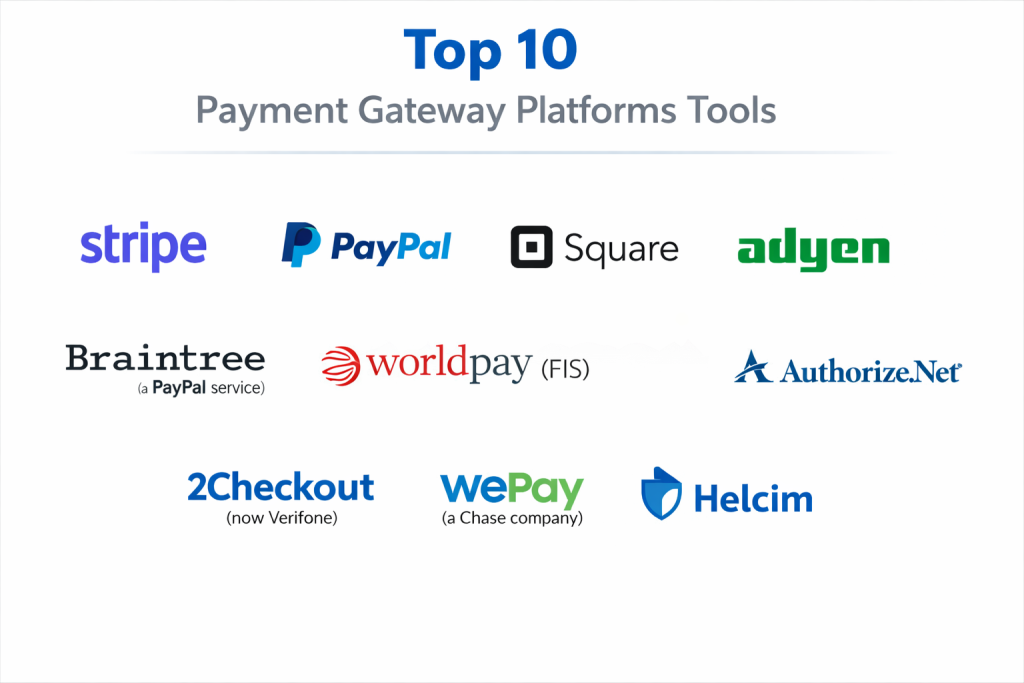
Top 10 Payment Gateway Platforms Tools
1 — Stripe
Stripe is a developer-centric, API-first payment platform built for the internet economy. It’s the preferred choice for tech-savvy startups and enterprises that value flexibility, powerful APIs, and a modern suite of financial tools.
Key features:
- Comprehensive API & Extensive Documentation: Clean, well-documented APIs for payments, subscriptions, invoicing, and more.
- Stripe Elements & Checkout: Pre-built, customizable UI components and a hosted, high-converting payment page.
- Radar Fraud Prevention: Machine learning-powered fraud detection that learns from data across the entire Stripe network.
- Billing & Subscription Management: Robust tools for managing recurring revenue, prorations, and customer billing portals.
- Global & Local Payment Methods: Supports cards, digital wallets (Apple/Google Pay), and hundreds of local payment methods worldwide.
- Stripe Connect: A full-featured platform for building and scaling marketplaces that need to split payments between parties.
Pros:
- Unparalleled flexibility and control for developers to create custom payment experiences.
- Continuously innovates with new financial products (banking-as-a-service, treasury).
- Scales seamlessly from a startup to a public company.
Cons:
- Can be complex for non-technical users to set up without developer help.
- Pricing is à la carte; advanced features like Radar add to the cost.
- Account stability can be a concern for some high-risk businesses.
Security & compliance: PCI DSS Level 1 compliant (the highest level). SOC 1, SOC 2, and ISO 27001 certified.
Support & community: Excellent technical documentation, active developer community (IRC, forums), and 24/7 support for all plans.
2 — PayPal
PayPal is the most recognized name in online payments, known for its massive consumer network. It’s a universal solution that offers both a simple checkout for merchants and a trusted wallet for buyers.
Key features:
- Massive Consumer Base: Over 400 million active accounts, reducing buyer friction.
- One-Touch & PayPal Checkout: Streamlined payment buttons and a fast, familiar checkout flow.
- Buyer & Seller Protection: Programs that build trust for both sides of a transaction.
- PayPal Credit & Pay in 4: Built-in consumer financing options that can increase average order value.
- Venmo Integration: Ability to accept payments via the popular P2P app (US).
- International Reach: Available in over 200 markets.
Pros:
- Extremely low barrier to entry; easy to set up and start accepting payments.
- The trusted PayPal brand can significantly boost checkout conversion, especially for new customers.
- Good for businesses selling to consumers (B2C) who value simplicity.
Cons:
- Higher fees for certain transaction types compared to pure gateways.
- Can pull customers away to the PayPal site, potentially increasing cart abandonment.
- Less flexibility for creating deeply integrated, branded payment experiences.
Security & compliance: PCI compliant with robust fraud prevention tools and dedicated security teams.
Support & community: Extensive help center, community forums, and phone support. Some users report variable support quality.
3 — Square
Square revolutionized in-person payments and has built a cohesive ecosystem that bridges offline and online commerce. It’s ideal for businesses that operate both a physical store and an online presence.
Key features:
- Unified Commerce: Seamlessly syncs inventory, sales, and customer data between online store, POS app, and hardware.
- Free Online Store & Invoicing: Includes basic e-commerce website builder and professional invoicing tools.
- Square Hardware Ecosystem: Integrated card readers, terminals, and POS systems.
- Square Capital & Banking: Offers business loans and banking services (checking, savings) within the ecosystem.
- Appointments & Loyalty: Built-in tools for service-based businesses to manage bookings and customer rewards.
- Transparent, Flat-Rate Pricing: Simple pricing model that’s easy to understand.
Pros:
- Excellent all-in-one solution for retailers, restaurants, and service businesses.
- Extremely easy to get started with minimal technical knowledge.
- The hardware/software integration is best-in-class for omnichannel sellers.
Cons:
- Online gateway features are less robust than specialized platforms like Stripe for complex digital businesses.
- Can become expensive as you add multiple services and hardware.
- Less customizable for developers seeking fine-grained control.
Security & compliance: PCI DSS compliant. End-to-end encryption for hardware transactions.
Support & community: 24/7 phone and chat support, detailed guides, and a large user base of small businesses.
4 — Adyen
Adyen is a global enterprise-grade payments platform built for large, international businesses. It focuses on providing a single unified solution to accept payments anywhere in the world through one contract and one API.
Key features:
- Single Global Platform: One integration to process payments across online, mobile, and in-store globally.
- Extensive Localization: Direct connections to major card networks and support for 250+ payment methods with local acquiring for better approval rates.
- RevenueOptimize & Dynamic Routing: Smart systems to route transactions for the highest authorization rates and lowest costs.
- Unified Commerce Reporting: A single data source for all sales channels, providing deep insights.
- Risk Management: Advanced, data-driven tools for fraud prevention and chargeback management.
- Issuing: Can also issue physical and virtual cards for commercial use.
Pros:
- Unmatched for large businesses with complex, high-volume, global payment needs.
- High level of service, with dedicated account management and technical support.
- Sophisticated data and optimization tools to maximize payment success.
Cons:
- Not accessible to small businesses; typically requires significant monthly volume.
- Implementation can be complex and lengthy.
- Pricing is custom and not publicly transparent.
Security & compliance: PCI DSS Level 1 certified, ISO 27001, and compliant with global data protection regulations.
Support & community: Dedicated 24/7 enterprise support with account managers and technical solutions engineers.
5 — Authorize.Net
Authorize.Net is one of the oldest and most established payment gateways. It’s known for its reliability, wide merchant account compatibility, and strong reputation among small to medium-sized businesses.
Key features:
- Gateway-Only or All-in-One: Can be used with any merchant account or bundled with a Chase merchant account.
- Wide E-commerce Platform Integration: Plugins for virtually every major shopping cart (WooCommerce, Shopify, BigCommerce, etc.).
- Customer Information Manager (CIM): Securely stores customer payment profiles for faster repeat checkouts.
- Advanced Fraud Detection Suite (AFDS): Set of customizable rules to screen for fraudulent transactions.
- Simple Checkout & Invoicing: Includes basic tools for accepting payments via a hosted form or email invoice.
- Virtual Terminal: Process card-not-present payments manually via a web browser.
Pros:
- Extremely reliable and stable with decades of operational history.
- Highly flexible, as it works with most merchant banks and e-commerce platforms.
- Strong fraud prevention tools included at no extra cost.
Cons:
- API and user interface feel dated compared to modern competitors.
- Fee structure includes a monthly gateway fee on top of processing rates.
- Less innovative; focuses on core payment processing rather than a full financial suite.
Security & compliance: PCI DSS compliant. Provides tools to help merchants maintain PCI compliance.
Support & community: 24/7 customer support via phone and chat, extensive knowledge base.
6 — Braintree (a PayPal service)
Braintree, owned by PayPal, is a full-stack payment platform designed for mobile and web experiences. It combines the developer-friendly features of Stripe with the added benefit of easy PayPal and Venmo integration.
Key features:
- Seamless PayPal & Venmo Integration: One integration adds PayPal, Venmo, and major credit/debit cards.
- Drop-in UI & Hosted Fields: Pre-built, mobile-optimized checkout components or the ability to customize your own secure iframes.
- Data Vault: Secure storage for customer payment methods to enable one-click checkout and subscriptions.
- Marketplace & Partner Solutions: Tools for platforms and marketplaces to onboard sellers and split payments (similar to Stripe Connect).
- Advanced Fraud Tools: Powered by Kount and PayPal’s fraud intelligence.
- Global Currency Support: Process and settle in dozens of currencies.
Pros:
- Best of both worlds: a great developer platform with easy access to the PayPal consumer network.
- Excellent for creating a modern, seamless mobile payment experience.
- Strong support for marketplace business models.
Cons:
- Can be seen as the “middle ground” between Stripe’s pure tech and PayPal’s simplicity.
- Some features may feel redundant if you’re already deeply integrated with core PayPal.
- Account stability underwriting can be stringent.
Security & compliance: PCI DSS Level 1 compliant. Inherits security infrastructure from PayPal.
Support & community: 24/7 phone and email support, detailed developer documentation.
7 — Worldpay (FIS)
Worldpay, now part of FIS, is a global payment processing giant. It serves businesses of all sizes but has a particularly strong footprint with large omnichannel retailers and businesses in high-risk industries.
Key features:
- Global Scale & Reach: Processes payments in over 120 currencies across 146 countries.
- Omnichannel Solutions: Unified platform for in-store, online, and mobile payments.
- High-Risk Industry Expertise: Specialized solutions for industries like travel, gaming, and digital goods.
- Alternative Payment Methods: Extensive support for global bank transfers, e-wallets, and buy-now-pay-later (BNPL) options.
- Security & Fraud Management: Advanced risk tools and tokenization services.
- Reporting & Analytics: Comprehensive business intelligence tools.
Pros:
- Unparalleled global acquiring capabilities and local market expertise.
- Can handle very high-risk merchants that other gateways reject.
- Robust, enterprise-grade platform with a long track record.
Cons:
- Can be complex and expensive for small businesses.
- May involve long-term contracts and setup fees.
- Service and support experience can vary by region and merchant size.
Security & compliance: Highest level of PCI DSS compliance, along with other global security certifications.
Support & community: 24/7 global support, with dedicated account management for larger clients.
8 — 2Checkout (now Verifone)
2Checkout (rebranding as Verifone) is a global payment platform that excels at helping digital goods and SaaS companies sell internationally. It handles payments, taxes, and compliance in a single system.
Key features:
- Global Monetization Platform: Combines payment processing, global tax calculation (VAT, GST), and merchant of record services.
- Optimized for Digital Goods & SaaS: Built-in features for subscriptions, one-time sales, and usage-based billing.
- Extensive Localization: Checkout translated and localized in over 100 currencies and 35 languages.
- Integrated Affiliate Marketing: Built-in network and tools to manage affiliate and partner programs.
- Multiple Payment Methods: Supports cards, PayPal, and many regional alternatives.
- Merchant of Record Option: Acts as the seller of record, handling tax liability and compliance.
Pros:
- Dramatically simplifies the complexity of selling digital products globally.
- The merchant of record service offloads significant legal and tax burden.
- Strong focus on the needs of online software and services companies.
Cons:
- Fees can be higher to account for the added services like tax handling.
- Less customizable than a pure gateway like Stripe.
- The rebranding and integration into Verifone may cause some transition uncertainty.
Security & compliance: PCI DSS Level 1 compliant. Adheres to global tax and data regulations.
Support & community: 24/7 global support, knowledge base, and community forums.
9 — WePay (a Chase company)
WePay, owned by JPMorgan Chase, is a payment platform uniquely focused on integrated software vendors (ISVs) and platforms. It provides white-label or co-branded payment solutions that can be embedded seamlessly into other software.
Key features:
- Embedded Payments API: Designed for platforms (marketplaces, fundraising, business software) to add payments without becoming payment experts.
- Underwriting & Risk Management: WePay handles the merchant onboarding, compliance, and fraud risk for the platform’s users.
- White-Label & Co-branded Options: Can provide a fully white-label experience or one co-branded with the platform.
- Instant Payouts: Ability to offer fast or instant deposits to the platform’s users (e.g., sellers, freelancers).
- Chase Ecosystem Benefits: Potential integrations with Chase banking services for business customers.
- Split Payments / Multi-Party Payouts: Built for platforms that need to distribute funds.
Pros:
- Ideal for SaaS companies and platforms that want to add payments as a feature, not a core business.
- Offloads the heavy regulatory and risk burden of payment facilitation.
- Strong backing and stability from a major financial institution (Chase).
Cons:
- Very niche; not designed for a standalone e-commerce merchant.
- Platform-centric model means less direct control over the payment experience for the end-merchant.
- Pricing and availability are typically negotiated with the platform, not the end-user.
Security & compliance: PCI DSS Level 1 compliant. Leverages JPMorgan Chase’s security infrastructure.
Support & community: Support is typically provided to the integrating platform partner, not to individual end-merchants.
10 — Helcim
Helcim is a payment processor and gateway that champions interchange-plus pricing transparency and is built for growing small to mid-sized businesses in the US and Canada.
Key features:
- True Interchange-Plus Pricing: Publicly displays its markup over the actual Visa/Mastercard interchange rates, which decrease as your volume increases.
- No Monthly Fees or Contracts: Transparent pricing with no hidden fees or long-term lock-in.
- Helcim Commerce Suite: Includes a free virtual terminal, online invoicing, and a basic online store builder.
- Customer Relationship Management (CRM): Built-in tools to track customer information and payment history.
- Card Vault: Secure storage for customer cards for recurring billing.
- Focus on SMBs: Designed with the needs of Main Street businesses in mind.
Pros:
- Exceptional pricing transparency and potential cost savings for businesses with consistent volume.
- No contracts provide flexibility and low risk to try the service.
- Good all-in-one toolset for a service-based or small retail business.
Cons:
- Primarily focused on the US and Canadian markets.
- Lacks the advanced developer tools and global capabilities of platforms like Stripe or Adyen.
- The feature set is more basic compared to enterprise suites.
Security & compliance: PCI DSS compliant. Employs tokenization and encryption.
Support & community: Highly-rated 24/7 North America-based phone support, with a focus on customer education.
Comparison Table
| Tool Name | Best For (target user or scenario) | Platform(s) Supported | Standout Feature | Rating |
|---|---|---|---|---|
| Stripe | Tech companies, developers, and businesses wanting maximum flexibility and a modern API-first platform. | Web, Mobile, API | Developer-Centric Flexibility & Comprehensive Financial APIs | High |
| PayPal | B2C businesses, freelancers, and anyone needing quick setup and access to a massive consumer network. | Web, Mobile, In-Person | Massive Consumer Trust & Network Effect | High |
| Square | Omnichannel businesses (retail, restaurants, services) needing seamless online/offline integration. | In-Person, Web, Mobile | Unified Commerce & Hardware/Software Ecosystem | High |
| Adyen | Large global enterprises needing a single, sophisticated platform for worldwide unified commerce. | Web, Mobile, In-Person | Enterprise-Grade Global Unified Commerce | High |
| Authorize.Net | Established SMBs using popular e-commerce platforms and valuing reliability and broad compatibility. | Web, Virtual Terminal | Reliable Gateway with Wide Platform & Bank Compatibility | Medium/High |
| Braintree | Mobile-focused businesses and those wanting a strong developer experience plus easy PayPal/Venmo access. | Web, Mobile, API | Seamless PayPal/Venmo Integration with Developer Control | High |
| Worldpay | Large businesses, high-risk industries, and companies needing deep global acquiring expertise. | Web, Mobile, In-Person | Global Scale & High-Risk Industry Specialization | High |
| 2Checkout (Verifone) | Digital goods & SaaS companies selling internationally and wanting to offload tax/compliance complexity. | Web, Digital Goods | Global Monetization & Merchant of Record Services | Medium/High |
| WePay | Software platforms (ISVs, marketplaces) that want to embed white-label payments without becoming a payment facilitator. | Web, API (for Platforms) | Embedded & White-Label Payments for Platforms | Medium/High |
| Helcim | Cost-conscious SMBs in US/Canada seeking transparent, interchange-plus pricing with no contracts. | Web, Virtual Terminal | Transparent Interchange-Plus Pricing & No Contracts | Medium |
Evaluation & Scoring of Payment Gateway Platforms
Score tools (1-10) using this rubric. Multiply by the weight to get a total score out of 100.
| Evaluation Category | Weight | What to Look For |
|---|---|---|
| Core Features | 25% | Payment method support (cards, wallets, local), fraud tools, subscription management, global capabilities, reporting. |
| Ease of Use | 15% | Simplicity of setup for non-developers, quality of admin dashboard, clarity of reporting, ease of managing disputes. |
| Integrations & Ecosystem | 15% | Pre-built plugins for your e-commerce platform (Shopify, WooCommerce), accounting software, CRM; quality of API documentation. |
| Security & Compliance | 10% | PCI DSS Level 1 compliance, data encryption, tokenization, and adherence to regional regulations (like PSD2 in Europe). |
| Performance & Reliability | 10% | Uptime history (99.9%+), payment success/authorization rates, speed of checkout experience. |
| Support & Community | 10% | Availability (24/7), channels (phone, chat, email), quality of documentation, active user/developer community. |
| Price / Value | 15% | Transaction fees, monthly costs, hidden fees (chargebacks, international), and the overall value of features provided. |
Which Payment Gateway Platform Tool Is Right for You?
Find the best fit based on your business profile:
- By Business Type & Size:
- Tech Startup / Developer-Led Company: Stripe is the default choice for its API and flexibility. Braintree is a close second, especially if PayPal is important.
- Small Retail/Service Business (Omnichannel): Square provides the best integrated online/offline solution. Helcim is great for transparent pricing.
- E-commerce Store on Shopify/BigCommerce: Use the platform’s native gateway or Stripe/PayPal for simplicity. Authorize.Net for broad compatibility.
- SaaS or Digital Goods Company: Stripe or 2Checkout. Choose 2Checkout if you want it to handle global taxes as the merchant of record.
- Large Global Enterprise: Adyen or Worldpay for their scale, unified commerce, and dedicated support.
- Software Platform/Marketplace: Stripe Connect or WePay to embed payments for your users.
- Budget-Conscious vs Premium Solutions:
- Budget-Conscious/SMB: Look for no monthly fees (Helcim, some Stripe/PayPal options) and transparent interchange-plus pricing (Helcim). Avoid long-term contracts.
- Premium Solutions: Adyen and Worldpay offer custom pricing and white-glove service for high-volume, complex needs. The value is in optimization and support.
- Simplicity vs Control & Flexibility:
- Prioritize Simplicity: PayPal, Square, and Helcim offer quick, easy setup with hosted checkouts. Ideal for launching fast.
- Prioritize Control/Flexibility: Stripe and Braintree give developers the tools to build a completely custom, branded payment flow.
- Integration and Scalability Needs:
- If you use Shopify or WooCommerce, check their recommended gateways for the smoothest integration.
- For global scalability, prioritize platforms with local acquiring (Adyen, Stripe) to boost approval rates and reduce costs.
- If you have a custom tech stack, an API-first platform (Stripe) is essential.
- Security and Compliance Requirements:
- All legitimate gateways are PCI DSS compliant. The key is how much of that burden they handle for you. Stripe, Braintree significantly reduce your PCI scope.
- If operating in Europe, ensure support for Strong Customer Authentication (SCA) as part of PSD2.
- For high-risk industries, specialized providers like Worldpay have the expertise and risk appetite.
Frequently Asked Questions (FAQs)
1. What’s the difference between a payment gateway and a merchant account?
A payment gateway is the software that securely transmits the payment data. A merchant account is a special bank account that holds funds from card sales before they’re transferred to your business bank account. Some providers (Stripe, PayPal) are aggregated, providing both in one. Others (Authorize.Net) are gateway-only.
2. What are PCI compliance fees, and do I need to pay them?
PCI DSS (Payment Card Industry Data Security Standard) is a mandatory security standard. Gateways help you comply. Some charge a small monthly PCI compliance fee to manage this, while others (like Stripe) bake it into their service with no separate fee.
3. What is “interchange-plus” pricing vs. “flat-rate” pricing?
Flat-rate (e.g., 2.9% + $0.30) is simple but can be more expensive. Interchange-plus charges the actual Visa/Mastercard interchange fee (which varies by card type) plus a small, transparent markup. It’s often cheaper for businesses with good volume.
4. What is a “hosted checkout page” vs. an “integrated checkout”?
A hosted page (like PayPal) redirects the customer to the gateway’s site to pay. It’s simple and reduces your PCI burden. An integrated checkout (using Stripe Elements) keeps the customer on your site for a seamless, branded experience but requires more technical work.
5. Can I accept payments in multiple currencies?
Yes, most modern gateways are multi-currency. However, check if they support dynamic currency conversion (letting the customer choose) and what the exchange rate markups and settlement currency options are.
6. How long does it take to get paid?
Funds are typically deposited into your bank account in 2-3 business days after the transaction. This is the settlement period. Some services like Square or PayPal offer instant transfers for a fee.
7. What is tokenization?
Tokenization replaces sensitive card data with a unique, random “token.” This token can be stored safely in your system for future customer purchases (subscriptions, one-click checkout) without you ever handling the actual card number, greatly improving security.
8. How do I handle chargebacks?
Gateways provide tools to dispute chargebacks by submitting evidence. The best defense is clear communication, good descriptors on statements, and using the gateway’s fraud prevention tools to screen risky transactions upfront.
9. What’s the best gateway for a nonprofit?
PayPal is very common due to donor familiarity. Stripe is also excellent and offers a discounted rate for registered 501(c)(3) nonprofits through the Stripe Climate program.
10. Can I switch gateways later?
Yes, but it can be a project. You’ll need to re-integrate your website/app, migrate saved customer cards (if possible), and update any automated billing. It’s best to choose carefully from the start, but don’t feel permanently locked in.
Conclusion
Selecting the right Payment Gateway Platform is a critical business decision that impacts revenue, customer experience, and operational efficiency. The market offers specialized leaders for every need—from the developer’s dream of Stripe and the universal reach of PayPal to Square’s omnichannel mastery, Adyen’s global enterprise power, and the transparent SMB focus of Helcim.
The key takeaway is that the “best” gateway is the one that aligns with your business model, technical capability, and growth ambitions. There is no one-size-fits-all winner. A sole proprietor selling crafts needs a vastly different tool than a multinational SaaS company. Start by honestly assessing your priorities: Is it low cost? Ease of use? Global scalability? Developer control? Your payment gateway should feel like a natural extension of your business, not a bottleneck. Test the developer experience or the admin dashboard during trials. Remember, this platform doesn’t just process payments; it enables your business to grow and adapt in a digital-first world. Choose a partner that can grow with you.