Introduction
Nonconformance Management Tools are specialized software solutions designed to identify, document, evaluate, and segregate products or processes that fail to meet predefined quality standards. In the manufacturing and regulated services sectors, a “nonconformance” (NC) occurs whenever a material, component, or finished good deviates from its specifications. These tools provide a structured, digital environment to replace manual logs, ensuring that every defect is captured, assigned a disposition (such as scrap, rework, or use-as-is), and linked to potential corrective actions.
The implementation of these tools is critical for maintaining “audit readiness” and protecting a company’s bottom line. Without a centralized system, quality issues often slip through the cracks, leading to costly product recalls, customer dissatisfaction, and regulatory fines from bodies like the FDA or EMA. Nonconformance management tools offer real-time visibility into quality trends, allowing managers to see if a specific machine, vendor, or operator is consistently producing out-of-spec work. By digitizing the workflow, companies can ensure that no nonconforming material is accidentally used in production, effectively creating a digital “red tag” system that enforces strict quality gates.
Key Real-World Use Cases
- Receiving Inspection: Automatically flagging a shipment of raw materials from a supplier that fails a dimensional check, preventing it from entering the main warehouse.
- In-Process Production: An operator on a medical device assembly line identifies a cracked casing and uses a tablet to log the NC, immediately triggering a quality engineer’s review.
- Laboratory Testing: Documenting a “vial breakage” or an “out-of-specification” (OOS) result in a pharmaceutical lab to maintain a complete batch history.
- Final Quality Audit: Spotting a cosmetic defect during the final packaging stage of high-end electronics and routing the item to a specialized “rework” station.
- Service Nonconformity: Documenting a failure in a standardized surgical procedure or a data entry error in a clinical trial to ensure patient safety and data integrity.
What to Look For (Evaluation Criteria)
When evaluating these tools, look for Disposition Workflow Flexibility—the tool must support various outcomes like scrap, return-to-vendor (RTV), and rework. Mobile Accessibility is a must-have for floor-level reporting, as delays in logging an issue lead to data loss. Risk-Based Filtering helps prioritize critical defects over minor cosmetic issues. Finally, check for Closed-Loop Integration; the tool should seamlessly pass data to a CAPA (Corrective and Preventive Action) module if the nonconformance is deemed systemic rather than isolated.
Best for: Quality Assurance (QA) teams, production supervisors, and regulatory compliance officers in high-stakes industries like Life Sciences, Aerospace, Automotive, and Defense.
Not ideal for: Very small businesses with low-volume production where paper-based “red tags” are sufficient, or pure software companies that utilize “Bug Tracking” tools instead of physical quality management systems.
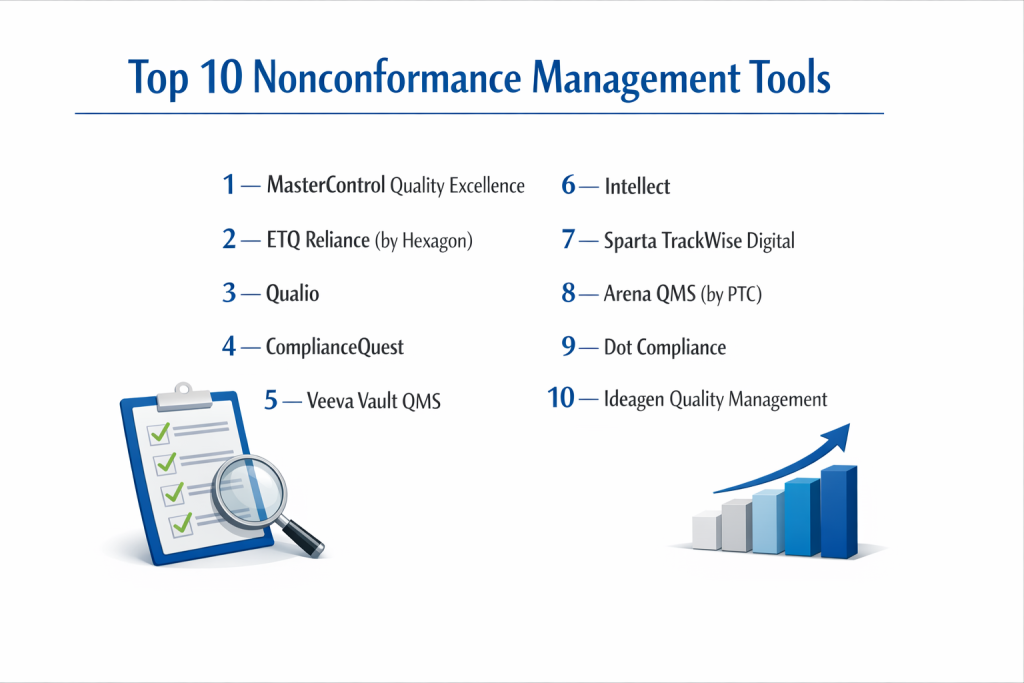
Top 10 Nonconformance Management Tools
1 — MasterControl Quality Excellence
MasterControl is a titan in the quality management space, offering a robust Nonconformance module that is deeply integrated into a full GxP compliance suite.
- Key features:
- Automated Data Capture: Pulls information from ERP and MES to pre-populate NC reports.
- Digital Red-Tagging: Virtually segregates materials to prevent accidental use in production.
- Step-by-Step Forms: Guides users through the evaluation, investigation, and disposition phases.
- Dynamic Routing: Automatically sends high-risk NCs to the Material Review Board (MRB).
- Integrated CAPA: Launch a corrective action directly from an NC record with one click.
- Pros:
- Best-in-class for FDA and ISO compliance; designed for the most rigorous audits.
- Eliminates manual data entry errors through deep system integrations.
- Cons:
- The cost is at the premium end of the market.
- Can feel “heavy” or overly complex for companies with simple quality needs.
- Security & compliance: 21 CFR Part 11, SOC 2 Type II, GDPR, and ISO 27001 compliant.
- Support & community: Enterprise-grade support, “MasterControl University,” and a massive global user base.
2 — ETQ Reliance (by Hexagon)
ETQ Reliance is a highly flexible, platform-based QMS that allows organizations to customize their nonconformance workflows using a “no-code” approach.
- Key features:
- Customizable Workflow Designer: Drag-and-drop to create unique NC approval paths.
- Risk Matrix Integration: Automatically assigns severity based on pre-defined quality risks.
- Supplier Portal: Allows vendors to respond to NCs and provide root cause data directly.
- Multi-Site Search: Centralized visibility across global manufacturing locations.
- Mobile App: Full functionality for quality inspectors on the shop floor.
- Pros:
- Incredible flexibility; it adapts to your process rather than forcing you to adapt to the software.
- Powerful analytics dashboards for spotting long-term quality trends.
- Cons:
- Implementation requires a significant time investment to configure the custom apps.
- Requires a dedicated administrator to manage the platform’s full capabilities.
- Security & compliance: ISO 27001, SOC 2, and various localized data residency options.
- Support & community: Strong network of certified integrators and a comprehensive online learning portal.
3 — Qualio
Qualio is a modern, cloud-native QMS specifically designed for scaling life science companies that need a fast, intuitive way to manage quality.
- Key features:
- Simplified NC Logging: A user-friendly interface that encourages floor-level reporting.
- Collaborative Investigations: Mention team members and collaborate in real-time on investigations.
- Automated Notifications: Keeps stakeholders informed of pending dispositions.
- Audit-Ready Reports: Generate a complete NC history in seconds for regulatory inspectors.
- Unified Quality Record: Links NCs to documents, training, and CAPA in a single view.
- Pros:
- Fast implementation; companies can go live in weeks, not months.
- Very low training barrier due to the clean, consumer-app-style UI.
- Cons:
- Lacks the extreme “deep-tier” customization of enterprise platforms like ETQ.
- Primarily focused on Life Sciences (Medical Devices, Pharma, Biotech).
- Security & compliance: 21 CFR Part 11, SOC 2 Type II, and HIPAA compliant.
- Support & community: Exceptional customer success team and an active “Quality Collective” community.
4 — ComplianceQuest
ComplianceQuest is a native Salesforce-based QMS that leverages the power of AI to streamline nonconformance detection and resolution.
- Key features:
- AI-Powered Insights: “Social” features and AI to suggest root causes based on historical data.
- Salesforce Ecosystem: Built-in integration with Salesforce CRM and Service Cloud.
- Guided RCA: Native tools for “5 Whys” and “Fishbone” root cause analysis.
- Electronic Signatures: Compliant approvals for disposition decisions.
- EHS Integration: Links quality nonconformances to environmental and safety incidents.
- Pros:
- Benefits from the world-class security and uptime of the Salesforce platform.
- Very scalable; grows effortlessly with the organization’s user count.
- Cons:
- Requires a Salesforce environment, which may be a hurdle for some IT departments.
- Pricing can be complex depending on Salesforce licensing.
- Security & compliance: ISO 9001, AS9100, IATF 16949, and 21 CFR Part 11.
- Support & community: Extensive documentation and a large ecosystem of Salesforce/Quality professionals.
5 — Veeva Vault QMS
Veeva is the dominant player in the pharmaceutical and biotech space, providing a unified QMS where nonconformance is part of a larger regulatory lifecycle.
- Key features:
- Unified Platform: Connects quality with clinical, regulatory, and safety data.
- Lifecycle Management: Tracks a defect from initial report to final effectiveness check.
- Supplier Quality Management: Direct collaboration with external manufacturing partners.
- Veeva Snap: A mobile app specifically for capturing photo/video evidence of defects.
- Advanced Dashboards: Real-time visibility into quality metrics for executive leadership.
- Pros:
- The “gold standard” for global pharma; used by the world’s largest drug manufacturers.
- Exceptionally high performance even with massive data volumes.
- Cons:
- Extremely expensive; strictly an enterprise-tier solution.
- Too specialized for general manufacturing outside of life sciences.
- Security & compliance: 21 CFR Part 11, EU Annex 11, and GDPR compliant.
- Support & community: Elite-level professional services and a strong global user community.
6 — Intellect
Intellect offers a “no-code” QMS platform that empowers quality managers to build and modify their own NC management apps without IT help.
- Key features:
- Intellect No-Code Platform: Drag-and-drop tool to modify forms and logic.
- Offline Mobile Access: Capture NC data even in areas with no Wi-Fi or cellular signal.
- Risk-Based CAPA: Automatically determines if an NC warrants a full CAPA based on risk.
- Dynamic Forms: Fields change based on the type of product or defect reported.
- Executive Reporting: Customizable charts for OEE and Quality Cost tracking.
- Pros:
- You are never “stuck” with a feature; you can build exactly what your process requires.
- Strong mobile functionality for field-based or rugged manufacturing environments.
- Cons:
- Requires an “internal champion” who is comfortable with no-code configuration.
- The flexibility can lead to inconsistent processes if not properly governed.
- Security & compliance: ISO 9001, 14001, and supports FDA 21 CFR Part 11.
- Support & community: Dedicated onboarding managers and a helpful online support portal.
7 — Sparta TrackWise Digital
Sparta Systems (a Honeywell company) provides TrackWise Digital, an enterprise-grade solution focused on high-volume quality events.
- Key features:
- Quality Event Management: Handles thousands of NC records simultaneously with ease.
- Integrated Risk Management: Assesses the impact of every NC on the overall business.
- Automated Workflows: Moves records through investigation and MRB review.
- Global Visibility: Standardize NC reporting across multiple global plants.
- Digital Continuity: Links NC data to the digital twin of the product.
- Pros:
- Highly reliable for large-scale operations with complex manufacturing logic.
- Backed by Honeywell’s deep industrial and aerospace expertise.
- Cons:
- The interface can be dense and requires significant user training.
- Implementation projects are typically long and capital-intensive.
- Security & compliance: SOC 2, HIPAA, GDPR, and FedRAMP authorized.
- Support & community: Global 24/7 support and extensive professional certification paths.
8 — Arena QMS (by PTC)
Arena is a combined PLM and QMS solution, making it unique in how it links nonconformance directly to the product’s Bill of Materials (BOM).
- Key features:
- BOM-Linked Quality: See which specific part revisions are experiencing the most NCs.
- Change Control Integration: NCs can automatically trigger an Engineering Change Order (ECO).
- Collaborative Supply Chain: Securely share quality records with contract manufacturers.
- Training Records: Links quality incidents to employee training requirements.
- Cloud-Native Architecture: No local servers or IT overhead.
- Pros:
- Best for electronics and high-tech firms where design and quality are inseparable.
- Eliminates the “silo” between Engineering and Quality departments.
- Cons:
- If you don’t need the PLM features, it can be expensive for just NC management.
- Not as specialized for “Batch/Chemical” manufacturing as it is for “Discrete” assembly.
- Security & compliance: SOC 2 Type II, ITAR (for aerospace), and GDPR compliant.
- Support & community: Strong support from PTC’s global enterprise network.
9 — Dot Compliance
Dot Compliance provides a “QMS in a Box” solution, offering pre-configured, validated modules for small to mid-sized regulated companies.
- Key features:
- Ready-to-Use NC Module: Comes with pre-built best-practice workflows.
- Pre-Validated: Significantly reduces the time and cost of software validation.
- Electronic Signatures: Compliant with all major global health authorities.
- Integrated CAPA: Seamless transition from defect report to corrective action.
- Supplier Quality: Tools to track and manage nonconformances from third-party vendors.
- Pros:
- The fastest way for a startup to become “audit-ready” for the FDA.
- Built on Salesforce, providing great reliability and mobile access.
- Cons:
- Limited ability to customize the “standard” workflows.
- May be too rigid for companies with highly unique manufacturing processes.
- Security & compliance: 21 CFR Part 11, EU Annex 11, and GDPR.
- Support & community: Responsive customer support team and personalized onboarding.
10 — Ideagen Quality Management
Ideagen (formerly Coruson) is a UK-based leader in quality and safety, particularly strong in aviation, rail, and highly complex heavy industries.
- Key features:
- Incident Reporting: Simple interface for staff to report any “out-of-spec” event.
- Heat Maps: Visualize where in the plant or process NCs are most frequent.
- Mobile Auditing: Conduct floor-level inspections that automatically generate NCs.
- Root Cause Management: Integrated tools for detailed incident investigation.
- Risk Register: Links quality failures to the corporate-level risk register.
- Pros:
- The best choice for “Safety-Critical” industries where quality is a life-safety issue.
- Extremely robust audit trails that meet the highest international standards.
- Cons:
- The UI can feel more “traditional” and corporate compared to newer SaaS tools.
- Primary focus is on Europe/UK; support coverage varies for US-based teams.
- Security & compliance: ISO 27001, 9001, AS9100, and GDPR compliant.
- Support & community: Global 24/7 support and a dedicated user forum.
Comparison Table
| Tool Name | Best For | Platform(s) Supported | Standout Feature | Rating (TrueReview) |
| MasterControl | Pharma & Med-Tech | Cloud (SaaS) | Digital Red-Tagging | 4.6 / 5 |
| ETQ Reliance | Flexible Enterprise | Cloud / On-Prem | No-Code Flexibility | 4.7 / 5 |
| Qualio | Scale-ups / SMBs | Cloud (SaaS) | Fastest Implementation | 4.9 / 5 |
| ComplianceQuest | Salesforce Users | Cloud (SaaS) | AI Quality Insights | 4.7 / 5 |
| Veeva Vault | Global Life Sciences | Cloud (SaaS) | Unified Regulatory Sync | 4.8 / 5 |
| Intellect | Custom Workflows | Cloud (SaaS) | Offline Mobile Access | 4.6 / 5 |
| TrackWise Digital | High-Vol Enterprise | Cloud (SaaS) | Industrial Reliability | 4.5 / 5 |
| Arena QMS | Electronics / High-Tech | Cloud (SaaS) | BOM-Linked Quality | 4.5 / 5 |
| Dot Compliance | Small Regulated Biz | Cloud (SaaS) | Pre-validated “In a Box” | 4.4 / 5 |
| Ideagen | Aviation / Safety | Cloud / On-Prem | Safety-Quality Synergy | 4.3 / 5 |
Evaluation & Scoring of Nonconformance Management Tools
| Criteria | Weight | Evaluation Logic |
| Core Features | 25% | Presence of disposition workflows, red-tagging, and MRB support. |
| Ease of Use | 15% | Intuitiveness for shop-floor operators and admin simplicity. |
| Integrations | 15% | Strength of API and native links to ERP, MES, and PLM. |
| Security & Compliance | 10% | Support for 21 CFR Part 11, GDPR, SOC 2, and ISO. |
| Performance | 10% | Search speed for large record volumes and mobile uptime. |
| Support & Community | 10% | Quality of documentation, forums, and consultant availability. |
| Price / Value | 15% | TCO (Total Cost of Ownership) relative to risk reduction. |
Which Nonconformance Management Tool Is Right for You?
Solo Users vs SMB vs Mid-Market vs Enterprise
If you are an SMB or a startup in a regulated field, your goal is “Compliance without Complexity.” Qualio and Dot Compliance are designed for this; they provide the guardrails you need to pass an audit without requiring a full-time IT person. Mid-Market companies with 2-3 manufacturing sites should look at ComplianceQuest or Intellect, which offer more room to customize as you grow. For Global Enterprises, the choice usually falls between MasterControl, Veeva, or TrackWise, as these tools can manage millions of quality events across disparate global entities.
Budget-Conscious vs Premium Solutions
If you are Budget-Conscious, starting with Qualio or a modular no-code approach with Intellect can save significant upfront costs. If you have a Premium Budget, investing in MasterControl or ETQ Reliance is essentially an insurance policy. The cost of the software is negligible compared to the cost of a single FDA Warning Letter or a product recall, which can run into the tens of millions.
Technical Depth vs Simplicity
If you need Technical Depth—especially for complex discrete manufacturing where you must link defects to specific product revisions—Arena QMS and ETQ Reliance are unrivaled. However, if your primary goal is Simplicity to ensure that employees actually report the issues they see, Qualio and ComplianceQuest offer the most modern, frictionless experience for the end-user.
Integration and Scalability Needs
For companies that already use Salesforce for their CRM, ComplianceQuest and Dot Compliance offer a “native” feel that simplifies IT management. If you need a system that can Scale from one pilot line to 50 global plants, MasterControl and Veeva have the most proven architectures for high-volume, multi-tenant cloud reliability.
Security and Compliance Requirements
If you are governed by the FDA, EMA, or other health authorities, you must ensure the vendor provides a “Validation Package.” MasterControl, Veeva, and Qualio are specifically built for this world. For Aviation or Automotive, ensure the tool (like Ideagen or ETQ) has specific templates and security protocols for AS9100 or IATF 16949 standards.
Frequently Asked Questions (FAQs)
1. What is the difference between a Nonconformance and a CAPA?
A nonconformance is a specific instance of a defect (e.g., “this batch of bolts is the wrong size”). A CAPA is an investigation into the systemic cause of that defect to prevent it from happening again.
2. Can I use a regular bug tracker for nonconformance?
Generally, no. Bug trackers (like Jira) lack the electronic signatures, disposition workflows, and “Material Review Board” (MRB) structures required by industrial quality standards.
3. What is a “Material Review Board” (MRB)?
An MRB is a committee of experts (quality, engineering, production) who review nonconformances to decide the best “disposition”—whether to scrap, rework, or use the part as-is.
4. How long does implementation typically take?
For a modern SaaS tool like Qualio, it can be 4-8 weeks. For an enterprise rollout of MasterControl or TrackWise, it can take 6-12 months.
5. Does nonconformance software help with ISO certification?
Yes. It provides the documented evidence of “control of nonconforming output” required by ISO 9001 and ISO 13485.
6. Can I report a nonconformance using my phone?
Most modern tools like ComplianceQuest, Intellect, and Veeva have mobile apps that allow operators to take a photo of a defect and log it instantly.
7. What is “Disposition”?
Disposition is the final decision made regarding a nonconforming product. Common dispositions include: Rework, Scrap, Return to Vendor (RTV), and Use-As-Is.
8. What is a “Digital Red Tag”?
It is a virtual lock on an inventory item within the software. It prevents anyone from “shipping” or “using” that item in the system until the nonconformance is resolved.
9. Is my data safe in a cloud QMS?
Yes. Top vendors use encrypted cloud environments (AWS/Azure/Salesforce) that are more secure than most private servers, featuring 24/7 monitoring and redundancy.
10. What is the most common mistake in managing nonconformances?
“Fear of Reporting.” If the software is too hard to use, or if the culture is punitive, workers will hide defects. Choosing an easy-to-use tool helps build a “Quality First” culture.
Conclusion
Selecting the right Nonconformance Management Tool is a pivotal step in maturing your company’s quality culture. It is the bridge between identifying a problem and fixing the system that caused it. For those in the high-stakes pharmaceutical or medical device world, the rigor of MasterControl or Veeva is essential. For agile manufacturers looking for speed and collaboration, Qualio and ComplianceQuest provide a path to excellence without the legacy bloat.
Ultimately, the goal of these tools is to make quality “invisible” by integrating it directly into the daily workflow. When reporting a defect is as easy as taking a photo, your data becomes more accurate, your products become safer, and your business becomes more profitable. Choose a tool that fits your current technical maturity but has the ceiling to grow with you as your production volume scales.