Introduction
Newsletter platforms are specialized software-as-a-service (SaaS) solutions designed to help individuals and businesses create, manage, and distribute email content to a list of subscribers. Unlike standard personal email providers, these platforms are built to handle bulk distribution while ensuring high deliverability, legal compliance (such as anti-spam laws), and detailed performance tracking. They provide drag-and-drop editors, subscriber management systems, and automation tools that allow creators to nurture a direct relationship with their audience without the interference of social media algorithms.
The importance of newsletter platforms has surged as creators and brands seek “platform independence.” Owning an email list means owning your audience data. Key real-world use cases include independent journalists launching paid subscription models, e-commerce brands sending weekly product digests, and corporate communications teams distributing internal updates. When choosing a platform, users should evaluate the quality of the visual editor, the robustness of automation features, deliverability rates, and how the pricing scales as the subscriber count grows.
Best for: Content creators, solo entrepreneurs, digital marketers, and media companies of all sizes. It is essential for those looking to monetize expertise, build brand loyalty, or drive consistent traffic to a website through a direct communication channel.
Not ideal for: One-to-one personal communication or businesses that only need to send transactional emails (like password resets). Companies with zero interest in content marketing or long-term audience building may find these tools unnecessary.
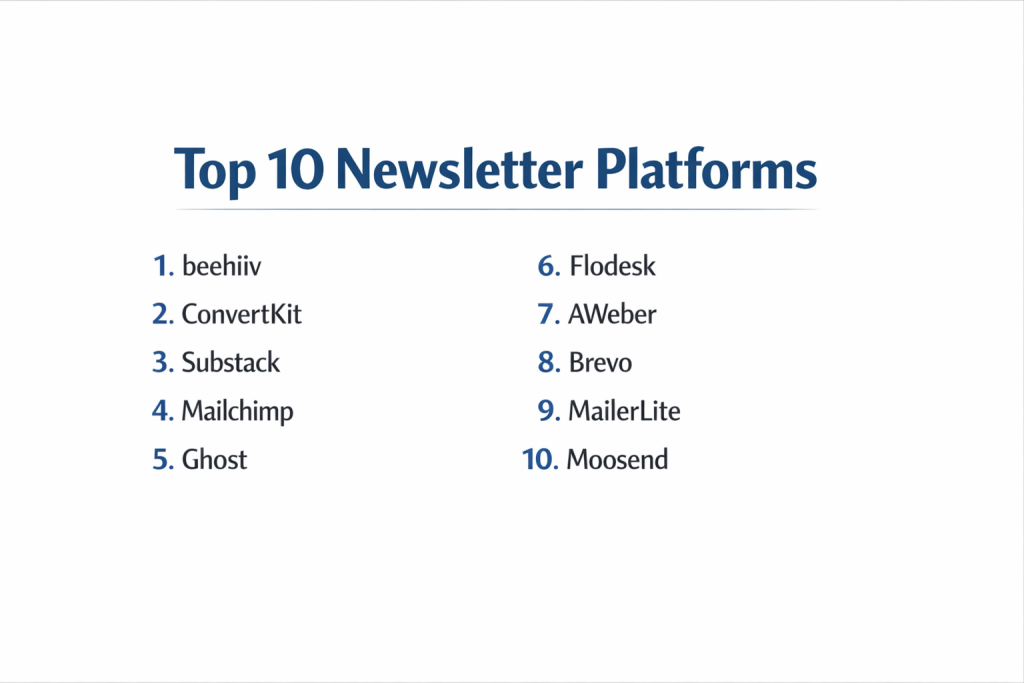
Top 10 Newsletter Platforms
1 — beehiiv
beehiiv is a rapidly growing platform built by the team behind Morning Brew. It is specifically engineered for “newsletter-first” creators who want high-growth features like referral programs and native monetization built directly into the dashboard.
- Key features
- Native referral program that rewards subscribers for inviting others.
- Advanced “Boosts” feature to get paid for recommending other newsletters.
- Integrated ad network to connect creators with premium sponsors.
- Custom domains and advanced SEO-optimized web hosting for newsletter archives.
- Robust 3D analytics that track open rates, clicks, and subscriber growth trends.
- No-code template editor with high flexibility for branding.
- Integrated premium subscription tools with $0 transaction fees.
- Pros
- Designed specifically for growth; the referral engine is best-in-class.
- Flat-rate pricing models that don’t penalize you for becoming successful.
- Cons
- The visual automation builder is less advanced than email marketing suites like ConvertKit.
- Can have a slight learning curve for users who aren’t familiar with modern digital publishing.
- Security & compliance: SOC 2 Type II, GDPR compliant, and 2FA support.
- Support & community: High-quality documentation, active creator community on social media, and responsive email support.
2 — ConvertKit (Kit)
Recently rebranded simply as “Kit,” ConvertKit is the industry standard for professional creators, including authors, YouTubers, and podcasters. It focuses on sophisticated automation and high deliverability.
- Key features
- Visual automation builder to create complex customer journeys.
- Creator Network to help users grow through cross-promotions with other creators.
- Paid newsletter support with integrated payment processing.
- Tag-based subscriber management for hyper-specific audience segmenting.
- High-converting landing page and opt-in form builders.
- “Commerce” features to sell digital products directly within emails.
- Automated email sequences for onboarding or sales funnels.
- Pros
- Exceptionally powerful automation that remains easy to understand visually.
- Excellent deliverability rates ensure your emails avoid the “Promotions” tab.
- Cons
- Can become very expensive as your subscriber list moves into the tens of thousands.
- The email design philosophy is “plain text first,” which may limit those wanting highly graphical layouts.
- Security & compliance: GDPR compliant, encryption at rest, and secure SSO options.
- Support & community: Extensive knowledge base, “Creator Pass” education, and premium support for higher tiers.
3 — Substack
Substack revolutionized the newsletter industry by making it incredibly easy for writers to start a paid subscription business. It serves as both a newsletter tool and a social network for discoverability.
- Key features
- Simplistic “Writer-first” interface focused on long-form text.
- Native payment processing through Stripe for paid subscriptions.
- “Recommendations” engine that drives significant organic growth from other writers.
- Integrated podcast and video hosting capabilities.
- Discussion threads and community features for subscriber engagement.
- Simple “Notes” feature for social-style microblogging.
- Mobile app that acts as a central feed for all Substack subscriptions.
- Pros
- Completely free to start; they only make money when you make money (10% fee).
- Built-in network effect that helps new writers get discovered without ads.
- Cons
- High long-term cost; the 10% revenue share is far more expensive than a flat monthly fee once you are successful.
- Very limited design customization; every Substack looks largely the same.
- Security & compliance: GDPR compliant and standard web encryption protocols.
- Support & community: Large community of writers, but direct customer support can be slower than paid competitors.
4 — Mailchimp
Mailchimp is the most recognizable name in the email space. Now owned by Intuit, it has evolved from a simple newsletter tool into a full-scale marketing automation and CRM platform.
- Key features
- Massive library of professionally designed templates.
- Creative Assistant AI that generates on-brand graphics for your campaigns.
- Advanced segmentation based on purchase behavior (ideal for e-commerce).
- Multi-channel marketing including social ads and postcards.
- “Customer Journey” builder for complex multi-step automations.
- Predictive analytics for estimating customer lifetime value.
- Robust mobile app for managing campaigns on the go.
- Pros
- Hundreds of integrations with third-party apps (Shopify, Salesforce, etc.).
- Highly polished drag-and-drop editor that is great for visual-heavy newsletters.
- Cons
- The pricing structure has become significantly more expensive and complex recently.
- Customer support is notoriously difficult to reach on the free and lower-priced plans.
- Security & compliance: SOC 2 Type II, GDPR, CCPA, and ISO 27001.
- Support & community: Huge knowledge base, global agency partner network, and 24/7 chat for paid users.
5 — Ghost
Ghost is an open-source alternative for professional publishers and independent media organizations. It combines a world-class CMS (Content Management System) with a powerful newsletter engine.
- Key features
- Markdown-based editor that provides a distraction-free writing experience.
- Native membership and subscription management with $0 fees.
- Fast, modern web architecture with excellent SEO out of the box.
- Automated newsletter delivery of every blog post published.
- Multi-tier subscription levels (free, monthly, yearly, founding).
- Deep developer access with a robust API and Webhooks.
- Detailed member analytics and engagement tracking.
- Pros
- You own your data and code completely; no 10% fees on your revenue.
- The most professional aesthetic for high-end digital publications.
- Cons
- Requires more technical setup (or paying for their managed “Ghost Pro” hosting).
- Does not have the built-in “Network discovery” of platforms like beehiiv or Substack.
- Security & compliance: GDPR compliant, secure SSO, and audit logs for enterprise.
- Support & community: Excellent documentation and an active developer forum.
6 — Flodesk
Flodesk is designed specifically for creative entrepreneurs, designers, and small business owners who prioritize aesthetics. It is famous for its flat-rate pricing and stunning design capabilities.
- Key features
- “Layouts” feature that allows for magazine-quality email designs.
- Flat-rate pricing: You pay the same whether you have 100 or 100,000 subscribers.
- Intuitive automation workflows for onboarding new leads.
- High-quality “Link in Bio” and landing page builders.
- Integration with Instagram to pull in your latest feed photos.
- Beautifully designed forms that match your brand’s aesthetic.
- “Flodesk Checkout” for selling products and services within the platform.
- Pros
- The most beautiful templates in the industry; no coding required.
- Predictable pricing that never increases as your list grows.
- Cons
- Very limited integration ecosystem compared to Mailchimp or ConvertKit.
- Lacks advanced data analytics and hyper-specific segmenting features.
- Security & compliance: GDPR compliant and standard encryption.
- Support & community: Strong community on social media and a helpful help center.
7 — AWeber
AWeber is one of the original pioneers of the newsletter world. It remains a reliable choice for small businesses that need a solid, dependable tool with excellent customer support.
- Key features
- AI-powered design assistant that builds templates from your website URL.
- Drag-and-drop landing page builder included in all plans.
- Web push notifications to reach subscribers outside of the inbox.
- Automated blog-to-email functionality (RSS to email).
- Free migration service to help you move from other platforms.
- Direct sales tools to sell products and subscriptions.
- Extensive library of stock images integrated into the editor.
- Pros
- Some of the best live customer support (phone, chat, email) in the business.
- Extremely reliable deliverability with decades of reputation.
- Cons
- The user interface feels dated compared to beehiiv or Flodesk.
- Subscriber management is “list-based” rather than “tag-based,” which can lead to duplicates.
- Security & compliance: GDPR compliant, SOC 2 (Varies), and secure data centers.
- Support & community: 24/7 live support and a massive library of educational content.
8 — Brevo (formerly Sendinblue)
Brevo is a versatile marketing platform that handles newsletters, SMS, and WhatsApp marketing. It is unique because it charges based on the number of emails sent rather than the number of contacts.
- Key features
- Multi-channel outreach: Email, SMS, WhatsApp, and Chat.
- Transactional email delivery for e-commerce notifications.
- Built-in CRM for managing detailed customer relationships.
- Real-time heatmaps to see where subscribers are clicking.
- Marketing automation with a visual workflow builder.
- Landing page and signup form builders.
- Send-time optimization using machine learning.
- Pros
- Unbeatable value for businesses with large contact lists but low sending frequency.
- Excellent for European companies requiring strict data localization.
- Cons
- The email editor is functional but not as “creative” as Flodesk.
- Setting up the advanced CRM features can be time-consuming.
- Security & compliance: ISO 27001, GDPR compliant, and HIPAA compliance options.
- Support & community: Multi-language support and comprehensive documentation.
9 — MailerLite
MailerLite is widely considered the best “balance” for small businesses. It offers a modern interface and advanced features at a price point that is significantly lower than Mailchimp.
- Key features
- Clean, modern drag-and-drop editor with a built-in photo editor.
- Advanced automation triggers and multi-step workflows.
- Website builder and landing page creator with custom domain support.
- A/B testing for subject lines and email content.
- Personalization features based on custom fields.
- iPad app for collecting subscribers at events or in-person shops.
- Paid subscription support with Stripe integration.
- Pros
- Exceptional value for money; the free tier is very generous.
- The interface is incredibly fast and responsive compared to older platforms.
- Cons
- The approval process for new accounts is very strict, which can be frustrating for beginners.
- Analytics are solid but lack the deep “predictive” insights of enterprise tools.
- Security & compliance: GDPR compliant, SOC 2 Type II, and secure SSO.
- Support & community: 24/7 email and chat support for paid plans and an active user base.
10 — Moosend
Moosend is a hidden gem for small-to-mid-sized businesses that need high-end automation features without the high-end price tag. It is known for its simplicity and powerful data tools.
- Key features
- Advanced personalization using data from your website (e.g., product recommendations).
- Weather-based recommendations (show different content based on local weather).
- Pre-built automation “recipes” for common tasks (abandoned cart, welcome).
- Robust reporting with detailed click-mapping.
- Subscription forms and landing pages.
- Seamless integration with WordPress, WooCommerce, and Shopify.
- Countdown timers integrated into the email editor.
- Pros
- Provides “Enterprise-level” automation logic at a mid-market price point.
- Very easy to navigate, making it great for teams with limited technical resources.
- Cons
- Limited template library compared to Mailchimp.
- No native “network effect” or referral tools like beehiiv.
- Security & compliance: GDPR compliant and standard SSL/TLS encryption.
- Support & community: Responsive chat support and extensive video tutorials.
Comparison Table
| Tool Name | Best For | Platform(s) Supported | Standout Feature | Rating |
| beehiiv | High-Growth Newsletters | Web | Native Referral Engine | 4.8/5 |
| ConvertKit | Professional Creators | Web / Mobile | Creator Network Growth | 4.7/5 |
| Substack | Solo Writers / Journalists | Web / Mobile App | Built-in Discoverability | 4.5/5 |
| Mailchimp | E-commerce / Mid-Market | Web / Mobile | Huge Integration Library | 4.4/5 |
| Ghost | Independent Publishers | Web / Self-hosted | Membership Management | 4.6/5 |
| Flodesk | Creative Visual Design | Web | Flat-Rate Pricing | 4.5/5 |
| AWeber | Small Business Support | Web | 24/7 Live Phone Support | 4.2/5 |
| Brevo | Multi-channel / SMS | Web | Pay-per-email Pricing | 4.3/5 |
| MailerLite | Value & Simplicity | Web / iPad | Best All-rounder UI | 4.6/5 |
| Moosend | Advanced Automation | Web | Weather-based Content | 4.3/5 |
Evaluation & Scoring of Newsletter Platforms
To provide an objective ranking, we have evaluated these platforms across several mission-critical categories.
| Category | Weight | Evaluation Highlights |
| Core Features | 25% | Focuses on editor quality, automation depth, and subscriber management. |
| Ease of Use | 15% | Measures the learning curve for non-technical users. |
| Integrations | 15% | Evaluates how well the tool connects with CRMs and e-commerce stacks. |
| Security & Compliance | 10% | Assesses GDPR status, encryption, and anti-spam protocols. |
| Performance | 10% | Considers deliverability reputation and platform uptime. |
| Support & Community | 10% | Quality of documentation and accessibility of live support. |
| Price / Value | 15% | Balances the feature set against the long-term cost of growth. |
Which Newsletter Platform Is Right for You?
Solo Users vs SMB vs Mid-Market vs Enterprise
If you are a Solo User just starting out, Substack or the free tier of MailerLite are the most logical choices. They allow you to build an audience without upfront costs. SMBs looking to drive revenue will benefit most from ConvertKit or Moosend due to their automation capabilities. For Mid-Market e-commerce companies, Mailchimp or Brevo provide the necessary integrations. Enterprises or large-scale media companies should look at Ghost or beehiiv Enterprise for their customizability and advanced governance.
Budget-Conscious vs Premium Solutions
If you are strictly budget-conscious, Flodesk is a “buy-it-for-life” style solution where your price never increases. MailerLite also remains highly affordable. On the premium side, ConvertKit and Mailchimp are expensive, but they offer the advanced segmentation that can significantly increase the ROI of a large email list, making them worth the investment for high-revenue businesses.
Feature Depth vs Ease of Use
For those who want power without complexity, beehiiv is currently the industry leader—it offers growth hacks that are very easy to turn on. If you want infinite “Feature Depth,” ConvertKit is the winner for automations. If you prioritize “Ease of Use” and aesthetics above all else, Flodesk will be the most satisfying experience.
Integration and Scalability Needs
If your business lives inside Shopify or Salesforce, Mailchimp has the best native connectivity. If you are scaling a media business and want to eventually own your platform, Ghost is the most scalable because it is open-source and allows for complete technical control.
Security and Compliance Requirements
Companies operating in the EU should prioritize Brevo or MailerLite, as they have strong European roots and localized data compliance. For those requiring the highest level of data governance, Mailchimp provides the most comprehensive security certifications (SOC 2, ISO, etc.).
Frequently Asked Questions (FAQs)
What is the difference between an email service provider (ESP) and a newsletter platform?
While often used interchangeably, an ESP (like AWS SES) is just the technical “pipes” to send email. A newsletter platform is the user-friendly interface that includes an editor, subscriber lists, and analytics.
How do I ensure my newsletters don’t go to spam?
Choose a reputable platform like AWeber or ConvertKit, which maintain high sender reputations. Additionally, always use a custom domain, provide a clear “Unsubscribe” link, and never buy email lists.
Can I move my subscribers from one platform to another?
Yes. All major platforms allow you to export your list as a CSV file. You can then import that file into a new platform. Note that you may need to re-verify your list if it hasn’t been used in a long time.
What is a “Double Opt-In”?
This is a process where a new subscriber must click a link in a confirmation email before they are added to your list. It is highly recommended for maintaining list quality and complying with GDPR.
How do newsletter platforms make money?
Most use a subscription model based on the number of contacts. Others, like Substack, take a percentage of your subscription revenue. Some, like beehiiv, also offer ad networks where they take a commission on sponsored placements.
Is it better to have one big list or multiple segments?
Segments are far more effective. Segmenting your list (e.g., by interest or purchase history) allows you to send more relevant content, which leads to higher open rates and fewer unsubscribes.
Do I need to be a designer to create a good newsletter?
No. Platforms like Flodesk and MailerLite provide professionally designed templates. You only need to swap out the text and images to have a magazine-quality result.
What is a good “Open Rate”?
This varies by industry, but generally, anything between 20% and 30% is considered healthy. If your open rate is below 15%, you likely have deliverability issues or unengaged subscribers.
What are “Automated Sequences”?
These are emails that are triggered by a specific action. For example, when someone signs up, they automatically receive a “Welcome” email immediately, a “Tips” email two days later, and a “Discount” email five days later.
Is there a free platform that stays free forever?
Most platforms have a free tier (usually up to 500 or 1,000 subscribers). Substack is unique because it remains free regardless of list size, as long as you aren’t charging your subscribers.
Conclusion
The “best” newsletter platform is ultimately the one that aligns with your primary goal. If you are an independent writer seeking discoverability and simplicity, Substack is your starting line. If you are an entrepreneur building a growth-focused media brand, beehiiv offers the most modern tools to scale. For those who need beautiful aesthetics without the price increasing as they grow, Flodesk is a clear favorite.
When choosing, don’t just look at today’s subscriber count; look at where you want to be in two years. Moving platforms is possible, but it is much easier to choose a tool that can scale with you. Prioritize deliverability and ease of use, as consistency is the single most important factor in newsletter success.