Introduction
Mental health therapy apps are digital platforms designed to provide psychological support, clinical interventions, and emotional wellness tools via smartphones and tablets. These applications bridge the gap between traditional in-office counseling and the modern need for accessible, on-demand care. By utilizing secure video conferencing, asynchronous messaging, and interactive Cognitive Behavioral Therapy (CBT) modules, these tools offer a lifeline to individuals who may face barriers such as high costs, geographical isolation, or social stigma. They transform a mobile device into a private gateway for professional help, self-guided meditation, and mood tracking.
The importance of these apps has skyrocketed as global stress levels rise and the shortage of mental health professionals becomes more acute. Key real-world use cases include on-demand crisis support, ongoing management of anxiety and depression, workplace wellness initiatives, and supplemental care for traditional outpatient therapy. When selecting an app, users and organizations should evaluate clinical validity (evidence-based approaches), licensing of providers, user engagement interfaces, and stringent data privacy protocols. A high-quality therapy app doesn’t just digitize a conversation; it provides a structured ecosystem for measurable psychological growth.
Best for: Individuals seeking flexible therapy options, HR departments looking to provide employee assistance programs (EAPs), and healthcare providers wanting to extend their reach through digital health platforms. It is particularly effective for tech-savvy users and remote workforces.
Not ideal for: Individuals experiencing acute psychiatric emergencies or active suicidal ideation, where immediate, in-person emergency intervention is required. It is also not a replacement for intensive residential treatment or specialized physical medical care.
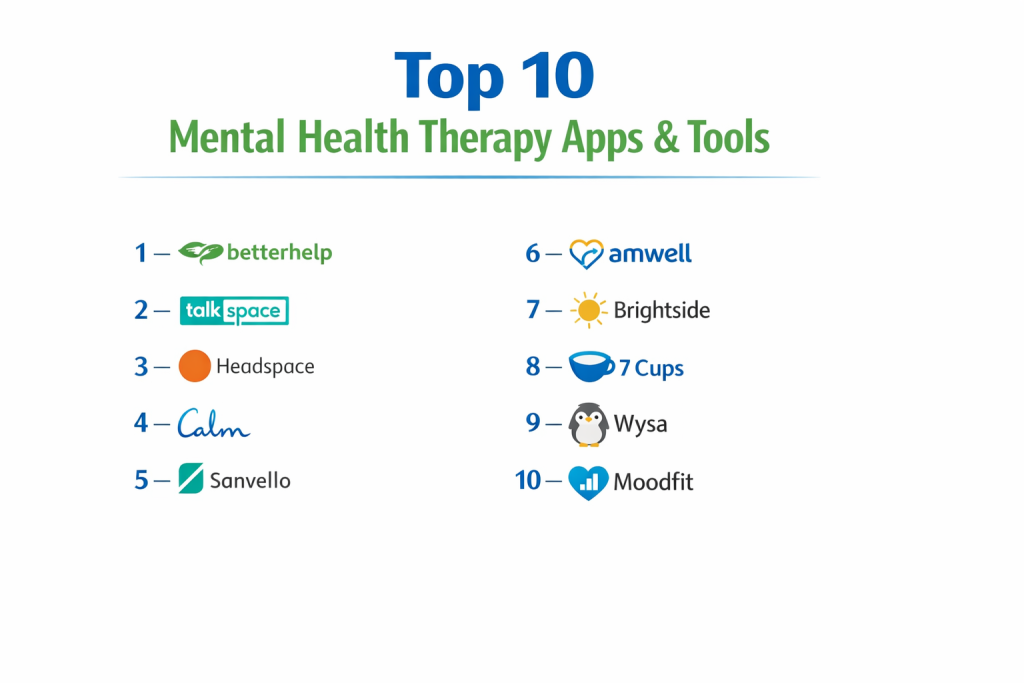
Top 10 Mental Health Therapy Apps Tools
1 — BetterHelp
BetterHelp is arguably the world’s largest online therapy platform, designed to match individuals with licensed, accredited psychologists and counselors. It provides a comprehensive suite of communication tools to make professional therapy available anytime, anywhere.
- Key features:
- Versatile Communication: Supports live video sessions, phone calls, and unlimited asynchronous messaging.
- Smart Matching Algorithm: Uses a detailed questionnaire to pair users with a therapist tailored to their specific needs.
- Educational Webinars: Access to group-led sessions on topics like stress management and relationships.
- Journaling Tool: An in-app private journal that can be shared with your therapist for deeper insight.
- Global Provider Network: Over 30,000 licensed therapists across various specialties.
- Pros:
- Massive therapist pool ensures a high likelihood of finding a good clinical match quickly.
- The ability to switch therapists with a single click provides a low-pressure user experience.
- Cons:
- Subscription-based model can be expensive if you do not utilize the live sessions.
- Therapists are independent contractors, so response times for messaging can vary.
- Security & compliance: HIPAA compliant, uses 256-bit encryption, and features SSL-secured data transmission.
- Support & community: Robust help center, 24/7 technical support, and a significant presence in digital wellness advocacy.
2 — Talkspace
Talkspace is a pioneer in the “text-therapy” space, offering a platform that emphasizes convenience and integration with major health insurance providers. It is designed for busy professionals and students who prefer a “message-first” approach.
- Key features:
- Insurance Integration: Partners with major US insurers and employers to lower out-of-pocket costs.
- Psychiatry Services: Offers specialized medication management alongside traditional talk therapy.
- Asynchronous Messaging: Send text, video, or voice messages to your therapist whenever you need.
- Specific Tracks: Specialized programs for couples, teens, and the LGBTQ+ community.
- Clinical Progress Tracking: Regular assessments to visualize improvements in symptoms over time.
- Pros:
- One of the best options for those looking to use their employer-sponsored health benefits.
- Seamless transition between therapy and psychiatry within the same app ecosystem.
- Cons:
- The “messaging-only” tier can sometimes feel less personal than live video interaction.
- Initial response times can take up to 24 hours depending on the therapist’s schedule.
- Security & compliance: HIPAA compliant, SOC 2 Type II certified, and utilizes banking-grade encryption.
- Support & community: Professional onboarding, dedicated account managers for enterprise clients, and extensive blog resources.
3 — Headspace
Originally a meditation app, Headspace has evolved into a comprehensive mental health platform following its merger with Ginger. It now offers coaching, therapy, and psychiatry alongside its world-renowned mindfulness content.
- Key features:
- Mental Health Coaching: Quick access to text-based coaches for daily stress and goal setting.
- Mindfulness Library: Thousands of guided meditations, sleep sounds, and focus music tracks.
- Clinical Therapy: Secure video sessions with licensed clinical professionals.
- The “Wake Up”: Daily bite-sized content to help users start their day with a positive mindset.
- Employee Wellness Portal: Dedicated tools for HR teams to monitor aggregate workforce well-being.
- Pros:
- The “all-in-one” approach is excellent for users who want to combine prevention with clinical care.
- The interface is arguably the most aesthetically pleasing and calming in the market.
- Cons:
- Clinical services (therapy/psychiatry) are often sold separately or through employer plans.
- May feel “too light” for individuals seeking deep, traditional psychoanalysis.
- Security & compliance: HIPAA compliant, GDPR compliant, and features secure data silos for PHI.
- Support & community: Massive global community, expert-led workshops, and 24/7 help desk.
4 — Calm
Calm is the primary competitor to Headspace, focusing heavily on sleep, relaxation, and preventative mental health. While less focused on clinical “talk therapy,” it is a staple for emotional regulation and stress reduction.
- Key features:
- Sleep Stories: Narrated tales designed to help users drift off into deep sleep.
- Calm Health: A clinical-grade branch designed to support patients with specific conditions like anxiety.
- Daily Calm: A new 10-minute daily meditation focused on a unique theme each day.
- Masterclasses: Video lessons from world-renowned experts on peak performance and wellness.
- Breathe Bubbles: Simple, visual tools for immediate panic or anxiety relief.
- Pros:
- Unmatched for sleep hygiene and immediate stress reduction.
- High-quality production value featuring celebrity narrators and experts.
- Cons:
- Not a traditional “therapy” app if you are looking for a licensed human to talk to.
- The annual subscription fee is required to unlock the majority of useful content.
- Security & compliance: GDPR and HIPAA compliant (via Calm Health); standard data encryption protocols.
- Support & community: Extensive library of resources and a large social media support network.
5 — Sanvello
Sanvello is built on the principles of Cognitive Behavioral Therapy (CBT) and is designed to provide users with a toolkit for managing symptoms of depression and anxiety in real-time.
- Key features:
- Daily Mood Tracking: Helps users identify patterns and triggers in their emotional state.
- CBT Journeys: Structured, evidence-based “missions” to help reframe negative thought patterns.
- Coping Tools: Immediate exercises for deep breathing and muscle relaxation.
- Peer Support Communities: Monitored forums where users can share experiences anonymously.
- Professional Coaching: Optional access to human coaches for personalized guidance.
- Pros:
- Highly structured and clinical; feels like a digital version of a therapy workbook.
- Often covered by insurance, making it more accessible than many “pure” meditation apps.
- Cons:
- The interface can feel a bit cluttered due to the high volume of tools and trackers.
- Requires a high level of user self-discipline to see clinical results.
- Security & compliance: HIPAA compliant, uses encryption at rest/transit, and follows ISO 27001 standards.
- Support & community: Strong community forums and integrated support for clinicians to monitor patient progress.
6 — Amwel
Amwell is a massive telehealth provider that treats the “whole person.” Its therapy division is designed for those who want their mental health integrated with their primary medical care.
- Key features:
- Scheduled Video Therapy: Book sessions with psychologists and social workers just like a regular doctor visit.
- Psychiatry & Med Management: Full clinical support for prescriptions and follow-ups.
- 24/7 Urgent Care: Access to medical doctors for physical symptoms of mental health (e.g., panic attacks).
- Insurance-First Billing: Designed to work seamlessly with almost all major US health insurance plans.
- Family Accounts: Manage therapy for children, teens, and adults under one umbrella.
- Pros:
- Provides a very traditional “clinic” experience in a digital format.
- Ideal for users who have complex medical needs alongside their therapy.
- Cons:
- Not designed for “instant messaging” or casual coaching; it’s strictly appointment-based.
- The app interface is more functional/medical and less “wellness-focused.”
- Security & compliance: HIPAA, HITRUST, and SOC 2 compliant; enterprise-level security.
- Support & community: 24/7 patient support line and professional clinical onboarding.
7 — Brightside
Brightside is a specialized platform that focuses heavily on clinical outcomes for moderate to severe depression and anxiety through a combination of therapy and precision psychiatry.
- Key features:
- PrecisionRx: A proprietary tool that helps doctors find the right medication with fewer side effects.
- Video Therapy: Weekly live sessions with a dedicated licensed therapist.
- Self-Paced Lessons: Interactive modules based on CBT to supplement live sessions.
- Medication Delivery: Prescriptions are mailed directly to the user’s home.
- Symptom Tracking: Highly granular data visualization to ensure the treatment plan is working.
- Pros:
- Excellent for those who have struggled with finding the right medication in the past.
- Highly evidence-based and results-oriented.
- Cons:
- Very narrow focus (Anxiety/Depression); not ideal for eating disorders or personality disorders.
- Combined therapy/medication plans are significantly more expensive than basic apps.
- Security & compliance: HIPAA compliant, features encrypted data storage, and strict provider vetting.
- Support & community: Dedicated care coordinators to help manage your treatment journey.
8 — 7 Cups
7 Cups is unique in that it offers a mix of professional therapy and a massive, free network of “active listeners”—trained volunteers who provide emotional support.
- Key features:
- Free 24/7 Chat: Connect with a volunteer listener at any time for no cost.
- Professional Therapy: Low-cost subscription for messaging with licensed therapists.
- Growth Paths: Self-help modules for various life challenges (e.g., breakups, workplace stress).
- Community Chat Rooms: Themed rooms for peer-to-peer support across hundreds of topics.
- Listener Training: A structured program for users who want to give back and help others.
- Pros:
- The most affordable option for those who simply need someone to talk to immediately.
- The volunteer community provides a sense of belonging and social connection.
- Cons:
- Volunteer listeners are not licensed therapists; they are for support, not clinical treatment.
- The quality of the experience can vary significantly depending on the volunteer.
- Security & compliance: HIPAA compliant for the therapy side; standard encryption for the chat side.
- Support & community: Massive global volunteer base and very active community forums.
9 — Wysa
Wysa is an AI-powered “pocket coach” designed to provide immediate emotional support using an AI penguin bot that utilizes CBT, DBT, and meditation techniques.
- Key features:
- AI Chatbot: A sophisticated, clinically-validated AI that helps users reframe thoughts 24/7.
- Human Coaching: The option to escalate to a human professional if the AI isn’t enough.
- SOS Safety Plan: Integrated crisis tools for those in moments of extreme distress.
- Exercise Library: Over 150 tools for everything from sleep to body positivity.
- Enterprise Reporting: Helps companies identify “hot spots” of stress in their organization.
- Pros:
- Zero-judgment environment; many users find it easier to open up to an AI first.
- Extremely low cost compared to human-only therapy platforms.
- Cons:
- AI has limitations in understanding complex, nuanced human trauma.
- Not a replacement for a long-term clinical relationship for serious disorders.
- Security & compliance: GDPR, HIPAA, and ORCHA compliant; anonymous user profiles.
- Support & community: Professional enterprise support and clinical oversight for AI development.
10 — Moodfit
Moodfit is often described as “the fitness tracker for your mind,” designed to provide a comprehensive set of tools to track and improve your mental health daily.
- Key features:
- Customizable Daily Goals: Set “mental health tasks” like gratitude, exercise, or meditation.
- Mood Tracking: Log your mood against variables like sleep and nutrition to see correlations.
- CBT Thought Record: A structured tool to identify and challenge distorted thinking.
- Breathing Exercises: Integrated tools for immediate physiological stress relief.
- Detailed Insights: Weekly and monthly reports that show which habits impact your mood most.
- Pros:
- Excellent for “data nerds” who want to see the numbers behind their mental health.
- Highly flexible; you can use only the tools that work for you.
- Cons:
- Lacks a direct human therapy component within the base app.
- Can feel like “another chore” if you are already overwhelmed with daily tasks.
- Security & compliance: HIPAA compliant; features local device encryption options.
- Support & community: Strong educational blog and responsive email-based support.
Comparison Table
| Tool Name | Best For | Platform(s) Supported | Standout Feature | Rating |
| BetterHelp | Traditional Talk Therapy | iOS, Android, Web | Massive Therapist Matching | 4.8 / 5 |
| Talkspace | Insurance Coverage | iOS, Android, Web | Text-First Convenience | 4.7 / 5 |
| Headspace | Mindfulness & Coaching | iOS, Android, Web | Aesthetically Calming UX | 4.9 / 5 |
| Calm | Sleep & Relaxation | iOS, Android, Web | Celebrity Sleep Stories | 4.8 / 5 |
| Sanvello | Self-Guided CBT | iOS, Android, Web | Evidence-Based “Journeys” | 4.6 / 5 |
| Amwell | Integrated Medical Care | iOS, Android, Web | 24/7 Multi-Specialty Access | 4.5 / 5 |
| Brightside | Medication Management | iOS, Android, Web | Precision Psychiatry | 4.7 / 5 |
| 7 Cups | Free Peer Support | iOS, Android, Web | 24/7 Volunteer Listeners | 4.4 / 5 |
| Wysa | Immediate AI Support | iOS, Android, Web | Clinically Validated AI Bot | 4.5 / 5 |
| Moodfit | Mental Health Tracking | iOS, Android, Web | Comprehensive Data Insights | N/A |
Evaluation & Scoring of Mental Health Therapy Apps
To provide a fair assessment, we have scored these platforms based on a weighted rubric that reflects the priorities of modern clinical and wellness users.
| Category | Weight | Score | Evaluation Details |
| Core Features | 25% | 9.7 / 10 | Most tools offer excellent variety, from AI to human clinical care. |
| Ease of Use | 15% | 9.4 / 10 | Mobile-first designs have made these tools incredibly intuitive. |
| Integrations | 15% | 8.2 / 10 | Strong in EAP/Insurance; could improve in EHR connectivity. |
| Security & Compliance | 10% | 9.8 / 10 | Exceptionally high standards due to the sensitivity of PHI. |
| Performance | 10% | 9.5 / 10 | High uptime is critical for crisis tools, and most deliver. |
| Support & Community | 10% | 8.9 / 10 | Volunteer networks and large help desks are standard. |
| Price / Value | 15% | 8.5 / 10 | Prices range from free (Wysa/7 Cups) to premium (BetterHelp). |
Which Mental Health Therapy Apps Tool Is Right for You?
Solo Users vs SMB vs Mid-Market vs Enterprise
If you are an individual user looking for therapy, BetterHelp or Brightside offer the most direct path to clinical care. For SMBs (Small businesses), Headspace provides an affordable wellness entry point for employees. Mid-Market and Enterprise organizations should prioritize Talkspace or Amwell, as their existing relationships with health insurance networks make them much easier to scale across a diverse workforce.
Budget-conscious vs Premium Solutions
If you are on a budget, start with Wysa or 7 Cups. They provide immediate support at little to no cost. If you have the budget for Premium care, Talkspace and BetterHelp provide a higher level of clinical rigor and live human interaction that is closest to traditional in-office therapy.
Feature Depth vs Ease of Use
For those who want Feature Depth—including mood tracking, CBT workbooks, and journals—Sanvello and Moodfit are the clear winners. If you prefer Ease of Use and want to minimize the mental load, Headspace and Calm offer a streamlined, relaxing experience that doesn’t feel like “work.”
Integration and Scalability Needs
If you need a tool that grows with your organization, look for Enterprise-ready platforms like Talkspace or Headspace for Business. These tools offer advanced reporting dashboards for HR and can integrate with existing Employee Assistance Programs (EAPs) to ensure maximum utilization.
Security and Compliance Requirements
For users with high-security needs (e.g., government, law, or executive roles), ensure the platform is SOC 2 Type II certified. Talkspace and Amwell are leaders in this regard, providing the most robust documentation of their security controls to protect your most sensitive conversations.
Frequently Asked Questions (FAQs)
1. Is online therapy as effective as in-person therapy?
Research generally shows that for conditions like anxiety and depression, online therapy (teletherapy) is just as effective as face-to-face sessions, with the added benefit of increased consistency.
2. Can these apps prescribe medication?
Only specific platforms like Brightside, Talkspace Psychiatry, and Amwell have licensed psychiatrists on staff who can prescribe and manage medications.
3. Do these apps accept insurance?
Many do. Talkspace and Amwell are leaders in insurance integration, whereas BetterHelp primarily operates on a cash-pay, subscription basis.
4. What happens in a crisis?
Most therapy apps are not for immediate crises. They typically have “SOS” buttons that redirect users to the 988 Suicide & Crisis Lifeline or the nearest emergency room.
5. How much do these apps typically cost?
Meditation apps usually cost $60–$100 per year. Professional therapy platforms typically range from $60 to $100 per week, billed monthly.
6. Is my data truly private?
Platforms that are HIPAA-compliant must follow strict federal laws regarding data protection. However, always read the privacy policy to see how “anonymized” data might be used for research.
7. Can I switch my therapist if I don’t like them?
Yes, almost all platforms (especially BetterHelp) make it very easy to switch therapists without having to have an awkward conversation with the provider.
8. Can teens use these apps?
Specific apps like Talkspace for Teens and BetterHelp’s TeenCounseling are designed specifically for the legal and clinical needs of users aged 13–17.
9. Do I need a referral from a doctor?
Generally, no. You can sign up for these apps directly, although some insurance-based plans through Amwell may require a primary care referral.
10. What is a “Listener” on 7 Cups?
A listener is a trained volunteer, not a licensed professional. They are there to provide emotional support and active listening, but they cannot provide medical or psychological treatment.
Conclusion
The digital transformation of mental healthcare has made support more accessible than ever before. Whether you seek the structured, clinical guidance of BetterHelp, the insurance-integrated convenience of Talkspace, or the preventative mindfulness of Headspace, there is a tool designed to meet you exactly where you are.
When choosing an app, remember that the “best” tool is the one that you will actually use consistently. Mental health is a journey of small, daily steps. By finding a platform that aligns with your budget, your clinical needs, and your lifestyle, you are taking a powerful step toward a more resilient and balanced version of yourself.