Introduction
Medication Adherence Apps are specialized digital health tools designed to help patients follow their prescribed treatment plans by providing timely reminders, tracking dosages, and offering health insights. In an era where chronic conditions are increasingly managed at home, these apps serve as a bridge between the doctor’s office and daily life. They range from simple notification-based “pill reminders” to sophisticated platforms that use Artificial Intelligence (AI) to predict health risks, integrate with smart hardware (like connected pill dispensers), and allow for real-time data sharing with healthcare providers and family members.
The importance of these tools cannot be overstated. Statistics suggest that nearly 50% of patients with chronic illnesses do not take their medications as prescribed, leading to avoidable hospitalizations and billions in unnecessary healthcare costs. These apps solve “real-world” challenges such as “polypharmacy” (managing multiple medications), forgetting whether a dose was already taken, and missing refills. When evaluating these tools, users should look for ease of use, security and HIPAA compliance, offline functionality, drug interaction warnings, and family/caregiver notification features.
Best for:
- Patients with Chronic Conditions: Individuals managing hypertension, diabetes, or HIV who require strict dosing schedules.
- Family Caregivers: People managing the health of aging parents or children with complex medical needs.
- Healthcare Providers: Physicians and pharmacists looking to monitor patient progress and improve outcomes through data-driven insights.
Not ideal for:
- Acute/Short-Term Use: Patients on a simple 7-day course of antibiotics might find a basic phone alarm sufficient.
- Emergency Scenarios: These apps are management tools, not life-saving emergency response systems; they should never replace immediate medical intervention.
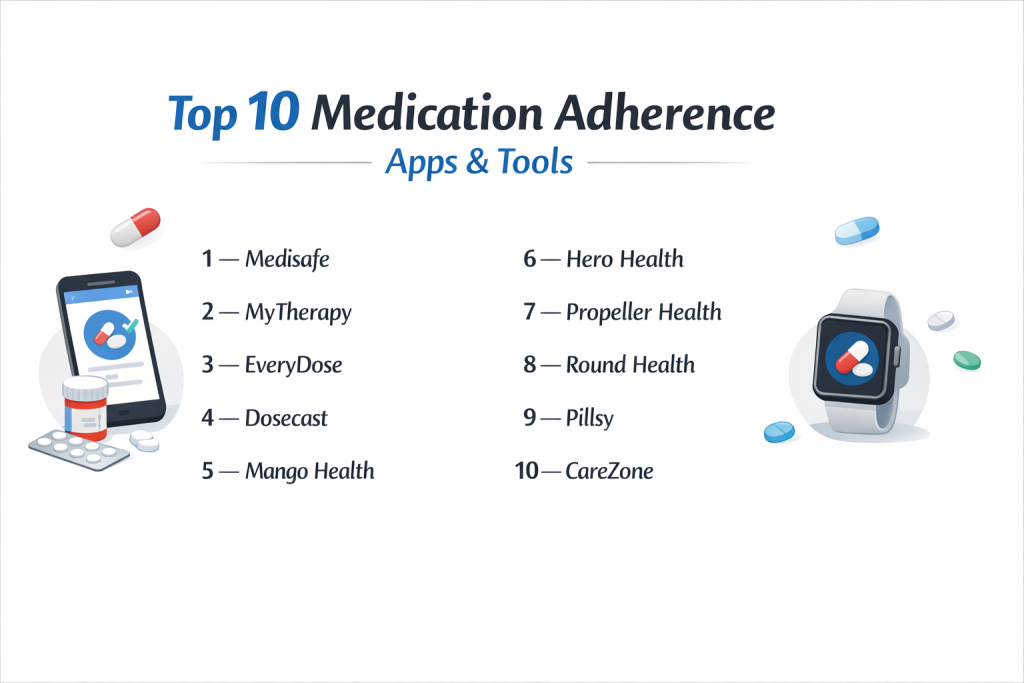
Top 10 Medication Adherence Apps Tools
1 — Medisafe
Medisafe is the leading medication management platform, utilized by millions worldwide. It is designed for both individual patients and enterprise partners (like pharma companies) to improve health outcomes through personalized engagement.
- Key features:
- “Medfriend” feature notifies family if a dose is missed.
- Drug-to-drug interaction warnings in real-time.
- Health measurement tracking (BP, glucose, weight).
- Refill reminders based on remaining pill counts.
- Complex scheduling for tapering doses or birth control.
- Exportable PDF/Excel reports for doctors.
- Pros:
- Extremely high reliability with “persistent” alarms that won’t stop until confirmed.
- Clean, intuitive interface that is easy for seniors to navigate.
- Cons:
- The free version is increasingly limited (now capping the number of medications).
- Premium features like “unlimited Medfriends” require a monthly subscription.
- Security & compliance: HIPAA and GDPR compliant; ISO 27001 and ISO 13485 certified; utilizes 256-bit encryption.
- Support & community: Extensive knowledge base, email support, and a massive community of over 10 million users.
2 — MyTherapy
MyTherapy is a comprehensive, free-to-use medication tracker that combines pill reminders with a health journal and mood tracking, focusing on holistic wellness.
- Key features:
- Adherence reports that can be printed for medical appointments.
- Symptom and mood tracking to identify patterns over time.
- Comprehensive database for easy medication entry.
- Lab result logging and vital sign tracking.
- In-app rewards and “team” features for family support.
- Pros:
- Completely ad-free, which is rare for a free health application.
- Excellent for patients managing mental health alongside physical conditions.
- Cons:
- Lacks the advanced AI-driven predictive insights of some paid competitors.
- The interface can feel slightly cluttered due to the volume of tracking options.
- Security & compliance: Strictly HIPAA and GDPR compliant; ensures data is not shared with third parties without consent.
- Support & community: Strong documentation and responsive email-based customer service.
3 — EveryDose
EveryDose is a modern adherence platform that leverages an AI assistant named “Maxwell” to provide personalized support and answer medication-related questions.
- Key features:
- AI-powered virtual assistant for medication guidance.
- Direct integration with health systems and employers.
- Progress sharing with clinicians via a secure portal.
- Smart alerts that adjust based on user behavior.
- Refill management and pharmacy coordination.
- Pros:
- The “Maxwell” AI provides a more conversational and engaging user experience.
- Strong focus on enterprise integration, making it great for employer-led health programs.
- Cons:
- Primarily focused on the US market and US-based health systems.
- Newer platform with a smaller community compared to Medisafe.
- Security & compliance: HIPAA compliant; infrastructure hosted on Microsoft Azure with AES-256 encryption.
- Support & community: Dedicated support for both individual members and healthcare partners.
4 — Dosecast
Dosecast is a highly flexible medication management tool available on Apple, Android, and Amazon devices, known for its deep customization of dose types.
- Key features:
- Support for all medication types (inhalers, injections, drops, etc.).
- CloudSync service keeps data updated across multiple devices.
- Intelligent “Smart Silencing” during sleep hours.
- Proximity-based reminders for specific locations.
- Multi-person support for managing an entire household.
- Pros:
- Outstanding for complex regimens that don’t follow a standard “take one pill” format.
- Works across a wide range of devices, including Kindle Fire tablets.
- Cons:
- The user interface feels dated compared to modern “Material Design” apps.
- Many critical features (like refill alerts) are locked behind the Pro version.
- Security & compliance: HIPAA aligned; encrypts information during transit; does not require personal registration for basic use.
- Support & community: Robust documentation and legacy user base providing extensive peer troubleshooting.
5 — Mango Health
Mango Health gamifies the medication experience by offering real-world rewards, such as gift cards and charitable donations, for consistent adherence.
- Key features:
- Points-based reward system for taking meds on time.
- Safety alerts for drug-drug and drug-food interactions.
- Daily health habit tracking (e.g., hydration, steps).
- Simplified medication list with pill photos.
- Pros:
- Proven psychological incentive for users who struggle with motivation.
- The most “fun” and visually vibrant app in the category.
- Cons:
- The gamification elements may feel childish to some older users.
- Fewer clinical tracking features compared to Medisafe or MyTherapy.
- Security & compliance: HIPAA compliant; uses standard industry encryption for user data.
- Support & community: Help desk support and a dedicated forum for reward-related questions.
6 — Hero Health
While primarily known for its smart dispenser hardware, the Hero app is a standalone powerhouse for tracking medications stored both inside and outside the device.
- Key features:
- Real-time notifications for late or missed doses.
- Adherence data logging for physician review.
- Refill alerts and low-pill warnings.
- Caregiver “Peace of Mind” dashboard.
- Manages up to 10 meds in the dispenser and unlimited outside.
- Pros:
- Perfect for those who suffer from “pill fatigue” and want a physical/digital hybrid solution.
- Highly accurate adherence tracking because the device knows when a pill is physically dispensed.
- Cons:
- The app is most effective when paired with expensive hardware ($400+ or subscription).
- Subscription-heavy model for the full experience.
- Security & compliance: HIPAA compliant; SSL/TLS encryption for all data transmissions.
- Support & community: 24/7 customer support for dispenser and app troubleshooting.
7 — Propeller Health
Propeller Health is a specialized adherence tool specifically for respiratory conditions like Asthma and COPD, utilizing sensors that attach to inhalers.
- Key features:
- Inhaler-mounted sensors track usage automatically.
- Daily asthma forecast based on local air quality and weather.
- Identification of triggers based on time and location of inhaler use.
- Direct reports sent to respiratory specialists.
- Pros:
- Removes the “manual entry” hurdle for inhaler users.
- Provides environmental context that simple pill reminders lack.
- Cons:
- Highly specialized; not useful for general medication management.
- Requires specific hardware (Propeller sensors) to be useful.
- Security & compliance: HIPAA compliant; SOC 2 Type 2 aligned; ISO certified.
- Support & community: Clinical support team and integration with many major US health plans.
8 — Round Health
Round Health focuses on “The Round,” a visual representation of your daily medication schedule that emphasizes simplicity and habit-forming design.
- Key features:
- “Windows” of time for doses rather than strict single-minute alarms.
- Clean, minimalist aesthetic with Apple Watch integration.
- Refill reminders and dosage history logs.
- Support for “as needed” (PRN) medications.
- Pros:
- The “window” approach reduces the anxiety associated with missing a dose by exactly one minute.
- One of the best-looking apps on the iOS platform.
- Cons:
- Currently only available for iOS (Apple) users.
- Lacks the advanced drug-interaction databases of larger competitors.
- Security & compliance: Varies / Standard encryption used; does not sell identifiable health data.
- Support & community: In-app help and a simplified documentation portal.
9 — Pillsy
Pillsy offers a “Smart Cap” that fits on standard pill bottles, syncing with an app that tracks every time the bottle is opened.
- Key features:
- Automatic tracking via the Smart Cap (no manual logging needed).
- Intelligent reminders that only trigger if the cap hasn’t been opened.
- Double-dose warnings to prevent accidental over-medication.
- Family sharing features for caregiver peace of mind.
- Pros:
- The most “passive” way to track medication adherence.
- Excellent for patients with cognitive decline who may forget they already took a dose.
- Cons:
- Requires the purchase of physical caps for every medication bottle.
- Caps may not fit all types of non-standard pharmacy bottles.
- Security & compliance: HIPAA compliant; uses secure Bluetooth and cloud encryption.
- Support & community: Comprehensive setup guides and email support for hardware issues.
10 — CareZone
CareZone is a multi-functional health management tool that goes beyond medication reminders to include document storage and insurance management.
- Key features:
- Photo-based medication entry (scan the bottle label).
- Storage for insurance cards, IDs, and legal documents.
- Journaling for symptoms and doctor visit notes.
- Pharmacy integration for easy refill ordering.
- Pros:
- An “all-in-one” binder for your health life.
- The scanning feature significantly reduces the risk of data entry errors.
- Cons:
- The app has a wider focus, which can make it feel less specialized for adherence.
- Privacy policies have been criticized in the past (though they have since been updated).
- Security & compliance: HIPAA aligned; utilizes multi-factor authentication (MFA).
- Support & community: Large user base with extensive peer-led support resources.
Comparison Table
| Tool Name | Best For | Platform(s) Supported | Standout Feature | Rating |
| Medisafe | General Use/Family | iOS, Android, Web | Medfriend Notifications | N/A |
| MyTherapy | Holistic Wellness | iOS, Android | Mood & Symptom Tracker | N/A |
| EveryDose | AI Engagement | iOS, Android, Web | Maxwell AI Assistant | N/A |
| Dosecast | Complex Regimens | iOS, Android, Amazon | Support for all Med Types | N/A |
| Mango Health | Gamification | iOS, Android | Real-world Rewards | N/A |
| Hero Health | Polypharmacy | App + Dispenser | Automatic Dispensing | N/A |
| Propeller Health | Asthma/COPD | App + Sensor | Trigger/Weather Analysis | N/A |
| Round Health | Simple iOS Users | iOS, Apple Watch | Flexible “Time Windows” | N/A |
| Pillsy | Seniors/Cognitive | App + Smart Cap | Cap-opening detection | N/A |
| CareZone | Health Organizing | iOS, Android | Document/Card Storage | N/A |
Evaluation & Scoring of Medication Adherence Apps
| Criteria | Weight | Score (1-10) | Explanation |
| Core Features | 25% | 9 | Reminders and logs are highly refined in this category. |
| Ease of Use | 15% | 8 | Most top apps prioritize senior-friendly interfaces. |
| Integrations | 15% | 7 | Hardware and health system integrations are growing. |
| Security | 10% | 9 | HIPAA compliance is standard for major players. |
| Performance | 10% | 8 | Offline functionality is good; sync issues are rare. |
| Support | 10% | 7 | Community forums are strong; direct support varies. |
| Price / Value | 15% | 8 | Many excellent free versions; hardware adds cost. |
Which Medication Adherence App Is Right for You?
Solo Users vs SMB vs Mid-Market vs Enterprise
If you are a solo user looking for a simple, reliable experience, Medisafe or MyTherapy are the industry leaders for a reason. For SMBs (like small independent pharmacies) looking to offer an app to their patients, CareZone or Pillsy provide white-label or partnership opportunities. Enterprise organizations (large health systems and pharma) will find EveryDose or Netsmart (via Medisafe’s SDK) more suitable for their scalability and deep data requirements.
Budget-Conscious vs Premium Solutions
If you want a 100% free experience without ads, MyTherapy is the winner. For those willing to pay a small monthly fee ($5-$10) for premium features like drug interaction warnings and family sharing, Medisafe is the better choice. If you have the budget for hardware-assisted adherence, Hero or Pillsy provide a layer of security that software alone cannot match.
Feature Depth vs Ease of Use
There is a fine line between a tool being “comprehensive” and “overwhelming.” Dosecast offers incredible depth for complex injections and nasal sprays but has a steeper learning curve. Conversely, Round Health and Mango Health prioritize a beautiful, simple user experience that doesn’t feel like “work,” making them better for patients who might otherwise give up on a complicated app.
Integration and Scalability Needs
For those with specific conditions like Asthma, choosing a specialized tool like Propeller Health is more valuable than a general app. If you plan on sharing your data with a Care Team, look for apps with “Clinician Portals” like EveryDose. Scalability is mostly a concern for caregivers managing multiple people; in this case, Dosecast or Medisafe’s multi-profile support is essential.
Security and Compliance Requirements
Always verify that the app is HIPAA compliant if you are in the US. This ensures your protected health information (PHI) is handled with medical-grade security. If you are in Europe, GDPR compliance is the standard. Apps like Medisafe and EveryDose go the extra mile with ISO certifications and annual third-party penetration tests, which is critical if you are storing sensitive data.
Frequently Asked Questions (FAQs)
Are these apps truly HIPAA compliant?
The top-tier apps like Medisafe, EveryDose, and MyTherapy are HIPAA compliant, meaning they follow federal guidelines for data security and privacy. Always check the privacy policy of lesser-known apps.
Can these apps work without an internet connection?
Yes, basic reminders usually function offline. However, features like “Medfriend” notifications, cloud syncing, and drug database searches typically require a Wi-Fi or cellular connection.
How do the apps know if I actually swallowed the pill?
Most apps rely on “self-reporting”—you have to tap a button to confirm. Hardware solutions like Pillsy (Smart Cap) or Hero (Smart Dispenser) offer more accuracy by tracking when the bottle is opened or the pill is dispensed.
Do these apps warn about drug interactions?
Premium versions of apps like Medisafe and Mango Health include a drug-interaction checker that alerts you if a new medication might react poorly with your current ones.
Can I manage my elderly parents’ meds from my own phone?
Yes, features like Medisafe’s “Medfriend” or the Hero app’s “Caregiver Dashboard” allow you to receive alerts on your own device if your loved one misses a dose.
What happens if I forget my phone?
This is a limitation of app-only solutions. Some systems like Dosecast allow you to log doses later, and hardware-based systems like Hero will still chime at the dispenser even if your phone is away.
Are these apps free to use?
Most follow a “freemium” model. Basic reminders are free, but advanced features like reports, unlimited medications, or ad removal often require a subscription.
Can the app help me get refills?
Many apps, including CareZone and Medisafe, track your remaining pill count and can send a reminder to you—and sometimes even your pharmacy—when it’s time for a refill.
Is it safe to store my insurance card in an app?
Apps like CareZone are designed specifically for this with high-level encryption. However, you should always ensure your phone itself is protected by a passcode or biometric lock.
What is the best app for seniors?
Medisafe is often cited as the best for seniors due to its large buttons, clear visuals, and the “Medfriend” safety net that involves family members.
Conclusion
The “best” Medication Adherence App is not the one with the most features, but the one that seamlessly integrates into your daily routine. For some, this means the high-tech AI of EveryDose; for others, the simple, habit-forming design of Round Health or the rewarding gamification of Mango Health.
When choosing a tool, prioritize security, ease of use, and whether you need hardware support. These apps represent a fundamental shift in healthcare, moving the power of management into the hands of the patient. By closing the gap between “prescribed” and “taken,” these tools are quite literally saving lives, one reminder at a time.