Introduction
Medical billing and coding software is a specialized category of healthcare IT designed to automate the lifecycle of a medical claim. In its simplest form, this software translates healthcare services into standardized alphanumeric codes—such as ICD-10 for diagnoses and CPT for procedures—and manages the submission of these codes to insurance payers for reimbursement. It serves as the bridge between clinical documentation and financial sustainability, ensuring that healthcare providers are paid accurately and timely for the care they provide. By automating “claim scrubbing” and electronic data interchange (EDI), these tools significantly reduce human error and administrative overhead.
The importance of this software is rooted in the complexity of modern healthcare finance. Without these systems, medical practices would face astronomical denial rates and delayed payments due to the thousands of evolving coding rules. Key real-world use cases include automated claim submission, real-time eligibility verification, denial management, and patient statement generation. When evaluating tools, users should look for coding automation capabilities, integration with Electronic Health Records (EHR), clearinghouse connectivity, and robust financial reporting.
Best for: Medical billers, certified coders, office managers, and healthcare administrators within private practices, hospitals, and third-party billing companies. It is essential for any healthcare entity that needs to manage insurance claims and patient collections efficiently.
Not ideal for: Purely cash-based or concierge practices that do not deal with insurance payers, or very small wellness clinics where a simple point-of-sale (POS) system might suffice for administrative tasks.
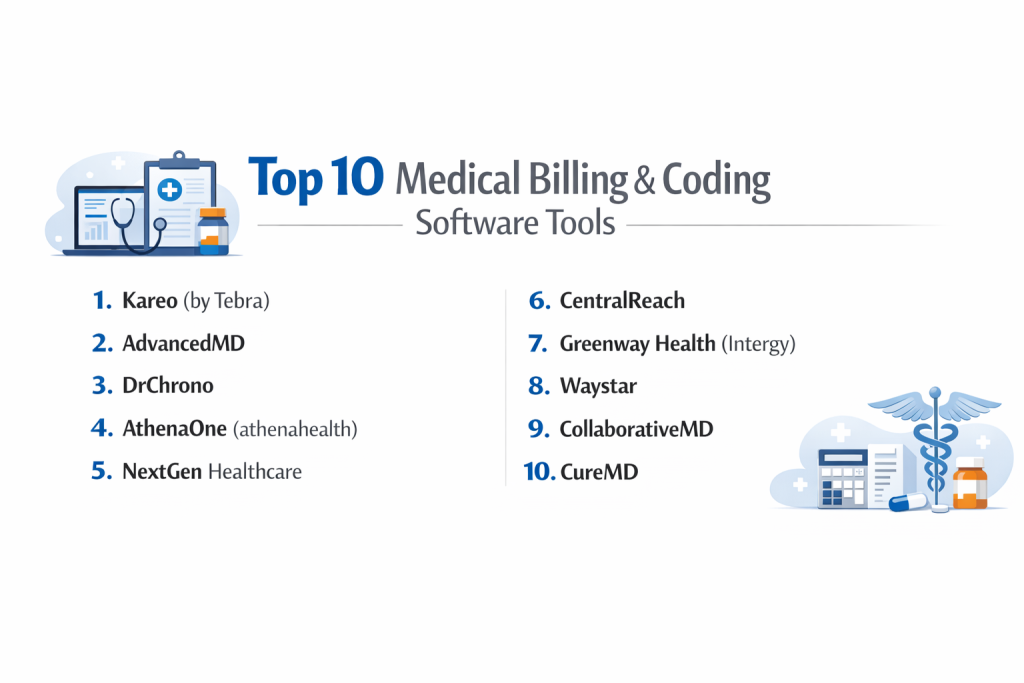
Top 10 Medical Billing & Coding Software Tools
1 — Kareo (by Tebra)
Kareo is a highly popular, cloud-based platform designed specifically for independent practices. It offers a comprehensive suite that balances powerful billing features with a user-friendly interface.
- Key features:
- Rules-Based Claim Scrubber: Automatically checks for errors before submission to minimize denials.
- Integrated Clearinghouse: Seamless connection to over 8,000 insurance payers.
- Smart Dashboard: Real-time tracking of Accounts Receivable (A/R) and key performance indicators.
- Patient Collections: Automated text and email reminders with an integrated payment portal.
- ICD-10 Code Look-up: Built-in tool to help coders find the most specific diagnosis codes quickly.
- Pros:
- Very low learning curve, making it ideal for practices without dedicated IT staff.
- Highly transparent pricing model compared to enterprise legacy systems.
- Cons:
- Customer support response times can be slow during peak hours.
- Advanced reporting customization is somewhat limited for complex multi-specialty groups.
- Security & compliance: HIPAA compliant, 256-bit AES encryption, audit logs, and SOC 2 Type II certification.
- Support & community: Extensive knowledge base, Kareo University training, and active user forums.
2 — AdvancedMD
AdvancedMD is a heavyweight in the medical billing space, known for its deep feature set and high level of configurability. It is designed to scale from small clinics to large, multi-site medical groups.
- Key features:
- ClaimCenter: A centralized hub for managing the entire claim lifecycle.
- Automated Eligibility: Checks patient insurance status automatically before the appointment starts.
- Custom Reporting: Over 150 standard reports with the ability to build complex custom queries.
- ERA Auto-Posting: Electronic Remittance Advice (ERA) is automatically applied to patient accounts.
- Mobile App: Allows providers to capture charges and view schedules on the go.
- Pros:
- Extremely powerful automation that can handle very high claim volumes.
- Excellent integration with its native EHR and many third-party clinical tools.
- Cons:
- The interface can feel overwhelming due to the sheer number of features.
- Contract terms can be rigid, often requiring long-term commitments.
- Security & compliance: HIPAA, HITRUST CSF Certified, SOC 2, and PCI-DSS compliant.
- Support & community: Dedicated account managers for enterprise clients and a robust online training portal.
3 — DrChrono
DrChrono is a mobile-first platform that gained fame for its iPad-native EHR and billing system. It focuses on modernizing the billing experience through a clean, intuitive design and strong API connectivity.
- Key features:
- Live Claims Feed: Real-time updates on claim status directly within the patient chart.
- Custom Billing Profiles: Set up macros for common procedures to speed up data entry.
- Integrated Credit Card Processing: Collect co-pays at the point of care via mobile devices.
- Medical Coding Services: Offers optional managed billing services for practices wanting to outsource.
- Direct Payer Connections: Reduces the middleman to speed up the reimbursement cycle.
- Pros:
- One of the most modern and sleek user interfaces on the market.
- Exceptional mobile functionality for providers who move between exam rooms.
- Cons:
- Premium features can lead to a high total cost of ownership.
- The billing modules sometimes feel “bolted on” to the clinical EHR.
- Security & compliance: HIPAA compliant, SSAE 16 SOC 1 Type II, and data encryption at rest.
- Support & community: Professional onboarding, 24/7 emergency support, and a growing community of tech-forward clinicians.
4 — AthenaOne (athenahealth)
Athenahealth’s AthenaOne is a premier cloud-based suite that combines software with service. It is famous for its “network knowledge,” where it uses data from millions of claims to prevent denials for all its users.
- Key features:
- AthenaCollector: A billing system that proactively flags claims likely to be denied.
- Rules Engine: A massive library of payer-specific rules that is updated daily.
- Authorization Management: Automates the tedious task of obtaining prior authorizations.
- Patient Engagement: Integrated portal and automated outreach to reduce “no-shows.”
- Performance Benchmarking: Compare your practice’s financial health against national averages.
- Pros:
- The collective intelligence of the network means fewer denials and faster payments.
- Very little maintenance required as rules and codes are updated by Athena.
- Cons:
- Higher pricing model (often a percentage of collections) which can be expensive for high-revenue practices.
- Less control over the specific billing process as much of it is automated.
- Security & compliance: HIPAA, SOC 1, SOC 2, and ISO 27001 compliant.
- Support & community: High-touch account management and a massive “AthenaNation” user conference.
5 — NextGen Healthcare
NextGen is a leader in specialty-specific billing, offering deep functionality for behavioral health, orthopedics, and other complex areas that require unique coding logic.
- Key features:
- Financial Suite: Comprehensive tools for general ledger and accounts payable integration.
- Adaptive Reimbursement: Logic that adapts to value-based care and MIPS reporting.
- Electronic Data Interchange (EDI): Robust engine for high-volume claim traffic.
- Specialty Coding Templates: Pre-built templates tailored to 25+ medical specialties.
- Patient Self-Service: Digital intake and online payment options to reduce front-desk work.
- Pros:
- Highly customizable for complex, multi-specialty organizations.
- Strong emphasis on meeting government regulatory and reporting requirements.
- Cons:
- Significant training is required to master the platform.
- On-premise legacy versions can be difficult to upgrade.
- Security & compliance: HIPAA, NIST 800-53, and SOC 2 Type II compliant.
- Support & community: Dedicated client success teams and a deep repository of technical documentation.
6 — CentralReach
CentralReach is a specialized billing and practice management platform designed for Applied Behavior Analysis (ABA) and behavioral health providers.
- Key features:
- ABA-Specific Billing: Handles the unique “units-based” billing required for therapy sessions.
- Integrated Timesheets: Automatically converts therapy logs into billable claims.
- Parent Portal: Allows families to manage balances and view session notes.
- Authorization Tracking: Visual alerts when therapy units are close to expiring.
- Clean Claim Scrubber: Tailored specifically for behavioral health codes.
- Pros:
- The “gold standard” for ABA clinics; handles complexities that general software cannot.
- Excellent at tracking authorization usage to prevent unpaid sessions.
- Cons:
- Not suitable for general medical practices (e.g., primary care or surgery).
- The interface can be cluttered with specialty-specific data.
- Security & compliance: HIPAA compliant, SOC 2, and PCI-DSS certification.
- Support & community: Strong niche community and specialized support staff who understand behavioral health.
7 — Greenway Health (Intergy)
Greenway Intergy is an enterprise-grade solution that excels in high-volume environments. It focuses on the “Revenue Cycle” as a holistic process rather than just individual claims.
- Key features:
- Intergy Practice Management: A unified hub for scheduling and billing.
- Task-Based Workflows: Automatically assigns billing errors to specific staff members.
- Denial Dashboard: Categorizes denials by reason to help identify systemic issues.
- Massive Clearinghouse Access: Supports thousands of different payer formats.
- Customizable Billing Rules: Allows practices to set their own internal audit logic.
- Pros:
- Very stable platform that can handle massive amounts of data without lag.
- Great for practices that have a dedicated, professional billing department.
- Cons:
- Higher upfront costs and implementation fees.
- The user interface is more “utilitarian” and less modern than competitors.
- Security & compliance: HIPAA, HITRUST CSF, and SOC 2 compliant.
- Support & community: Professional consulting services and a structured training program for new users.
8 — Waystar
Waystar is a specialized, “best-of-breed” revenue cycle platform. It is often used as a high-powered clearinghouse and billing engine that sits on top of existing EHR systems.
- Key features:
- Hubble AI: Uses artificial intelligence to predict payer behavior and claim success.
- Unified Platform: Manages commercial, government, and patient payments in one view.
- Proprietary Clearinghouse: One of the largest and fastest claim networks in the US.
- Patient Estimation: Provides patients with accurate cost estimates before service.
- Medicare Connectivity: Direct-to-Medicare submission to bypass third-party delays.
- Pros:
- Can be integrated with almost any EHR, making it very flexible.
- AI features significantly reduce the manual labor of denial management.
- Cons:
- It is a secondary platform, meaning you have to manage two different software environments.
- Pricing is enterprise-focused and can be high for small clinics.
- Security & compliance: HIPAA, SOC 2 Type II, and HITRUST certified.
- Support & community: 24/7 technical support and high ratings for implementation assistance.
9 — CollaborativeMD
CollaborativeMD is a cloud-based billing and practice management system known for its speed and “at-a-glance” visibility into financial health.
- Key features:
- Claim Tracker: A visual “package tracking” style interface for medical claims.
- Real-Time Scrubbing: Claims are scrubbed the moment they are created.
- Enhanced Financial Reporting: Drill-down reports that show exactly why money is stuck.
- Centralized Multi-Office Management: Manage multiple tax IDs and locations in one login.
- Automated ERA Matching: Matches insurance payments to claims automatically.
- Pros:
- Very efficient workflow that reduces the number of “clicks” per claim.
- Great for third-party billing companies managing multiple clients.
- Cons:
- The clinical EHR component is not as strong as the billing component.
- Limited mobile features compared to DrChrono or AdvancedMD.
- Security & compliance: HIPAA compliant, data encryption, and regular third-party audits.
- Support & community: US-based support team and a comprehensive online help center.
10 — CureMD
CureMD is an integrated platform that prides itself on providing “Enterprise functionality at an SMB price point.” It is a solid choice for practices looking for a full EHR/Billing suite without the Athena/Epic price tag.
- Key features:
- Enterprise Scheduler: Manages complex multi-provider and multi-room bookings.
- Integrated Billing: Charges flow directly from clinical notes to the billing queue.
- Key Performance Indicators (KPIs): Visual graphs showing collection rates and A/R days.
- Electronic Eligibility: Automated checks at the time of check-in.
- Patient Portal: Secure messaging and online bill pay.
- Pros:
- High value; includes many “premium” features in its standard package.
- Excellent for mid-sized practices that need to be frugal but functional.
- Cons:
- The system can be slow during high-volume data entry periods.
- Onboarding can be intensive due to the complexity of the configuration options.
- Security & compliance: HIPAA, SOC 2, and ONC-certified EHR.
- Support & community: 24/7 support and personalized account management for larger groups.
Comparison Table
| Tool Name | Best For | Platform(s) Supported | Standout Feature | Rating |
| Kareo | Small Independent Practices | Cloud / Web / Mobile | User-Friendly Interface | 4.5/5 |
| AdvancedMD | High-Volume Multi-Site | Cloud / Web | ClaimCenter Hub | 4.3/5 |
| DrChrono | Mobile-First Providers | iPad / Web / iPhone | iPad-Native Billing | 4.4/5 |
| AthenaOne | Hands-off Automation | Cloud / Web | Payer-Rules Engine | 4.7/5 |
| NextGen | Complex Specialties | Cloud / On-Prem | Specialty Templates | 4.2/5 |
| CentralReach | ABA & Behavioral Health | Cloud / Web | Units-Based Billing | 4.6/5 |
| Greenway Health | Enterprise Revenue Cycle | Windows / Web | Professional Workflow Logic | 4.1/5 |
| Waystar | Best-of-Breed RCM | Cloud / API | AI-Powered Hubble Engine | 4.8/5 |
| CollaborativeMD | Billing Companies | Cloud / Web | Claim Tracker Interface | 4.3/5 |
| CureMD | Mid-Market Value | Cloud / Web | Enterprise SMB Value | 4.2/5 |
Evaluation & Scoring of Medical Billing & Coding Software
| Category | Weight | Score | Reasoning |
| Core Features | 25% | 9.4/10 | Most top tools now offer excellent scrubbing and EDI features as standard. |
| Ease of Use | 15% | 7.5/10 | Billing is inherently complex; modern cloud tools are improving but still have learning curves. |
| Integrations | 15% | 8.8/10 | Strong shift toward open APIs and native EHR connections across the industry. |
| Security & Compliance | 10% | 9.9/10 | Non-negotiable in healthcare; almost all leaders have perfect compliance records. |
| Performance | 10% | 8.5/10 | Cloud uptime is excellent, but high-volume lag can still be an issue in older systems. |
| Support & Community | 10% | 8.0/10 | Support quality varies significantly by vendor size and pricing tier. |
| Price / Value | 15% | 8.2/10 | Value is subjective; higher-priced automation often pays for itself in collected revenue. |
Which Medical Billing & Coding Software Tool Is Right for You?
Solo Users vs SMB vs Mid-Market vs Enterprise
If you are a solo practitioner, simplicity is your best friend. Kareo is designed exactly for your needs—it doesn’t require an IT team and is very intuitive. SMBs and growing clinics should look at AdvancedMD or CollaborativeMD for a balance of power and ease of use. For Enterprise hospital systems or massive multi-state groups, AthenaOne or Greenway Health provide the architectural “heft” and data intelligence required to manage thousands of providers.
Budget-conscious vs Premium Solutions
If you are budget-conscious, look at Kareo or CureMD. They offer lower entry points and transparent monthly fees. If you can afford a premium solution, AthenaOne or Waystar are worth the investment. While they cost more, their ability to proactively prevent denials through AI and massive rule libraries usually results in a higher “Net Collection Ratio,” which means more money in the practice’s pocket at the end of the year.
Feature Depth vs Ease of Use
If you prioritize Ease of Use, DrChrono and Kareo are the winners. They feel like modern apps. However, if you require Feature Depth—such as the ability to manage complex secondary insurance, worker’s comp claims, or specialized therapy units—you will need a more complex tool like NextGen or CentralReach.
Integration and Scalability Needs
Do you already have an EHR you love? If so, look for a “best-of-breed” billing engine like Waystar that can plug into what you have. If you want a “single-source” solution where clinical and billing data live in one database, AdvancedMD is a better fit. As for Scalability, ensure your chosen tool can handle multiple Tax IDs and NPI numbers without needing separate logins.
Security and Compliance Requirements
Every tool on this list is HIPAA compliant. However, if you deal with sensitive government data or international patients, look for vendors with HITRUST or ISO 27001 certifications (like Waystar or AthenaOne), as these indicate a higher level of third-party security validation beyond simple self-attestation.
Frequently Asked Questions (FAQs)
1. What is the difference between Medical Billing and Medical Coding?
Medical coding is the act of translating a doctor’s notes into standard codes (ICD-10, CPT). Medical billing is the process of taking those codes and submitting them to insurance companies to get paid.
2. Can I use these tools if I outsource my billing?
Yes. Most billing companies will ask you to use their software, or they will log into your software (like Kareo or AdvancedMD) to process the claims for you.
3. What is a “Clearinghouse”?
A clearinghouse is a middleman that takes your claims, scrubs them for errors, and then sends them to the various insurance companies. Many tools on this list have a “native” clearinghouse built-in.
4. How long does it take to implement new software?
Small practices can be live on Kareo in 2-4 weeks. Large enterprise rollouts for systems like NextGen or Greenway can take 6 months to a year.
5. How much does this software typically cost?
Pricing is either a flat monthly fee (e.g., $150 – $500 per provider) or a percentage of your collections (e.g., 2% – 7%).
6. Is cloud-based software safe for patient data?
Yes. Modern cloud vendors use bank-level encryption and are often more secure than local servers because they are managed by specialized cybersecurity teams.
7. Does the software automatically update with new codes?
Yes, most cloud-based billing software will automatically update ICD-10 and CPT codes annually, so you don’t have to enter them manually.
8. What is a “Clean Claim Rate”?
This is the percentage of claims that are paid on the first submission without being denied or sent back for corrections. A good software should help you achieve a rate of 95% or higher.
9. Can I bill for telehealth using this software?
Yes, almost all modern billing tools have specific modifiers and logic to handle the unique requirements of virtual visits.
10. What is “Denial Management”?
This is the process of investigating why a claim was rejected and resubmitting it. High-end software like AthenaOne or Waystar automates much of this research.
Conclusion
The selection of a medical billing and coding software is a high-stakes decision that directly impacts the financial survival of a healthcare practice. While AthenaOne and Waystar lead the pack in terms of advanced automation and payer intelligence, the “best” tool is the one that fits your specific workflow and specialty.
Independent practices often find their perfect match in Kareo or DrChrono, while behavioral health specialists are best served by CentralReach. Regardless of which you choose, the transition from manual billing to a modern, cloud-based platform is the single most effective way to reduce administrative burnout and ensure you are paid every dollar you have earned.