Introduction
Marketplace platforms are specialized software solutions designed to enable multi-vendor commerce. Unlike a standard e-commerce site where one seller offers goods to many buyers, a marketplace platform creates an ecosystem where multiple independent sellers can list products, manage their own inventories, and fulfill orders, while the platform owner facilitates the transactions. These platforms act as a digital landlord, providing the infrastructure for search, discovery, secure payments, and dispute resolution. By using a dedicated marketplace platform, businesses can scale their offerings infinitely without the traditional overhead of purchasing and storing inventory themselves.
The importance of these tools has grown exponentially as the “platform economy” matures. They allow businesses to leverage network effects—where the value of the service increases as more participants join. Key real-world use cases include global retail giants like Amazon, service-based marketplaces like Airbnb or Uber, and niche B2B industrial exchanges. When choosing a platform, users must look for robust vendor onboarding workflows, flexible commission structures, split-payment capabilities (to pay both the seller and the platform owner automatically), and sophisticated search algorithms.
Key Real-World Use Cases
- Retail Drop-shipping Hubs: A large retailer expands its catalog by allowing third-party brands to sell directly on its site, taking a 15% commission on every sale without touching the physical product.
- Service Marketplaces: A startup builds a platform for freelance graphic designers where clients can book projects, review portfolios, and release payments through an escrow system.
- B2B Industrial Exchanges: A construction company creates a marketplace where suppliers of heavy machinery can rent equipment to contractors across a specific region.
- Hyper-local Delivery: A city-wide app connects local restaurants with independent couriers and hungry customers, managing three-way logistics in real-time.
- C2C Re-commerce: A fashion enthusiast launches a peer-to-peer marketplace where users can buy and sell vintage luxury clothing safely.
What to Look For (Evaluation Criteria)
- Vendor Management Portal: A dedicated, easy-to-use interface for sellers to upload products, track their earnings, and respond to customer queries.
- Payment Orchestration: The ability to handle complex “split payments,” ensuring the seller gets their portion while the marketplace owner automatically receives their commission.
- Scalability & Performance: The capacity to handle high concurrent traffic and manage millions of SKUs across thousands of different vendor accounts.
- Governance Tools: Built-in moderation features for product listings, vendor vetting processes, and a robust ratings/review system to maintain quality.
- Flexibility of Business Models: Support for commissions, listing fees, subscription tiers for vendors, or lead-generation fees.
Best for: Entrepreneurs launching niche startups, established retail brands looking to move to a multi-vendor model, and B2B organizations aiming to digitize their supply chain. It is ideal for companies that want to facilitate trade rather than own inventory.
Not ideal for: Individual sellers who only need a simple digital storefront (for those, a standard e-commerce platform like Shopify is better) or service businesses that do not involve third-party vendors.
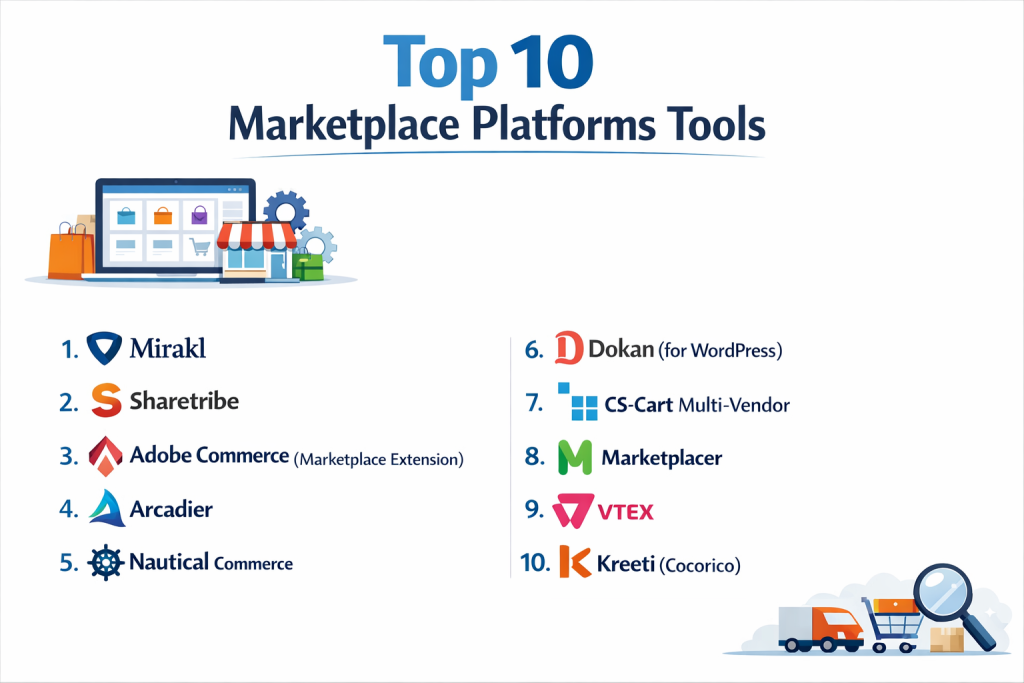
Top 10 Marketplace Platforms Tools
1 — Mirakl
Mirakl is widely considered the gold standard for enterprise-level marketplace transformations. It is a SaaS platform designed specifically to help large B2C and B2B organizations launch and scale their own marketplaces.
- Key features:
- Advanced vendor onboarding and management at scale.
- Sophisticated catalog integration and automated quality control.
- B2B-specific features like request-for-quote (RFQ) and volume pricing.
- Powerful data insights and seller performance tracking.
- Seamless integration with existing e-commerce engines (Adobe, Salesforce).
- Automated tax and regulatory compliance handling.
- Pros:
- Unrivaled scalability; it powers some of the world’s largest retail marketplaces.
- Extremely robust B2B capabilities that cater to complex industrial workflows.
- Cons:
- Prohibitively expensive for small startups or mid-market players.
- Implementation requires a significant investment in time and professional services.
- Security & compliance: ISO 27001, SOC 2 Type II, GDPR, and HIPAA compliant.
- Support & community: High-touch enterprise support, dedicated account managers, and a massive network of certified implementation partners.
2 — Sharetribe
Sharetribe is the leading choice for startups and mid-market companies that need to launch a marketplace quickly. It offers two versions: “Go” for simple needs and “Flex” for developers.
- Key features:
- Optimized for both product and service-based marketplaces.
- Built-in availability calendars for booking services.
- Customizable commission structures and transaction flows.
- Mobile-responsive design out of the box.
- Advanced API-first architecture (in the Flex version).
- Integrated Stripe Connect for automated split payments.
- Pros:
- Incredibly user-friendly; you can launch a basic marketplace in a day.
- The Flex version provides total creative freedom for developers via headless architecture.
- Cons:
- The “Go” version has limited customization for unique business logic.
- Transaction fees can add up as the marketplace scales.
- Security & compliance: GDPR compliant, PCI DSS through Stripe, and encrypted data storage.
- Support & community: Excellent documentation, active developer forums, and responsive email/chat support.
3 — Adobe Commerce (Marketplace Extension)
Adobe Commerce (formerly Magento) is an open-source powerhouse. While it is a standard e-commerce tool, its marketplace extensions allow for deep, custom-built multi-vendor environments.
- Key features:
- Total ownership of the code and customer experience.
- Massive extension marketplace for adding niche vendor features.
- Multi-warehouse and multi-inventory management.
- Advanced SEO and marketing tools built into the core.
- Scalability for millions of products and complex taxonomies.
- Highly flexible API for mobile app integrations.
- Pros:
- Unmatched flexibility; if you can code it, you can build it.
- Perfect for businesses that want a hybrid model (selling their own goods + vendor goods).
- Cons:
- High “Total Cost of Ownership” (TCO) due to hosting and developer fees.
- Requires constant security patching and maintenance.
- Security & compliance: PCI DSS compliant, SOC 2, and GDPR (user-managed).
- Support & community: Massive global developer community and enterprise support plans available.
4 — Arcadier
Arcadier is a highly versatile SaaS marketplace builder that offers specialized templates for retail, rental, and service-based businesses.
- Key features:
- Pre-built templates for specific marketplace types (e.g., Space Rental).
- Multi-lingual and multi-currency support.
- Private marketplace options for B2B procurement.
- Customizable “landing pages” for each vendor.
- Integrated chat between buyers and sellers.
- API access for custom front-end development.
- Pros:
- Very low technical barrier to entry for non-developers.
- Great value for mid-market companies that don’t need enterprise-level complexity.
- Cons:
- Templates can feel a bit rigid for brands wanting a highly unique look.
- The administrative dashboard can be complex to navigate initially.
- Security & compliance: GDPR compliant, SSL encryption, and PCI Level 1.
- Support & community: Comprehensive help center, email support, and video tutorials.
5 — Nautical Commerce
Nautical Commerce is a modern, headless marketplace platform that focuses on “Marketplace Operations” (Marketplace Ops) to simplify the back-end complexity of multi-vendor trade.
- Key features:
- Headless architecture for total front-end flexibility.
- Unified catalog management for multiple suppliers.
- Automated vendor payouts and financial reconciliation.
- Built-in logistics orchestration for multi-vendor orders.
- Real-time inventory syncing across external systems.
- Developer-friendly SDKs and documentation.
- Pros:
- Built specifically for the modern “composable” tech stack.
- Strong focus on solving the logistics and financial “headaches” of marketplaces.
- Cons:
- Requires a developer or technical team to build the front-end.
- A newer player in the market compared to giants like Mirakl.
- Security & compliance: SOC 2, GDPR, and enterprise-grade encryption.
- Support & community: Dedicated onboarding and technical support for enterprise clients.
6 — Dokan (for WordPress)
Dokan is a powerful plugin that transforms any WordPress site running WooCommerce into a fully functional multi-vendor marketplace like eBay or Amazon.
- Key features:
- Individual vendor dashboards on the front-end.
- Support for physical, digital, and variable products.
- Vendor withdrawal system with automated thresholds.
- Shipping management at the vendor level.
- Product reviews and vendor ratings system.
- Integration with over 100 WooCommerce payment gateways.
- Pros:
- The most cost-effective way to launch a marketplace if you already use WordPress.
- Extremely high level of plugin compatibility within the WordPress ecosystem.
- Cons:
- Can become slow if you have hundreds of vendors on a cheap server.
- Managing “plugin bloat” is a constant concern for security and speed.
- Security & compliance: Varies by hosting; GDPR compliant via plugins.
- Support & community: Robust ticketing system and a massive community of WordPress developers.
7 — CS-Cart Multi-Vendor
CS-Cart is a standalone, self-hosted software package designed specifically for marketplaces, providing a rich feature set right out of the box.
- Key features:
- Advanced vendor subscription plans (monetize via memberships).
- Separate vendor panels for inventory and order management.
- Real-time shipping calculations for multiple vendors in one cart.
- Detailed vendor statistics and earnings reports.
- Over 500 built-in features (no need for many add-ons).
- One-time license fee (for the on-premise version).
- Pros:
- Incredible feature density; it handles complex scenarios without extra plugins.
- The “on-premise” model is great for those who want to avoid monthly SaaS fees.
- Cons:
- The UI can feel slightly dated compared to modern SaaS platforms.
- Updates and hosting are the responsibility of the marketplace owner.
- Security & compliance: PCI DSS compliant and GDPR ready.
- Support & community: Dedicated technical support and a large marketplace for add-ons.
8 — Marketplacer
Marketplacer is an enterprise SaaS platform that excels at helping existing retail brands add a marketplace layer to their current e-commerce site.
- Key features:
- Seamless integration with Shopify, Salesforce, and Adobe.
- Vendor acquisition and onboarding tools.
- Automated seller performance management.
- Flexible monetization engines (commissions, ads, fees).
- Advanced product data mapping for consistent catalogs.
- Scalable global infrastructure.
- Pros:
- The best “bolt-on” solution for retailers who don’t want to replace their storefront.
- High focus on “Seller Success” through specialized management tools.
- Cons:
- Enterprise-level pricing is out of reach for most small businesses.
- Less ideal for “pure-play” startups compared to Sharetribe.
- Security & compliance: SOC 2, ISO 27001, and GDPR.
- Support & community: Global 24/7 support and strategic consulting services.
9 — VTEX
VTEX is a “Composable” commerce platform that uniquely integrates e-commerce, marketplace, and Order Management (OMS) into a single cloud-native solution.
- Key features:
- Native marketplace functionality (become a seller or an owner).
- Omnichannel fulfillment capabilities (Ship from store, pickup in store).
- SmartCheckout for high-conversion, password-less payments.
- Integrated collaborative commerce network.
- Headless commerce and React-based front-end framework.
- Global multi-tenant architecture.
- Pros:
- Unrivaled for omnichannel retail (merging physical and digital).
- Very fast time-to-market for complex enterprise deployments.
- Cons:
- Pricing is based on a percentage of sales (GMV), which can become very high.
- The developer ecosystem is smaller than WordPress or Adobe.
- Security & compliance: SOC 2, PCI DSS, GDPR, and ISO 27001.
- Support & community: Strong presence in Latin America and expanding globally; 24/7 support.
10 — Kreeti (Cocorico)
Cocorico is an open-source marketplace solution specifically tailored for service-based and rental marketplaces (the “Sharing Economy”).
- Key features:
- Advanced booking and availability calendars.
- Geo-location search for local service providers.
- Escrow payment management for service security.
- Complex yield management and seasonal pricing.
- Rating and review system for both buyers and sellers.
- Multi-criteria search for finding specific service skills.
- Pros:
- The best open-source choice for Airbnb or TaskRabbit style platforms.
- Highly specialized for time-based and service-based commerce.
- Cons:
- Requires strong Symfony (PHP) developer skills to customize.
- Small community compared to general e-commerce platforms.
- Security & compliance: GDPR compliant and standard encryption.
- Support & community: Developer-led support and GitHub community.
Comparison Table
| Tool Name | Best For | Platform(s) Supported | Standout Feature | Rating |
| Mirakl | Enterprise B2C/B2B | SaaS / Cloud | Massive Scalability | 4.8 / 5 |
| Sharetribe | Startups | SaaS / Headless | Ease of Launch | 4.7 / 5 |
| Adobe Commerce | Custom Hybrid Stores | Self-Hosted | Unlimited Flexibility | 4.4 / 5 |
| Arcadier | Mid-Market Niche | SaaS / Cloud | Industry Templates | 4.2 / 5 |
| Nautical | Logistics-Heavy | Headless SaaS | Logistics Orchestration | 4.5 / 5 |
| Dokan | WordPress Users | WordPress Plugin | Cost-Effectiveness | 4.3 / 5 |
| CS-Cart | Feature-Rich SMB | Self-Hosted / SaaS | Built-in Feature Density | 4.4 / 5 |
| Marketplacer | Retailer Expansion | SaaS / Integration | Retail Adjacency | 4.6 / 5 |
| VTEX | Omnichannel Retail | SaaS / Cloud | Native OMS Integration | 4.7 / 5 |
| Cocorico | Service/Rentals | Open-Source | Booking/Escrow Focus | 4.1 / 5 |
Evaluation & Scoring of Marketplace Platforms
| Criteria | Weight | Evaluation Rationale |
| Core Features | 25% | Vendor portals, split payments, and catalog management. |
| Ease of Use | 15% | Intuitiveness for both the marketplace owner and the vendors. |
| Integrations | 15% | Ability to connect with ERPs, CRMs, and payment gateways. |
| Security & Compliance | 10% | PCI DSS, GDPR, and financial regulatory standards. |
| Performance | 10% | Handling of high traffic and large multi-vendor databases. |
| Support & Community | 10% | Quality of documentation and availability of developers. |
| Price / Value | 15% | Cost vs. features and the scalability of the pricing model. |
Which Marketplace Platform Is Right for You?
Solo Users vs SMB vs Mid-Market vs Enterprise
If you are a solo entrepreneur testing a new idea, Sharetribe Go or Dokan are the clear winners due to their low cost and high speed. SMBs that need more control should look at CS-Cart or Arcadier. Mid-market companies aiming for high growth should consider Nautical or Sharetribe Flex. Finally, Enterprise giants like Best Buy or Kroger must use Mirakl, VTEX, or Marketplacer to ensure the stability and security required for billion-dollar operations.
Budget-conscious vs Premium Solutions
For those on a strict budget, Dokan is unbeatable, as it leverages the free WordPress ecosystem. However, you will pay for it in maintenance time. If you have the budget for a premium solution, Mirakl or VTEX are worth the investment because they handle the “ugly” side of marketplaces—taxes, compliance, and logistics—automatically, allowing you to focus on marketing.
Feature Depth vs Ease of Use
If you prioritize Ease of Use, Sharetribe and Arcadier are designed for you. You can have a professional site without writing a line of code. If you require Feature Depth for a complex industry (like medical supplies or aviation parts), Adobe Commerce or Mirakl provide the granular controls necessary for those regulated environments.
Integration and Scalability Needs
If you already have a successful Shopify or Salesforce store and just want to add a marketplace, Marketplacer is the most seamless integration. If you are starting from scratch and plan to grow into a global player, VTEX or Nautical offer the best cloud-native scalability to handle millions of transactions across borders.
Security and Compliance Requirements
Marketplaces handle money for third parties, which brings heavy financial regulation (like PSD2 in Europe). Mirakl and VTEX have the strongest built-in compliance engines. For data privacy, ensure your chosen platform is SOC 2 and GDPR compliant, especially if you are handling sensitive consumer information or B2B contracts.
Frequently Asked Questions (FAQs)
What is the difference between e-commerce and a marketplace?
E-commerce is one-to-many (you sell your stuff). A marketplace is many-to-many (you provide the platform for others to sell their stuff).
How do marketplace owners make money?
Common models include taking a commission (e.g., 15%) on every sale, charging vendors a monthly subscription fee, or charging for “featured” product listings.
What are “split payments”?
It is a technology that automatically divides a customer’s payment at checkout, sending $85 to the vendor and $15 to the marketplace owner instantly.
Do I need to handle shipping for my vendors?
Usually no. In a marketplace model, the vendors handle their own shipping, but the platform (like Nautical or VTEX) helps track the status for the customer.
Can I build a marketplace for services like Uber?
Yes. Platforms like Sharetribe and Cocorico are specifically designed for service bookings and rentals rather than just physical products.
Is WordPress/Dokan secure enough for a marketplace?
Yes, if you use high-quality hosting and keep your plugins updated. However, SaaS platforms are generally more secure as the provider handles the “hardening.”
What is a “Headless” marketplace?
It means the back-end (data/logic) is separated from the front-end (design). This allows you to build a custom app or website that connects to the marketplace via API.
How do I prevent “platform leakage”?
Leakage is when buyers and sellers move off your platform to avoid fees. You can prevent this by offering superior protection, escrow services, and ease of use.
What is “vendor onboarding”?
It is the process of vetting a seller, verifying their identity, and helping them upload their initial catalog to your platform.
Which platform is best for B2B?
Mirakl and Nautical Commerce are specifically designed to handle the complexities of B2B, such as bulk pricing, net-payment terms, and RFQs.
Conclusion
Building a marketplace is significantly more complex than building a standard online store. You are essentially building a community, a bank, and a logistics hub all at once. The “best” platform is the one that aligns with your technical capabilities and your specific business model—whether that is selling shoes, renting apartments, or connecting consultants with clients.
For most startups, Sharetribe provides the perfect balance of speed and power. For retailers looking to evolve, Marketplacer or Mirakl offer the enterprise security needed to protect an existing brand. Ultimately, your success won’t just depend on the software, but on your ability to attract high-quality vendors and provide a safe, frictionless experience for buyers.