Introduction
Maritime Vessel Management Software is a specialized digital ecosystem designed to handle the complex operations of running a fleet of ships. Often referred to as “Fleet Management Systems,” these platforms act as the central nervous system for shipowners and managers. They integrate various functions—such as maintenance, crew payroll, safety compliance, and fuel tracking—into a single interface. In an industry where assets are constantly moving across different time zones and jurisdictions, this software provides the visibility needed to keep ships sailing safely and profitably.
The importance of this technology cannot be overstated. Operating a modern vessel involves juggling strict international laws, mechanical upkeep, and the well-being of a global workforce. Doing this with paper logs or basic spreadsheets is no longer sustainable. Vessel management software ensures that a ship is always “audit-ready,” meaning all safety certificates and maintenance records are up to date. Furthermore, it plays a massive role in environmental goals by monitoring fuel consumption and emissions, helping companies reduce their carbon footprint while saving on operational costs.
Key Real-World Use Cases
- Planned Maintenance Systems (PMS): Scheduling engine overhauls and equipment checks to prevent expensive breakdowns in the middle of the ocean.
- Crew Management: Handling the certifications, contracts, and payroll for hundreds of seafarers across multiple vessels.
- Procurement and Supply Chain: Automating the ordering of spare parts and provisions so they are ready for pickup at the next port of call.
- Compliance and HSEQ: Digitalizing safety drills and accident reporting to ensure the fleet meets IMO (International Maritime Organization) standards.
What to Look For (Evaluation Criteria)
When choosing a tool, the first priority should be offline capability. Ships often lose internet access in deep water, so the software must allow crew members to enter data that syncs once a connection is restored. You should also look for modular design, allowing you to buy only the features you need. Data analytics are essential for identifying trends in fuel use or equipment failure. Finally, the user interface must be simple enough for crew members of various nationalities and technical backgrounds to use without constant assistance.
Best for: Technical managers, shipowners, fleet directors, and crewing agencies. It is essential for commercial shipping companies, offshore energy fleets, and large-scale cruise lines that need to manage high-value assets across global routes.
Not ideal for: Recreational boaters or small fishing vessel owners with only one or two ships. For these users, simple maintenance apps or even basic inventory tools are usually more cost-effective and less complicated.
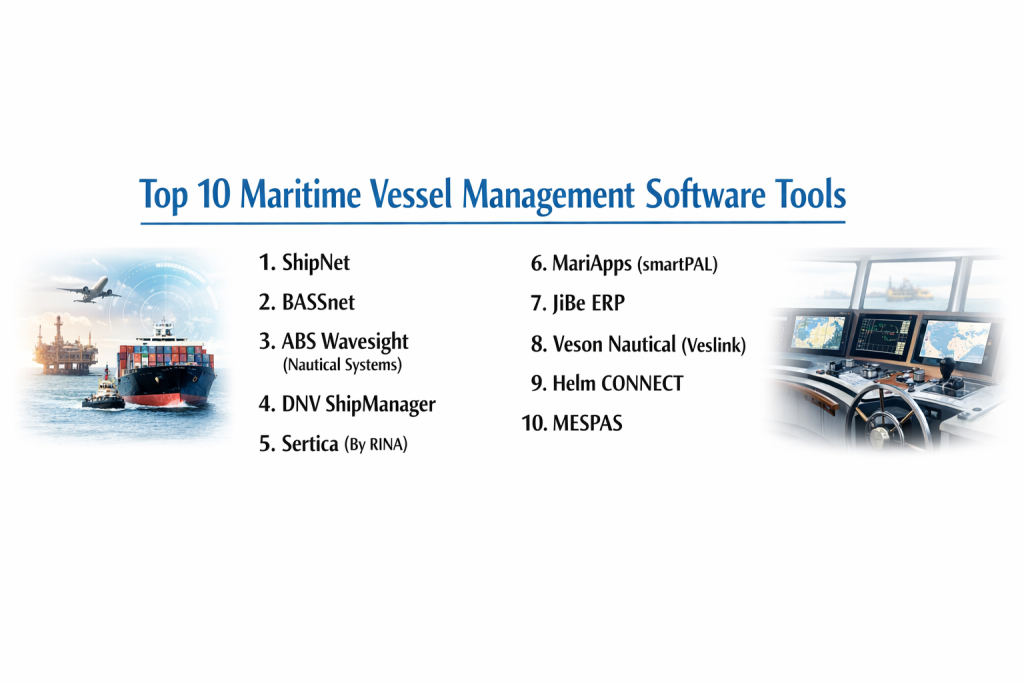
Top 10 Maritime Vessel Management Software Tools
1 — ShipNet
ShipNet is one of the most established names in the industry, offering a full ERP (Enterprise Resource Planning) solution designed specifically for the maritime sector. It covers everything from commercial chartering to technical management.
- Key features:
- Integrated financial management and maritime accounting.
- Comprehensive technical maintenance and dry-docking modules.
- Procurement automation with supplier portal integration.
- Advanced crew management including training and payroll.
- Real-time commercial voyaging and chartering tools.
- High-level business intelligence reporting.
- Pros:
- Exceptionally deep functionality that connects the office to the ship seamlessly.
- Decades of industry experience, ensuring all maritime-specific tax and legal needs are met.
- Cons:
- The system can be quite heavy and requires significant hardware/cloud resources.
- The learning curve is steep due to the sheer volume of features.
- Security & compliance: ISO 27001 certified, features heavy encryption for financial data, and provides full audit logs for regulatory compliance.
- Support & community: Offers global 24/7 support, dedicated account managers, and a well-structured onboarding program for new fleets.
2 — BASSnet
BASSnet is a modular fleet management suite that is widely praised for its focus on safety and environmental compliance. It is designed to help shipowners achieve “paperless” operations.
- Key features:
- Planned Maintenance System (PMS) with visual equipment hierarchies.
- Integrated HSEQ (Health, Safety, Environment, and Quality) module.
- Mobile apps for inventory counting and safety inspections.
- Environmental reporting for EU MRV and IMO DCS emissions tracking.
- Crew self-service portal for managing documents.
- Electronic logbooks to replace traditional paper logs.
- Pros:
- Highly intuitive interface compared to older legacy systems.
- Excellent at keeping companies compliant with the latest environmental laws.
- Cons:
- Pricing can become expensive as you add more specialized modules.
- Initial data migration from old systems can be time-consuming.
- Security & compliance: GDPR compliant, supports SSO (Single Sign-On), and meets all major IACS requirements for digital records.
- Support & community: Provides a comprehensive knowledge base, regular software updates, and an active user community forum.
3 — ABS Wavesight (Nautical Systems)
Formerly known as Nautical Systems, ABS Wavesight is backed by the American Bureau of Shipping. It is a highly technical tool focused on operational excellence and risk management.
- Key features:
- Deep integration with vessel classification and survey data.
- Advanced hull and structural integrity monitoring.
- Asset management focused on maximizing the lifespan of the ship.
- Workforce management with a focus on compliance and fatigue tracking.
- Operational insights using AI-driven data.
- Supply chain management with automated requisition workflows.
- Pros:
- Strongest choice for companies that prioritize technical safety and “survey readiness.”
- Directly linked to classification standards, making audits much smoother.
- Cons:
- Can feel overly “technical” for staff in the accounting or HR departments.
- Customization often requires professional services from the vendor.
- Security & compliance: SOC 2 compliant, features robust encryption, and adheres to the strictest cybersecurity standards in shipping.
- Support & community: Access to ABS’s global network of experts and extensive technical documentation.
4 — DNV ShipManager
ShipManager by DNV is a leading fleet management system that emphasizes data smarts. It is designed for managers who want to use data to make better decisions about fuel and maintenance.
- Key features:
- Integrated hull integrity management with 3D models.
- Advanced procurement and “smart” inventory suggestions.
- Crewing module with global payroll support.
- Project management tools specifically for dry-docking.
- Data analytics dashboard for fleet-wide performance.
- Compliance management for STCW and other maritime laws.
- Pros:
- The 3D hull management feature is a market leader for structural safety.
- Very reliable data syncing between the ship and the shore office.
- Cons:
- Premium pricing reflects its position as a high-end enterprise tool.
- Requires a stable technical setup on the ship for the best experience.
- Security & compliance: Meets ISO 27001 and Cyber Secure standards; fully compliant with GDPR and IMO cybersecurity guidelines.
- Support & community: Strong enterprise support with a global footprint and high-quality training sessions.
5 — Sertica (By RINA)
Sertica is known for its flexibility and user-friendliness. It is designed to be a tool that the crew actually enjoys using, which leads to better data entry and more accurate reports.
- Key features:
- Highly customizable dashboards for different user roles.
- Simplified procurement with integrated e-commerce links.
- Master Data Management to ensure consistency across the fleet.
- Mobile task management for engineers on the deck.
- Advanced analytics for fuel consumption and CO2 emissions.
- Integrated safety and risk management modules.
- Pros:
- One of the best user interfaces in the maritime software world.
- Very flexible—you can start small and add features as your company grows.
- Cons:
- Some of the most advanced reporting features require a higher technical skill level.
- Not as many “built-in” financial accounting features as ShipNet.
- Security & compliance: ISO 27001 certified, supports encrypted data transfers, and offers full audit trails for every action.
- Support & community: Responsive customer support and a dedicated “Sertica Academy” for training crew and office staff.
6 — MariApps (smartPAL)
MariApps offers smartPAL, a web-based, mobile-compliant suite that is built using modern tech stacks. It is designed for the “next generation” of ship managers.
- Key features:
- Comprehensive suite covering 25+ different maritime modules.
- Live tracking of vessel position and performance.
- Mobile-first approach for all crew-related tasks.
- Integrated catering and victualling management.
- Advanced dry-docking and repair tracker.
- Real-time financial transparency for shipowners.
- Pros:
- The web-based nature makes it very easy to access from anywhere in the world.
- Cloud-native design means no expensive servers are needed on-site.
- Cons:
- Relies heavily on internet connectivity for real-time features.
- The interface, while modern, can be quite dense with information.
- Security & compliance: SOC 2 Type II certified and provides high-level encryption and SSO support.
- Support & community: Offers 24/7 global support and has a strong presence in major shipping hubs like Singapore and Dubai.
7 — JiBe ERP
JiBe is a modern, cloud-based ERP that challenges the legacy players with an integrated, “all-in-one” philosophy. It aims to eliminate the need for third-party software.
- Key features:
- Fully integrated crewing, technical, and purchasing systems.
- “Single Source of Truth” data architecture.
- Automated invoice processing with OCR technology.
- Performance monitoring with high-frequency data collection.
- Intuitive recruitment and HR tools for seafarers.
- Integrated vessel documentation and certificate vault.
- Pros:
- The automation of invoices and paperwork saves hours of office work.
- Very fast implementation compared to traditional enterprise ERPs.
- Cons:
- As a newer player, it doesn’t have the 40-year track record of some competitors.
- The “all-in-one” approach means it can be harder to integrate with existing niche tools.
- Security & compliance: Uses AWS (Amazon Web Services) security protocols, features full encryption, and is GDPR compliant.
- Support & community: Known for a very proactive development team and modern support ticket systems.
8 — Veson Nautical (Veslink)
Veson Nautical is the gold standard for commercial maritime management. While others focus on the “engine room,” Veson focuses on the “chartering desk.”
- Key features:
- Market-leading voyage estimation and chartering tools.
- Comprehensive bunker (fuel) management and hedging.
- Integrated risk management and exposure tracking.
- Real-time voyage reporting and financial analysis.
- Seamless integration with technical management systems.
- Fleet-wide map views with live weather overlays.
- Pros:
- Unrivaled for making a profit and managing commercial shipping contracts.
- Used by the world’s largest commodity traders and shipowners.
- Cons:
- It is not a full “technical” management system (PMS) on its own.
- Very expensive, targeted primarily at the mid-to-enterprise market.
- Security & compliance: SOC 1 and SOC 2 compliant; features world-class cybersecurity and data privacy.
- Support & community: Elite-level enterprise support and a large community of commercial shipping professionals.
9 — Helm CONNECT
Helm CONNECT is a highly popular choice for workboats, tugs, and barges. It is designed to be the simplest and most accessible tool for smaller vessels.
- Key features:
- Very simple drag-and-drop maintenance scheduling.
- Compliance tracking specifically for sub-chapter M and other local rules.
- Quick crew check-ins and certification alerts.
- Inventory management with low-stock notifications.
- Clear “To-Do” lists for captains and engineers.
- Basic offline capability for local operations.
- Pros:
- So easy to use that crew members can learn it in minutes.
- Highly affordable for smaller companies with fewer ships.
- Cons:
- Lacks the deep global “big ship” features like multi-currency payroll.
- Not designed for massive ocean-going tankers or container ships.
- Security & compliance: Standard web encryption and secure data hosting; compliant with regional safety standards.
- Support & community: Excellent customer service and a very helpful online training portal.
10 — Mespas
Mespas is a Swiss company that provides a unique “Technical Ship Management” cloud platform. It focuses on the connection between shipowners and their suppliers.
- Key features:
- Integrated maritime e-marketplace for parts and services.
- Planned Maintenance System with pre-loaded equipment data.
- HSEQ and document management.
- Crew management and payroll.
- Simplified data syncing between ship and shore.
- KPI dashboards for technical performance.
- Pros:
- The pre-loaded data makes setting up the maintenance system much faster.
- The direct link to a marketplace makes ordering parts incredibly easy.
- Cons:
- The system is a bit more rigid in how it expects you to work.
- Not as much flexibility for “outside-the-box” customizations.
- Security & compliance: High Swiss standards for data privacy and security; GDPR compliant.
- Support & community: Professional support with a focus on technical excellence and engineering accuracy.
Comparison Table
| Tool Name | Best For | Platform(s) Supported | Standout Feature | Rating |
| ShipNet | Large Fleet ERP | Web, Windows | Maritime Accounting | N/A |
| BASSnet | Compliance & Safety | Web, Mobile, App | Modular Flexibility | N/A |
| ABS Wavesight | Technical Excellence | Web, Desktop | Class-Link Integration | N/A |
| DNV ShipManager | Data-Driven Owners | Web, Desktop | 3D Hull Modeling | N/A |
| Sertica | User Experience | Web, Mobile | Customizable UI | N/A |
| MariApps | Modern Ship Managers | Web, Mobile | Cloud-Native Suite | N/A |
| JiBe ERP | Automation | Cloud, Web | OCR Invoice Scanning | N/A |
| Veson Nautical | Commercial/Chartering | Web, Mobile | Voyage Estimation | N/A |
| Helm CONNECT | Workboats & Tugs | Web, Mobile | Ease of Use | N/A |
| Mespas | Procurement/PMS | Cloud, Web | Integrated Marketplace | N/A |
Evaluation & Scoring of Maritime Vessel Management Software
The table below shows how these tools are evaluated based on the critical needs of the shipping industry.
| Category | Weight | Average Score | Evaluation Logic |
| Core Features | 25% | 9/10 | Includes PMS, Crewing, and Procurement. |
| Ease of Use | 15% | 7/10 | Vital for crew adoption and reducing data errors. |
| Integrations | 15% | 8/10 | Ability to “talk” to GPS, AIS, and Finance tools. |
| Security & Compliance | 10% | 9.5/10 | Ships are critical infrastructure; security is high. |
| Performance | 10% | 8.5/10 | Offline reliability and sync speed are key. |
| Support | 10% | 8/10 | Global 24/7 availability is the industry standard. |
| Price / Value | 15% | 7.5/10 | ROI is found in reduced downtime and fuel savings. |
Which Maritime Vessel Management Software Tool Is Right for You?
Solo Users vs SMB vs Mid-Market vs Enterprise
There are rarely “solo users” in shipping, but for Small Owners with 1–3 vessels, Helm CONNECT is the perfect starting point. It offers the essentials without the “big ship” complexity. Mid-Market fleets (10–30 vessels) will find a great balance in Sertica or MariApps. For Global Enterprises managing 50+ tankers or container ships, only the “big” ERPs like ShipNet, BASSnet, or DNV ShipManager can provide the necessary depth and control.
Budget-Conscious vs Premium Solutions
If budget is the main concern, Helm CONNECT or AeroCRS (in aviation) equivalents like Mespas are cost-effective because of their cloud models. However, shipping is an industry where “cheap” often leads to “expensive.” Premium solutions like ABS Wavesight or Veson Nautical cost more upfront but can save millions by preventing a single structural failure or optimizing one major charter contract.
Feature Depth vs Ease of Use
If your priority is high-level engineering and structural integrity, you must accept the technical depth (and complexity) of ABS Wavesight. However, if you have a crew that is resistant to new technology, prioritizing the Ease of Use found in Sertica will result in better data and a more successful implementation.
Integration and Scalability Needs
Always check if the software can scale. A tool that works for 5 ships might fail when you have 20. Ensure the tool uses API-first design, allowing it to connect with future technologies like autonomous sensors, AI fuel optimizers, or new satellite communication systems like Starlink.
Security and Compliance Requirements
Cybersecurity is now a mandatory part of maritime law (IMO 2021). Any tool you pick must have robust encryption and a clear policy on data backups. If you operate in Europe, GDPR is essential for passenger and crew data. For those in the US, look for Sub-Chapter M compliance if you operate tugs or towboats.
Frequently Asked Questions (FAQs)
1. What is the most important part of vessel management software?
The Planned Maintenance System (PMS). It prevents engine failures and ensures the ship stays legal and safe by tracking every bolt and filter.
2. Can these tools work without internet?
Yes, the best tools have a “Ship-Shore” sync feature. Crew enter data offline, and the system automatically sends it to the office once the ship gets a signal.
3. How long does it take to install these systems?
For a small fleet, it can take 3 months. For a large international fleet with an ERP like ShipNet, it can take 12 to 18 months to fully set up.
4. Will this software help me pass an inspection?
Yes. These tools keep all your certificates and maintenance records in one place, so when a Port State Control officer walks on board, you can prove compliance instantly.
5. How much does vessel management software cost?
It usually involves a “per vessel” fee. Small tools might cost $100–$300 per month per ship, while enterprise tools can cost thousands per month plus setup fees.
6. Can I manage crew payroll with these tools?
Most “all-in-one” suites (ShipNet, BASSnet, MariApps) have full payroll modules that handle multiple currencies and international tax rules.
7. Does the software track fuel consumption?
Yes, modern tools include “Environmental” or “Performance” modules that help you track fuel use to meet IMO DCS and EU MRV emission rules.
8. Can I use the software on a tablet?
Many modern systems like Sertica and Helm CONNECT have mobile apps, allowing engineers to update tasks while they are actually in the engine room.
9. Is it hard to move my data from my old system?
It is a challenge. Most vendors provide a “Data Migration” service to help move your equipment lists and crew files from your old software or spreadsheets.
10. What is a “Modular” system?
It means the software is broken into pieces (Maintenance, Crewing, Purchasing). You only pay for the pieces you need, making it more affordable for smaller companies.
Conclusion
Choosing a Maritime Vessel Management Software is a commitment that will affect your fleet’s operations for years to come. The most important lesson is to choose a tool that fits your specific vessel type and your team’s technical ability. A massive tanker fleet needs the deep engineering power of ABS Wavesight or DNV, while a local tugboat company will be much happier with the simplicity of Helm CONNECT.
In the end, the “best” software is the one that your crew actually uses every day. No matter how many fancy charts a system has, it is useless if the data entered is incorrect. Focus on finding a balance between technical depth and a user-friendly interface. By doing so, you will ensure that your ships stay safe, your crew stays happy, and your business stays profitable in a competitive global market.