Introduction
Manufacturing Execution Systems (MES) are comprehensive software solutions that bridge the gap between enterprise-level planning (ERP) and the actual shop floor control systems (SCADA/PLC). Often described as the “functional layer” of the factory, an MES tracks and documents the transformation of raw materials into finished goods in real-time. By capturing data directly from machines and human operators, these systems provide a “single version of the truth” regarding production progress, quality levels, and resource utilization. Instead of relying on manual paper logs or delayed reports, an MES allows manufacturers to see exactly what is happening on the line at any given second.
The importance of an MES has magnified with the rise of Smart Manufacturing and Industry 4.0. In an era where supply chains are volatile and customer demands for customization are high, an MES provides the agility needed to pivot production schedules instantly. It ensures that every product is built to specification, providing full “traceability” from the moment a raw material enters the facility to the moment the finished product ships. This is not just about efficiency; for many industries, it is about survival, ensuring regulatory compliance and preventing costly recalls through rigorous automated quality gates.
Key Real-World Use Cases
- Electronic Assembly: Managing complex Bill of Materials (BOM) and ensuring high-precision component placement with 100% digital traceability.
- Pharmaceutical Production: Maintaining strict “eBR” (Electronic Batch Records) to comply with FDA regulations and ensure patient safety.
- Automotive Manufacturing: Coordinating multi-stage assembly lines with thousands of variations, ensuring the right parts meet the right chassis.
- Food & Beverage: Monitoring shelf-life, managing allergens, and ensuring thermal processing times are met to prevent contamination.
- Aerospace & Defense: Tracking the specialized certifications of every technician and the precise torque applied to every bolt in a high-stakes assembly.
What to Look For (Evaluation Criteria)
When choosing an MES, the first priority is Vertical Specialization; a system designed for a chemical plant won’t work for a microchip factory. Look for Integration Capabilities, specifically how well it talks to your existing ERP (like SAP or Oracle) and your shop floor hardware (via OPC UA or MQTT). User Interface (UI) Simplicity is critical—if the software is too hard for operators to use on the floor, data quality will suffer. Finally, evaluate the Scalability, ensuring the system can handle a transition from a single pilot line to a global, multi-site rollout without a total architectural overhaul.
Best for: Production managers, Quality Assurance (QA) directors, and CIOs in mid-market to enterprise-sized companies within regulated industries like Life Sciences, Automotive, and Electronics.
Not ideal for: Very small “mom-and-pop” machine shops where production is simple enough to manage with basic scheduling tools or companies that only perform high-level assembly with very few process steps.
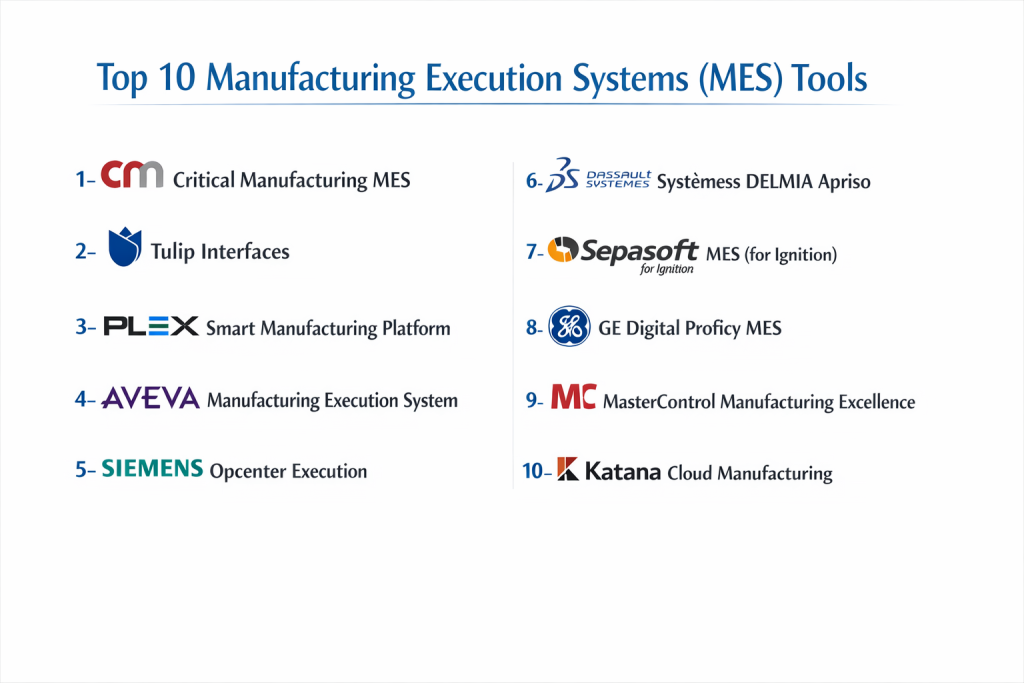
Top 10 Manufacturing Execution Systems (MES) Tools
1 — Critical Manufacturing MES
Critical Manufacturing is a modern, highly flexible MES designed specifically for complex, high-tech industries such as semiconductors, medical devices, and electronics.
- Key features:
- Native IoT Connectivity: Built-in layers to connect directly to equipment without heavy custom coding.
- Digital Twin Integration: 2D and 3D visualization of the plant floor with real-time data overlays.
- Dynamic Scheduling: Automatically re-optimizes production based on machine downtime or material shortages.
- Modular Architecture: Choose only the modules you need (Quality, Maintenance, Warehouse, etc.).
- Low-Code Personalization: Allows citizen developers to create custom dashboards and logic.
- Pros:
- Exceptionally modern interface that feels like a consumer app, not a legacy industrial tool.
- Highly scalable for global multi-site deployments.
- Cons:
- May be “over-engineered” for simple manufacturing processes.
- Implementation requires a high level of data maturity within the organization.
- Security & compliance: ISO 27001, SOC 2 Type II, GDPR compliant; supports 21 CFR Part 11 for medical devices.
- Support & community: Strong professional services team; active user community and comprehensive online learning academy.
2 — Tulip Interfaces
Tulip is a “Frontline Operations” platform that takes a unique, no-code approach to MES, focusing on empowering the people on the shop floor.
- Key features:
- No-Code App Builder: Create custom shop-floor apps using a drag-and-drop interface.
- Edge Connectivity: Native support for cameras, sensors, and smart tools (like torque wrenches).
- Computer Vision: Built-in AI to detect assembly errors or count parts automatically.
- Human-Centric Design: Focuses on guiding operators through complex tasks with visual cues.
- Cloud-Native: Instant deployment with no on-premise server maintenance required.
- Pros:
- The fastest time-to-value; you can go from zero to a live app in days.
- Extremely agile; changes can be made and deployed in minutes rather than weeks.
- Cons:
- Not a “traditional” MES; may lack some deep “heavy-duty” scheduling features found in legacy systems.
- Subscription costs can scale quickly as you add more users and devices.
- Security & compliance: SOC 2 Type II, HIPAA, and GDPR compliant; features robust audit logs and SSO integration.
- Support & community: Excellent documentation and “Tulip University”; very active community of frontline innovators.
3 — Plex Smart Manufacturing Platform
Plex, now a Rockwell Automation company, is a cloud-native leader that offers an all-in-one solution combining MES, ERP, and Quality management.
- Key features:
- Integrated ERP/MES: Eliminates the “sync issues” between the office and the shop floor.
- Plex Quality Management: Robust tools for SPC (Statistical Process Control) and FMEA.
- Supply Chain Visibility: Real-time tracking of materials before they even reach the factory.
- Production Monitoring: High-level OEE (Overall Equipment Effectiveness) dashboards.
- Asset Performance Management: Tracks machine health to predict maintenance needs.
- Pros:
- The “Single Version of the Truth” is actually achievable because of the integrated ERP.
- Being cloud-native from day one means no messy local upgrades.
- Cons:
- Transitioning to Plex is a major undertaking that usually requires replacing existing ERP systems.
- Less flexibility for companies that want a “Best-of-Breed” specialized MES.
- Security & compliance: ISO 27001, SOC 1 and SOC 2; designed for high-security automotive and aerospace standards.
- Support & community: Strong backing from Rockwell Automation; extensive partner network for global implementation.
4 — AVEVA Manufacturing Execution System
AVEVA (formerly Wonderware) provides a highly reliable and scalable MES that is deeply integrated with their world-class SCADA and HMI tools.
- Key features:
- Model-Driven Approach: Standardize processes once and deploy them across multiple plants.
- Job Management: Track work orders and labor utilization in high detail.
- Inventory & Traceability: Full geneology tracking from raw material to finished pallet.
- Quality Management: Automated data collection for quality samples and testing.
- Integration with System Platform: Seamless data flow from PLC to MES.
- Pros:
- Unrivaled for “hybrid” manufacturing that involves both batch and discrete processes.
- Extremely stable; used by some of the largest food and beverage brands in the world.
- Cons:
- The software suite can feel fragmented across different legacy modules.
- Requires a significant amount of specialized engineering to configure.
- Security & compliance: ISO 27001; features granular role-based access control and detailed electronic signatures.
- Support & community: Huge global ecosystem of system integrators; 24/7 enterprise support tiers available.
5 — Siemens Opcenter Execution
Part of the Xcelerator portfolio, Opcenter is Siemens’ premier MES, providing deep vertical-specific versions for electronics, pharma, and aerospace.
- Key features:
- Vertical Blueprints: Specialized modules for different industries (e.g., Opcenter RD&L for Food/Bev).
- Advanced Scheduling: Deep integration with Siemens APS (Advanced Planning and Scheduling).
- Quality Gate Control: Prevents a product from moving to the next station if a test fails.
- Paperless Manufacturing: Full digitialization of work instructions and batch records.
- PLM Integration: Direct link to Teamcenter for seamless “Design-to-Manufacturing” workflows.
- Pros:
- The best integration in the market for users already using Siemens PLCs and PLM.
- Massive feature depth; there is almost no manufacturing scenario it can’t handle.
- Cons:
- Very high cost of ownership and complex implementation.
- The user interface can be dense and intimidating for casual users.
- Security & compliance: IEC 62443 certified; supports 21 CFR Part 11 and EU Annex 11.
- Support & community: Global reach with Siemens’ worldwide support infrastructure and specialized partners.
6 — Dassault Systèmes DELMIA Apriso
DELMIA Apriso is an enterprise-grade MES designed for global manufacturers who need to standardize operations across dozens of factories.
- Key features:
- Global Process Manager: Centralize process definitions and push them to local sites.
- Just-In-Sequence (JIS) Logistics: Highly optimized for automotive delivery standards.
- Manufacturing Process Intelligence: Advanced analytics for multi-site benchmarking.
- Maintenance Management: Integrated tool for tracking machine downtime and repairs.
- Warehouse Management (WMS) Integration: Seamless flow between the rack and the line.
- Pros:
- Powerful “Center of Excellence” capabilities for global standardization.
- Exceptional at handling highly complex, multi-stage discrete manufacturing.
- Cons:
- Extremely complex and expensive to implement; typically requires a dedicated internal team.
- Not suitable for single-site manufacturers looking for a “quick win.”
- Security & compliance: ISO 27001, SOC 2; meets the most stringent aerospace and defense security requirements.
- Support & community: Extensive enterprise support and a large network of global consulting partners.
7 — Sepasoft MES (for Ignition)
Sepasoft is a unique MES built directly on top of the Ignition SCADA platform, making it the top choice for control engineers.
- Key features:
- Native Ignition Integration: No “bridge” needed; the MES uses the same tags as your SCADA.
- OEE & Downtime Module: Specialized tool for tracking equipment efficiency.
- Track & Trace: Full genealogy and lot tracking capabilities.
- Recipe Management: Manage and push machine setpoints directly from the MES.
- Python Scripting: Uses the familiar Ignition scripting environment for customization.
- Pros:
- The most “engineer-friendly” MES; if you know Ignition, you know Sepasoft.
- Excellent value for money, avoiding the massive overhead of “Big Tech” MES suites.
- Cons:
- Requires an existing Ignition installation and expertise.
- UI design is limited by the Ignition framework (which is functional but “industrial”).
- Security & compliance: Inherits Ignition’s security (SSO, TLS, RBAC); supports 21 CFR Part 11.
- Support & community: Highly active Inductive Automation community; excellent direct support.
8 — GE Digital Proficy MES
Proficy is a proven, high-performance MES suite that specializes in process improvement and regulatory compliance for heavy industry.
- Key features:
- Efficiency Management: Real-time OEE and root-cause analysis for downtime.
- Quality Management: Digitialized inspection plans and non-conformance tracking.
- Workflow Optimization: Guided steps for operators to ensure procedural compliance.
- Proficy Historian Integration: World-class data archival for millions of data points.
- Batch Analysis: specialized tools for chemical and food batch consistency.
- Pros:
- Deep expertise in regulated industries like Water and Life Sciences.
- Strong ability to handle very high-speed data ingestion.
- Cons:
- The portfolio can feel like a collection of separate tools rather than one unified platform.
- The look and feel of certain modules can be dated.
- Security & compliance: NIST-aligned security; extensive tools for regulatory audit trails.
- Support & community: Solid professional support from GE Vernova; global reach.
9 — MasterControl Manufacturing Excellence
MasterControl is a specialized MES focused specifically on the “Quality and Compliance” needs of the Life Sciences industry.
- Key features:
- Electronic Batch Records (eBR): Completely eliminates paper-based batch records.
- Error-Proofing: Prevents “out-of-spec” data entries in real-time.
- Quality Integration: Direct link to CAPA (Corrective and Preventive Actions) and training.
- Mobile-First Data Entry: Operators can use tablets for all checks on the cleanroom floor.
- Rapid Implementation: Designed to get pharma sites compliant in months, not years.
- Pros:
- The clear winner for companies whose primary goal is “FDA Compliance.”
- Very intuitive for people used to quality and document management systems.
- Cons:
- Lacks the deep “machine-level” IoT connectivity of an engineering-focused MES like Siemens or Critical.
- Not suitable for general discrete manufacturing like automotive.
- Security & compliance: HIPAA, GDPR, 21 CFR Part 11, EU Annex 11; world-class audit readiness.
- Support & community: Industry-leading compliance consulting and specialized customer support.
10 — Katana Cloud Manufacturing
Katana is a modern, lightweight MES designed specifically for SMBs and growing “DTC” (Direct-to-Consumer) manufacturers.
- Key features:
- Live Inventory Management: Tracks raw materials and finished goods in real-time.
- Visual Production Planning: Drag-and-drop scheduling interface.
- Contract Manufacturing Support: Manage outsourced production within the same tool.
- E-commerce Integration: Native links to Shopify, WooCommerce, and BigCommerce.
- Shop Floor App: Simple tablet-based interface for operators to start/stop tasks.
- Pros:
- Incredible ease of use; can be set up in a single afternoon.
- Affordable, transparent pricing for small companies.
- Cons:
- Lacks the “Industrial IoT” depth for automated machine data collection.
- Not suitable for highly regulated industries like aerospace or pharma.
- Security & compliance: SOC 2; standard cloud encryption and data privacy controls.
- Support & community: Fast, friendly email and chat support; excellent knowledge base.
Comparison Table
| Tool Name | Best For | Platform(s) Supported | Standout Feature | Rating (TrueReview) |
| Critical Manufacturing | High-Tech / Semi-Con | Cloud, On-Prem | Digital Twin / IoT Native | 4.8 / 5 |
| Tulip | Agile / No-Code | Cloud | App Builder / Vision | 4.9 / 5 |
| Plex | Automotive / Integrated | Cloud | Unified ERP + MES | 4.6 / 5 |
| AVEVA MES | Food & Bev / Hybrid | On-Prem, Cloud | Process Standardization | 4.5 / 5 |
| Siemens Opcenter | Aerospace / Electronics | On-Prem, Cloud | PLM / Xcelerator Synergy | 4.7 / 5 |
| DELMIA Apriso | Global Enterprise | Cloud, On-Prem | Multi-site Standardizer | 4.5 / 5 |
| Sepasoft | Control Engineers | On-Prem (Ignition) | Deep SCADA Integration | 4.8 / 5 |
| Proficy MES | Heavy Industry / Pharma | On-Prem, Cloud | High-Speed Data Logic | 4.4 / 5 |
| MasterControl | Life Sciences | Cloud | eBR / Compliance Focus | 4.8 / 5 |
| Katana | SMB / E-commerce | Cloud | Shopify/Direct Integration | 4.7 / 5 |
Evaluation & Scoring of Manufacturing Execution Systems (MES)
| Criteria | Weight | Evaluation Logic |
| Core Features | 25% | Presence of scheduling, quality, maintenance, and genealogy tools. |
| Ease of Use | 15% | Operator interface quality and administrative configuration complexity. |
| Integrations | 15% | Connectivity to ERP, PLM, and shop-floor automation (OPC UA). |
| Security & Compliance | 10% | Support for 21 CFR Part 11, ISO, and modern cloud security (SOC 2). |
| Performance | 10% | Ability to handle high tag counts and real-time transaction volume. |
| Support & Community | 10% | Availability of third-party integrators and quality of training docs. |
| Price / Value | 15% | TCO (Total Cost of Ownership) relative to feature depth. |
Which Manufacturing Execution System Is Right for You?
Solo Users vs SMB vs Mid-Market vs Enterprise
If you are an SMB or a scaling brand, Katana or Tulip are your best options. They provide immediate visibility without requiring a team of engineers to maintain the system. Mid-Market manufacturers (single or dual-site) often find the best value in Sepasoft or Plex, as they offer a “grown-up” feature set without the complexity of global enterprise suites. Large Enterprises with global footprints must look toward Dassault DELMIA Apriso or Siemens Opcenter, as these are the only tools capable of standardizing processes across dozens of different cultural and geographical contexts.
Budget-Conscious vs Premium Solutions
For those on a Tight Budget, starting with a modular approach via Tulip or Sepasoft allows you to “pay for only what you use.” You can start with a single “OEE Dashboard” and expand. If you have the budget for a Premium Solution, Critical Manufacturing or Siemens provide a future-proofed “Digital Thread” that integrates your design, engineering, and production into one seamless loop, significantly reducing long-term “hidden” costs of data silos.
Feature Depth vs Ease of Use
There is a classic trade-off here. Siemens and Apriso have incredible Feature Depth, but they are hard to use and even harder to change. Tulip is the king of Ease of Use, but your team will have to “build” their logic rather than using a pre-configured industrial blueprint. If you want a middle ground, Critical Manufacturing offers a very modern UI that doesn’t compromise on deep technical features.
Integration and Scalability Needs
If your factory is already full of Siemens or Rockwell hardware, choosing the “home team” MES (Opcenter or Plex) will drastically simplify your integration. If you are a “mixed bag” shop with hardware from everyone, an agnostic MES like Critical Manufacturing or AVEVA will be easier to scale across your varied equipment.
Security and Compliance Requirements
If you are in Med-Tech or Pharma, MasterControl or Proficy are the gold standards for compliance. They don’t just “support” 21 CFR Part 11; their entire software lifecycle is built around it. For Aerospace & Defense, ensure your provider (like Dassault or Siemens) offers “GovCloud” or on-premise deployments to meet strict data residency and ITAR requirements.
Frequently Asked Questions (FAQs)
1. What is the difference between ERP and MES?
ERP handles the “Why” and “How Many” (business logic, finances, high-level orders). MES handles the “How” and “When” (shop floor execution, machine control, real-time quality).
2. Can an MES work without an ERP?
Yes, but it’s not ideal. Without an ERP, you’ll have to manually enter work orders. Integration allows the office to send orders directly to the machines.
3. What is “OEE” and why does every MES track it?
OEE stands for Overall Equipment Effectiveness. It is the gold standard metric for measuring how well your machines are being utilized (Availability x Performance x Quality).
4. How long does a typical MES implementation take?
For a simple tool like Tulip, it can be weeks. For a global rollout of Siemens or Apriso, it is often a 12-to-24 month journey.
5. Is cloud MES safe for factories?
Modern cloud providers offer better security than most local IT teams. However, for “mission-critical” control, many factories prefer a “Hybrid” model where the MES can still run if the internet goes down.
6. What is “Genealogy” in an MES?
It is the “birth certificate” of a product. It tells you which batch of raw material was used, which operator was on shift, and which machine built the product.
7. Does an MES replace paper on the shop floor?
That is one of its primary goals. By moving to tablets and digital terminals, you eliminate the risk of lost paperwork and illegible handwriting.
8. What is “VDA 5050” or “OPC UA”?
These are communication standards. OPC UA is the “language” that allows your MES to talk to almost any brand of PLC (Siemens, Rockwell, etc.).
9. Can an MES help with sustainability?
Yes. By tracking energy usage per part and reducing scrap/waste, an MES is a primary tool for “Green Manufacturing” initiatives.
10. What is a “Digital Twin” in the context of MES?
It is a virtual representation of your factory. The MES feeds real-time data into this model so you can see bottlenecks or issues in a 3D interface.
Conclusion
The selection of a Manufacturing Execution System (MES) is a foundational decision for any “Factory of the Future.” The era of managing production via spreadsheets and whiteboards is over; in today’s competitive landscape, data is the primary fuel for growth. If you are looking for an agile, person-centered approach, Tulip is the clear innovator. If you require deep, industry-specific hardening for a global enterprise, Siemens Opcenter and Critical Manufacturing offer the technical depth required to win.
Remember that the “best” tool is the one that your operators will actually use. No amount of feature depth can compensate for a system that is too complex for the person on the line to engage with. By prioritizing ease of use alongside integration and compliance, you can ensure that your MES becomes the “heart” of your operation, driving efficiency, quality, and profit for years to come.