Introduction
A logistics visibility platform is a software system that gives you a real-time, end-to-end view of your shipments and inventory as they move through the supply chain. Think of it as a live tracking dashboard that connects data from all your carriers, warehouses, and suppliers into one single, clear picture. It goes beyond simple package tracking to show you the location, condition, and estimated time of arrival (ETA) of your goods, from the factory floor to the customer’s door.
This visibility is critically important because modern supply chains are complex and often opaque. Without a unified view, you’re left in the dark, reacting to delays, stockouts, and customer complaints. A good visibility platform enables proactive management, reduces risk, and builds resilience by allowing you to see problems before they cause major disruptions.
In practice, these platforms are used to monitor in-transit shipments across ocean, air, rail, and road, provide customers with accurate delivery updates, manage warehouse and yard inventory, predict potential delays using AI, and ensure compliance for sensitive shipments like pharmaceuticals or food. When choosing a platform, you should evaluate its geographic and modal coverage, data accuracy and freshness, predictive analytics capabilities, ease of integration with your existing systems (ERP, TMS, WMS), the quality of its alerting system, and the clarity of its user interface for different teams.
Best for: These platforms are essential for Supply Chain Managers, Logistics Directors, Operations Planners, and Customer Service teams in manufacturing, retail, e-commerce, and distribution. They deliver immense value for companies of all sizes that manage complex, multi-step shipments or have a critical need for delivery reliability.
Not ideal for: A business that only ships a handful of domestic parcels per month using a single carrier (like UPS or FedEx) can likely rely on the carrier’s own free tracking tools. They are also not a substitute for a full Transportation Management System (TMS) that executes bookings and payments, though they often integrate with one.
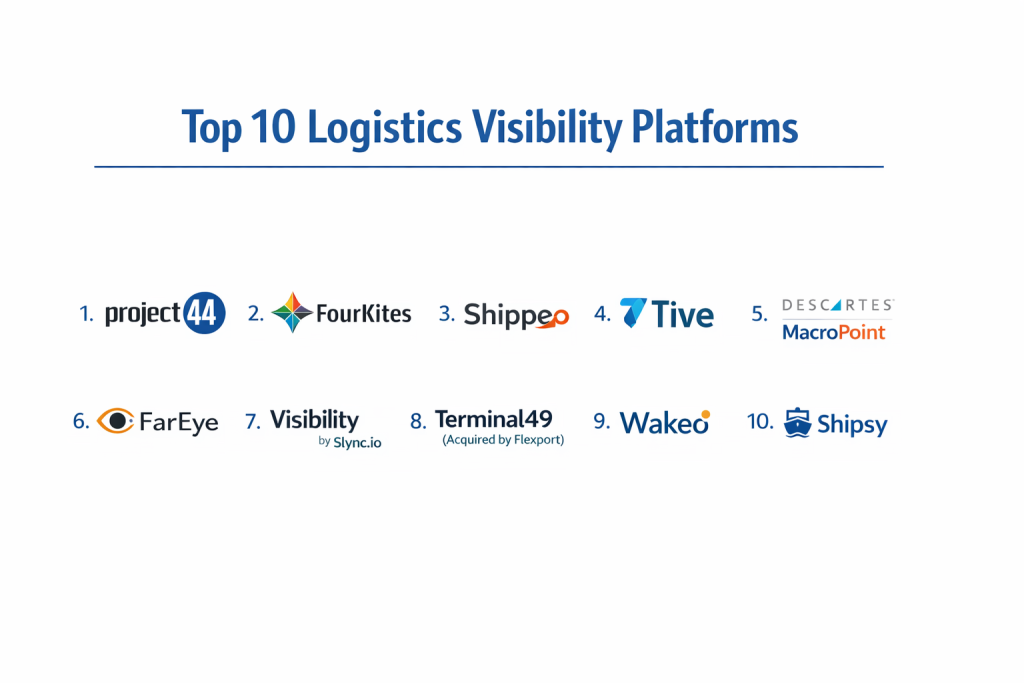
Top 10 Logistics Visibility Platforms
Here is a detailed look at the leading platforms that bring clarity and control to global supply chains.
1 — project44
project44 is a leader in the advanced visibility space, known for its massive network of direct carrier integrations and its focus on high-fidelity, real-time data for enterprise supply chains.
Key features:
- Movement & Visibility Cloud: A unified platform covering ocean, air, rail, trucking, and last-mile visibility.
- Dynamic ETA & Predictive Analytics: Uses machine learning to provide highly accurate ETAs and predict delays before they happen.
- Extensive Carrier Network: Connects directly via API to thousands of carriers and logistics providers globally, reducing reliance on low-quality Electronic Data Interchange (EDI) scans.
- Dwell & In-Transit Analytics: Pinpoints bottlenecks (like at ports or ramps) and measures carrier performance.
- Sustainability Insights: Tracks and reports on the carbon emissions of shipments.
- Strong Ecosystem Integrations: Deep, pre-built connections to major ERP (SAP, Oracle) and TMS systems.
Pros:
- Arguably the highest data quality and most reliable ETAs in the industry due to direct carrier APIs.
- Unmatched breadth and depth of multimodal, global coverage.
- Powerful analytics that move beyond “where is it?” to “what will happen and why?”.
Cons:
- Premium pricing; can be a significant investment, typically geared towards larger enterprises.
- The wealth of data and features can be overwhelming for companies with simpler needs.
- Implementation can be complex due to the depth of integration.
Security & compliance: Enterprise-grade security with SOC 2 Type II, ISO 27001 certifications. GDPR, CCPA compliant. A trusted partner for data-sensitive industries.
Support & community: Offers enterprise-level support and dedicated customer success management. Active in industry forums and has a strong reputation.
2 — FourKites
FourKites is a major competitor to project44, with a similarly vast network and a strong emphasis on collaboration and workflow tools that extend visibility to partners and customers.
Key features:
- Real-Time Visibility: Tracks shipments across all transportation modes globally.
- Predictive & Dynamic ETAs: AI-powered arrival predictions for all stages of the journey.
- Dock Appointment Scheduling: Integrates visibility with yard management, allowing carriers to schedule dock appointments digitally.
- Collaboration Hub: Enables seamless communication and document sharing between shippers, carriers, and customers within the platform.
- Temperature & Condition Tracking: Specialized monitoring for cold chain and high-value goods.
- Capacity & Network Intelligence: Provides market data on rates and capacity to inform planning.
Pros:
- Excellent collaborative features that make it more than just a tracking dashboard.
- Strong in North American truckload and intermodal visibility.
- Focus on turning visibility data into actionable workflows (like appointment scheduling).
Cons:
- Like its main competitor, it is an enterprise-scale solution with corresponding complexity and cost.
- Some users note that the interface, while powerful, can be busy.
- The depth of ocean carrier integrations, while strong, is sometimes compared closely with project44.
Security & compliance: Robust security with SOC 2, ISO 27001 certifications. Adheres to global data privacy regulations.
Support & community: Provides 24/7 global support and strategic customer success teams. Has a large and active user community.
3 — Shippeo
Shippeo is a European-born visibility platform that has grown into a global player. It is renowned for its highly reliable Estimated Time of Arrival (ETA) accuracy and its strong performance in the complex European multimodal logistics environment.
Key features:
- Reliability & ETA Accuracy: Stakes its reputation on providing the most reliable ETAs, with a publicly tracked accuracy score.
- Multimodal & Global Coverage: Tracks road, rail, ocean, air, and barge shipments worldwide.
- Anomaly Detection & Alerts: Automatically detects exceptions (delays, route deviations) and sends proactive alerts.
- Carrier Connectivity: Connects to a vast network of telematics, TMS, and carrier systems for real-time data.
- Sustainability Reporting: Automated CO2 emission tracking and reporting per shipment.
- Customizable Dashboards & KPIs: Allows companies to track the specific metrics that matter most to their operations.
Pros:
- Exceptional focus on ETA reliability and data quality, which is its core selling point.
- Deep understanding and strong execution in the complex European logistics market.
- Clean, user-friendly interface that makes critical information easy to find.
Cons:
- Historically strongest in Europe, though global coverage is now extensive.
- May have less brand recognition in North America compared to FourKites and project44.
- The premium focus on reliability can come with a premium price tag.
Security & compliance: ISO 27001 certified, GDPR compliant, and follows stringent data security protocols. Trusted by large enterprises with high compliance needs.
Support & community: Multilingual support with a strong European presence. Known for responsive customer service.
4 — Tive
Tive takes a unique hardware-plus-software approach. It provides standalone cellular and satellite trackers (pucks, stickers, cards) that ship with goods, and a software platform to monitor them. It’s ideal for high-value, sensitive, or critical shipments where carrier data is insufficient.
Key features:
- Hardware-Independent Tracking: Tive trackers provide location, temperature, humidity, shock, light, and pressure data regardless of the carrier.
- Real-Time Solo & Cellular GPS: Offers real-time tracking even in remote areas or across ocean crossings (with satellite option).
- Condition Monitoring: Critical for pharmaceuticals, electronics, food, and other sensitive goods.
- No Carrier Dependency: Does not rely on carrier data feeds, providing a single, trustworthy source of truth.
- Battery-Efficient & Global: Trackers have long battery life and work globally with multi-network SIMs.
- Simple Platform: Cloud software to monitor all trackers, set alerts, and view trip history.
Pros:
- Unbeatable for condition monitoring and real-time location where carrier visibility is poor or non-existent.
- Eliminates blind spots in the supply chain, especially for international or multi-modal shipments.
- Provides irrefutable proof of condition for damage claims and compliance.
Cons:
- Requires purchasing, deploying, and retrieving physical hardware, adding cost and operational steps.
- Not a scalable solution for tracking every single parcel; best for high-value or critical shipments.
- The total cost includes both hardware and software subscriptions.
Security & compliance: Data is encrypted in transit and at rest. Useful for compliance with FDA (Food and Drug Administration) CFR 21 Part 11, GDP (Good Distribution Practice), and other cold-chain regulations.
Support & community: Strong technical support for both hardware and software. Popular in life sciences, aerospace, and high-tech industries.
5 — Descartes MacroPoint
Descartes MacroPoint is a visibility platform focused specifically on freight matching and tracking within the trucking industry. It is deeply integrated into the ecosystem of freight brokers, shippers, and carriers in North America.
Key features:
- Freight Tracking & Visibility: Primarily focused on over-the-road (OTR) truckload and less-than-truckload (LTL) shipments.
- Automated Check-Ins: Uses mobile apps and ELD (Electronic Logging Device) integrations for automated location updates without driver calls.
- Capacity & Freight Matching: Connects shippers and brokers with available carriers in the Descartes network.
- Proof of Delivery (POD): Digital capture of delivery confirmation and documents.
- Integration with Descartes Suite: Works seamlessly with other Descartes solutions like routing, mobile, and customs compliance.
- Strong Broker & 3PL Focus: A standard tool in the North American brokerage industry.
Pros:
- The dominant platform for freight tracking within the North American brokerage and 3PL market.
- Excellent automated tracking that reduces check-in calls to drivers.
- More than just visibility—it’s a tool for finding capacity and executing shipments.
Cons:
- Primarily focused on North American road freight, not a global multimodal platform.
- The user experience can feel utilitarian and less modern than some newer cloud-native platforms.
- Heavily tied to the Descartes ecosystem.
Security & compliance: Part of Descartes, a publicly traded company with standard enterprise security. Data privacy measures are in place.
Support & community: Standard Descartes support channels. Its widespread use creates a de facto network effect among brokers and carriers.
6 — FarEye
FarEye is a platform that focuses on delivery orchestration and visibility, particularly for the last-mile and complex urban logistics. It helps brands and logistics providers optimize and visualize the final leg of delivery to consumers and businesses.
Key features:
- Last-Mile & Parcel Visibility: Real-time tracking for e-commerce, retail, and food delivery.
- Dynamic Route Optimization: Plans and adjusts delivery routes in real-time to improve efficiency.
- Delivery Orchestration: Manages a mix of own fleet, couriers, and crowdsourced drivers from a single platform.
- Predictive Customer Communication: Sends automated, accurate ETA notifications to end customers via SMS, email, or app.
- Returns Management: Streamlines and tracks the reverse logistics process.
- Performance Analytics: Tracks driver performance, on-time delivery rates, and customer satisfaction.
Pros:
- Specialized and powerful for the unique challenges of last-mile and omnichannel delivery.
- Strong focus on improving the end-customer delivery experience.
- Good at managing complex, multi-driver ecosystems common in today’s delivery networks.
Cons:
- Less focused on long-haul, ocean, or air freight visibility.
- May be overkill for businesses that only need simple long-haul tracking.
- Competitive space with many regional players.
Security & compliance: Implements standard cloud security practices. GDPR compliant and follows data privacy norms for customer communications.
Support & community: Global support teams. Popular among retailers, e-commerce brands, and 3PLs specializing in last-mile.
7 — Visibility by Slync.io
Slync.io (now rebranding its platform) offers a visibility solution that is part of a broader Logistics Orchestration Platform. It aims to connect operational data with financial and commercial processes, providing context beyond just location.
Key features:
- Global, Multimodal Visibility: Tracks shipments across ocean, air, and ground.
- Operational & Financial Context: Links shipment events to documents, invoices, and purchase orders to show business impact.
- Automated Exception Management: Identifies discrepancies (e.g., shipment delayed but invoice due) and suggests actions.
- Collaboration Tools: Built-in workflow tools for teams and partners to resolve issues.
- Platform Approach: Designed to be a central system that connects to and synchronizes data from many other logistics applications.
- API-Led Integration: Focus on easy connectivity to existing enterprise systems.
Pros:
- Unique value in connecting shipment visibility with financial and document flows.
- Good for organizations where supply chain disruptions have direct accounting and working capital implications.
- Strong integration capabilities.
Cons:
- The broader orchestration vision can be more complex than a pure visibility need.
- The company has undergone restructuring, which may cause potential customers to seek clarity on its long-term roadmap.
- Brand recognition is lower than the top-tier pure-play visibility leaders.
Security & compliance: Enterprise security standards. Specific certifications should be confirmed given the company’s recent changes.
Support & community: Support is part of its platform offering. Its user community is developing.
8 — Terminal49 (Acquired by Flexport)
Terminal49 started as a best-in-class ocean container tracking platform before its acquisition by digital freight forwarder Flexport. It remains a powerful tool for deep, predictive visibility into the complex ocean journey.
Key features:
- Deep Ocean Container Tracking: Specializes in detailed port and rail movements, vessel schedules, and container status.
- Predictive Port & Rail ETAs: Uses historical data and algorithms to predict when containers will move through specific port terminals and onto rail.
- Automated Notifications: Alerts for vessel delays, gate-in, load/discharge, and container availability.
- Dwell Time Analytics: Identifies bottlenecks at ports and ramps.
- Simple API & Interface: Clean design focused on making complex ocean data understandable.
- Integration with Flexport: Now deeply integrated into the Flexport platform, but also offered as a standalone service.
Pros:
- Unmatched depth and predictive intelligence for ocean container tracking.
- Transforms confusing carrier updates into clear, actionable timelines.
- Excellent for importers/exporters who want to manage their ocean freight proactively.
Cons:
- Primarily focused on ocean (though integrates with trucking for drayage).
- As part of Flexport, its future as a neutral, multi-forwarder platform is part of a broader strategy.
- Less of a full multimodal visibility solution.
Security & compliance: Benefits from Flexport’s security infrastructure. Handles sensitive shipment data securely.
Support & community: Supported by the Terminal49/Flexport team. Has a loyal following among logistics professionals focused on ocean freight.
9 — Wakeo
Wakeo is a global visibility platform with a strong reputation in Europe and growing global reach. It emphasizes data science and AI to provide reliable ETAs and risk analysis for multimodal transport.
Key features:
- AI-Powered Predictive Visibility: Focuses on accurate ETAs and delay predictions using AI models.
- Multimodal Coverage: Tracks road, rail, air, ocean, and inland waterways.
- Risk Scoring & Alerting: Assigns risk scores to shipments and alerts users to potential issues.
- Carbon Footprint Calculation: Automated emissions reporting for sustainability tracking.
- Carrier Performance Benchmarking: Analytics to compare carrier reliability and performance.
- Customizable Dashboards: Role-based views for planners, managers, and customers.
Pros:
- Strong AI/Data science foundation for predictive insights.
- Good balance of feature depth and user-friendly design.
- Solid performance and growing presence in competitive markets.
Cons:
- Facing stiff competition from well-funded leaders like project44 and FourKites.
- While global, its brand strength is currently more pronounced in Europe.
- May need to prove scalability to the very largest global enterprises.
Security & compliance: ISO 27001 certified and GDPR compliant. Meets standard enterprise security requirements.
Support & community: Provides customer support in multiple languages. Building its community in the logistics tech space.
10 — Shipsy
Shipsy is a SaaS-based platform with a strong focus on emerging markets, particularly the Middle East and India. It provides a suite of tools covering visibility, route optimization, and delivery management for SMBs and enterprises.
Key features:
- End-to-End Visibility: Tracks shipments across international and domestic legs.
- Smart Route Optimization: Dynamic planning for delivery fleets to save time and fuel.
- Last-Mile Management: Tools for electronic proof of delivery (ePOD), customer notifications, and returns.
- Supplier & Purchase Order Management: Extends visibility back to the order and supplier level.
- Customizable for Regional Needs: Built to handle the specific documentation and processes of markets like India and the GCC.
- SMB-Friendly Pricing: Offers tiered plans to accommodate smaller businesses.
Pros:
- Excellent regional expertise and product fit for the Middle East and South Asian markets.
- Combines visibility with execution tools (optimization, delivery management) in one platform.
- More accessible for small and mid-sized businesses in its core regions.
Cons:
- Global footprint and multimodal depth are not as extensive as the top global players.
- The platform’s broad scope can mean it’s a master of none compared to specialized best-in-breed tools.
- Primarily a regional powerhouse rather than a global leader.
Security & compliance: Implements standard cloud security. Complies with local data residency laws in its operating regions.
Support & community: Strong local support in its key markets. Growing user base among regional exporters, importers, and 3PLs.
Comparison Table
| Tool Name | Best For (Target User or Scenario) | Platform(s) Supported | Standout Feature | Rating |
|---|---|---|---|---|
| project44 | Large enterprises needing the highest data quality & predictive analytics globally | Web, Mobile, API | Direct Carrier API Network & Advanced Predictive Analytics | N/A |
| FourKites | Enterprises wanting collaboration tools & workflow automation alongside visibility | Web, Mobile, API | Collaboration Hub & Dock Appointment Scheduling | N/A |
| Shippeo | Companies prioritizing exceptional ETA reliability, especially in Europe | Web, Mobile, API | Industry-Leading ETA Accuracy & Reliability Focus | N/A |
| Tive | High-value, sensitive, or critical shipments requiring hardware-based tracking | Web, Mobile, Hardware | Hardware-Independent Condition & Location Monitoring | N/A |
| Descartes MacroPoint | Freight brokers, 3PLs & shippers in the North American trucking market | Web, Mobile, App | Deep Integration in North American Brokerage Ecosystem | N/A |
| FarEye | Brands & logistics providers focused on last-mile delivery & customer experience | Web, Mobile | Last-Mile Delivery Orchestration & Customer Comms | N/A |
| Slync.io Visibility | Organizations linking operational visibility with financial/document flows | Web, API | Operational-Financial Data Context & Orchestration | N/A |
| Terminal49 (Flexport) | Importers/Exporters needing deep, predictive ocean container tracking | Web, API | Best-in-Class Ocean Container Predictive Tracking | N/A |
| Wakeo | Companies seeking AI-driven predictive visibility with a strong European base | Web, Mobile, API | AI-Powered Risk Scoring & Predictive ETAs | N/A |
| Shipsy | SMBs & enterprises operating in Middle Eastern & South Asian markets | Web, Mobile | Regional Expertise & Combined Visibility/Optimization | N/A |
Evaluation & Scoring of Logistics Visibility Platforms
Use this rubric to systematically compare platforms. Score each from 1 (Poor) to 5 (Excellent) based on your specific supply chain needs.
| Evaluation Criteria | Weight | Score (1-5) | Weighted Score | Notes on What to Look For |
|---|---|---|---|---|
| Core Features | 25% | Does it track your needed modes (ocean, air, truck, rail)? How good are its ETAs and alerts? | ||
| Ease of Use | 15% | Is the dashboard intuitive? Can your team find what they need quickly? | ||
| Integrations & Ecosystem | 15% | Does it connect to your TMS, ERP, WMS, and carriers via API, or is it manual? | ||
| Security & Compliance | 10% | How is your data protected? Does it meet regulations for your industry (e.g., GDP for pharma)? | ||
| Performance & Reliability | 10% | Is the data accurate and real-time? Is platform uptime guaranteed? | ||
| Support & Community | 10% | Can you get help when a shipment is stuck? Is there knowledge sharing? | ||
| Price / Value | 15% | Does the pricing model (per shipment, per user, enterprise) match your volume and budget? | ||
| TOTAL SCORE | 100% | /100 |
Which Logistics Visibility Platform Is Right for You?
Your choice depends on your primary pain points, geographic scope, and shipment characteristics.
- Large Global Enterprises (Complex, Multi-Modal): You need the highest data quality and predictive power. project44 and FourKites are the top contenders. Shippeo is a strong third, especially with a European focus. These are strategic, enterprise-wide decisions.
- Importers/Exporters (Ocean-Focused): Your world revolves around containers. Terminal49 (by Flexport) offers the deepest predictive ocean intelligence. The major platforms (project44, FourKites, Shippeo) also have strong ocean modules.
- North American Shippers & 3PLs (Truckload Focused): For freight brokerage and truckload tracking, Descartes MacroPoint is the embedded industry standard. project44 and FourKites also have excellent North American trucking visibility.
- Retailers & E-commerce (Last-Mile Focused): Your battle is won at the customer’s doorstep. FarEye specializes here. FourKites also has strong last-mile capabilities. Shipsy is excellent for these markets in its regions.
- High-Value/Sensitive Goods Shippers: You need condition monitoring and guaranteed tracking. Tive’s hardware-based solution is the clear choice for pharmaceuticals, aerospace, electronics, and high-value commodities.
- Small & Mid-Sized Businesses / Regional Focus: Look for value and regional expertise. Shipsy is ideal for the Middle East/India. Wakeo offers enterprise-like features for growing companies. Some larger platforms now offer scaled-down packages.
- Budget-Conscious vs. Premium: Shipsy and some modules from Wakeo can be more accessible. Tive has a clear cost (hardware + subscription). project44, FourKites, and Shippeo are premium investments with premium capabilities.
- Feature Depth vs. Ease of Use: project44 and FourKites offer immense depth. Shippeo and Wakeo balance depth with clean design. FarEye is specialized but user-friendly for its domain.
- Integration Needs: If you use a major ERP (SAP, Oracle) or TMS, check for pre-built connectors. An API-first platform is crucial for building a custom tech stack. Descartes MacroPoint integrates seamlessly with other Descartes products.
- Security & Compliance Requirements: For life sciences (GDP, FDA), platforms with strong audit trails and condition monitoring (Tive, specialized modules from FourKites/project44) are key. For general data privacy (GDPR), ensure the vendor is compliant.
Frequently Asked Questions (FAQs)
1. How is this different from the free tracking my carrier provides?
Carrier tracking is reactive and siloed—you get basic updates from one carrier at a time. A visibility platform is proactive and unified. It aggregates data from all your carriers, applies AI for better ETAs, provides a single dashboard, and sends alerts before you know to ask, turning data into actionable intelligence.
2. What’s the difference between a Visibility Platform and a TMS?
A Transportation Management System (TMS) is for execution: planning routes, booking carriers, managing rates, and settling payments. A Visibility Platform is for monitoring and insight: tracking those shipments in real-time, predicting delays, and analyzing performance. They are complementary; the best tech stacks integrate them.
3. How accurate are the predictive ETAs?
The best platforms (project44, Shippeo, FourKites) use machine learning on historical and real-time data (weather, traffic, port congestion) to provide highly accurate ETAs, often within a few hours for long-haul shipments. This is far superior to a simple calendar estimate.
4. Can these platforms help reduce freight costs?
Indirectly, yes. By reducing detention and demurrage fees through better planning, enabling better carrier performance management, optimizing inventory holding costs (by knowing exactly when goods will arrive), and preventing expensive emergency shipments to cover for “lost” inventory, visibility drives significant cost out of the supply chain.
5. What about data privacy and who owns the shipment data?
This is a critical contract point. In a robust platform, you, the shipper, own your data. The platform is the processor. Ensure your contract specifies data ownership, usage rights, and compliance with regulations like GDPR. Reputable platforms are transparent about this.
6. How long does implementation typically take?
For a cloud-based platform using API integrations, an initial dashboard can be live in weeks. A full, enterprise-wide rollout with deep TMS/ERP integrations can take 3-6 months. Simpler, carrier-connectivity-only setups are faster.
7. Do I have to force my carriers to use this platform?
The best platforms have pre-built connections to thousands of carriers via API or telematics. Your carrier often doesn’t need to “do” anything differently; the platform pulls data from their existing systems. For smaller carriers, they might use a simple mobile app or email updates.
8. What is the total cost of ownership?
Look beyond the software subscription. Consider: Implementation/Integration fees, costs for dedicated hardware (like Tive), internal IT resources to manage the system, and potential costs to incentivize carrier participation (though this is rare with major platforms).
9. Can I provide this tracking data to my customers?
Absolutely. This is a major benefit. Most platforms offer white-label tracking portals or embeddable widgets that let you provide a branded, real-time tracking experience to your end customers, improving their satisfaction and reducing “where is my order?” (WISMO) calls.
10. What’s the biggest mistake companies make?
Treating visibility as just a tracking dashboard. The real value is in acting on the insights. The mistake is buying the tool but not changing processes to respond to alerts, hold carriers accountable with data, or inform customers proactively. The technology enables the transformation, but people and processes must change to capture the full value.
Conclusion
Choosing a logistics visibility platform is a strategic investment in supply chain resilience, customer satisfaction, and operational intelligence. The right platform transforms your supply chain from a reactive cost center into a proactive, data-driven competitive advantage.
Remember, the “best” platform is not the one with the most features on a checklist, but the one that best solves your specific visibility blind spots—whether that’s ocean container uncertainty, last-mile customer anxiety, or the need to monitor sensitive pharmaceuticals. Your operational geography, primary transport modes, and internal tech stack are the most important filters.
In a world of constant disruption, visibility is no longer a luxury; it’s a necessity for doing business. By selecting a platform that delivers accurate, actionable data and integrates seamlessly into your operations, you gain the clarity needed to navigate complexity, build trust with customers, and drive continuous improvement across your entire logistics network.