Introduction
A Loan Servicing Platform is a specialized financial software suite designed to manage the “aftercare” of a loan once the funds have been disbursed. While origination systems focus on the application and approval process, servicing platforms handle the long-term relationship between the lender and the borrower. These systems act as a sub-ledger that tracks every penny of principal, interest, and fees. They automate the complex task of calculating amortizations, managing escrow accounts for taxes and insurance, processing monthly payments, and generating regulatory statements. In the event of a missed payment, these platforms also trigger collection workflows and loss mitigation strategies to protect the lender’s capital.
The importance of a robust servicing platform has increased significantly as lending regulations become more stringent and consumer expectations for digital self-service grow. For lenders, the servicing phase is where the actual profit is realized and where the risk of delinquency is managed. An inefficient platform can lead to “servicing leakage”—money lost through calculation errors or missed late fees—and high operational costs due to manual customer support. Modern platforms mitigate these risks through automation and real-time data accessibility, ensuring that lenders remain compliant with laws such as the Fair Debt Collection Practices Act (FDCPA) while providing borrowers with a transparent, easy-to-use payment experience.
Key Real-World Use Cases
Loan servicing platforms are essential for maintaining the financial health of diverse lending portfolios:
- Mortgage Servicing: Managing 30-year fixed-rate loans, including the complex administration of property tax and insurance escrow accounts.
- Student Loan Administration: Handling various repayment plans, interest subsidies, and complex regulatory reporting for educational debt.
- Auto Loan Management: Tracking vehicle collateral, managing title releases, and coordinating with repossession agents for delinquent accounts.
- Commercial Real Estate (CRE): Managing high-value loans with complex floating interest rates, covenants, and multi-party participation.
- Private Money Lending: Allowing boutique firms to manage fractionalized investments where multiple investors own a piece of a single loan.
What to Look For (Evaluation Criteria)
When vetting a loan servicing platform, decision-makers should evaluate vendors based on these four critical areas:
- Automation of Calculations: Does the system natively support your specific loan types (Daily Simple Interest, Rule of 78s, Step-rates) without manual workarounds?
- Borrower Self-Service: Does the platform offer a modern web and mobile portal where borrowers can make payments, download tax forms, and view statements?
- Investor Reporting: Can the system automatically generate “Remittance Reports” for secondary market investors or warehouse lenders?
- Compliance and Audit Trails: Does every single transaction and user action leave a permanent, unalterable “read-only” log for regulatory examinations?
Best for:
- Financial Institutions: Banks and credit unions looking to bring servicing in-house to increase margin and control the customer experience.
- Private Lenders and MGAs: Smaller firms that need professional-grade automation to manage growing portfolios without increasing staff.
- Fintech Disruptors: Companies building new lending products (like BNPL) that require API-first, highly scalable back-ends.
- Third-Party Servicers: Agencies that manage loan portfolios on behalf of other owners and require robust multi-client reporting.
Not ideal for:
- Originators-only: Firms that “originate to sell” and immediately transfer servicing rights may not need a full-scale servicing platform.
- Simple Personal Bookkeeping: Individuals lending to friends or family where a basic spreadsheet or a consumer-grade tracking app is sufficient.
- General ERP Users: Large corporations that need general accounting but don’t handle the specific regulatory and interest-calculation nuances of debt assets.
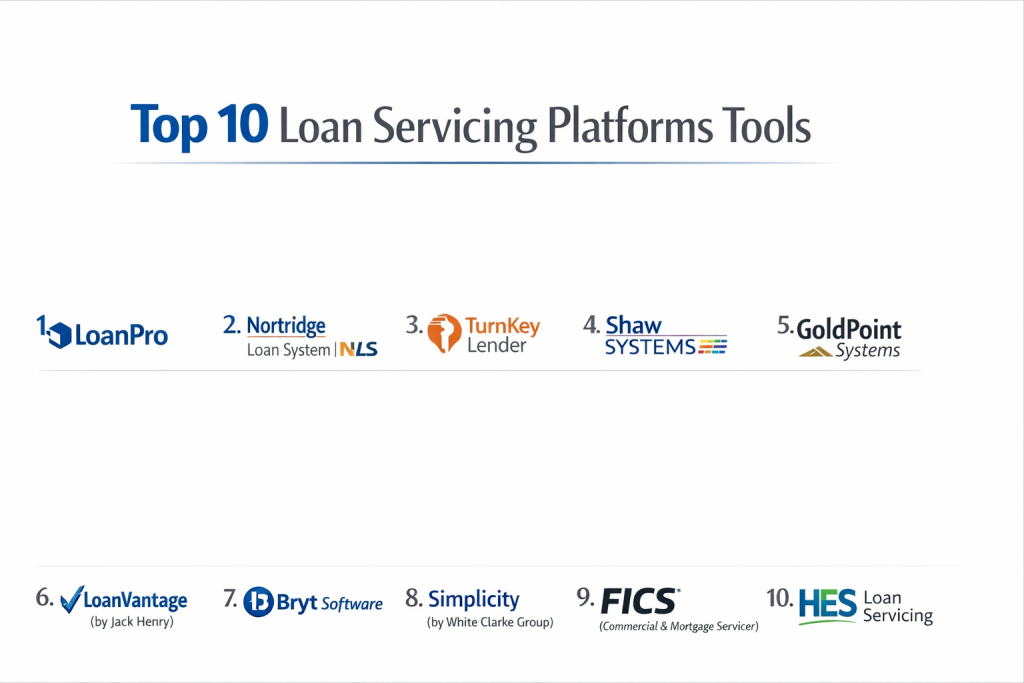
Top 10 Loan Servicing Platforms Tools
1 — LoanPro
LoanPro is a modern, API-first loan servicing platform built in the cloud. It is designed for lenders who want ultimate flexibility and the ability to automate complex loan structures through a “programmable” ledger.
Key features:
- API-First Architecture: Every feature in the UI is available via a robust API for custom integrations.
- Automated Payments: Native integration with multiple payment processors for ACH, Debit, and Credit Card.
- Configurable Amortization: Supports almost any conceivable interest calculation and payment schedule.
- Automated Communications: Trigger-based SMS, email, and physical mail for late notices or statements.
- Real-time Ledgering: Provides an instant, accurate financial picture of every loan in the portfolio.
Pros:
- Highly scalable and ideal for fintechs that need to build custom front-end experiences.
- Exceptional “Rules Engine” that automates the entire collections and workflow process.
Cons:
- Requires a certain level of technical maturity to fully utilize the API capabilities.
- The vast number of configuration options can make initial setup feel complex.
Security & compliance: SOC 1 Type II, SOC 2 Type II, PCI DSS Level 1, and HIPAA compliant.
Support & community: Extensive developer documentation, an active Slack community, and dedicated customer success managers.
2 — Nortridge Loan System (NLS)
Nortridge is a powerhouse in the loan servicing world, known for its ability to handle virtually any type of loan. It is a favorite among mid-to-large lenders who require a “Swiss Army Knife” for their back office.
Key features:
- Universal Loan Support: Handles consumer, commercial, auto, mortgage, and more within one system.
- Integrated Servicing & Collections: High-powered tools for collectors, including “Promise to Pay” tracking.
- Escrow Management: Robust handling of taxes and insurance for mortgage and auto-impound accounts.
- Multi-Book Accounting: Allows for different accounting views (GAAP, Tax, etc.) on the same loan.
- Detailed Investor Reporting: Specialized tools for managing participants and fractionalized interests.
Pros:
- Incredible depth; if a loan structure exists, Nortridge can likely model it.
- Very strong reporting engine that can generate highly customized financial statements.
Cons:
- The user interface feels more like a traditional desktop application than a modern web app.
- Higher hardware/hosting requirements if opting for the on-premise version.
Security & compliance: SOC 2 Type II compliant; features rigorous audit logs and role-based permissions.
Support & community: Well-established user groups, annual conferences, and a very experienced support staff.
3 — TurnKey Lender
TurnKey Lender provides an “all-in-one” platform that covers the entire lifecycle, but its servicing module is particularly praised for its use of AI to predict delinquency and automate repayments.
Key features:
- AI-Driven Collections: Predictive analytics that flag borrowers likely to miss a payment before it happens.
- White-Label Borrower Portal: A sleek, modern interface for borrowers to manage their debt.
- Automated Document Generation: Creates compliant statements, tax forms, and notices on the fly.
- Integrated Servicing: No “hand-off” issues because origination and servicing share the same data.
- Global Support: Supports multi-currency and localized regulatory requirements.
Pros:
- The best “user experience” for both the lender’s staff and the borrower.
- Very fast implementation time compared to legacy enterprise systems.
Cons:
- Might lack some of the extreme niche “Commercial” features found in NLS.
- Pricing can be higher for lenders with very large, low-margin portfolios.
Security & compliance: SOC 1/2, ISO 27001, PCI DSS, and GDPR compliant.
Support & community: Strong online training portals, 24/7 technical support, and a growing global community.
4 — Shaw Systems (Spectrum)
Shaw Systems is a legacy provider that has modernized for the cloud. They are a “Tier 1” solution, used by some of the largest banks and captive auto finance companies in North America.
Key features:
- Enterprise Scalability: Built to handle millions of active loans with high performance.
- Specialized Auto Finance: Market-leading tools for vehicle-specific servicing needs.
- Integrated Recovery: Specialized modules for post-charge-off collections and bankruptcy.
- Workflow Automation: Highly sophisticated “next-best-action” logic for customer service agents.
- Cloud or On-Prem: Flexible deployment options to meet strict bank security requirements.
Pros:
- Proven “battle-tested” reliability for high-volume enterprise lenders.
- Deeply integrated recovery and litigation management for delinquent portfolios.
Cons:
- Implementation is a major enterprise project that requires significant time and budget.
- The system is very powerful but can be intimidating for smaller, agile teams.
Security & compliance: FFIEC regulated, SOC 1/2 Type II, and GLBA compliant.
Support & community: High-end enterprise support and a professional services team for custom integrations.
5 — GoldPoint Systems
GoldPoint offers a comprehensive suite that is particularly strong in the consumer finance and “Buy Now Pay Later” (BNPL) space. They are known for their integrated “Direct Mail” and payment processing services.
Key features:
- Integrated Payment Processing: In-house debit and ACH processing for seamless reconciliation.
- Custom Reporting Engine: Allows users to build complex SQL-based reports easily.
- Mobile Borrower App: Native iOS and Android apps for borrower account management.
- Direct Mail Integration: Automates the printing and mailing of physical statements and notices.
- Flexible Accounting: Supports daily simple interest and complex compounding rules.
Pros:
- One of the best for “Consumer Finance” lenders who need a complete front-to-back solution.
- The “all-in-one” nature reduces the need for third-party payment or mailing vendors.
Cons:
- The platform’s look and feel can vary between different modules.
- Not as widely used for large-scale commercial or industrial lending.
Security & compliance: SOC 1/2 Type II and PCI DSS compliant.
Support & community: High customer retention rate and a reputation for “knowing their clients” personally.
6 — LoanVantage (by Jack Henry)
LoanVantage is a modern servicing and credit management platform designed for community banks and credit unions. It focuses on the commercial lending experience.
Key features:
- Commercial Specialist: Designed for complex C&I (Commercial and Industrial) and CRE loans.
- Covenant Tracking: Automates the monitoring of borrower financial health and compliance.
- Integrated Credit Analysis: Links servicing data directly back to the credit renewal process.
- Relationship Management: Tracks the “entire” customer relationship across multiple loans.
- Seamless Core Integration: Connects directly with Jack Henry’s core banking systems.
Pros:
- The premier choice for banks that want to move away from “spreadsheets” for commercial loan monitoring.
- Excellent at managing the “soft” side of servicing (covenants, financial statements, site visits).
Cons:
- Not designed for high-volume, low-balance consumer loans like BNPL.
- Best realized when used within the broader Jack Henry ecosystem.
Security & compliance: FFIEC compliant, SOC 2 Type II, and GLBA compliant.
Support & community: Backed by the massive Jack Henry user group and support infrastructure.
7 — Bryt Software
Bryt is a cloud-native platform specifically built for small to mid-market private lenders. It is known for its extreme ease of use and rapid setup.
Key features:
- Pure SaaS: No software to install; everything runs in a secure browser environment.
- Automated QuickBooks Sync: Direct, automated integration with popular accounting software.
- Investor Portals: Allows private investors to log in and see the performance of their funded loans.
- Drag-and-Drop Document Storage: Simple management of loan files and borrower communications.
- ACH Integration: Automated payment pulls through partnerships with providers like Forte.
Pros:
- Can be set up and running in days, not months.
- Very affordable pricing for lenders with smaller portfolios (under 1,000 loans).
Cons:
- Lacks the enterprise-grade “Workflow Engines” found in LoanPro or Shaw.
- Not suitable for large banks with millions of complex consumer accounts.
Security & compliance: SOC 2 Type II and GDPR compliant; uses AES-256 encryption.
Support & community: Responsive digital support and a very helpful online knowledge base.
8 — Simplicity (by White Clarke Group / NETSOL)
Simplicity is a global platform that dominates the asset and auto finance sectors. It is designed for multi-country, multi-language operations.
Key features:
- Asset-Centric Servicing: Built to track the value and lifecycle of the “Asset” (car, equipment).
- Multi-Country Engine: Handles different tax regimes and regulations across the globe.
- Dealer Portal: Allows vehicle dealers to track the performance of their referred loans.
- Flexible Contract Management: Handles leases, loans, and hire-purchase agreements easily.
- Advanced API Layer: Modern architecture for connecting to automotive ecosystems.
Pros:
- The “Go-To” for international auto manufacturers and large equipment lessors.
- Exceptional at handling the transition from “Origination” to “End-of-Lease” processing.
Cons:
- The platform can be overly complex for simple personal loan portfolios.
- Implementation usually requires a dedicated project team and significant custom configuration.
Security & compliance: ISO 27001, SOC 2, and GDPR compliant.
Support & community: Extensive global support network with regional experts in Europe, US, and APAC.
9 — FICS (Commercial & Mortgage Servicer)
FICS is a mainstay in the mortgage and commercial real estate industry. They offer two distinct, powerful systems: Mortgage Servicer and Commercial Servicer.
Key features:
- Regulatory Compliance: Built-in tools for CFPB, Fannie Mae, Freddie Mac, and Ginnie Mae reporting.
- Escrow Administration: Precise management of tax, insurance, and PMI accounts.
- Integrated Imaging: Built-in document management to keep the loan “file” digital.
- Year-End Processing: Highly automated tools for 1098 and 1099 reporting.
- SAP (Standard Accounting Package): A robust general ledger interface.
Pros:
- The definitive choice for mortgage lenders who need to sell and service for the secondary market.
- Very cost-effective compared to larger “Core” bank systems.
Cons:
- The interface is functional but lacks the modern “look” of newer cloud entrants.
- Primarily focused on the US market and US mortgage regulations.
Security & compliance: SSAE 18 (SOC 1/2) and GLBA compliant.
Support & community: Exceptional training programs (FICS University) and very loyal user base.
10 — HES Loan Servicing
HES FinTech offers a modular, modern servicing engine that is particularly popular in the European market and among fintech startups.
Key features:
- Modular Design: You can use just the servicing engine if you have your own front-end.
- GiniMachine AI: Native integration for predictive scoring and late-payment modeling.
- GDPR Focus: Built with European data privacy as a core architectural principle.
- Dynamic Payment Schedules: Handles “interest-only” periods and balloon payments easily.
- Multi-Currency: Excellent handling of cross-border lending and diverse currencies.
Pros:
- Very flexible for startups building “non-standard” lending products.
- Modern tech stack that is easy for developers to work with.
Cons:
- Smaller North American footprint than legacy providers like Shaw or NLS.
- Documentation is strong but may follow European terminology.
Security & compliance: ISO 27001 and GDPR compliant.
Support & community: Direct access to the engineering team and proactive customer success programs.
Comparison Table
| Tool Name | Best For | Platform(s) Supported | Standout Feature | Rating |
| LoanPro | Fintechs / API-First | Cloud (SaaS) | Programmable Ledger | N/A |
| Nortridge (NLS) | All-in-One / Complex | Cloud / On-Prem | Universal Loan Support | N/A |
| TurnKey Lender | AI-Driven / UX | Cloud (SaaS) | Predictive Delinquency | N/A |
| Shaw Systems | Enterprise / Auto | Cloud / On-Prem | Recovery Management | N/A |
| GoldPoint | Consumer Finance | Cloud (SaaS) | Integrated Payments | N/A |
| LoanVantage | Commercial Banks | Cloud (SaaS) | Covenant Tracking | N/A |
| Bryt Software | Small Private Lenders | Cloud (SaaS) | QuickBooks Integration | N/A |
| Simplicity | International Auto | Cloud / Hybrid | Multi-Country Engine | N/A |
| FICS | Mortgage / Secondary | Windows / Cloud | Secondary Market Rpt | N/A |
| HES Servicing | European Startups | Cloud (SaaS) | Modular Architecture | N/A |
Evaluation & Scoring of Loan Servicing Platforms
| Criterion | Weight | Evaluation Focus |
| Core Features | 25% | Interest calculations, escrow, investor reporting, and collections. |
| Ease of Use | 15% | Administrative UI, borrower portal UX, and dashboarding. |
| Integrations | 15% | API depth, payment processors, and accounting sync (GL). |
| Security & Compliance | 10% | SOC 2 status, audit trails, and regulatory reporting tools. |
| Performance | 10% | Calculation speed, cloud uptime, and large-portfolio stability. |
| Support | 10% | Documentation quality, onboarding speed, and user community. |
| Price / Value | 15% | ROI based on labor savings and reduced “servicing leakage.” |
Which Loan Servicing Platform Is Right for You?
Solo Users vs SMB vs Mid-Market vs Enterprise
If you are a Solo Private Lender or a small family office, Bryt Software is the clear winner. It removes the complexity of enterprise tools and focuses on getting your loans tracked and payments processed via QuickBooks. Mid-Market lenders who have a variety of loan types (Auto, Personal, some Commercial) will find the most value in Nortridge or GoldPoint. For Large Enterprises and banks, Shaw Systems or LoanPro (for modern tech-stacks) provide the scale and rigorous auditability required for high-volume operations.
Budget-Conscious vs Premium Solutions
If budget is the primary driver, Bryt and FICS offer very competitive price points for their specific niches. Premium solutions like LoanPro or Shaw require a higher initial investment but deliver value through massive automation—potentially replacing the need for dozens of back-office employees.
Feature Depth vs Ease of Use
For those who want “Ease of Use” so their team can start working immediately, TurnKey Lender and Bryt are highly intuitive. However, if you have “Feature Depth” requirements—such as complex commercial loan participations or multi-state escrow rules—you will need the deep configuration capabilities of Nortridge or FICS, even if the learning curve is steeper.
Integration and Scalability Needs
If you are building a custom mobile app or an integrated fintech ecosystem, an API-first platform like LoanPro or HES is mandatory. If your scalability needs are “Traditional”—meaning you just need to handle more loans without the system slowing down—enterprise leaders like Shaw Systems are the most proven.
Security and Compliance Requirements
Every tool on this list is professional-grade, but for those with the strictest requirements (e.g., selling to Fannie Mae or Freddie Mac), FICS is the industry standard. For firms operating in Europe, HES and TurnKey Lender provide the best out-of-the-box support for GDPR compliance.
Frequently Asked Questions (FAQs)
What is the difference between an LOS and a Servicing Platform?
An LOS (Origination) gets the loan “on the books” (application, credit, funding). A Servicing Platform manages the loan once it’s “on the books” (payments, interest, collections).
Can a servicing platform help with collections?
Yes. Modern platforms have “Collection Queues” that automatically assign delinquent accounts to agents and track all “Promises to Pay.”
What is Escrow Administration?
It is the process of collecting extra money each month from the borrower to pay for property taxes and insurance on their behalf.
How long does it take to implement a new servicing system?
For small lenders (Bryt), it can take 1-2 weeks. For large banks (Shaw, LoanPro), it typically takes 6-12 months due to data migration.
Is it hard to move my data from a legacy system?
Data migration is the hardest part of any implementation. Most top vendors have dedicated “Mapping” teams to help move your historical loan data.
Can these platforms handle fractional ownership?
Yes, systems like Nortridge and FICS are designed to track “Participations,” where multiple investors own different percentages of one loan.
Do these systems integrate with QuickBooks?
Many (like Bryt and LoanPro) have direct integrations, while others provide “General Ledger” exports that can be uploaded into any accounting software.
What is a ‘Borrower Portal’?
It is the website where your customers log in to see their balance, make a payment, and download their 1098-INT tax forms.
Why shouldn’t I just use Excel for servicing?
Excel cannot provide an audit trail, it doesn’t automate 1098 reporting, and it is prone to manual formula errors that can lead to legal liability.
How does AI help in loan servicing?
AI can analyze payment patterns to predict which borrowers are about to default, allowing you to reach out and offer help before they miss a payment.
Conclusion
The “servicing” phase is where the long-term success of a lending business is determined. In 2026, the gap between lenders using legacy spreadsheets and those using modern Loan Servicing Platforms has become a chasm. Whether you choose the “Programmable” flexibility of LoanPro, the “Universal” depth of Nortridge, or the “Mortgage Precision” of FICS, the goal remains the same: accuracy, compliance, and borrower satisfaction.
Ultimately, the best platform is the one that scales with your ambition without requiring a proportional increase in your back-office headcount. When choosing, look past the initial price tag and focus on the API connectivity and Automation rules, as these will be the engines of your profitability in the years to come. By automating the routine, you allow your team to focus on the high-value tasks of managing risk and building relationships.