Introduction
LLM Orchestration Frameworks are specialized software development kits (SDKs) and libraries designed to simplify the complex process of building applications powered by Large Language Models. In the early days of generative AI, developers simply sent a prompt to an API and received a response. However, building a production-ready application requires much more: managing prompts, connecting to external data sources (RAG), chaining multiple model calls together, and maintaining conversation state. These frameworks act as the “engine room,” providing a structured way to manage the data flow between user inputs, various AI models, and third-party tools.
The importance of these frameworks lies in their ability to provide abstraction and modularity. Without them, developers would have to write thousands of lines of custom code to handle memory, data retrieval, and error handling for every new project. By using an orchestration layer, teams can easily swap out one model (like GPT-4) for another (like Claude or Llama) with minimal changes to the codebase. This agility is essential in a fast-moving field where new models and techniques emerge weekly. These tools essentially turn raw AI models into functional, reliable software components.
Key Real-World Use Cases
- Retrieval-Augmented Generation (RAG): Connecting a model to a company’s private PDF library or database to answer customer questions with factual accuracy.
- Autonomous Agents: Building entities that can plan a series of actions, use a browser to find information, and execute a purchase or booking.
- Code Interpretation: Creating environments where an AI can write and test code to solve complex mathematical or data-analysis problems.
- Multimodal Content Pipelines: Orchestrating workflows that take text inputs and generate a coordinated series of images, videos, and social media posts.
- Large-Scale Summarization: Processing thousands of legal documents or research papers by breaking them into manageable chunks and synthesizing the results.
What to Look For (Evaluation Criteria)
When evaluating an orchestration framework, developers should prioritize Model Agnosticism (support for multiple LLM providers) and Context Management (how efficiently the tool handles long conversations). Additionally, Ecosystem Integration—specifically with vector databases like Pinecone or Weaviate—is critical for modern applications. Finally, look for Observability Features that allow you to trace every step of a model’s reasoning to debug errors and monitor API costs.
Best for: Software engineers, AI researchers, and DevOps teams at tech startups or enterprise innovation labs who are building complex, data-driven generative AI applications.
Not ideal for: Simple applications that only require a single, straightforward prompt-response interaction, or for non-technical users looking for a finished “no-code” product without a development background.
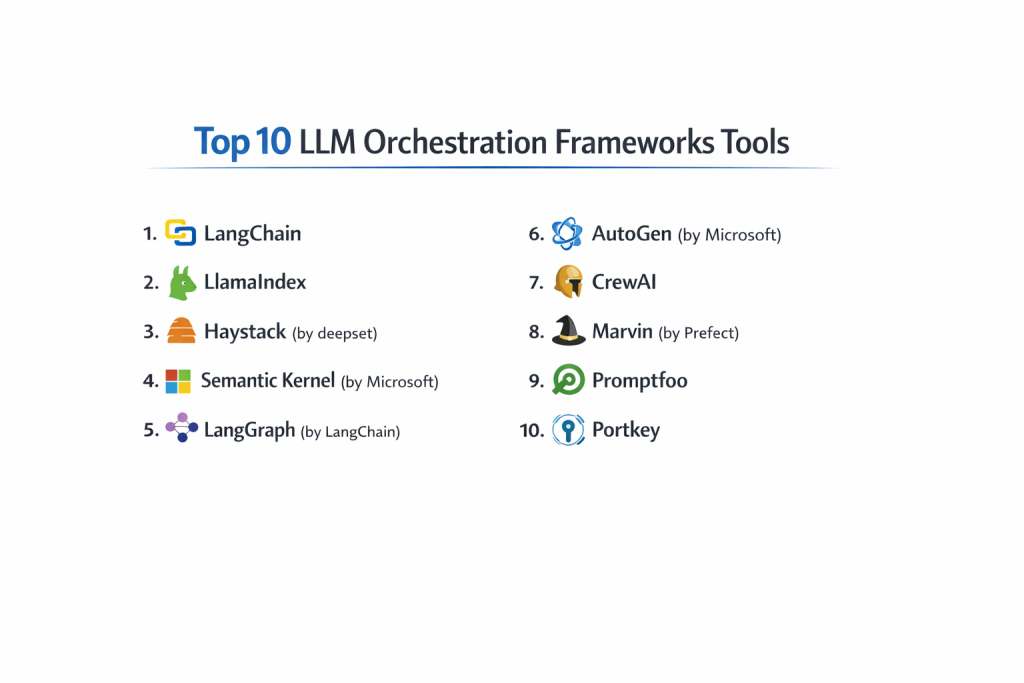
Top 10 LLM Orchestration Frameworks Tools
1 — LangChain
LangChain is the most widely adopted framework in the world, known for its extensive library of components and its pioneering role in defining the “chaining” concept for LLMs.
- Key features:
- Prompt Templates: Standardized ways to manage and version complex instructions.
- Document Loaders: Over 100 integrations to ingest data from Slack, Notion, Google Drive, and more.
- Chains: A syntax for linking multiple model calls and data processing steps.
- Memory Modules: Various ways to store conversation history, from short-term buffers to long-term databases.
- LangSmith Integration: A dedicated platform for tracing, debugging, and testing LangChain applications.
- Pros:
- The largest community and ecosystem; almost every new AI tool creates a LangChain integration first.
- Extremely modular, allowing developers to pick and choose only the parts they need.
- Cons:
- Can feel “over-engineered” with too many layers of abstraction for simple tasks.
- Documentation can sometimes lag behind the rapid pace of library updates.
- Security & compliance: SOC 2 Type II compliant for LangSmith; library itself is open-source and depends on host environment security.
- Support & community: Massive GitHub community, extensive tutorials, and professional support available through LangChain’s enterprise services.
2 — LlamaIndex
LlamaIndex (formerly GPT Index) is a data-centric framework specifically optimized for connecting LLMs to diverse, private data sources.
- Key features:
- Data Connectors: Specialized tools for “indexing” complex data structures.
- Query Engines: Advanced logic for finding the most relevant piece of information within a massive dataset.
- Data Agents: Agents specifically designed to act as advanced interfaces for your data.
- Post-processing: Tools to rerank or filter data retrieved from a vector store to ensure relevance.
- Workflows: A recently added feature for building event-driven, stateful AI applications.
- Pros:
- The undisputed leader for RAG applications; its indexing logic is more sophisticated than LangChain’s.
- Easier to use for data engineers who are focused on “retrieval” rather than “chaining.”
- Cons:
- Less versatile than LangChain for general-purpose agentic workflows or non-data tasks.
- The transition from the older “Index” style to the newer “Workflow” style has created some learning curve friction.
- Security & compliance: GDPR and SOC 2 compliance for their cloud-managed services; local library is environment-dependent.
- Support & community: Very active Discord and GitHub; excellent documentation for data-specific use cases.
3 — Haystack (by deepset)
Haystack is an enterprise-grade orchestration framework that excels in building production-ready search and question-answering systems.
- Key features:
- Pipeline Architecture: A directed acyclic graph (DAG) approach to building workflows.
- Flexible Retrievers: Supports traditional keyword search (BM25) alongside modern vector search.
- Open-Source Core: Transparent codebase designed for high-performance industrial applications.
- Evaluation Framework: Built-in tools to measure the “correctness” of your AI’s answers.
- REST API Integration: Easily turn your AI pipeline into a deployable web service.
- Pros:
- Extremely stable and well-suited for high-traffic production environments.
- The “Pipeline” visual logic is often easier to debug than complex code chains.
- Cons:
- Smaller integration ecosystem compared to LangChain.
- Can feel less “bleeding-edge” than startup-led frameworks that ship features daily.
- Security & compliance: ISO 27001 and GDPR compliant via deepset Cloud; focuses heavily on enterprise security standards.
- Support & community: Strong European presence; professional enterprise support and dedicated community forums.
4 — Semantic Kernel (by Microsoft)
Semantic Kernel is Microsoft’s SDK that integrates LLMs with conventional programming languages like C#, Python, and Java.
- Key features:
- Plugins: A structured way to expose existing business logic and code to an AI model.
- Planners: AI-driven logic that can automatically combine plugins to achieve a user goal.
- Strong Typing: Native support for C# and Java, making it the choice for enterprise software architects.
- Connectors: First-class support for Azure OpenAI and other enterprise AI services.
- Function Calling: Advanced handling of how models interact with external functions.
- Pros:
- The best choice for enterprise teams working in the .NET or Java ecosystems.
- Designed for reliability and “grounding” the AI in existing business code.
- Cons:
- The Python version has historically lagged behind the C# version in features.
- Steeper learning curve for developers used to lightweight scripting.
- Security & compliance: Inherits Microsoft Azure’s industry-leading security suite (FedRAMP, HIPAA, SOC 1/2/3).
- Support & community: Professional enterprise support from Microsoft; well-documented for corporate developers.
5 — LangGraph (by LangChain)
LangGraph is a specialized library built on top of LangChain specifically designed to create stateful, multi-agent applications.
- Key features:
- Cyclical Logic: Allows agents to “loop back” and retry a task if they fail—something standard chains can’t do easily.
- Persistence: Built-in “checkpoints” that save the state of a conversation even if the server restarts.
- Human-in-the-loop: Native support for pausing a process to wait for a human to approve an AI action.
- Multi-agent Support: Sophisticated ways for different agents to pass data to one another.
- Fine-grained Control: Developers can control every transition in the agent’s logic graph.
- Pros:
- The most robust tool for building complex agents that don’t get “lost” in long tasks.
- Perfect for applications requiring high reliability and human oversight.
- Cons:
- Requires a deep understanding of LangChain and “graph theory” logic.
- More verbose code compared to simple linear chains.
- Security & compliance: SOC 2 compliant via the LangChain enterprise platform; standard encryption protocols.
- Support & community: Rapidly growing; benefits from the existing massive LangChain user base.
6 — AutoGen (by Microsoft)
AutoGen is a framework for building applications that use multiple agents that can “talk” to each other to solve a task.
- Key features:
- Conversational Patterns: Supports hierarchical, joint, and sequential agent conversations.
- Code Execution: Agents can write code and execute it in a sandbox to verify their own work.
- Customizable Personas: Easily define agents like “Technical Writer,” “Senior Developer,” or “QA Tester.”
- Human Integration: Humans can act as one of the agents in the “chat room.”
- LLM Caching: Reduces costs by caching model responses for repetitive agent tasks.
- Pros:
- Unbeatable for research and development of complex multi-step automated workflows.
- Highly innovative; pioneers many of the newest multi-agent techniques.
- Cons:
- Can be unpredictable; agents may get stuck in “conversational loops.”
- Primarily a research-oriented tool, making production deployments challenging.
- Security & compliance: Varies; primarily intended for localized development or secure Docker environments.
- Support & community: Very active GitHub and Discord; heavily discussed in academic AI circles.
7 — CrewAI
CrewAI is a framework that takes a “role-based” approach to agents, treating them like members of a real-world workforce.
- Key features:
- Backstory and Goals: You don’t just prompt an agent; you give them a job description and a personality.
- Task Delegation: Agents can decide to hand off a piece of a project to a different “crew member.”
- Process Management: Define if the crew works sequentially or if they all work on a task at once.
- Output Formatting: Strong focus on ensuring agents return data in specific, predictable JSON formats.
- Tool Usage: Easy interface for agents to use search engines, calculators, or custom APIs.
- Pros:
- Very intuitive for managers and non-engineers to understand the logic.
- Focuses on “getting work done” rather than just technical “chaining.”
- Cons:
- Less granular control over the logic flow compared to LangGraph.
- Can be slower to execute as agents deliberate with one another.
- Security & compliance: Standard web security; depends largely on the LLM API’s compliance (e.g., OpenAI or Anthropic).
- Support & community: Vibrant community on social media and Discord; very beginner-friendly.
8 — Marvin (by Prefect)
Marvin is a “batteries-included” framework that aims to make building AI applications as simple as writing standard Python functions.
- Key features:
- AI Functions: Decorators that turn any Python function into an LLM-powered one.
- AI Models: Uses Pydantic to ensure that AI-generated data always matches your required schema.
- AI Classifiers: Simple tools to categorize text without writing complex prompts.
- Implicit Chaining: Handles the data flow between AI steps behind the scenes.
- Task Integration: Deeply integrated with Prefect for enterprise-grade workflow orchestration.
- Pros:
- The “cleanest” code of any framework; feels like native Python.
- Excellent for developers who want to add AI to an existing app without a total rewrite.
- Cons:
- Harder to do complex, low-level prompt engineering.
- Smaller ecosystem of third-party “connectors” than LangChain.
- Security & compliance: SOC 2 compliant via the Prefect platform; emphasizes data privacy.
- Support & community: Backed by the established Prefect engineering community; high-quality technical support.
9 — Promptfoo
Promptfoo is not just an orchestrator, but a specialized framework focused on the “evaluation” and “testing” of LLM outputs.
- Key features:
- Matrix Testing: Run dozens of prompts against dozens of models simultaneously to see which works best.
- Automated Grading: Use AI to “grade” another AI’s answers based on accuracy or tone.
- Red-Teaming: Specialized tools to try and “break” your LLM to find security holes.
- CI/CD Integration: Automatically test your prompts every time you push new code to GitHub.
- Side-by-Side Comparison: Visual UI to see exactly how model responses differ.
- Pros:
- Critical for teams that need to prove their AI is safe and accurate before launching.
- Works alongside other frameworks like LangChain or LlamaIndex.
- Cons:
- Not designed for building the “app” itself, only for testing it.
- Requires a different mindset (QA and testing) than standard development.
- Security & compliance: Can be run entirely locally (CLI-based), ensuring no data ever leaves your machine.
- Support & community: High adoption among security-conscious AI engineers and “red-team” researchers.
10 — Portkey
Portkey is a control plane for LLM apps, focusing on the production challenges of observability, caching, and “fallback” logic.
- Key features:
- Unified API: Use one single format to talk to over 100 different AI models.
- Semantic Caching: Saves money by identifying prompts that are “similar” to previous ones and reusing the answer.
- Automatic Retries: If OpenAI is down, Portkey can automatically switch your app to Anthropic or Google Gemini.
- Logging and Tracing: Every single prompt and response is logged for audit and debugging.
- Load Balancing: Distributes requests across multiple API keys to avoid “rate limits.”
- Pros:
- Essential for “mission-critical” apps that cannot afford even a few minutes of downtime.
- Significant cost savings through aggressive and intelligent caching.
- Cons:
- Adds another “hop” or layer between your app and the AI provider.
- Focused more on “management” than the creative logic of orchestration.
- Security & compliance: ISO 27001, SOC 2, and GDPR compliant; designed for high-security enterprise environments.
- Support & community: Dedicated enterprise support; active developer Discord and fast-response technical help.
Comparison Table
| Tool Name | Best For | Platform(s) Supported | Standout Feature | Rating (TrueReview) |
| LangChain | General Purpose AI | Python, JS | Massive Integration Library | 4.8 / 5 |
| LlamaIndex | Data-Heavy RAG | Python, JS | Advanced Data Indexing | 4.7 / 5 |
| Haystack | Enterprise Search | Python | DAG Pipeline Architecture | 4.6 / 5 |
| Semantic Kernel | .NET / Java Teams | C#, Java, Python | First-class C# Support | 4.5 / 5 |
| LangGraph | Complex Agents | Python, JS | Cyclic State Management | N/A |
| AutoGen | Multi-Agent R&D | Python | Agent-to-Agent Chat | N/A |
| CrewAI | Process Automation | Python | Role-Based Crew Logic | 4.7 / 5 |
| Marvin | Python Developers | Python | Native AI Functions | N/A |
| Promptfoo | Security / QA | CLI, Web | Red-Teaming & Eval | 4.9 / 5 |
| Portkey | Production Reliability | Web, API | Gateway & Fallback Logic | 4.8 / 5 |
Evaluation & Scoring of LLM Orchestration Frameworks
| Category | Weight | Score (1-10) | Evaluation Rationale |
| Core features | 25% | 9.5 | The top frameworks now cover RAG, agents, and state management comprehensively. |
| Ease of use | 15% | 7.5 | There is a trade-off: more powerful tools (LangGraph) are significantly harder to learn. |
| Integrations | 15% | 9.0 | LangChain and LlamaIndex dominate here with hundreds of pre-built connectors. |
| Security & compliance | 10% | 8.8 | Enterprise-backed tools (Semantic Kernel, Haystack) lead in formal certifications. |
| Performance | 10% | 8.5 | Latency is improving, but complex multi-agent chains still add overhead. |
| Support & community | 10% | 9.2 | The open-source communities for these tools are among the most active in tech. |
| Price / value | 15% | 9.0 | Most core libraries are free; paid value comes from managed observability tools. |
Which LLM Orchestration Framework Tool Is Right for You?
Solo Users vs SMB vs Mid-Market vs Enterprise
If you are a solo user or hobbyist, LangChain or CrewAI are the most rewarding places to start due to the sheer volume of free tutorials and “copy-paste” examples available. SMBs looking to build a specific data-driven product should prioritize LlamaIndex to ensure their RAG accuracy is high from day one. Mid-Market teams who need to balance speed with reliability will find Marvin or Haystack easier to maintain long-term. Enterprises with legacy codebases in .NET or Java will likely find Semantic Kernel to be the only viable choice that passes their internal architecture reviews.
Budget-Conscious vs Premium Solutions
The core libraries for all these tools are open-source and free. However, the “hidden cost” is in the observability and management layers. If you are budget-conscious, you can use Promptfoo locally for free to test your prompts. If you are a premium-focused organization, investing in Portkey or LangSmith is essential to prevent “runaway” API costs that can occur when an autonomous agent gets stuck in a loop.
Feature Depth vs Ease of Use
This is the most common trade-off. Marvin is the easiest to use but has the least “depth” for low-level prompt hacking. LangGraph has the most depth for building complex, error-correcting agents but will take a developer several weeks to master. For most teams, LlamaIndex offers the best “middle ground” for data-intensive projects.
Integration and Scalability Needs
If your app needs to talk to hundreds of different tools (Slack, Jira, Gmail, Salesforce), LangChain is non-negotiable. For scalability, Haystack and Portkey are designed specifically to handle millions of requests without the framework itself becoming a bottleneck.
Security and Compliance Requirements
If you are in a highly regulated field like Finance or Healthcare, you must look for frameworks that support self-hosting. Haystack and Semantic Kernel allow you to keep everything within your own VPC. If you need a framework that helps you proactively find security flaws, Promptfoo is a mandatory addition to your stack for red-teaming your models.
Frequently Asked Questions (FAQs)
1. Do I really need a framework, or can I just use the OpenAI API?
You can use the API for simple apps. However, as soon as you need to remember past conversations, pull data from a PDF, or have the AI use a tool, a framework will save you hundreds of hours of manual coding.
2. Is LangChain still the best, or has it become too bloated?
It is still the most capable, but many developers find it “bloat-y.” For those who want something lighter, Marvin or Portkey are popular alternatives that achieve similar results with cleaner code.
3. What is the difference between an LLM and an Orchestrator?
An LLM (like GPT-4) is the “brain” that generates text. An Orchestrator (like LlamaIndex) is the “body” that brings the brain data, remembers where it is, and gives it tools to interact with the world.
4. Can I use multiple LLMs in one framework?
Yes. All these frameworks are “model agnostic.” You can have a cheap model (GPT-4o-mini) handle the categorization and an expensive model (Claude 3.5 Sonnet) handle the final writing.
5. How do I prevent my AI from hallucinating?
Frameworks like LlamaIndex use “grounding.” They force the AI to only answer based on the documents you provide, significantly reducing the chance of the AI making things up.
6. Which framework is best for building agents?
LangGraph is currently considered the most robust for production agents because of its “state machine” logic. CrewAI is excellent for simpler, role-played automation tasks.
7. Are these tools free?
The Python and Javascript libraries are free. You only pay for the “tokens” you use from the AI providers (like OpenAI) and for managed monitoring services like LangSmith.
8. Do these frameworks work with local models (like Llama 3)?
Yes. Most integrate with Ollama or vLLM, allowing you to run your entire AI stack on your own hardware for maximum privacy.
9. What is “Human-in-the-loop”?
It is a safety feature in orchestration where the AI must stop and wait for a human to click “Approve” before it performs a sensitive action, like sending an email or moving a file.
10. How do I choose between LangChain and LlamaIndex?
If your app is about doing things (apps, tools, agents), pick LangChain. If your app is about knowing things (searching documents, answering data questions), pick LlamaIndex.
Conclusion
The LLM Orchestration landscape has matured from experimental scripts into a robust ecosystem of enterprise-ready tools. Choosing the right framework is no longer just about which one is the most popular, but which one fits your specific architecture. If you are building a data-heavy research tool, LlamaIndex remains the gold standard. If you are building a complex, autonomous multi-agent system, LangGraph offers the reliability you need.
Ultimately, the best approach for many teams is a “hybrid” one: using LangChain for its integrations, Promptfoo for testing, and Portkey to manage production traffic. The key is to start with a modular mindset, ensuring that as the AI world changes, your orchestration layer allows you to adapt without rebuilding your entire product.