Introduction
Listings management tools are specialized software platforms designed to help businesses manage their digital presence across a vast network of directories, maps, and search engines. These tools act as a centralized control center for a business’s Name, Address, and Phone number (NAP) data. By connecting to major platforms like Google Business Profile, Apple Maps, Bing, and Yelp, as well as niche industry directories, these tools ensure that a company’s information is consistent and accurate everywhere a potential customer might look. Without these tools, multi-location businesses would have to manually update dozens of profiles every time their hours changed or they moved locations.
The importance of listings management lies in the mechanics of local search algorithms. Search engines prioritize “trust” and “authority.” When Google finds identical, accurate information across 50 different directories, its confidence in that business increases, leading to higher rankings in the “Local Pack” or “Map Pack.” Key real-world use cases include a retail chain updating holiday hours across 200 stores instantly, a medical group ensuring their physicians’ credentials and locations are correct across healthcare directories, or a restaurant managing its menu and photos across various dining apps. When choosing a tool, evaluation criteria should include the size of the publisher network, the speed of data syncing, the ability to suppress duplicate listings, and the depth of local search analytics.
Best for: Local business owners, digital marketing agencies, multi-location franchises, and enterprise brands in retail, hospitality, or healthcare. It is essential for anyone whose revenue depends on being found in “near me” searches.
Not ideal for: Purely online SaaS companies or e-commerce brands with no physical footprint or service area. If your customers don’t visit you or you don’t go to them, traditional SEO tools are a better investment than local listings management.
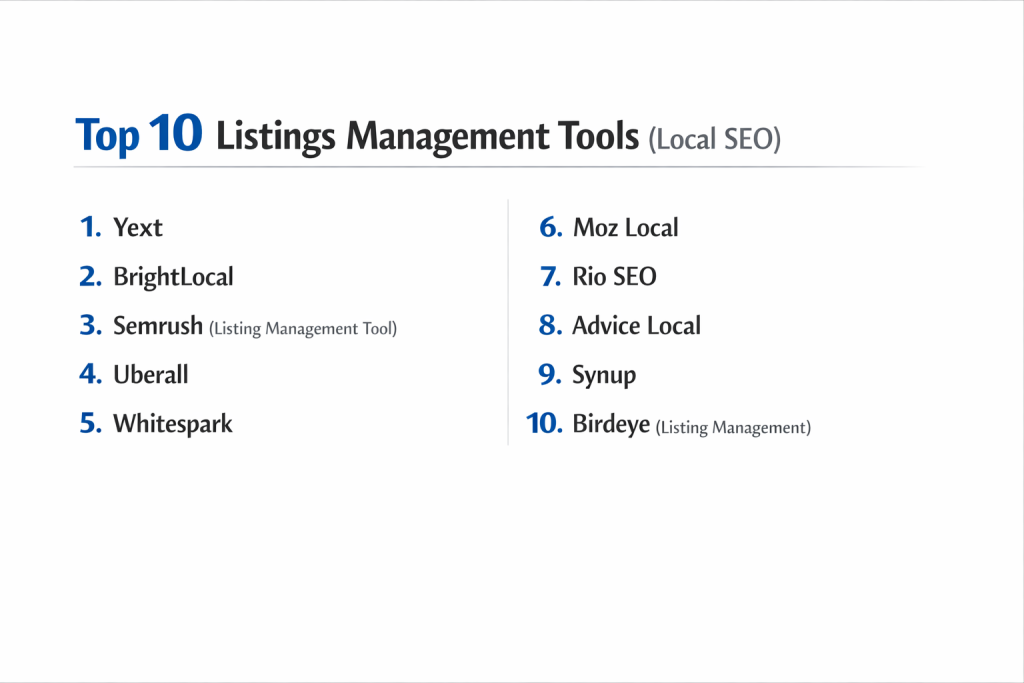
Top 10 Listings Management Tools (Local SEO) Tools
1 — Yext
Yext is widely considered the enterprise market leader in “Knowledge Management.” It uses direct API integrations with over 200 publishers worldwide to give brands absolute control over their digital facts.
- Key features
- Direct API connections with major publishers for near-instant data updates.
- Duplicate listing suppression that identifies and shuts down “ghost” listings.
- Integrated review management and social media posting from a single dashboard.
- Yext Pages for creating SEO-optimized local landing pages.
- Advanced analytics showing “Search Views” and “Customer Actions” across the network.
- Knowledge Graph architecture to store and deliver complex business facts.
- Support for real-time updates like menu changes or professional credentials.
- Pros
- The most robust and fastest syncing network in the industry.
- Exceptional for massive enterprises with thousands of locations and complex data needs.
- Cons
- When you stop paying for the service, your listings may revert to their unmanaged state.
- The pricing is significantly higher than most competitors.
- Security & compliance: SOC 2 Type II, HIPAA, ISO 27001, GDPR compliant, and SSO support.
- Support & community: Dedicated account managers, “Yext Hitchhikers” training platform, and 24/7 global support.
2 — BrightLocal
BrightLocal is the favorite tool for agencies and small businesses. Unlike the “sync” model of Yext, BrightLocal focuses on “manual” citations and deep local SEO auditing at a very accessible price point.
- Key features
- Citation Tracker to find existing, incorrect, or missing listings.
- Manual Citation Building service to “own” your listings forever.
- Local Search Audit that analyzes rankings, reviews, and on-page SEO.
- Google Business Profile (GBP) audit and management tools.
- Whitelabel reporting for agencies to present to their clients.
- Active Sync options for major platforms like Google and Facebook.
- Reputation management to monitor and generate customer reviews.
- Pros
- You own the listings even if you cancel; they don’t revert to old data.
- Excellent value for money, especially for agencies managing multiple small clients.
- Cons
- Manual citation building takes longer (weeks) compared to API-based syncing (minutes).
- Not designed for the massive scale of a Fortune 500 company.
- Security & compliance: GDPR compliant and secure data encryption.
- Support & community: High-quality blog, “BrightLocal Academy,” and responsive email/chat support.
3 — Semrush (Listing Management Tool)
Semrush, the SEO powerhouse, offers a specialized listing management tool powered by Yext’s network. It is ideal for marketers who already use Semrush for their keyword research and want to centralize their local SEO.
- Key features
- Distribution of business data to 70+ top directories in the US and international markets.
- Integrated “Map Rank Tracker” to see exactly where you rank in specific neighborhoods.
- Voice search optimization to ensure data is ready for Alexa and Siri.
- Review monitoring and “Review Management” functionality.
- Automatic duplicate suppression for the most important directories.
- Local SEO audit that checks for NAP consistency.
- Integration with the broader Semrush SEO ecosystem.
- Pros
- Great for users who want all their SEO data (backlinks, keywords, local) in one place.
- Leverages Yext’s technology at a slightly different price point and interface.
- Cons
- Limited to the specific directories included in the Semrush-Yext partnership.
- Can feel expensive if you only need the local listings part and not the full SEO suite.
- Security & compliance: GDPR compliant, SOC 2 (Varies), and secure SSO.
- Support & community: Extensive knowledge base, Semrush Academy, and 24/7 global support.
4 — Uberall
Uberall is a global enterprise platform that focuses on the “Near Me” customer journey. It is particularly strong in the European market and for brands focused on hybrid retail.
- Key features
- Uberall CoreX platform for centralized location data management.
- Local SEO “Presence” management across global and regional directories.
- Integrated social media and reputation management.
- Local “Locator” and “Local Pages” for brand websites.
- Advanced analytics showing the ROI of local search efforts.
- Google Business Profile “Post” scheduling and management.
- Multi-user permissions for franchise managers.
- Pros
- Strongest international coverage, making it ideal for brands with a global footprint.
- Highly collaborative interface for brands with local franchise owners.
- Cons
- The interface can be complex for small business owners.
- Pricing is enterprise-level and usually requires a sales consultation.
- Security & compliance: ISO 27001, GDPR compliant, and secure API architecture.
- Support & community: Dedicated success managers and a professional resource center.
5 — Whitespark
Whitespark is a specialist agency and software provider famous for its “Local Citation Finder.” It is designed for those who want to “win” at local SEO through high-quality, manual link building and citations.
- Key features
- Local Citation Finder to identify where your competitors are listed.
- Manual Citation Building and Cleanup services (one-time fee).
- Reputation Builder to help businesses get more reviews.
- Local Rank Tracker that monitors rankings in the Local Pack and Maps.
- Google Business Profile management service.
- Google Business Profile “Optimization” audits.
- Free tools for generating review links and checking NAP.
- Pros
- “One-time fee” model for citation building—no ongoing subscription required to keep listings.
- Deep expertise; their software is built by some of the world’s leading local SEO experts.
- Cons
- Software is divided into separate modules rather than one “all-in-one” dashboard.
- Lacks the real-time API sync of enterprise tools like Yext or Uberall.
- Security & compliance: GDPR compliant and standard web encryption.
- Support & community: Highly active in the local SEO community and excellent customer support.
6 — Moz Local
Moz Local is a streamlined, automated tool designed for businesses that want a “hands-off” approach to maintaining their presence on the most important directories and aggregators.
- Key features
- Automated data distribution to major search engines and data aggregators.
- Real-time update syncing for Google, Facebook, and Bing.
- Duplicate listing identification and closure process.
- Review monitoring and response management.
- Local search visibility scoring.
- Profile completeness reporting.
- Integration with Moz Pro for broader SEO tracking.
- Pros
- Very easy to set up and maintain; ideal for those who don’t want to spend hours on SEO.
- Focuses on the “Big” players that matter most for rankings.
- Cons
- Smaller network of directories compared to Yext or Uberall.
- Less granular control over niche or local citations.
- Security & compliance: GDPR compliant and secure SSO options.
- Support & community: Famous for “Moz Academy” and their extensive SEO community.
7 — Rio SEO
Rio SEO is an enterprise-level platform that specializes in “Open Local” solutions. It is designed for massive brands (1,000+ locations) that need a high degree of customization and strategic partnership.
- Key features
- Automated listing management across the global ecosystem.
- Local Reporting and “Insights” suite for high-level data analysis.
- Local Pages and Store Locators with built-in schema markup.
- Reputation management with automated sentiment analysis.
- Managed services for businesses that want Rio to handle the work.
- Social media management for local pages.
- Deep integration with enterprise CRM and POS data.
- Pros
- Highly consultative approach; they function more as a partner than a software vendor.
- Exceptional at managing extremely large data sets for multi-national brands.
- Cons
- Not accessible or affordable for small businesses or individual locations.
- Pricing is opaque and requires custom quoting.
- Security & compliance: SOC 2 Type II, GDPR, and HIPAA compliant.
- Support & community: High-touch account management and executive-level support.
8 — Advice Local
Advice Local is a “white-label” focused platform that provides agencies with the tools to manage local SEO for their clients under their own brand.
- Key features
- Real-time data distribution to GPS systems and in-car navigation.
- Manual citation building and cleanup services.
- Whitelabel dashboard and reporting for agencies.
- Voice search readiness audits.
- Vertical-specific directory submissions (Legal, Medical, Home Services).
- Google Business Profile “Sync” and management.
- Data aggregator submission to Foursquare, Data Axle, etc.
- Pros
- The best option for agencies that want a brandable “Local SEO” service.
- Strong focus on “New Tech” like in-car navigation systems.
- Cons
- The user interface is functional but lacks the modern polish of Sprout or Yext.
- Network depth can vary by industry.
- Security & compliance: GDPR compliant and standard SSL encryption.
- Support & community: Dedicated partner support and regular webinars.
9 — Synup
Synup is an “all-in-one” marketing platform that combines listing management with social media, reputation, and content marketing for local businesses.
- Key features
- Automated listing updates across 40+ major publishers.
- AI-driven review response generation.
- Social media post scheduling for local profiles.
- “Store Locator” and “Local Pages” widgets.
- Insights and analytics on profile views and interactions.
- Voice search readiness check.
- Support for “Offer” and “Event” posts across the network.
- Pros
- Great “all-in-one” solution for small businesses that don’t want multiple tools.
- Modern, fast-loading interface that is easy to navigate.
- Cons
- Smaller list of supported directories compared to Yext.
- Some advanced SEO features are not as deep as BrightLocal or Whitespark.
- Security & compliance: GDPR compliant and secure API protocols.
- Support & community: 24/7 support and a growing library of local marketing resources.
10 — Birdeye (Listing Management)
Birdeye is primarily known for reviews, but its listing management tool is a core part of its “all-in-one” local experience platform. It is best for businesses that want to link their reputation directly to their search visibility.
- Key features
- Listing management across 50+ of the most influential sites.
- Direct Google and Facebook integrations.
- Automated “Scan” tool to find incorrect information.
- Review generation and management integrated with listings.
- Webchat-to-text leads generated directly from local profiles.
- Competitive benchmarking for local rankings.
- Multi-location reporting and permission settings.
- Pros
- Powerful for brands that want to use reviews to boost their local SEO.
- Integrated “Messaging” features make the tool a full customer experience suite.
- Cons
- Listing management is often part of a broader, more expensive package.
- Not a “pure-play” SEO tool; focuses more on the customer experience.
- Security & compliance: SOC 2 Type II, HIPAA, and GDPR compliant.
- Support & community: Extensive customer success team and Birdeye University.
Comparison Table
| Tool Name | Best For | Platform(s) Supported | Standout Feature | Rating |
| Yext | Global Enterprise | Web / API | Knowledge Graph Sync | 4.6/5 |
| BrightLocal | Agencies / SMBs | Web | Manual Citation Building | 4.8/5 |
| Semrush | SEO Professionals | Web | Integrated Map Rank Tracker | 4.5/5 |
| Uberall | International Brands | Web / API | Global Multi-directory Sync | 4.4/5 |
| Whitespark | Local SEO Specialists | Web | Manual Citation Discovery | 4.7/5 |
| Moz Local | Automated Simplicity | Web | Listing Score Optimization | 4.3/5 |
| Rio SEO | Massive Franchises | Web / Service | Custom Managed Solutions | 4.4/5 |
| Advice Local | Whitelabel Agencies | Web | In-Car Navigation Sync | 4.2/5 |
| Synup | All-in-One Marketing | Web | AI-Powered Review Responses | 4.3/5 |
| Birdeye | Reputation & Local | Web / Mobile | Review-to-Listing Synergy | 4.6/5 |
Evaluation & Scoring of Listings Management Tools
To help you decide, we have evaluated these platforms using a weighted scoring system based on the most critical needs of local marketing teams.
| Category | Weight | Evaluation Highlights |
| Core Features | 25% | Network size, sync speed, and duplicate suppression. |
| Ease of Use | 15% | Dashboard intuitiveness and bulk update capabilities. |
| Integrations | 15% | Native connections with GBP, Bing, and major CRMs. |
| Security & Compliance | 10% | Presence of SOC 2, HIPAA, and GDPR certifications. |
| Performance | 10% | Uptime, API reliability, and reporting accuracy. |
| Support & Community | 10% | Access to experts and educational content. |
| Price / Value | 15% | Long-term ROI and whether you own the listings. |
Which Listings Management Tool Is Right for You?
Solo Users vs SMB vs Mid-Market vs Enterprise
If you are a Solo User or a local boutique, BrightLocal or Whitespark are the winners. They allow you to pay for what you need without high monthly overhead. SMBs with 2-10 locations should look at Moz Local or Synup for an automated, low-maintenance experience. Mid-Market and Enterprise companies (10-500+ locations) require the industrial-scale power of Yext or Uberall to ensure data integrity across thousands of digital endpoints.
Budget-Conscious vs Premium Solutions
For the Budget-Conscious, manual citation building from Whitespark is a great “one-time” investment. You pay once, they build the listings, and you don’t have a recurring bill. On the Premium end, Yext provides a “live” connection that is more expensive but ensures your hours or status can be updated across the web in minutes—critical for emergency closures or rapid expansion.
Feature Depth vs Ease of Use
If you want Ease of Use, Moz Local is incredibly straightforward. It tells you exactly what is wrong and fixes it with a few clicks. If you want Feature Depth, BrightLocal and Semrush provide the data-nerd’s dream: rankings grids, competitor citation analysis, and deep-dive technical audits.
Integration and Scalability Needs
If you are an agency scaling to hundreds of clients, Advice Local or BrightLocal’s whitelabel dashboards are indispensable. If you are a corporation that needs listings data to flow into your custom mobile app or store locator, Yext and Rio SEO offer the best API and developer tools to scale your “source of truth.”
Security and Compliance Requirements
Healthcare organizations must prioritize HIPAA compliance, making Yext, Rio SEO, or Birdeye the top choices. For financial services requiring high-level data governance and audit logs, enterprise tools with SOC 2 Type II certification (like Yext) are the only viable options.
Frequently Asked Questions (FAQs)
What is the difference between a listing and a citation?
A listing is a full business profile on a site like Yelp. A citation is any mention of your Name, Address, and Phone number (NAP) online. All listings are citations, but not all citations (like a mention in a local blog) are listings.
Does listings management help with SEO?
Yes. Consistent NAP data is a major ranking factor for Google’s Local Map Pack. If your data is consistent across 50+ sites, Google trusts your business more and ranks you higher.
What happens if I cancel my subscription?
It depends on the tool. With “API Sync” tools like Yext, your listings may revert to their unmanaged, potentially incorrect state. With “Manual” tools like BrightLocal or Whitespark, the listings are yours to keep forever.
What is “NAP Consistency”?
NAP stands for Name, Address, and Phone number. Consistency means this info is identical across every site. Even small differences (like “St.” vs “Street”) can sometimes confuse search engines.
How long does it take to see results?
For API-based tools, data updates in minutes or hours. However, it usually takes 4-8 weeks to see a meaningful impact on search rankings as Google re-crawls the web.
Can these tools fix my reviews?
Most listings tools include review monitoring, but they cannot delete negative reviews. They help you respond quickly, which can improve your rating over time.
What are “Data Aggregators”?
Data Aggregators (like Data Axle and Foursquare) are massive databases that feed information to thousands of smaller directories. Tools like Moz Local often push data to these aggregators.
Do I need a tool if I only have one location?
It’s not strictly necessary, but it saves time. Manually managing 50 sites is a full-day job; a tool does it in five minutes.
Why is voice search important for listings?
When people ask Siri or Alexa for “pizza near me,” those assistants pull data from listings directories. If your data is wrong, voice assistants won’t recommend you.
How do tools handle “Duplicate Listings”?
Duplicates confuse Google and split your “ranking power.” Tools like Yext and BrightLocal find these duplicates and either merge them or ask the publisher to remove them.
Conclusion
The “best” listings management tool depends entirely on your scale and your SEO philosophy. If you believe in the “set it and forget it” power of real-time syncing, Yext and Uberall are the industry benchmarks. If you prefer the control and “permanent” nature of manual citation building, BrightLocal and Whitespark are the superior choices.
Ultimately, your digital presence is your modern-day storefront. Inconsistent or incorrect listings don’t just hurt your SEO; they lose you customers who might show up to a closed store or call a disconnected number. By investing in a dedicated listings management tool, you ensure that your business is “open for business” everywhere the digital consumer looks.