Introduction
Lead generation platforms are comprehensive software solutions designed to identify, attract, and capture potential customers (leads) for a business. These platforms serve as the engine for a company’s growth by automating the process of finding people or businesses interested in a specific product or service. They typically offer a combination of tools, including contact databases, email automation, landing page builders, and visitor tracking. By centralizing these functions, lead generation platforms allow sales and marketing teams to move away from manual “cold calling” and toward a data-driven approach that focuses on high-intent prospects.
The importance of these platforms lies in their ability to scale revenue predictably. In a competitive market, waiting for customers to find you is rarely enough; businesses must be proactive. Real-world use cases include B2B SaaS companies using database tools to find decision-makers at target firms, real estate agents using landing pages to capture local buyer interest, and agencies using automated outreach to book meetings. When evaluating a platform, users should prioritize data accuracy, ease of integration with existing CRMs, the quality of automation workflows, and compliance with global privacy laws.
Best for: Sales Development Representatives (SDRs), marketing managers, and business owners in B2B sectors, professional services, and high-growth startups. It is ideal for those needing to build large outbound pipelines or capture inbound interest at scale.
Not ideal for: B2C companies with very low-cost, transactional products (e.g., a $5 phone case) where the cost of lead acquisition would exceed the profit margin. It may also be unnecessary for businesses that rely purely on physical walk-in traffic or local word-of-mouth.
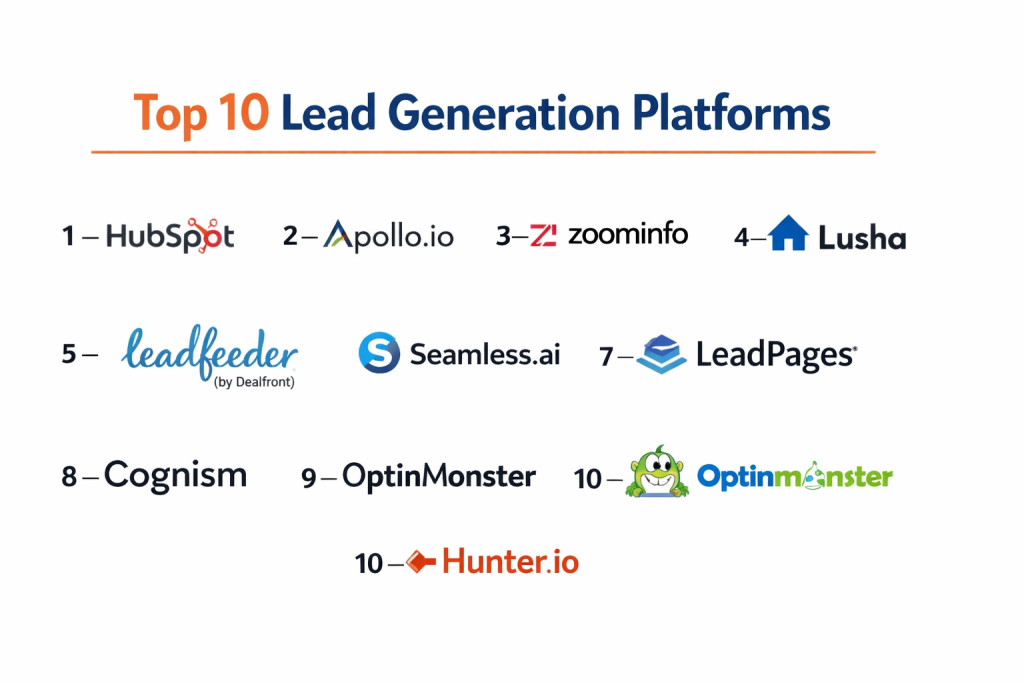
Top 10 Lead Generation Platforms
1 — HubSpot
HubSpot is an all-in-one CRM and marketing platform that provides a massive suite of inbound lead generation tools. It is designed to attract visitors through content and convert them via sophisticated forms, pop-ups, and automated workflows.
- Key features
- High-converting landing page and form builders with A/B testing.
- Integrated “Leads” database that tracks every interaction a prospect has.
- Live chat and automated chatbots for real-time lead capture.
- Lead scoring to prioritize prospects based on engagement levels.
- Advanced email marketing automation triggered by user behavior.
- Ad management tools to track ROI from LinkedIn, Google, and Facebook.
- Comprehensive SEO tools to drive organic traffic to lead magnets.
- Pros
- The most user-friendly interface in the enterprise software space.
- Seamlessly connects marketing, sales, and service data in one place.
- Cons
- Costs escalate quickly as your database of contacts grows.
- Advanced automation features are locked behind expensive “Professional” tiers.
- Security & compliance: SOC 2 Type II, GDPR compliant, HIPAA support (on Enterprise), and ISO 27001.
- Support & community: World-class documentation, HubSpot Academy, and a massive global user community.
2 — Apollo.io
Apollo.io is a “sales intelligence” and engagement platform that combines a massive database of over 275 million contacts with powerful outbound orchestration tools. It is built for teams that need to find and contact leads in a single workflow.
- Key features
- Verified B2B database with direct dials and personal emails.
- Integrated email sequencer with AI-powered writing assistance.
- LinkedIn extension for extracting prospect data directly from profiles.
- “Job Change” alerts to catch prospects when they move to new companies.
- Advanced filtering based on technographics, funding, and intent data.
- Click-to-dialer with call recording and transcription.
- Automated data enrichment to keep your CRM records current.
- Pros
- Incredible value for money, offering features usually split across three tools.
- The Chrome extension is one of the most efficient in the industry.
- Cons
- Database accuracy can vary, requiring manual verification for some records.
- The platform can occasionally feel “buggy” due to the rapid release of new features.
- Security & compliance: SOC 2 Type II, GDPR compliant, and CCPA compliant.
- Support & community: Extensive help center, webinar series, and active community Slack groups.
3 — ZoomInfo
ZoomInfo is the enterprise gold standard for B2B data. It provides deep intelligence on companies and the people who work there, designed for large sales teams that need the highest quality direct-dial data available.
- Key features
- Market-leading accuracy for direct-dial phone numbers and email addresses.
- “Intent Data” that flags which companies are currently researching your solution.
- Website visitor tracking that identifies anonymous companies browsing your site.
- “Chorus” integration for conversation intelligence and call analysis.
- Automated workflows that trigger outreach based on specific “scoops” (e.g., a new project launch).
- Hierarchy mapping to see parent-subsidiary relationships in corporations.
- Robust API for custom data integrations and large-scale enrichment.
- Pros
- Unmatched data depth for North American B2B markets.
- Provides “Scoops” (inside information) that offer excellent conversation starters.
- Cons
- One of the most expensive platforms on the market.
- Contract terms are famously rigid and typically require annual commitments.
- Security & compliance: ISO 27001, SOC 2 Type II, GDPR, and CCPA.
- Support & community: Dedicated account managers, ZoomInfo University, and premium enterprise support.
4 — Lusha
Lusha is a streamlined lead generation tool that focuses on simplicity and speed. It is primarily used by individual sales reps and recruiters who need to find contact information quickly without a complex setup.
- Key features
- Browser extension that works on LinkedIn, Salesforce, and company websites.
- High-accuracy mobile numbers and direct emails.
- “Lusha Lists” for building prospect segments within the platform.
- Simple CRM sync for Salesforce, HubSpot, and Pipedrive.
- Prospecting filters based on company size, revenue, and industry.
- Intent data signals to identify active buyers.
- Usage-based credits that allow for flexible spending.
- Pros
- Extremely easy to use with almost zero learning curve.
- Known for high-quality mobile phone data, which is vital for remote sales.
- Cons
- Lacks the advanced email automation/sequencing found in Apollo or HubSpot.
- The database is smaller than enterprise giants like ZoomInfo.
- Security & compliance: GDPR and CCPA compliant, SOC 2 Type II, and ISO 27001.
- Support & community: 24/7 chat support and a helpful library of “how-to” guides.
5 — Leadfeeder (by Dealfront)
Leadfeeder focuses on the “Inbound” side of lead generation by identifying the companies that visit your website, even if they never fill out a form. It is designed to help sales teams follow up with “warm” anonymous traffic.
- Key features
- Identification of company names from anonymous IP addresses.
- Behavior tracking to see which pages a company visited and for how long.
- Automatic lead filtering to remove “junk” traffic (like ISPs or current customers).
- Integration with LinkedIn to show you who you might know at the visiting company.
- Email alerts for when a high-value target account visits your site.
- Seamless sync with CRMs to add visiting companies to your sales pipeline.
- “Dealfront” database integration for finding contact info for those visitors.
- Pros
- Turns anonymous web traffic into a tangible list of warm leads.
- Great for aligning sales and marketing on website ROI.
- Cons
- Only identifies the company, not the specific individual who visited.
- Effectiveness can be limited by remote work/VPN usage.
- Security & compliance: GDPR compliant and SOC 2.
- Support & community: Fast-response chat support and a comprehensive “Sales Intelligence” blog.
6 — Seamless.ai
Seamless.ai uses a real-time search engine to find contact information, rather than a static database. This approach is designed to provide the most up-to-date information possible for B2B sales professionals.
- Key features
- Real-time search engine for finding emails and cell phone numbers.
- “Autopilot” feature that automates the list-building process based on your ICP.
- Browser extension that scrapes data from LinkedIn and search results.
- Data enrichment for cleaning up old or incomplete CRM records.
- Pitch intelligence that provides insights into why a prospect might buy.
- High-volume lead importing for large outreach campaigns.
- Integrated “Writer” tool for generating sales messages.
- Pros
- The “Autopilot” feature is a massive time-saver for building lists at scale.
- Strong focus on providing mobile numbers for modern outreach.
- Cons
- The aggressive marketing and high-energy UI can be polarizing for some users.
- Because it searches in real-time, some results can be “hit or miss” in quality.
- Security & compliance: SOC 2 Type II and GDPR compliant.
- Support & community: Extensive video training (Seamless University) and a highly active Facebook community.
7 — LeadPages
LeadPages is a specialized platform for creating high-converting landing pages. It is designed for marketers and small business owners who need to capture leads through advertising or social media campaigns.
- Key features
- Easy drag-and-drop builder with a focus on conversion-optimized templates.
- Unlimited lead capture and landing page hosting.
- Built-in A/B testing to see which headlines or images perform better.
- “Pop-ups” and “Alert Bars” that can be added to any website.
- Integration with over 40 tools, including Mailchimp, HubSpot, and Stripe.
- Built-in lead magnet delivery (automatically send a PDF after a signup).
- Real-time analytics on conversion rates and traffic sources.
- Pros
- One of the fastest ways to get a professional lead-capture page online.
- Pricing is much more accessible for small businesses than enterprise platforms.
- Cons
- It is not a CRM; you need another tool to manage and email the leads you capture.
- Design flexibility is slightly lower than “general” builders like Elementor.
- Security & compliance: GDPR compliant and uses secure SSL encryption.
- Support & community: Reliable email/chat support and a large library of marketing tutorials.
8 — Cognism
Cognism is a leader in “International” B2B data, specifically for the UK, Europe, and Asia. It is designed for global sales teams that need compliant, high-quality mobile data outside of North America.
- Key features
- “Diamond Verified” mobile numbers (manually verified for accuracy).
- Strict adherence to GDPR and “Do Not Call” lists in multiple countries.
- Intent data powered by Bombora to find active buyers.
- Technographic and firmographic filters for precise targeting.
- Browser extension for LinkedIn and Salesforce enrichment.
- Global company hierarchy data for complex enterprise selling.
- Seamless integration with major sales engagement platforms like Outreach.
- Pros
- The best option for European markets due to its strict compliance focus.
- The “Diamond Verification” significantly reduces “wrong number” calls.
- Cons
- The North American database is growing but not yet as deep as ZoomInfo.
- The cost is on the higher end of the spectrum.
- Security & compliance: ISO 27001, SOC 2 Type II, and strict GDPR/CCPA compliance.
- Support & community: High-touch customer success and localized support for global time zones.
9 — OptinMonster
OptinMonster is a “conversion rate optimization” (CRO) platform that turns existing website traffic into leads. It is the tool of choice for e-commerce and content-heavy sites that want to maximize their email signups.
- Key features
- “Exit-Intent” technology that triggers a pop-up when a user is about to leave.
- Wide variety of campaigns: pop-ups, slide-ins, gamified wheels, and scroll boxes.
- Geolocation targeting to show different offers based on the visitor’s location.
- Advanced “MonsterLinks” that trigger pop-ups when a specific link is clicked.
- Precision targeting based on device, referral source, or page visited.
- Comprehensive A/B testing and conversion analytics.
- Integration with almost every major email marketing and CRM platform.
- Pros
- Unrivaled targeting logic—you can show the right offer to the right person at the right time.
- Extremely effective at reducing cart abandonment for e-commerce.
- Cons
- Requires an existing website with traffic to be effective.
- It can be annoying for users if not configured with proper “display rules.”
- Security & compliance: GDPR compliant and uses secure data handling.
- Support & community: Excellent documentation and a very responsive support team.
10 — Hunter.io
Hunter.io is a specialized tool for “Email Discovery.” It is designed for marketers and PR professionals who need to find the specific email format for a company and verify that the addresses are active.
- Key features
- “Domain Search” that lists all publicly available email addresses for a company.
- Email Verifier that checks if an address is valid to prevent “bounces.”
- “Author Finder” to find the email of a person who wrote a specific article.
- Bulk tasks for searching or verifying thousands of emails at once.
- Simple outbound campaign tool for sending cold emails.
- Browser extension and API for developers.
- Integration with CRM tools to export found emails directly.
- Pros
- The most reliable tool for verifying email deliverability.
- Very affordable and offers a generous “free” tier for low-volume users.
- Cons
- Does not provide phone numbers or deep firmographic data.
- Focuses on “discovery” rather than a pre-built contact database.
- Security & compliance: GDPR compliant and uses transparent data sourcing.
- Support & community: Fast email support and a very clear, technical knowledge base.
Comparison Table
| Tool Name | Best For | Platform(s) Supported | Standout Feature | Rating |
| HubSpot | Inbound Marketing | Web / Cloud | All-in-one CRM integration | 4.5/5 |
| Apollo.io | Outbound Teams | Web / Chrome | Combined Database & Dialer | 4.8/5 |
| ZoomInfo | Enterprise Sales | Web / Cloud | “Intent” and “Scoops” data | 4.4/5 |
| Lusha | Quick Prospecting | Web / Chrome | High-accuracy mobile data | 4.6/5 |
| Leadfeeder | Visitor ID | Web | Identifying anonymous companies | 4.3/5 |
| Seamless.ai | High-volume lists | Web / Chrome | Real-time Search Engine | 4.2/5 |
| LeadPages | Paid Campaigns | Web | High-converting templates | 4.4/5 |
| Cognism | EU/Global Market | Web / Cloud | GDPR-compliant mobile data | 4.7/5 |
| OptinMonster | E-commerce / CRO | Web | Exit-intent pop-ups | 4.6/5 |
| Hunter.io | Email Verification | Web / Chrome | Reliable email deliverability | 4.5/5 |
Evaluation & Scoring of Lead Generation Platforms
To help you decide, we have evaluated these platforms against a weighted scoring rubric that represents the priorities of a modern growth team.
| Category | Weight | Evaluation Criteria |
| Core Features | 25% | Data accuracy, builder quality, and automation depth. |
| Ease of Use | 15% | Time to value and intuitiveness of the user interface. |
| Integrations | 15% | Native connectivity with popular CRMs and tech stacks. |
| Security & Compliance | 10% | GDPR, SOC 2, and data privacy protections. |
| Performance | 10% | Uptime, data refresh rates, and software speed. |
| Support & Community | 10% | Quality of documentation and customer help access. |
| Price / Value | 15% | ROI for the cost of the subscription. |
Which Lead Generation Platform Is Right for You?
Solo Users vs SMB vs Mid-Market vs Enterprise
For a Solo User or freelancer, Hunter.io and Lusha offer the best entry point because they are low-cost and don’t require a complex setup. SMBs often find the best value in Apollo.io, as it covers both data and email outreach for one price. Mid-Market companies usually thrive on HubSpot because it allows marketing and sales to play on the same field. Finally, Enterprises with large budgets and a need for 99% data accuracy should look to ZoomInfo or Cognism.
Budget-Conscious vs Premium Solutions
If you are on a tight budget, Apollo.io and Hunter.io have the most generous free or low-cost tiers. You can start generating leads for under $50/month. On the opposite end, ZoomInfo and NICE-style enterprise tools are premium solutions. These are expensive, but for a company selling a $100,000 product, the cost is easily justified by the high quality of the direct-dial data they provide.
Feature Depth vs Ease of Use
If you want something that just “works” with a single click, Lusha and OptinMonster are the winners. They are designed for speed. If you need “feature depth”—meaning you want to build a complex, multi-stage automated journey that scores leads based on their specific behavior—you will need the power of HubSpot or Amazon-scale marketing suites.
Integration and Scalability Needs
For teams that are already “locked-in” to the Salesforce ecosystem, ZoomInfo and Apollo.io offer the deepest native integrations. If you are looking to scale globally, particularly into Europe, Cognism is the most scalable choice because it manages the complex legal compliance of international data automatically.
Security and Compliance Requirements
If you operate in the European Union, you should prioritize Cognism or Leadfeeder, as they are built from the ground up to be GDPR compliant. For businesses in the US Healthcare space, HubSpot is one of the few platforms that offers a HIPAA-compliant environment for managing lead data (on their Enterprise plans).
Frequently Asked Questions (FAQs)
What is the difference between a lead and a prospect?
A lead is someone who has shown interest or matches your target criteria but hasn’t been qualified yet. A prospect is a lead that has been “vetted” and has a higher likelihood of becoming a customer.
Is cold emailing legal?
Yes, in most jurisdictions, provided you follow laws like CAN-SPAM (US) or GDPR (EU). This usually requires providing a clear way to “opt-out” and having a “legitimate interest” in contacting the person.
Do these platforms find personal or business emails?
Most B2B platforms like ZoomInfo and Apollo focus on business emails. However, some tools like Lusha also provide personal emails, which can be more effective for reaching busy executives.
How often is the data updated?
This varies. Static databases may update every 3-6 months, while “real-time” search engines like Seamless.ai or Hunter.io check for data the moment you ask for it.
Can I use a lead generation platform for a local business?
Yes, but you may have better results with “Inbound” tools like LeadPages or OptinMonster to capture traffic from local SEO or Facebook Ads.
Will these tools work on LinkedIn?
Most of the tools listed (Apollo, Lusha, Seamless) have Chrome extensions that “sit” on top of LinkedIn, allowing you to pull data directly from a person’s profile.
How do I prevent my emails from going to spam?
Use a tool like Hunter.io to verify emails before sending, and ensure you use “Email Warming” services to build a good sender reputation.
What is “Intent Data”?
Intent data is a signal that a company is currently looking for a solution. For example, if a company is repeatedly visiting review sites for “CRM software,” ZoomInfo can alert you to that behavior.
Do I need a CRM if I have a lead generation platform?
While some platforms (like Apollo) have basic CRM features, it is usually best to connect your lead gen tool to a dedicated CRM like HubSpot or Salesforce for long-term management.
What is the “Exit-Intent” feature?
It is a technology used by tools like OptinMonster that tracks mouse movement. When it detects a user moving toward the “close” button, it triggers a final offer to capture their email before they leave.
Conclusion
The “best” lead generation platform is not a single winner; it is the one that aligns with your specific sales motion. If you are a hunter focused on outbound sales, the data-rich environments of Apollo.io or ZoomInfo are essential. If you are a marketer focused on inbound traffic, the conversion tools of HubSpot or OptinMonster will be your primary drivers.
Choosing a platform is a balance of data accuracy, legal compliance, and budget. As AI continues to evolve, these platforms are becoming smarter—predicting not just who to call, but when they are most likely to buy. By investing in the right platform today, you aren’t just buying a list of names; you are building a scalable system for the future of your business.