Introduction
Last-mile delivery platforms are specialized software solutions designed to manage the final leg of the supply chain journey—the movement of goods from a distribution hub to the end customer’s doorstep. This stage is often the most complex, expensive, and critical part of the logistics process. These platforms act as a centralized “brain,” orchestrating dispatching, route optimization, driver communication, and customer notifications in real-time. By utilizing data-driven algorithms, they ensure that deliveries are made as efficiently as possible, minimizing fuel costs and maximizing the number of successful drop-offs per shift.
The importance of these platforms has skyrocketed in the post-pandemic era, where “Amazon-prime” expectations have become the standard for every industry. A high-quality last-mile platform provides the transparency and speed that modern consumers demand. Key real-world use cases include e-commerce fulfillment, grocery and meal delivery, pharmaceutical distribution, and big-and-bulky furniture logistics. When evaluating these tools, users should prioritize real-time tracking accuracy, automated dispatch logic, proof of delivery (POD) capabilities, and the robustness of the customer communication suite.
Best for: Logistics managers, e-commerce business owners, 3PL (Third-Party Logistics) providers, and fleet operators. These tools benefit companies ranging from local startups with five drivers to global retail giants managing thousands of deliveries daily across multiple continents.
Not ideal for: Long-haul trucking companies focusing on port-to-warehouse transport, or businesses that rely exclusively on traditional postal services where they have no control over the final delivery execution.
Key Real-World Use Cases
- E-commerce & Retail: Automating the delivery of online orders while providing customers with live “map views” of their driver.
- On-Demand Food & Grocery: Managing hyper-local, time-sensitive deliveries where a 10-minute delay can result in a spoiled product.
- White-Glove Services: Coordinating the delivery and installation of appliances or furniture, requiring specialized driver skills and multi-person crews.
- Healthcare & Pharmacy: Ensuring secure, temperature-controlled, and HIPAA-compliant delivery of sensitive medical supplies or prescriptions.
What to Look For (Evaluation Criteria)
When selecting a last-mile delivery platform, consider these essential pillars:
- Route Optimization: The ability to handle hundreds of variables (traffic, windows, load capacity) to create the most efficient path.
- Driver Experience: A mobile app that is easy to use in the field, even with gloves or in low-connectivity areas.
- Customer Communication: Automated SMS and email triggers that keep the buyer informed without manual intervention.
- Proof of Delivery: Flexible options for capturing signatures, photos, barcodes, or ID verification.
- Integration Breath: How easily the platform “talks” to your existing Shopify, Magento, or ERP system.
Best for: Mid-market to enterprise companies that prioritize a premium, branded customer experience and deep automation.
Not ideal for: Solo couriers looking for a free, simple GPS navigation app.
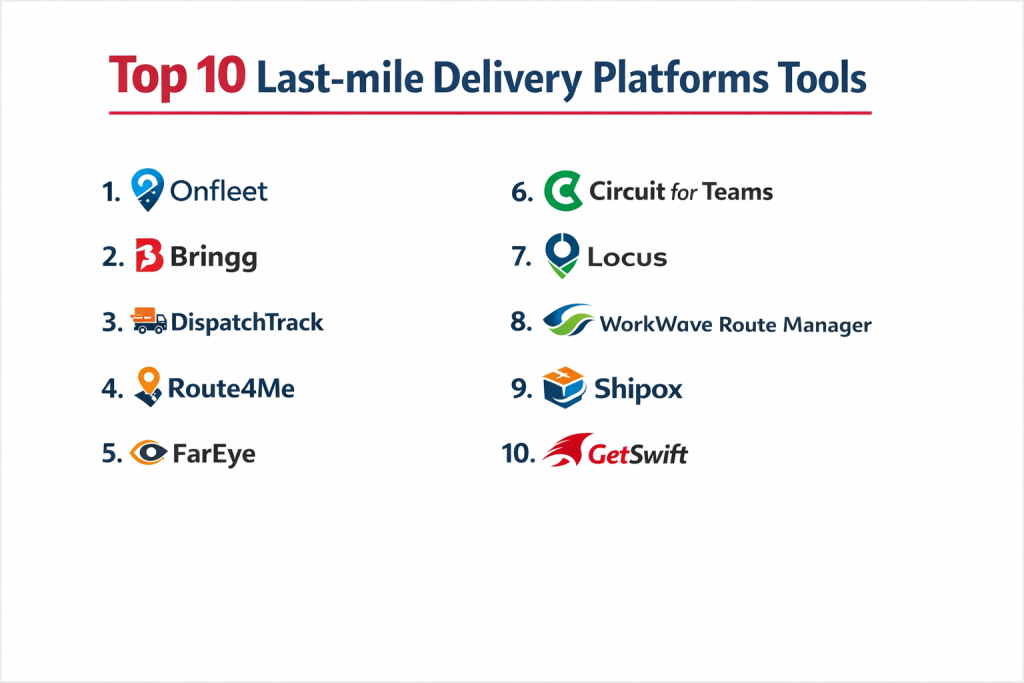
Top 10 Last-mile Delivery Platforms Tools
1 — Onfleet
Onfleet is widely considered the “Apple” of last-mile delivery, offering a sleek, intuitive interface combined with powerful back-end automation designed for high-end brands.
- Key features:
- Automated Dispatch: Assigns tasks based on proximity and load to minimize idle time.
- Predictive ETAs: Uses machine learning to provide highly accurate arrival windows.
- Anonymized Communication: Drivers and customers can chat without revealing private phone numbers.
- Comprehensive API: Allows for deep integration into custom-built e-commerce checkout flows.
- Feedback Collection: Automatically prompts customers for a star rating after a drop-off.
- Pros:
- The most polished and user-friendly dashboard in the industry.
- Exceptional customer notification features that reduce “Where is my order?” calls.
- Cons:
- Higher price point compared to basic routing tools.
- Some advanced reporting features are locked behind the most expensive tiers.
- Security & compliance: SOC 2 Type II, HIPAA-ready, GDPR, and AES-256 encryption.
- Support & community: High-touch enterprise support, dedicated success managers, and extensive API documentation.
2 — Bringg
Bringg is an enterprise-scale delivery orchestration platform built for global retailers who need to manage a mix of internal fleets and third-party delivery partners.
- Key features:
- Delivery Orchestration: Switches between internal drivers and crowdsourced fleets (like DoorDash or Uber) automatically.
- Inventory Visibility: Tracks item-level data from the warehouse to the consumer.
- BOPIS Support: Specialized workflows for “Buy Online, Pick Up In Store.”
- Sustainability Tracking: Measures and reports on the carbon footprint of delivery routes.
- AI-Powered Dispatch: Optimizes for cost, speed, or service quality based on business goals.
- Pros:
- Unmatched scalability for massive, multi-regional operations.
- Strong ability to manage 3PL and external delivery provider networks.
- Cons:
- Too complex and expensive for small businesses.
- Implementation can take months due to the platform’s depth.
- Security & compliance: ISO 27001, SOC 2 Type II, GDPR, and HIPAA compliance.
- Support & community: 24/7 global support, executive training programs, and a large partner network.
3 — DispatchTrack
DispatchTrack is the industry leader for “Big and Bulky” logistics, focusing on the unique challenges of delivering furniture, appliances, and construction materials.
- Key features:
- Self-Service Scheduling: Lets customers pick their own delivery date and time window.
- Route Visibility: Live map tracking with 2-way communication between driver and customer.
- Billing & Settlements: Automates the payment process for third-party contractors.
- Returns Management: Streamlines the pick-up and grading of returned heavy goods.
- Photo & Signature Capture: Standardized proof of delivery for insurance and audit.
- Pros:
- Specialized features for heavy-goods delivery that generic platforms lack.
- Excellent tools for managing third-party delivery contractors and their pay.
- Cons:
- The user interface can feel a bit traditional compared to modern SaaS tools.
- Pricing is generally opaque and requires a sales consultation.
- Security & compliance: SOC 2, GDPR, and ISO standards.
- Support & community: Dedicated onboarding specialists and 24/7 technical support for enterprises.
4 — Route4Me
Route4Me is a versatile, modular platform that allows businesses to “pick and choose” the features they need, making it a favorite for diverse fleet types.
- Key features:
- Dynamic Sequencing: Re-orders stop lists instantly for the shortest travel time.
- Territory Management: Allows managers to draw geographical zones for specific drivers.
- Marketplace Add-Ons: Specialized modules for curbside pickup, voice navigation, and more.
- Mobile App: Simple, GPS-integrated app for drivers on iOS and Android.
- Driver Analytics: Tracks idling time, speeding, and route deviations.
- Pros:
- Very fast route generation for lists with thousands of stops.
- Highly flexible pricing—you don’t pay for features you don’t use.
- Cons:
- The interface is cluttered due to the modular “marketplace” structure.
- Mobile app can occasionally be resource-heavy on older smartphones.
- Security & compliance: SOC 2 Type II, GDPR compliant, and secure data encryption.
- Support & community: Extensive video tutorial library and a robust user knowledge base.
5 — FarEye
FarEye is an AI-driven last-mile platform that focuses on “delivery experience” and operational excellence for global e-commerce and grocery brands.
- Key features:
- Loop Optimization: Handles forward deliveries and reverse pickups in the same route.
- Dynamic Slot Booking: Real-time delivery window availability during the checkout process.
- Crowdsourcing Integration: Connects with local delivery networks to handle peak demand.
- Automated Billing: Reconciles delivery costs and taxes automatically.
- Visibility Control Tower: A high-level view of all delivery activities across various hubs.
- Pros:
- Exceptional AI capabilities for predictive maintenance and route adjustment.
- Strong presence in both the US and Asian markets, offering global expertise.
- Cons:
- Can be overly complex for businesses that only operate in a single city.
- Documentation for custom integrations could be more detailed.
- Security & compliance: ISO 27001, GDPR, and SOC 2 Type II.
- Support & community: Enterprise-grade support with local teams in major global hubs.
6 — Circuit for Teams
Circuit focuses on a “driver-first” philosophy, aiming to make the hardest job in the supply chain as easy as possible through extreme simplicity.
- Key features:
- Fastest Route Planning: Optimized for speed so drivers can get on the road quickly.
- Recipient Notifications: Simple, clear SMS alerts for customers.
- Driver Tracking: Real-time visibility for dispatchers without complex setups.
- Delivery Windows: Ensures priority packages are delivered at the right time.
- Proof of Delivery: Basic signature and photo capture in a minimalist app.
- Pros:
- The shortest learning curve—drivers can be trained in minutes.
- Extremely reliable mobile app that doesn’t drain battery excessively.
- Cons:
- Lacks deep enterprise orchestration features (e.g., managing 3PLs).
- Not designed for “white-glove” installation service workflows.
- Security & compliance: GDPR compliant and standard web encryption.
- Support & community: Quick chat support and helpful onboarding guides for small teams.
7 — Locus
Locus is a “Deep Tech” logistics platform that uses proprietary algorithms to automate complex decision-making in the last mile.
- Key features:
- Lot Selection: Intelligently groups orders to minimize the number of vehicles needed.
- Clubbing & Cross-docking: Specialized logistics for B2B and retail distribution.
- Driver App: Multi-lingual support for global workforces.
- Analytics Insights: Deep-dive reports on delivery performance and cost-per-drop.
- Geocoding Engine: Converts messy addresses into precise coordinates.
- Pros:
- Some of the strongest mathematical algorithms for route efficiency.
- Excellent for large distribution networks with high order density.
- Cons:
- The dashboard has a high cognitive load—it takes time to master.
- Premium pricing reflects its “Deep Tech” status.
- Security & compliance: SOC 2 Type II, ISO 27001, and GDPR.
- Support & community: Technical account managers for enterprise clients and an active R&D blog.
8 — WorkWave Route Manager
WorkWave is an established leader in the field service industry, offering a route manager that is particularly strong for service-based deliveries (lawn care, pest control, HVAC).
- Key features:
- Time Window Compliance: Real-time alerts if a driver is trending to be late.
- What-If Scenarios: Test the impact of adding new vehicles or changing hub locations.
- GPS Tracking: Seamless integration with vehicle-mounted hardware or mobile apps.
- Drag-and-Drop Dispatch: Easily move stops between drivers on a live timeline.
- Custom Forms: Drivers can fill out checklists or service reports at the door.
- Pros:
- The best choice for companies that combine “delivery” with “service.”
- Very stable, mature platform with decades of history.
- Cons:
- The interface feels a bit dated compared to modern SaaS startups.
- Integration with modern e-commerce platforms can be more manual.
- Security & compliance: SOC 2 compliant and standard data encryption.
- Support & community: Robust telephone support and an extensive online training academy.
9 — Shipox
Shipox is a specialized last-mile platform that gained popularity for its ability to handle the extreme demands of logistics in the Middle East and emerging markets.
- Key features:
- Cash on Delivery (COD) Management: Advanced tracking for cash handling and reconciliation.
- Marketplace Integration: Built-in links to Amazon, eBay, and noon.com.
- White-Labeling: Full branding of the driver app and customer portal.
- Multi-Carrier Support: Allows for shipping via multiple couriers from one dashboard.
- Automated Invoicing: Generates bills for customers and carriers instantly.
- Pros:
- Excellent for regions where Cash on Delivery is the primary payment method.
- Very affordable for mid-sized logistics providers.
- Cons:
- Customer support can be slow for users outside their primary time zones.
- Lacks the AI-depth of platforms like FarEye or Locus.
- Security & compliance: GDPR compliant and secure payment processing.
- Support & community: Primarily email-based support with localized teams.
10 — GetSwift
GetSwift is a simple, scalable delivery management platform that is often the first choice for small businesses transitioning from paper to digital.
- Key features:
- Real-time Map: See every driver and every delivery status at a glance.
- Smart Dispatch: Automatically sends orders to the most available driver.
- Driver Feedback: Simple ratings to keep quality high.
- Merchant Portal: Allows your retail partners to log in and see their own orders.
- Digital Proof of Delivery: Standard signature and photo capture.
- Pros:
- Transparent, pay-per-delivery pricing model for low-volume users.
- Very quick to set up; go live in a single afternoon.
- Cons:
- Limited advanced routing features for complex multi-stop paths.
- Recent corporate shifts have led to some user concerns about long-term roadmap.
- Security & compliance: Standard data encryption and GDPR compliant.
- Support & community: Online help center and email support.
Comparison Table
| Tool Name | Best For | Platform(s) Supported | Standout Feature | Rating (Gartner) |
| Onfleet | Branded Experience | Cloud / Mobile | Anonymized 2-way Chat | 4.7 / 5 |
| Bringg | Enterprise Orchestration | Cloud / Mobile | 3PL Fleet Management | 4.5 / 5 |
| DispatchTrack | Big & Bulky Goods | Cloud / Mobile | Self-Service Scheduling | 4.6 / 5 |
| Route4Me | Versatile Routing | Cloud / Mobile | Modular Marketplace | 4.4 / 5 |
| FarEye | Global AI Logistics | Cloud / Mobile | Loop/Reverse Logistics | 4.3 / 5 |
| Circuit | Driver Simplicity | Mobile First | Minimalist UI | 4.8 / 5 |
| Locus | Complex Optimization | Cloud / Mobile | Deep-Tech Geocoding | 4.4 / 5 |
| WorkWave | Field Service + Deliv | Cloud / Mobile | Time-Window Alerts | 4.2 / 5 |
| Shipox | Cash on Delivery | Cloud / Mobile | Advanced COD Tracking | N/A |
| GetSwift | SMBs / Pay-as-you-go | Cloud / Mobile | Pay-per-delivery Price | 4.0 / 5 |
Evaluation & Scoring of Last-mile Delivery Platforms
| Category | Weight | Evaluation Logic |
| Core Features | 25% | Route optimization, POD, and real-time tracking accuracy. |
| Ease of Use | 15% | Training time for dispatchers and mobile app intuitiveness. |
| Integrations | 15% | Strength of API and native links to Shopify/ERPs. |
| Security & Compliance | 10% | Support for GDPR, SOC 2, and data encryption standards. |
| Performance | 10% | Uptime, map refresh speed, and algorithm efficiency. |
| Support & Community | 10% | Quality of documentation, forums, and technical support. |
| Price / Value | 15% | ROI based on fuel savings and reduction in manual labor. |
Which Last-mile Delivery Platforms Tool Is Right for You?
Solo Users vs SMB vs Mid-Market vs Enterprise
If you are a Solo User or a very Small Business (under 5 drivers), you need simplicity and low cost. Circuit for Teams or the pay-per-delivery model of GetSwift are your best options. They get you on the road without a massive upfront investment. Mid-Market companies with 10–50 vehicles should look at Onfleet or Route4Me—these platforms provide the professional reporting and customer notifications needed to compete with larger brands. Enterprises with complex, global, or multi-carrier needs should strictly consider Bringg, FarEye, or DispatchTrack.
Budget-conscious vs Premium Solutions
For Budget-conscious teams, Route4Me’s modular approach is ideal because you can strip away the features you don’t need to save money. If you are looking for a Premium Solution where the software acts as a marketing tool for your brand, Onfleet is the clear winner. The branded tracking pages and high-quality notifications build customer trust that often justifies the higher subscription cost.
Feature Depth vs Ease of Use
If your business has highly complex requirements—like “this truck can only carry 500 lbs” or “this driver needs to have a specific HVAC certification”—you need Feature Depth. OptimoRoute (within the Route4Me ecosystem) or Locus provide the technical “granularity” you need. If your biggest problem is driver turnover and you need to get new people productive in 10 minutes, Ease of Use is your top priority; in this case, choose Circuit.
Integration and Scalability Needs
If you plan to scale from 100 to 10,000 deliveries a month, you need an API-first platform. Bringg and Onfleet have the most mature documentation for developers. For companies moving large, heavy items that require specialized billing and contractor settlements, DispatchTrack offers the most scalable solution for that specific niche.
Frequently Asked Questions (FAQs)
1. What exactly is “last-mile delivery”?
It is the final step of the logistics process where a product travels from a local hub to the end customer. It is typically the most expensive and time-consuming part of shipping.
2. How does a platform save me money on fuel?
By using algorithms to calculate the shortest path for multiple stops, these tools typically reduce total miles driven by 15–30%, leading to significant fuel savings.
3. Do my drivers need special hardware?
No. Almost all modern last-mile platforms run on standard iOS and Android smartphones, though some can integrate with vehicle-mounted telematics hardware.
4. What is “Proof of Delivery” (POD)?
It is a digital record that a delivery was completed. This usually includes a photo of the package at the door, a digital signature, or a barcode scan.
5. Can I track my drivers in real-time?
Yes. These platforms provide a “Dispatcher Dashboard” where you can see every driver’s live GPS location on a map.
6. How do customers know when their package will arrive?
The platform sends automated SMS or email alerts. Many also provide a “Live Tracking Link” where customers can see the driver’s progress on a map.
7. Can these platforms handle returns?
Yes, most advanced platforms (like Bringg or FarEye) have “Reverse Logistics” modules to manage pick-ups and returns in the same route.
8. What is “Crowdsourced Delivery”?
It is the practice of using third-party networks (like Uber Direct) to handle deliveries during peak times. Platforms like Bringg manage this automatically.
9. Is my data secure on these platforms?
Most leading platforms are SOC 2 Type II compliant and use high-level encryption, but you should always check the specific compliance certifications of your vendor.
10. How long does it take to implement a last-mile platform?
For small businesses using a SaaS tool like Circuit, you can be live in a day. For enterprise solutions like Bringg, it can take 3–6 months.
Conclusion
The “last mile” is no longer just a logistics challenge; it is the most critical touchpoint in the modern customer experience. Choosing the right Last-mile Delivery Platform can transform your operation from a cost center into a competitive advantage. Whether you are a local courier needing the simplicity of Circuit, a furniture retailer requiring the power of DispatchTrack, or a global brand looking for the orchestration of Bringg, the right tool exists for your specific needs.
Ultimately, the best platform is the one that your drivers will actually use and that your customers will trust. By automating the “math” of logistics, you free up your team to focus on what matters most: delivering excellence to the doorstep.