Introduction
A Laboratory Information Management System (LIMS) is the digital backbone of a modern laboratory. It is specialized software designed to track, manage, and report on samples, tests, workflows, and associated data throughout their entire lifecycle. Think of it as the central command center that replaces paper notebooks, spreadsheets, and ad-hoc databases, bringing order and efficiency to complex lab operations.
The importance of a LIMS cannot be overstated. It ensures data integrity by eliminating manual transcription errors, enforces standardized workflows to maintain quality, provides full traceability for compliance audits, and delivers powerful analytics to drive better decision-making. In short, it transforms a lab from a cost center into a strategic, data-driven asset.
Key real-world uses include a pharmaceutical lab managing clinical trial samples, a food and beverage company testing products for safety, an environmental lab tracking water quality samples from field to report, or a forensic lab maintaining the unbreakable chain of custody for evidence.
When choosing a LIMS, you should look for robust sample and test management, workflow automation, instrument integration capabilities, flexible reporting, and compliance features like audit trails and electronic signatures. The system should match your lab’s specific scientific domain (e.g., chemistry, molecular biology) and scale with your growth.
Best for: These systems are essential for laboratory managers, scientists, and technicians across many industries. They benefit pharmaceutical and biotech companies, clinical diagnostics labs, environmental monitoring organizations, food and beverage manufacturers, forensic labs, and academic research institutions.
Not ideal for: Very small research groups or startups with minimal sample volume and basic data needs might initially manage with specialized electronic lab notebooks (ELNs) or simple databases. Organizations that only need to manage final results (not the entire sample lifecycle) may find simpler data management tools sufficient.
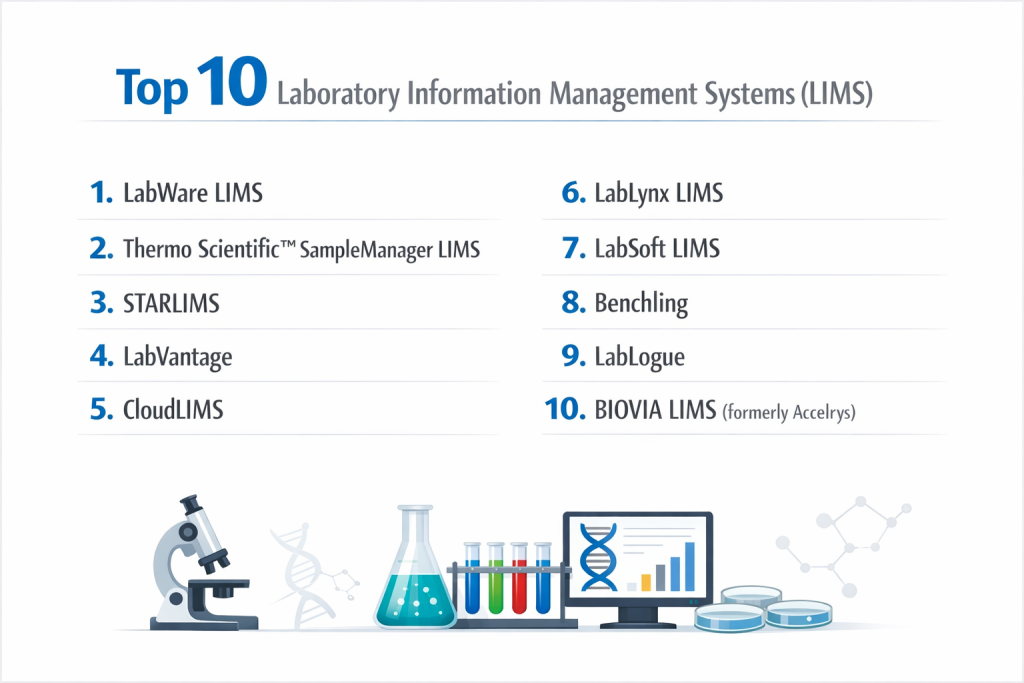
Top 10 Laboratory Information Management Systems (LIMS)
Here is a detailed look at ten of the most capable and widely-used LIMS platforms in the scientific community today.
1 — LabWare LIMS
LabWare LIMS is one of the most established and powerful enterprise-grade platforms. It is known for its extreme configurability and suitability for the most complex, high-volume laboratory environments.
Key features:
- Unmatched Configurability: Uses a “configuration, not coding” approach with visual tools (CARE) to adapt the system to highly specific workflows without traditional programming.
- Integrated ELN & LES: Natively includes a full Electronic Lab Notebook (ELN) and Laboratory Execution System (LES) within the same database.
- Enterprise Deployment: Supports both on-premise and cloud (LabWare 7 SaaS) deployments, scaling to global, multi-site organizations.
- Advanced Instrument Integration: Robust tools for bidirectional communication with a vast array of lab instruments and automation systems.
- Comprehensive Compliance Framework: Built-in features for 21 CFR Part 11, EU Annex 11, GLP, and GMP, including full audit trails and electronic signatures.
- Powerful Analytics & Dashboards: Includes the “Twister” analytics engine for real-time dashboards and business intelligence.
Pros:
- Virtually Limitless Customization: Can model almost any laboratory process, making it a fit for unique, complex operations.
- Single-Platform Unity: The integrated LIMS/ELN/LES eliminates data silos and provides a unified user experience.
- Proven Enterprise Track Record: Trusted by the world’s largest pharmaceutical, chemical, and environmental labs.
Cons:
- High Cost & Long Implementation: The total investment (software, services, training) is significant, with implementations often taking 12+ months.
- Requires Expert Configuration: Realizing its potential demands skilled in-house administrators or costly professional services.
- Can Be Overwhelming: The breadth and depth of features can be excessive for small or mid-sized labs with simpler needs.
Security & compliance: Enterprise-grade security. Offers robust data encryption, detailed audit logs, and supports SSO. Designed and validated for the strictest regulatory environments (FDA, EMA). SOC 2 reports and GDPR compliance are standard.
Support & community: Provides global 24/7 support with dedicated client managers for large enterprises. Offers extensive training (LabWare University) and hosts a large annual user conference with a very active community.
2 — Thermo Scientific™ SampleManager LIMS
Thermo Scientific SampleManager LIMS is a pillar of the industry, known for its robustness, scientific depth, and strong out-of-the-box functionality for process and quality control labs.
Key features:
- Strong Vertical Solutions: Offers pre-configured templates and workflows for key industries like pharmaceuticals, food & beverage, and environmental monitoring.
- Integrated SDMS: Includes a Scientific Data Management System (SDMS) to automatically capture, parse, and store raw data files from instruments.
- Workflow-Driven Design: Visual workflow editor allows labs to map and automate their exact testing procedures, ensuring consistency.
- Advanced Stability Management: Excellent module for managing complex stability studies, including chamber management and pull schedules.
- Thermo Fisher Ecosystem Integration: Seamlessly connects with other Thermo Fisher hardware and software, like chromatography data systems (CDS).
- Scalable Architecture: Available for on-premise, cloud (SaaS), and hybrid deployments to suit different IT policies.
Pros:
- Industry-Specific Strength: Delivers significant value quickly for labs in its core vertical markets.
- Excellent Data Integrity Tools: The integrated SDMS is a major advantage for labs drowning in instrument data files.
- Reliable and Performant: Known for handling high transaction volumes with stability and speed.
Cons:
- Expensive Licensing Model: Carries a premium price tag reflective of its enterprise positioning.
- Complexity for Simple Labs: Can feel heavyweight and require considerable administrative overhead for straightforward testing labs.
- Vendor-Lock in Potential: Deep integration with the Thermo Fisher ecosystem can make alternative instrument choices more complex.
Security & compliance: Meets highest regulatory standards (21 CFR Part 11, GxP). Provides comprehensive audit trails, e-signatures, and role-based security. Cloud offerings include SOC 2 Type II certification and GDPR compliance.
Support & community: Backed by Thermo Fisher’s global service organization. Offers tiered support plans, validated installation services, and a well-established user group network.
3 — STARLIMS
STARLIMS is a modern, web-native LIMS platform built on a unified technology stack. It emphasizes a streamlined user experience, flexibility, and strong life sciences capabilities.
Key features:
- 100% Web-Based Architecture: Zero client installation; accessible from any modern browser, simplifying deployment and updates.
- XFD Designer: A powerful, drag-and-drop interface for building custom applications, forms, and workflows without coding.
- Advanced Analytics Platform: Features a built-in, self-service analytics and visualization engine (LIMS Analytics) with role-based dashboards.
- Strong Life Sciences Focus: Robust functionality for clinical research, biobanking, and genomics, alongside traditional QC labs.
- Mobile & Offline Capable: Supports data collection on mobile devices, even in environments with intermittent connectivity.
- Unified Platform (LIMS/ELN): Offers a seamlessly integrated ELN module on the same platform, promoting data continuity.
Pros:
- Excellent User Experience: The clean, intuitive web interface reduces training time and improves user adoption.
- Rapid Application Development: The XFD tool empowers labs to build and modify forms and workflows quickly in response to changing needs.
- Built for Modern IT: The web-native, SaaS-ready architecture aligns with current IT preferences for cloud and easy maintenance.
Cons:
- Can Require Internal Expertise: While configurable, maximizing the XFD tool’s potential benefits from having a power-user or analyst on staff.
- Pricing Can Be Opaque: As an enterprise solution, pricing often requires a custom quote, making initial comparisons difficult.
- Less Legacy Market Penetration: While growing, it has a smaller install base in traditional heavy industries than some older platforms.
Security & compliance: Designed with data security as a core principle. Includes full audit trails, e-signatures, and configurable security policies. Its cloud deployment is SOC 2 compliant and adheres to GDPR, HIPAA (for clinical data), and 21 CFR Part 11.
Support & community: Provides global support with regional centers. Known for strong professional services for implementation. Maintains an active user community with annual symposiums.
4 — LabVantage
LabVantage is a comprehensive, flagship LIMS known for its breadth of functionality and strong position in the biobanking, clinical, and pharmaceutical markets.
Key features:
- Sapphire Configuration Toolset: A comprehensive suite of tools for administrators to configure screens, workflows, and business rules without coding.
- Industry-Specific Editions: Offers tailored solutions for Biobanking & Biospecimen Management, Pharma & Biotech, and Clinical Diagnostics.
- Integrated ELN & LES: Provides fully unified LIMS, ELN, and LES capabilities on a single platform.
- Advanced Biobanking: Specialized modules for managing complex freezer inventories, patient cohorts, consent, and aliquot derivatives.
- Enterprise Scalability: Supports large, multi-site, multi-tenant deployments with centralized management.
- Analytics & Reporting: Includes the “Insights” dashboarding and reporting module for real-time operational intelligence.
Pros:
- Deep Industry Specialization: Its pre-configured editions can dramatically accelerate implementation for target industries.
- Unified Informatics Platform: The combination of LIMS/ELN/LES in one system breaks down workflow barriers.
- Strong Track Record in Pharma/Biobanking: A market leader in these scientifically complex and compliance-heavy domains.
Cons:
- Enterprise-Level Cost: Positioned as a premium solution with corresponding investment in software and services.
- Implementation Complexity: Realizing its full potential often involves a substantial implementation project with consultancy.
- May Be Over-Featured for QC Labs: Some traditional quality control labs may find its extensive feature set more than they need.
Security & compliance: Enterprise-grade security framework. Features comprehensive audit trails, electronic signatures, and supports regulatory standards like 21 CFR Part 11, CLIA, CAP, and GDPR. Offers both cloud (SaaS) and on-premise deployment.
Support & community: Offers 24/7 global support and dedicated client success management. Hosts a major annual user conference (LVUG) and maintains specialized Special Interest Groups (SIGs) for different industries.
5 — CloudLIMS
CloudLIMS is a true, zero-infrastructure SaaS LIMS built specifically for the cloud. It caters to biobanks, clinical, research, and testing labs looking for a fast, affordable startup.
Key features:
- 100% SaaS, No Hardware: Entirely cloud-hosted with no software to install or servers to manage; labs can be operational in days.
- Affordable Subscription Model: Straightforward, predictable monthly or annual pricing based on users and storage, with a low total cost of entry.
- Out-of-the-Box Biobanking: Comes pre-configured with biospecimen management workflows, including barcode labeling, freezer management, and consent tracking.
- Built-In Compliance: Designed with compliance (CLIA, HIPAA, GDPR, 21 CFR Part 11) as a core feature, including audit trails and e-signatures.
- Client & Portal Access: Allows lab clients to submit requests, track sample status, and download reports through a branded portal.
- Mobile Accessibility: Fully responsive design allows access and data entry from tablets and smartphones.
Pros:
- Rapid Deployment & Low Overhead: The fastest path to a fully functional LIMS with minimal IT involvement or upfront cost.
- True Pay-as-You-Go: Converts a large capital expenditure into a predictable operating expense, ideal for startups and growing labs.
- Excellent for Biobanks & Startups: Its focus and pricing model are perfectly aligned with the needs of modern biobanks and small research organizations.
Cons:
- Limited Customization: As a multi-tenant SaaS product, deep, low-level customization of the core software is not possible.
- Internet Dependency: Requires a reliable internet connection for all access, which can be a constraint in some environments.
- Less Suitable for Heavy Industry: May lack the extreme configurability and depth required for complex petrochemical or metallurgy labs.
Security & compliance: Built on secure AWS infrastructure with data encryption at rest and in transit. Complies with HIPAA, GDPR, and 21 CFR Part 11. Provides SOC 2 Type II audit reports to clients.
Support & community: Provides customer success management and support directly from the vendor. Being a younger company, its user community is smaller but growing, with virtual user meetings.
6 — LabLynx LIMS
LabLynx offers a flexible approach, providing both a fully-managed cloud ELab LIMS and an on-premise option (LabLynx LIMS). It is known for its configurability and strong support for public health and environmental labs.
Key features:
- Hybrid Deployment Options: Choose between the cloud-hosted, managed ELab LIMS or a traditional on-premise installation.
- Visual Workflow Configurator: Includes tools for labs to design and modify their own workflows and data entry screens.
- Strong NELAP & Environmental Support: Has specific functionality and reporting for environmental labs complying with NELAC standards.
- Integrated Instrument Interfacing: Provides tools and services to connect a wide variety of lab instruments for automated data capture.
- Customer Portal & Billing: Includes modules for client self-service, reporting, and integrated billing management.
- Industry Templates: Offers pre-configured setups for environmental, water/wastewater, manufacturing, and public health.
Pros:
- Deployment Flexibility: The choice between cloud and on-premise allows labs to match their IT strategy and compliance needs.
- Good Value for Public/Environmental Labs: Its focus on this sector provides relevant features at a competitive price point.
- Strong Customer Support: Often praised for responsive and helpful technical support and services.
Cons:
- Brand Recognition: Less widely known on a global scale compared to the industry giants, which can be a factor for large multinationals.
- Interface Can Feel Dated: Some users note that the visual design of the interface is functional but not as modern as some web-native competitors.
- Variable Implementation Experience: Success can depend heavily on the specific project team and scope definition.
Security & compliance: For its cloud ELab LIMS, it manages security on AWS/GCP with data encryption and audit trails. Compliant with 21 CFR Part 11, HIPAA, and NELAC standards as required. On-premise security is the lab’s responsibility.
Support & community: Offers direct support from the company. Provides training and has a user community, particularly strong among its public health and environmental clients.
7 — LabSoft LIMS
LabSoft LIMS is a cost-effective, user-friendly system often favored by small to mid-sized commercial testing labs, particularly in the environmental and food safety sectors.
Key features:
- Affordable Pricing Model: Positioned as a more accessible LIMS with competitive licensing and maintenance costs.
- Streamlined Interface: Designed to be intuitive for technicians, focusing on the core tasks of sample login, result entry, and reporting.
- Comprehensive Reporting Engine: Features a flexible report writer to generate certificates of analysis (CoAs) and custom reports.
- Basic Instrument Integration: Supports connecting to common lab instruments for automated data upload.
- Workflow & COA Templates: Comes with pre-built templates for common lab workflows and industries to speed setup.
- Client Management Tools: Includes features for managing client information, pricing, and portal access.
Pros:
- Lower Cost of Entry: Makes LIMS automation feasible for smaller labs with tighter budgets.
- Ease of Use & Quick Training: Staff can often become proficient with minimal formal training, speeding adoption.
- Strong Core Functionality: Covers the essential needs of a commercial testing lab effectively without unnecessary complexity.
Cons:
- Limited Advanced Features: Lacks the depth in stability management, advanced biobanking, or complex R&D workflows of enterprise systems.
- Less Customizable: While configurable, it does not offer the near-infinite customization of platforms like LabWare.
- Scalability for Large Enterprises: May not be the ideal choice for a globally distributed organization with thousands of users.
Security & compliance: Provides standard security features like user roles and audit trails. Can be configured for 21 CFR Part 11 compliance. Specific high-level certifications (SOC 2) are less commonly highlighted, reflecting its target market.
Support & community: Support is provided directly by the company. Its community is comprised mainly of its installed base of small to mid-sized testing labs.
8 — Benchling
Benchling is a modern, cloud-native informatics platform that began as an ELN for molecular biology and has expanded into a unified R&D cloud with strong LIMS capabilities for biologics development.
Key features:
- Intuitive, Modern User Interface: A clean, consumer-grade interface designed specifically for scientists, with a focus on biology-aware tools.
- Unified R&D Platform: Combines ELN, LIMS, molecular biology tools (sequence editor, plasmid mapping), and data analytics in one connected system.
- Biologics-First Design: Deep functionality for managing biologics workflows: cell line development, protein engineering, and reagent tracking.
- Powerful Collaboration Tools: Built for cross-functional and external (CRO) collaboration with fine-grained sharing permissions.
- API-First Architecture: Offers a robust REST API for easy integration with other lab software and automation.
- Registry & Inventory: Flexible biomaterial and inventory registries to track plasmids, cell lines, samples, and chemicals.
Pros:
- Exceptional Scientist Adoption: Its user-centric design leads to high enthusiasm and voluntary use by researchers.
- Ideal for Biotech R&D: Perfectly aligns with the data and workflow needs of modern biotech and pharma R&D teams.
- Rapid Innovation Pace: As a cloud-native SaaS, it deploys new features frequently without customer effort.
Cons:
- Less Suitable for Routine QC/Production Labs: Its strengths are in R&D, not high-volume, repetitive quality control testing.
- Can Be Expensive for Small Teams: Pricing, while subscription-based, can be significant for very small startups.
- Evolving LIMS Maturity: While its LIMS functionality is strong and growing, it may not have the decades of refinement in complex sample management found in traditional LIMS leaders.
Security & compliance: Enterprise-grade security on AWS. SOC 2 Type II, ISO 27001 certified, and compliant with 21 CFR Part 11, HIPAA, and GDPR. Designed for IP protection in collaborative environments.
Support & community: Provides dedicated customer success managers. Fosters a very active user community through its annual “Benchling Momentum” conference and specialized interest groups.
9 — LabLogue
LabLogue is a straightforward, web-based LIMS aimed at small to medium-sized laboratories seeking an uncomplicated and affordable path to digital management.
Key features:
- Simple Web-Based Access: Requires only a browser, with no complex client software to install.
- Quick Setup & Templated Workflows: Designed for rapid deployment with pre-built templates for common lab types.
- Core Sample & Test Management: Handles the fundamental lifecycle of samples, tests, results, and reporting.
- Basic Instrument Connectivity: Supports integration with instruments for direct data capture.
- Client Reporting Portal: Allows external clients to view status and results online.
- Affordable Subscription Pricing: Offers tiered monthly subscriptions based on users and features.
Pros:
- Low Barrier to Entry: One of the most cost-effective ways for a small lab to implement a true LIMS.
- Simplicity and Speed: Focuses on doing the essential tasks well without overwhelming users with options.
- Managed Cloud Service: The vendor handles all updates, backups, and server maintenance.
Cons:
- Limited Functionality: Does not include advanced modules for stability, biobanking, or complex workflow automation.
- Minimal Customization: Offers limited ability to deeply alter data models or processes to fit unique needs.
- Not for Regulated Enterprises: While it has audit trails, it may not meet the stringent validation requirements of highly regulated pharma manufacturing.
Security & compliance: As a cloud SaaS, it employs standard security practices like encryption and backups. It supports basic audit trails but is not typically positioned for validated 21 CFR Part 11 environments.
Support & community: Support is provided directly by the company via email and phone. Its user base consists of smaller commercial and research labs.
10 — BIOVIA LIMS (formerly Accelrys)
BIOVIA LIMS is part of the Dassault Systèmes 3DEXPERIENCE platform, offering deep integration with process modeling, cheminformatics, and formulation design, particularly strong in chemicals and materials science.
Key features:
- Enterprise Process Integration: Part of a broader platform that connects lab data with process development, scale-up, and manufacturing (Industry 4.0).
- Materials & Formulation Science: Strong capabilities for managing complex material specifications, formulations, and test data.
- Advanced Analytics & Modeling: Integrates with BIOVIA’s data science and predictive modeling tools for materials and chemicals.
- Compliance & Quality Management: Robust features for GMP/GLP environments, including deviations, CAPA, and change control.
- Cross-Disciplinary Collaboration: Facilitates data sharing and workflow coordination across R&D, QC, and manufacturing within a unified platform.
- Scalable Deployment: Supports large, global deployments across research and production sites.
Pros:
- Unified R&D to Manufacturing View: Exceptional for companies wanting to close the loop between lab innovation and production.
- Deep Domain Science for Materials/Chemicals: Offers specialized functionality that generic LIMS cannot match.
- Part of a Strategic Platform: Enables digital continuity beyond the lab, supporting broader digital transformation goals.
Cons:
- Extremely Complex & Expensive: Represents a major strategic investment and one of the most complex systems to implement.
- Overkill for Testing-Only Labs: Its value is unlocked when integrated into the broader product lifecycle; standalone, it may be excessive.
- Steep Learning Curve: Requires significant training and organizational change management to adopt effectively.
Security & compliance: Enterprise-level security as part of the Dassault Systèmes ecosystem. Designed for compliance in highly regulated industries (FDA, EMA). Offers detailed audit trails, electronic signatures, and validation support.
Support & community: Supported by Dassault Systèmes’ global services organization. Access to a community of enterprise users, particularly in pharmaceutical, chemical, and consumer goods industries.
Comparison Table
| Tool Name | Best For | Platform(s) Supported | Standout Feature | Rating |
|---|---|---|---|---|
| LabWare LIMS | Large, complex enterprises needing max customization | Client-Server, Cloud (v7) | “Configure, don’t code” flexibility & integrated ELN/LES | 4.5/5 |
| Thermo Scientific SampleManager | Process & QC labs in Pharma, Food, Enviro | Client-Server, Cloud (SaaS) | Industry templates & integrated SDMS | 4.6/5 |
| STARLIMS | Modern labs wanting a web-native, configurable platform | Web (SaaS, On-prem) | Visual app designer (XFD) & strong analytics | 4.4/5 |
| LabVantage | Pharma R&D, Biobanking, Clinical Diagnostics | Web (SaaS, On-prem) | Industry-specific editions & unified platform | 4.5/5 |
| CloudLIMS | Biobanks, Startups, Clinical labs wanting pure SaaS | Web (SaaS only) | Zero-infrastructure, fast startup for biobanking | 4.2/5 |
| LabLynx LIMS | Public Health & Environmental labs (NELAP) | Web (SaaS, On-prem) | Environmental focus & deployment flexibility | 4.0/5 |
| LabSoft LIMS | Small-Mid sized commercial testing labs | Client-Server, Cloud | Cost-effective core functionality & ease of use | 3.9/5 |
| Benchling | Biotech R&D, Molecular Biology labs | Web (SaaS only) | Unified R&D Cloud with biologist-friendly tools | 4.7/5 |
| LabLogue | Small labs needing simple, affordable LIMS | Web (SaaS only) | Straightforward setup & low-cost subscription | 3.7/5 |
| BIOVIA LIMS | Chemicals, Materials Science, connected Manufacturing | Client-Server, Cloud | Integration with process & formulation science | 4.5/5 |
Evaluation & Scoring of Laboratory Information Management Systems (LIMS)
To find the right system, weigh its performance in these key areas based on your lab’s priorities.
| Evaluation Category | Weight | What to Look For | Top Performer Example |
|---|---|---|---|
| Core Features | 25% | Sample/test lifecycle, workflow automation, instrument integration, reporting, and fit for your science (e.g., biobanking, stability). | LabWare, LabVantage |
| Ease of Use | 15% | Intuitive interface for scientists and techs, minimal training required, reduces manual data entry errors. | Benchling, CloudLIMS |
| Integrations & Ecosystem | 15% | API strength, pre-built instrument drivers, connectivity to CDS, ERP, MES, and other lab software. | Thermo SampleManager, BIOVIA |
| Security & Compliance | 10% | Audit trails, e-signatures, data encryption, support for 21 CFR Part 11, GxP, HIPAA, GDPR. | All Major Enterprise (LabWare, Thermo, etc.) |
| Performance & Reliability | 10% | System uptime, speed with high data volumes, ability to support multi-site operations. | STARLIMS, Thermo SampleManager |
| Support & Community | 10% | Quality of vendor support, training availability, active user community for shared knowledge. | LabWare, LabVantage |
| Price / Value | 15% | Total cost (license, implementation, support) relative to features delivered and ROI (time saved, errors reduced). | CloudLIMS, LabSoft |
Which Laboratory Information Management System (LIMS) Is Right for You?
Your choice depends on your lab’s type, size, primary function, and regulatory environment.
- Startups & Small Research Labs (Biotech Focus): You need speed, collaboration, and R&D tools. Benchling is the ideal modern platform. CloudLIMS is excellent for sample-focused startups or biobanks.
- Small to Mid-Sized Commercial Testing Labs: You need affordability and core efficiency. LabSoft LIMS or LabLogue provide essential functionality. LabLynx is a strong choice for environmental testing.
- Mid-Market to Large Enterprises (Pharma, Biotech, Chemicals): You need depth, compliance, and scalability. LabVantage (for pharma/biobanking), Thermo SampleManager (for QC), STARLIMS (for a modern web platform), and LabWare (for maximum customization) are the top contenders.
- Academic & Core Facilities: Balance cost with functionality. A well-supported CloudLIMS or LabLynx instance can work well. Benchling is gaining traction in academia for its user-friendly biology tools.
- Heavy Industry & Materials Science: You need integration with process data. BIOVIA LIMS is the specialized choice for chemicals and materials. LabWare can also be configured for these complex environments.
Budget-conscious vs. premium solutions: LabLogue and LabSoft offer low-cost entry points. CloudLIMS and STARLIMS provide modern SaaS value. LabWare, LabVantage, and BIOVIA represent major strategic investments for large enterprises.
Feature depth vs. ease of use: LabWare and BIOVIA offer immense depth for experts. Benchling and CloudLIMS prioritize an intuitive, task-oriented experience that scientists love.
Integration and scalability needs: If seamless integration with a specific instrument vendor (Thermo Fisher) is critical, that’s a strong point for SampleManager. For scaling in the cloud, STARLIMS and CloudLIMS are built for it. For global multi-site deployments, LabVantage and LabWare are proven.
Security and compliance requirements: All major enterprise systems are built for validated environments (21 CFR Part 11). For clinical data (HIPAA), ensure your choice (LabVantage, CloudLIMS, Benchling) explicitly supports it. SaaS providers should provide SOC 2 reports.
Frequently Asked Questions (FAQs)
1. What is the difference between a LIMS and an ELN?
A LIMS is sample-centric, tracking physical samples and their associated test results through a workflow. An ELN is experiment-centric, replacing the paper notebook to capture the intellectual process, procedures, and observations. Modern platforms often combine both.
2. How long does a typical LIMS implementation take?
It ranges from a few weeks for a simple SaaS system like CloudLIMS using default templates, to 12-24 months for a full-scale, validated implementation of an enterprise system like LabWare at a global pharmaceutical company.
3. Can a LIMS help us become compliant with FDA 21 CFR Part 11?
Yes, a validated LIMS provides the technical controls (audit trails, e-signatures, security) required. However, the lab must also establish and follow the corresponding procedural controls (SOPs) to achieve full compliance.
4. What is the biggest cost in a LIMS project?
For enterprise systems, the cost of professional services (consulting, configuration, validation) often far exceeds the initial software license fee. For SaaS systems, the subscription fee is the primary, predictable cost.
5. Should we choose an on-premise or cloud (SaaS) LIMS?
Cloud (SaaS) offers lower upfront cost, automatic updates, and no server maintenance. On-premise may be required for air-gapped labs, specific data sovereignty laws, or labs with existing IT infrastructure they prefer to use. Hybrid models also exist.
6. How do we handle instrument integration?
Modern LIMS offer middleware, direct drivers, or file parsers. The best approach depends on the instrument’s age and connectivity options. Vendors often have pre-built interfaces for common instruments.
7. Can we customize the system ourselves after go-live?
It depends on the platform. Systems like LabWare (CARE) and STARLIMS (XFD) empower admins to make changes. Highly configurable SaaS systems like Benchling also allow customization. Others may require vendor assistance for significant changes.
8. What happens to our data if we switch LIMS vendors in the future?
Data migration is standard but can be complex and expensive. Ensure your contract includes rights to your data in an accessible format (e.g., CSV, SQL). Vendor lock-in is a real risk with highly customized systems.
9. Is a LIMS only for huge labs?
No. The rise of affordable, user-friendly SaaS LIMS like CloudLIMS and LabLogue has made automation accessible to labs of all sizes, delivering ROI even with a handful of users.
10. What’s the #1 mistake labs make when selecting a LIMS?
Choosing a system based on a feature checklist without considering the daily user experience for scientists and technicians. Poor adoption by end-users will doom any implementation, regardless of the system’s power.
Conclusion
Selecting a Laboratory Information Management System is a pivotal decision that impacts your lab’s efficiency, data integrity, compliance, and ultimately, its scientific output. The market offers a diverse range of solutions, from the accessible simplicity of LabLogue to the R&D-focused brilliance of Benchling, and from the industry-specific power of Thermo SampleManager to the nearly limitless configurability of LabWare.
The critical insight is that there is no universally “best” LIMS. The optimal choice is the one that aligns precisely with your laboratory’s primary mission—whether it’s high-throughput quality control, groundbreaking biotech research, complex biobanking, or materials innovation.
Success hinges on aligning the system’s core strengths with your lab’s unique workflows, compliance needs, user skills, and growth trajectory. By focusing on these fundamentals rather than just a list of features, you can implement a LIMS that doesn’t just store data, but actively transforms your laboratory into a more productive, compliant, and data-driven organization. This strategic investment lays the digital foundation for scientific excellence for years to come.