Introduction
KYC (Know Your Customer) and AML (Anti-Money Laundering) Compliance Tools are digital platforms designed to verify the identities of clients and monitor their financial activities for suspicious behavior. In the modern financial ecosystem, these tools act as a high-tech filter, ensuring that businesses do not inadvertently facilitate money laundering, terrorism financing, or fraud. KYC focuses on the “onboarding” phase—verifying that a person is who they say they are using ID documents and biometrics—while AML is an ongoing process that scans global watchlists and monitors transactions for red flags.
The importance of these tools has skyrocketed as global regulators impose multi-billion dollar fines on firms with weak oversight. Beyond avoiding legal penalties, these platforms protect a company’s reputation and provide a smoother experience for legitimate users. By automating the heavy lifting of data cross-referencing against thousands of government databases and “Sanctions Lists,” these tools allow compliance teams to focus on investigating actual threats rather than manually typing names into search engines.
Key Real-World Use Cases
- Digital Banking Onboarding: Allowing a customer to open a bank account in minutes by taking a selfie and a photo of their passport.
- Crypto Exchange Verification: Ensuring that users trading digital assets are not on international “Prohibited Persons” lists.
- Real Estate Transaction Screening: Verifying the source of funds for high-value property purchases to prevent the “washing” of criminal cash.
- Ongoing Transaction Monitoring: Automatically flagging a sudden $50,000 transfer from an account that usually only moves $500.
- Politically Exposed Persons (PEP) Screening: Identifying if a new client holds a high-ranking government position, which requires a higher level of scrutiny (Enhanced Due Diligence).
What to Look For (Evaluation Criteria)
When choosing a tool, prioritize Verification Accuracy (low false-positive rates) and Global Coverage. A tool is only useful if it can read IDs from the specific countries where you do business. Furthermore, look for Seamless API Integration—the tool should work inside your app, not force customers to visit a separate website. Finally, Explainable AI is critical; if a user is rejected, your compliance officer needs to know exactly why.
Best for:
These tools are most beneficial for Compliance Officers, MLROs (Money Laundering Reporting Officers), and Fintech Founders. They are essential for banks, neo-banks, crypto platforms, gambling sites, and high-end law or real estate firms.
Not ideal for:
Small local businesses with physical “walk-in” customers and no online presence. If you run a local coffee shop or a small retail boutique, the high cost and complexity of these enterprise-grade compliance suites would be unnecessary.
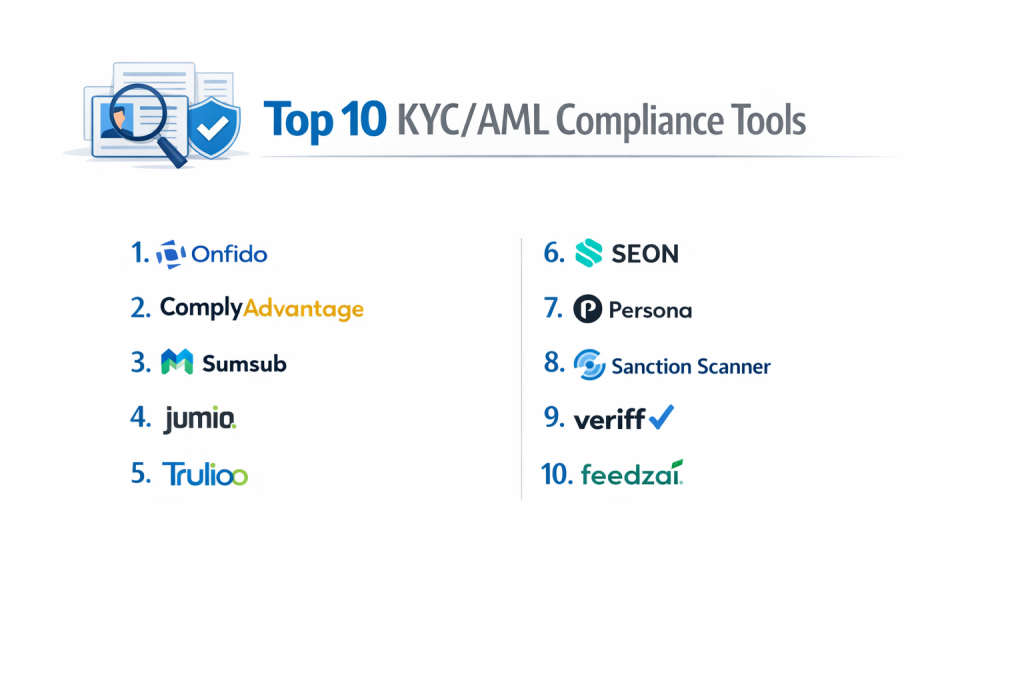
Top 10 KYC/AML Compliance Tools
1 — Onfido
Onfido is a global leader in AI-powered identity verification. It is designed for businesses that need to scale fast while keeping the “onboarding friction” for customers as low as possible.
- Key features:
- Document verification supporting over 2,500 document types from 195 countries.
- Biometric “liveness” testing to ensure the person is physically present.
- AI-based fraud detection that spots sophisticated digital forgeries.
- Customizable “Smart Capture” SDK for mobile and web.
- Automated “Known Faces” check to prevent duplicate accounts.
- Workflow orchestration to automate different rules for different regions.
- Pros:
- Excellent user experience; the selfie-capture process is very smooth.
- Highly reliable AI that significantly reduces the need for manual ID review.
- Cons:
- Can be expensive for low-volume startups.
- The automated system can occasionally be “too strict” with poor-quality photos.
- Security & compliance: SOC 2 Type II, ISO 27001, and GDPR compliant; uses high-tier data encryption.
- Support & community: Dedicated account managers for enterprise clients and comprehensive developer documentation.
2 — ComplyAdvantage
ComplyAdvantage provides a real-time database of people and companies that pose financial crime risks. It is built for firms that need the most up-to-date AML data in the world.
- Key features:
- Real-time AML data feed for Sanctions, PEPs, and Adverse Media.
- Automated transaction monitoring with customizable alert rules.
- “Adverse Media” screening that uses AI to read news stories globally.
- Case management tool for investigating flagged individuals.
- Batch screening for checking an entire database at once.
- Integration-ready REST API for seamless data flow.
- Pros:
- Their proprietary database updates every few minutes, not daily.
- Very flexible rule-building for transaction monitoring.
- Cons:
- The interface for manual case reviews can be data-heavy and complex.
- Does not offer the “Document/ID Verification” (KYC) hardware/software itself.
- Security & compliance: ISO 27001 and GDPR compliant; focused on high-integrity data sourcing.
- Support & community: Strong technical support and regular industry-leading reports on financial crime trends.
3 — Sumsub
Sumsub is an “all-in-one” verification platform that handles KYC, KYB (Know Your Business), and AML. It is particularly popular in the crypto and gambling industries.
- Key features:
- Integrated KYC/AML/KYB in a single dashboard.
- Liveness check and 3D face mapping.
- Proof of Address verification via automated document reading.
- Crypto-specific travel rule compliance tools.
- Video identification for high-risk jurisdictions.
- No-code workflow builder for compliance officers.
- Pros:
- Great “one-stop shop” for companies that don’t want to buy multiple tools.
- Very transparent pricing and easy self-service setup.
- Cons:
- Customer support response times can vary for smaller accounts.
- The mobile SDK is slightly heavier than some specialized competitors.
- Security & compliance: SOC 2 Type II, GDPR, and ISO 27001 compliant; data centers in various regions for residency.
- Support & community: Extensive online “Sumsub Academy” and reliable documentation for developers.
4 — Jumio
Jumio is one of the “founding fathers” of digital identity. It provides a highly robust, industrial-strength platform for large banks and enterprises.
- Key features:
- Advanced “KYX” platform for identity, risk, and compliance.
- Automated ID verification with human-in-the-loop backup.
- Fully automated AML screening against global watchlists.
- Orchestration layer to manage multiple third-party data sources.
- Transaction monitoring with AI-driven behavioral signals.
- High-fidelity biometric authentication for returning users.
- Pros:
- Massive global footprint and experience with “Tier 1” banks.
- The hybrid AI + Human review option ensures almost 100% accuracy.
- Cons:
- Can feel “legacy” and clunky compared to newer SaaS competitors.
- Implementation takes longer due to the depth of the platform.
- Security & compliance: PCI-DSS Level 1, SOC 2, and GDPR compliant; high-tier banking security.
- Support & community: Large global support team and extensive enterprise professional services.
5 — Trulioo
Trulioo specializes in “Identity Data.” Instead of just looking at an ID card, they connect to thousands of “trusted data sources” (like utility bills and government records) to verify users.
- Key features:
- Access to 450+ data sources to verify 5 billion people.
- Document verification for 11,000+ types of government IDs.
- Global Business Verification (KYB) for verifying company structures.
- “Watchlist” screening for AML compliance in real-time.
- Risk-based workflow triggers.
- Simple API that provides a single point of access to global data.
- Pros:
- Best-in-class for verifying people in countries where IDs are hard to come by.
- Strong capability for complex “Know Your Business” checks.
- Cons:
- The “Data-Only” verification can sometimes fail if credit bureau data is thin.
- Pricing is complex due to the different data sources used.
- Security & compliance: SOC 2 Type II and GDPR compliant; focuses heavily on data privacy.
- Support & community: Robust documentation and a dedicated customer success team for mid-market.
6 — SEON
SEON is a modern, “Fraud-First” compliance tool. It identifies risky users based on their “Digital Footprint”—things like social media profiles and IP addresses—before they even show their ID.
- Key features:
- Email and Phone “Social Lookup” to see 50+ social signals.
- Device fingerprinting to catch bot attacks.
- Fully transparent “Whitebox” machine learning rules.
- AML screening for PEPs and Sanctions integrated into the flow.
- Real-time data enrichment from open-source intelligence (OSINT).
- Chrome extension for manual “one-off” investigative checks.
- Pros:
- Catches fraud that standard KYC tools miss (like “synthetic identities”).
- Very affordable and modern; no-contract options are available.
- Cons:
- Not a standalone solution if you strictly need “Passport Scanning” (KYC).
- Requires a bit of technical skill to set up the most complex rules.
- Security & compliance: GDPR compliant; uses high-standard encryption for API calls.
- Support & community: Excellent chat support and a very proactive “fraud fighter” community.
7 — Persona
Persona is known for its high level of customization. It allows businesses to build “Identity Flows” that look and feel exactly like their own brand.
- Key features:
- Drag-and-drop workflow builder for the entire user journey.
- Automated ID and biometric verification.
- Integrated AML screening and database lookups.
- “Graph” tool to see how different suspicious accounts are connected.
- Case management for manual reviews and escalations.
- High-level automation for “re-verifying” users after a set time.
- Pros:
- The most flexible and “beautiful” UI in the industry.
- Very fast to implement for modern engineering teams.
- Cons:
- Can be more expensive than “utility” verification tools.
- Focuses more on the “Identity” side than the deep “AML Transaction” side.
- Security & compliance: SOC 2 Type II, HIPAA, and GDPR compliant; allows for fine-tuned data retention rules.
- Support & community: High-quality developer docs and very responsive email support.
8 — Sanction Scanner
Sanction Scanner is a specialized, cost-effective tool focused purely on the AML and “Screening” side of the compliance equation.
- Key features:
- Global Sanctions, PEP, and Adverse Media screening.
- Real-time transaction monitoring for banking and finance.
- Customer risk scoring based on custom parameters.
- Automated API for continuous background screening.
- Case management for auditing and reporting suspicious activity.
- Support for over 200 countries’ watchlists.
- Pros:
- Very specialized and efficient; it does one thing (AML) very well.
- One of the most affordable options for startups needing AML coverage.
- Cons:
- Does not include ID Document verification (KYC).
- Interface is functional but lacks the “slickness” of competitors.
- Security & compliance: GDPR compliant; focused on high-integrity regulatory data.
- Support & community: Direct support and a good library of AML-focused webinars.
9 — Veriff
Veriff is a tech-forward KYC provider that uses “Video First” technology to stop even the most sophisticated deepfakes and mask-based fraud.
- Key features:
- AI-driven video verification to catch “liveness” more accurately.
- Automated document reading for 10,000+ IDs.
- Real-time feedback for users if their photo is blurry.
- Advanced “Velocity” checks to see if an ID has been seen elsewhere.
- Integrated AML screening.
- “Assisted Image Capture” for non-tech-savvy users.
- Pros:
- Very strong security; almost impossible to “spoof” with a video/photo.
- Fast verification speeds (often under 10 seconds).
- Cons:
- Can be slightly more “friction-heavy” for users due to the video requirement.
- Pricing is on the higher end for small-volume businesses.
- Security & compliance: SOC 2 Type II and GDPR compliant; uses biometric data responsibly.
- Support & community: Top-rated customer service and clear integration guides.
10 — Feedzai
Feedzai is an enterprise “RiskOps” platform. It is designed for the world’s largest banks to manage Fraud, AML, and Compliance in one single, high-speed engine.
- Key features:
- AI-native transaction monitoring at massive scale.
- “Fair AI” to ensure no bias in compliance decisions.
- Integrated KYC and AML lifecycle management.
- Visual Link Analysis to find money laundering “rings.”
- AutoML that allows banks to build their own custom models.
- Real-time risk scoring for instant payments.
- Pros:
- The “gold standard” for speed and scale in high-volume banking.
- Unifies all compliance tasks into one single team view.
- Cons:
- Strictly for large enterprises; too complex for most startups.
- Extremely high cost of implementation.
- Security & compliance: ISO 27001, SOC 2, and GDPR compliant; meets global banking standards.
- Support & community: 24/7 global enterprise support and dedicated strategic consulting.
Comparison Table
| Tool Name | Best For | Platform(s) Supported | Standout Feature | Rating |
| Onfido | Fast-Growth Startups | Web / iOS / Android | AI Document Verification | 4.8/5 |
| ComplyAdvantage | Real-Time AML Data | API / Web | Global Sanctions Database | 4.5/5 |
| Sumsub | All-in-One Compliance | Web / Mobile SDK | No-Code Workflow Builder | 4.7/5 |
| Jumio | Large Banks | Web / Hybrid | AI + Human Review Hybrid | 4.3/5 |
| Trulioo | Global Data Coverage | API / Web | Access to 450+ Data Sources | 4.4/5 |
| SEON | Fraud Prevention | API / Chrome | Digital Footprint Analysis | 4.6/5 |
| Persona | Custom UX/UI | Web / Mobile SDK | Dynamic Workflow Orchestration | 4.8/5 |
| Sanction Scanner | Budget AML | API / Web | Affordable Sanctions Screening | 4.2/5 |
| Veriff | Stopping Deepfakes | Web / iOS / Android | Video-First Liveness Check | 4.7/5 |
| Feedzai | High-Volume Enterprise | Cloud / On-Prem | High-Speed “RiskOps” | 4.5/5 |
Evaluation & Scoring of KYC/AML Compliance Tools
| Criteria | Weight | Evaluation Method |
| Core features | 25% | Accuracy of ID scan, AML data depth, and liveness testing. |
| Ease of use | 15% | Customer onboarding speed and admin dashboard clarity. |
| Integrations | 15% | Quality of API documentation and native SDK support. |
| Security & compliance | 10% | Internal certifications (SOC 2, ISO) and data privacy focus. |
| Performance | 10% | Verification speed (latency) and system uptime. |
| Support & community | 10% | Responsiveness of help desk and developer resources. |
| Price / value | 15% | Cost-per-check vs. the manual labor saved. |
Which KYC/AML Compliance Tool Is Right for You?
Solo Users vs. SMB vs. Mid-Market vs. Enterprise
A solo user (like a freelance lawyer) might only need a simple, low-cost “one-off” tool like Sanction Scanner. SMBs and early-stage fintechs should look for Sumsub or SEON because they are easy to set up without a huge engineering team. Mid-Market firms looking for a balance of speed and brand control should prioritize Persona or Onfido. Large Enterprises and banks have no choice but to go with heavy-duty platforms like Jumio, Trulioo, or Feedzai to handle their massive data and regulatory needs.
Budget-Conscious vs. Premium Solutions
If you are on a tight budget, Sanction Scanner and Sumsub offer some of the most competitive entry-level pricing. If you are a premium brand where every second of the customer journey matters, a premium solution like Onfido or Veriff is worth the extra cost because their high “Auto-Pass” rates mean fewer customers get frustrated and quit.
Feature Depth vs. Ease of Use
If you need feature depth (like checking the “Ultimate Beneficial Owner” of a shell company in the Cayman Islands), you need Trulioo or ComplyAdvantage. If you just need ease of use to verify someone’s driver’s license for a scooter rental app, a tool like Persona or Sumsub is much more appropriate.
Integration and Scalability Needs
For companies that plan to grow from 1,000 to 1 million users, scalability is key. Ensure the tool you pick has a Global SDK that can handle local languages and IDs. Also, look for “Webhooks”—this allows the tool to automatically tell your backend when a user has been approved, so you don’t have to manually refresh a page.
Security and Compliance Requirements
This is the most critical part. If you handle European data, GDPR is non-negotiable. If you are a US-based financial firm, ensure the tool is SOC 2 Type II certified. For crypto firms, check if the tool supports the “Travel Rule.” Always ask where your customers’ sensitive biometric data is being stored and for how long.
Frequently Asked Questions (FAQs)
1. What is the difference between KYC and AML?
KYC (Know Your Customer) is the process of verifying a person’s identity (e.g., checking an ID card). AML (Anti-Money Laundering) is the broader set of rules used to stop criminals from moving money, which includes checking watchlists and monitoring transactions.
2. How long does a digital KYC check take?
In most modern platforms like Onfido or Veriff, the AI can verify an ID and a selfie in under 10–30 seconds.
3. Do these tools store my customers’ ID photos?
Most platforms allow you to choose. You can either have them store the data (acting as a secure vault) or have them delete it as soon as the check is finished. This is vital for GDPR compliance.
4. What is “Liveness Detection”?
This is a security feature that asks the user to move their head or blink to prove they are a real, living person and not just holding up a photo or a video of someone else.
5. Can these tools detect “Deepfakes”?
Advanced tools like Veriff and Onfido use AI to look for pixel patterns and “digital artifacts” that only appear in deepfake videos, helping to stop sophisticated identity theft.
6. Is manual review still necessary?
For about 80–90% of users, the AI handles everything. However, if an ID is blurry or a name is a “partial match” on a sanctions list, a human compliance officer will still need to make the final decision.
7. How much do these tools cost?
Pricing is usually “per check.” It can range from $0.50 to $3.00 per verification depending on your volume and the “depth” of the search (e.g., adding a liveness check or a PEP check increases the cost).
8. Can I use these tools for “Know Your Business” (KYB)?
Yes, tools like Trulioo and Sumsub have specific modules that can scan company registries to find out who actually owns a business (the Ultimate Beneficial Owner).
9. What happens if a customer is flagged?
The software will move the user into a “Pending” or “Rejected” state in your dashboard. Your team can then review the evidence and either ask the customer for more info or block them entirely.
10. What is “Adverse Media” screening?
This is a feature that scans global news and blogs to see if a potential client has been mentioned in connection with financial crimes, even if they aren’t on an official government sanctions list yet.
Conclusion
Choosing a KYC/AML compliance tool is a foundational decision for any modern business. The right platform doesn’t just “tick a box” for regulators; it serves as a silent partner that builds trust with your customers while guarding your front door against bad actors. There is no “perfect” tool—only the tool that fits your specific risk level, budget, and customer base.
When making your final choice, remember that the “Hidden Cost” of a cheap tool is often high manual labor and frustrated customers. By investing in a platform that balances Security and Compliance Requirements with a great user experience, you turn compliance from a hurdle into a competitive advantage.