Introduction
Knowledge Graph Construction Tools are specialized software solutions designed to transform disparate, often messy data into a unified network of interconnected entities and relationships. Unlike traditional databases that store data in flat tables, these tools identify “entities” (people, places, concepts) and the “edges” (relationships) that bind them, creating a machine-readable map of organizational intelligence. These tools often employ Natural Language Processing (NLP), machine learning, and semantic modeling to ingest structured data from SQL databases alongside unstructured data from PDFs, emails, and web pages, effectively “connecting the dots” that human analysts might miss.
The importance of these tools has skyrocketed in the era of Generative AI. For an AI to be truly useful, it needs context; knowledge graphs provide a stable, factual “source of truth” that grounds AI models, reducing hallucinations and enabling complex reasoning. By using these construction tools, organizations can build a “digital twin” of their collective knowledge, making information discoverable, traceable, and actionable across the entire enterprise.
Key Real-World Use Cases
- Fraud Detection: Linking seemingly unrelated transactions, IP addresses, and physical locations to uncover sophisticated crime rings.
- Drug Discovery: Connecting chemical compounds, genetic markers, and clinical trial results to predict the efficacy of new pharmaceutical treatments.
- Customer 360: Consolidating touchpoints from sales, support, and social media to create a holistic view of the customer journey.
- Supply Chain Optimization: Mapping dependencies between thousands of suppliers, logistics routes, and geopolitical risks to predict disruptions.
- Semantic Search: Powering internal search engines that understand intent and context rather than just matching keywords.
What to Look For (Evaluation Criteria)
When evaluating construction tools, look for Automated Entity Resolution—the ability to recognize that “Apple Inc.” and “Apple” are the same entity. Ontology Support is vital for defining the “grammar” of your graph. You should also prioritize Scalability, as graphs often grow exponentially, and Integration Capabilities, ensuring the tool can ingest data from your existing cloud and on-premise silos. Finally, consider Query Language Support (such as Cypher or SPARQL) to ensure your data science team can actually extract value from the constructed graph.
Best for: Data architects, AI researchers, and knowledge managers in large-scale enterprises or research institutions who need to unify vast amounts of complex, interconnected data for intelligence and automation.
Not ideal for: Small businesses with simple, linear data needs (e.g., a basic customer list) where a traditional relational database or even a spreadsheet would be more cost-effective and easier to maintain.
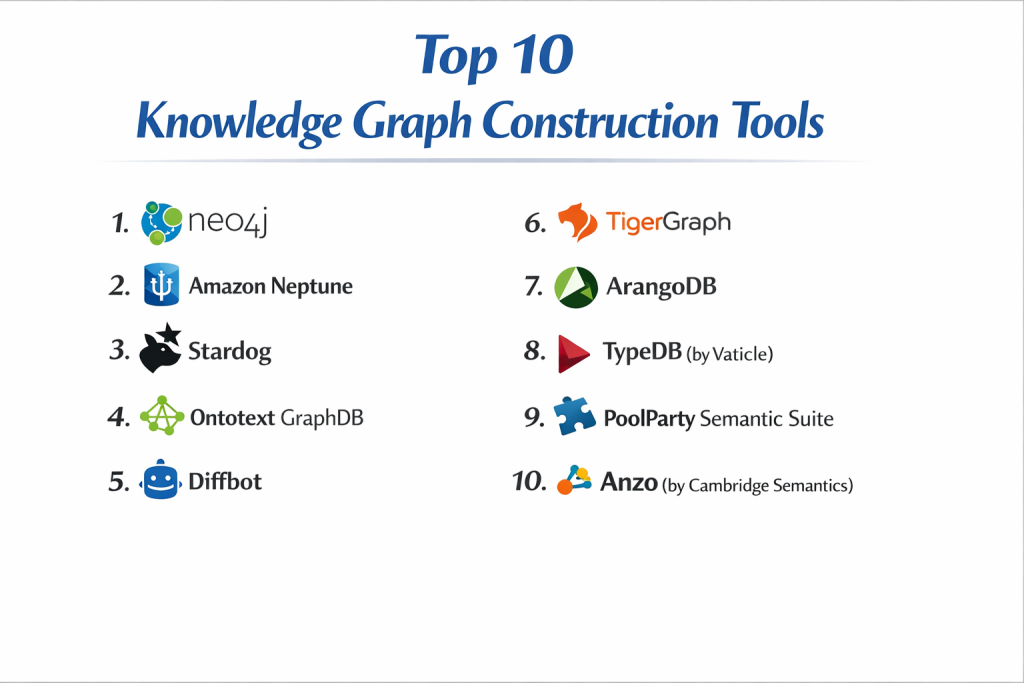
Top 10 Knowledge Graph Construction Tools
1 — Neo4j
Neo4j is widely considered the pioneer of the graph database world, offering a comprehensive ecosystem for both constructing and querying massive-scale property graphs.
- Key features:
- Cypher Query Language: An intuitive, industry-standard language for graph pattern matching.
- Neo4j Bloom: A visual exploration tool that allows non-technical users to “see” the graph.
- Graph Data Science (GDS) Library: Over 65 pre-built algorithms for pathfinding, community detection, and link prediction.
- AuraDB: A fully managed cloud service that removes the burden of infrastructure management.
- Native Graph Storage: Optimized from the ground up to store relationships as “first-class citizens.”
- Pros:
- Massive community and vast library of third-party integrations and plugins.
- Superior performance for deep, multi-hop traversals compared to relational systems.
- Cons:
- Can be resource-heavy (RAM-intensive) for very large datasets.
- The enterprise license can be quite expensive for mid-sized organizations.
- Security & compliance: SOC 2 Type II, GDPR, and HIPAA compliant; features role-based access control (RBAC) and encryption at rest/transit.
- Support & community: Industry-leading documentation, a massive “Neo4j Ninja” community, and 24/7 premium enterprise support.
2 — Amazon Neptune
Amazon Neptune is a fast, reliable, and fully managed graph database service that makes it easy to build and run applications that work with highly connected datasets.
- Key features:
- Multi-Model Support: Supports both Property Graphs (Gremlin/OpenCypher) and RDF (SPARQL).
- Serverless Option: Automatically scales graph workloads based on demand.
- High Availability: Automatically replicates data across three Availability Zones for 99.99% uptime.
- Neptune ML: Built-in machine learning capabilities for predicting missing links or classifying nodes.
- Fast Bulk Loading: Specialized APIs for ingesting billions of records from Amazon S3.
- Pros:
- Seamless integration with the broader AWS ecosystem (S3, Lambda, IAM).
- No need to manage server hardware, patching, or backups.
- Cons:
- Vendor lock-in; it is impossible to run Neptune outside of the AWS environment.
- Can become costly with high “I/O” rates if queries are not highly optimized.
- Security & compliance: Highly secure; integrated with AWS IAM, KMS (encryption), and VPC. Certified for ISO, PCI DSS, and HIPAA.
- Support & community: Backed by AWS enterprise support; extensive documentation but a smaller independent community than Neo4j.
3 — Stardog
Stardog is an “Enterprise Knowledge Graph” platform that excels at data unification through its unique “Virtual Graph” technology.
- Key features:
- Virtual Graphs: Query data in its original source (SQL, NoSQL) without moving or copying it.
- Logical Reasoning: Uses a built-in inference engine to discover new relationships based on defined rules.
- Semantic Search: Combines keyword search with graph-based context for high-precision results.
- Stardog Designer: A no-code visual interface for modeling ontologies and mapping data.
- GraphQL Support: Allows web developers to query the graph using standard GraphQL syntax.
- Pros:
- Best-in-class for “Data Fabric” use cases where moving data is impractical.
- Powerful reasoning capabilities that go far beyond simple “search.”
- Cons:
- Higher learning curve due to its heavy reliance on semantic web standards (RDF/OWL).
- Virtual queries can be slower than native graph queries depending on the source database.
- Security & compliance: SOC 2 compliant; supports Kerberos, LDAP, and fine-grained attribute-based access control (ABAC).
- Support & community: Excellent professional services and training; strong focus on enterprise customer success.
4 — Ontotext GraphDB
Ontotext GraphDB is a leading RDF database (triplestore) that focuses on semantic metadata management and high-performance reasoning.
- Key features:
- Inference Engine: High-speed, rule-based reasoning for automatic data enrichment.
- Text Analysis Integration: Built-in connectors for extracting entities from unstructured text.
- Elasticsearch Integration: Synchronizes with search engines for powerful full-text indexing.
- Visual Workbench: An easy-to-use web interface for managing data, queries, and users.
- Cluster Architecture: Supports high-availability clusters with zero data loss.
- Pros:
- Exceptionally stable and reliable for managing complex, multi-lingual ontologies.
- Strong alignment with W3C open standards, preventing vendor lock-in.
- Cons:
- The user interface for the free version is somewhat limited.
- SPARQL query optimization requires a higher degree of technical expertise.
- Security & compliance: Supports LDAP/Active Directory integration; GDPR compliant with robust audit logging.
- Support & community: Highly responsive technical support; comprehensive documentation and a dedicated developer forum.
5 — Diffbot
Diffbot takes a fundamentally different approach, providing a “Knowledge Graph as a Service” by using AI to crawl the entire public web.
- Key features:
- Automatic Data Extraction: AI-powered “vision” to turn web pages into structured data without scraping rules.
- Global Knowledge Graph: Access to billions of pre-extracted entities (people, companies, articles).
- Natural Language API: Identifies entities and relationships in your own uploaded text.
- Crawlbot: A scalable system for crawling and processing specific domains or the whole web.
- Enhance API: Automatically enriches your existing CRM or database with fresh web data.
- Pros:
- Eliminates the need to build the “construction pipeline” from scratch for public data.
- Incredibly fast to implement for market intelligence or lead generation.
- Cons:
- Less flexible for building “Private” knowledge graphs from internal sensitive documents.
- Pricing is based on a credit system which can be unpredictable for large crawls.
- Security & compliance: GDPR and CCPA compliant; emphasizes data privacy for its AI-extracted datasets.
- Support & community: 24/7 live representative support for enterprise tiers; active developer blog and API documentation.
6 — TigerGraph
TigerGraph is a “native” distributed graph database designed for massive parallel processing (MPP) of complex analytics on the largest datasets.
- Key features:
- GSQL Language: A Turing-complete, SQL-like language designed for complex graph analytics.
- Massive Scalability: Built to handle petabytes of data and trillions of relationships.
- Deep Link Analytics: Optimized for queries that go 10+ hops deep into the graph.
- Real-Time Updates: Can process millions of updates per second while serving queries.
- TigerGraph Insights: A low-code tool for building visual graph dashboards.
- Pros:
- Unmatched speed for deep, analytical queries on enterprise-scale datasets.
- Efficient storage compression, often reducing the hardware footprint.
- Cons:
- GSQL has a steeper learning curve than Cypher for those coming from a SQL background.
- The visual design tools are powerful but can be complex for casual users.
- Security & compliance: ACID compliant; includes RBAC, encryption, and is built for SOC 2 environments.
- Support & community: Growing community through the “Graph for All” initiative; dedicated enterprise account managers.
7 — ArangoDB
ArangoDB is a “multi-model” database that supports graphs, documents, and key-values in a single, unified engine.
- Key features:
- AQL (ArangoDB Query Language): A single language to query different data models together.
- ArangoGraph Insights Platform: A fully managed cloud service with advanced search capabilities.
- SmartGraphs: Automatically shards large graphs across a cluster to maintain performance.
- Pregel Framework: Built-in support for distributed graph processing (e.g., PageRank).
- Integrated Search: Native full-text search engine (ArangoSearch) for complex filtering.
- Pros:
- Reduces “architectural complexity” by using one database for multiple needs.
- Very easy to deploy and get started, with a developer-friendly community.
- Cons:
- While great at everything, it may not outperform specialized “graph-only” engines on extreme edge cases.
- Query optimization can be tricky when mixing document and graph models.
- Security & compliance: SOC 2 Type II, HIPAA, and GDPR compliant; features robust encryption and masking.
- Support & community: Very active Slack community and GitHub presence; responsive professional support.
8 — TypeDB (by Vaticle)
TypeDB is a “strongly-typed” database that uses a hyper-intelligent schema to manage complex data structures and reasoning.
- Key features:
- TypeQL Language: A near-natural language for defining schemas and querying data.
- Hyper-Relation Modeling: Unlike standard graphs, it allows relations to connect more than two entities.
- Built-in Inference: Automatically deduces new facts through its logic engine.
- Strong Typing: Prevents “garbage in” by enforcing a strict logical schema at the database level.
- Distributed Architecture: Engineered for horizontal scalability and high availability.
- Pros:
- The most powerful tool for modeling complex “nested” relationships and logical rules.
- Querying feels like writing English, making it accessible to domain experts.
- Cons:
- It is a “unique” system; skills are less transferable than Cypher or SPARQL.
- Smaller ecosystem of third-party connectors compared to Neo4j or AWS.
- Security & compliance: Enterprise version includes SSO, encryption, and audit logs.
- Support & community: Strong academic and research community; active Discord and high-quality documentation.
9 — PoolParty Semantic Suite
PoolParty is a world-class semantic middleware that specializes in taxonomy and ontology management for knowledge graphs.
- Key features:
- Taxonomy Management: Industry-leading tools for building and managing controlled vocabularies.
- Corpus Analysis: Uses AI to extract terms and concepts from your own document collections.
- Unified Semantic View: Connects data silos through a shared semantic layer.
- Recommender Engine: Uses graph context to provide personalized content recommendations.
- PPT (PoolParty Transformer): A powerful tool for transforming various data formats into RDF.
- Pros:
- Best-in-class for the “Human-in-the-loop” part of graph construction (governance).
- Excellent for highly regulated industries requiring precise terminology (e.g., Pharma).
- Cons:
- Focused on the “Semantic” layer; often needs to be paired with a separate database (like GraphDB).
- Enterprise-only pricing model with no low-cost entry point for small teams.
- Security & compliance: Heavily focused on security; SOC 2 compliant and used by global government agencies.
- Support & community: Exceptional professional services, “PoolParty Academy” training, and expert consulting.
10 — Anzo (by Cambridge Semantics)
Anzo is an end-to-end data discovery and integration platform built on a high-performance “Graph OLAP” engine.
- Key features:
- AnzoGraph: A massively parallel, in-memory graph database for lightning-fast analytics.
- Automated Data Onboarding: “Graphmarts” allow users to blend data from many sources instantly.
- Hi-Res Analytics: Built-in dashboards for visualizing graph data and discovering trends.
- No-Code Data Modeling: Allows business users to define the graph without writing code.
- W3C Standards: Fully based on RDF, OWL, and SPARQL for maximum interoperability.
- Pros:
- The fastest tool for “On-the-fly” data blending from dozens of enterprise sources.
- Designed for business users, not just data scientists.
- Cons:
- Can be very resource-intensive (high memory requirements for the in-memory engine).
- Complex initial setup requires significant enterprise architecture planning.
- Security & compliance: Enterprise-grade; integrates with LDAP, Active Directory, and supports SOC 2 protocols.
- Support & community: High-touch enterprise support model; extensive documentation for professional users.
Comparison Table
| Tool Name | Best For | Platform(s) Supported | Standout Feature | Rating (TrueReview) |
| Neo4j | General Purpose Graph | Cloud, On-Prem, Local | GDS Algorithm Library | 4.8 / 5 |
| Amazon Neptune | AWS-Native Teams | AWS (Fully Managed) | Serverless Scalability | 4.6 / 5 |
| Stardog | Virtual Data Unification | Cloud, On-Prem | Zero-copy “Virtual Graphs” | 4.7 / 5 |
| Ontotext GraphDB | Semantic Metadata | Cloud, On-Prem | High-Speed RDF Inference | 4.7 / 5 |
| Diffbot | Public Web Intelligence | SaaS / API | AI-powered Web Extraction | 4.5 / 5 |
| TigerGraph | Massive Parallel Analytics | Cloud, On-Prem | 10+ Hop Query Speed | 4.6 / 5 |
| ArangoDB | Multi-Model Needs | Cloud, On-Prem, Local | Document + Graph Unity | 4.8 / 5 |
| TypeDB | Complex Logic/Reasoning | Cloud, On-Prem | Hyper-relation Modeling | N/A |
| PoolParty | Taxonomy & Governance | Cloud, On-Prem | Semantic Terminology Mgmt | 4.9 / 5 |
| Anzo | Enterprise Data Blending | Cloud, On-Prem | In-memory Graph OLAP | 4.7 / 5 |
Evaluation & Scoring of Knowledge Graph Construction Tools
| Category | Weight | Avg. Score (1-10) | Evaluation Rationale |
| Core features | 25% | 9.2 | Most tools now feature built-in ML, inference, and automated ingestion. |
| Ease of use | 15% | 7.5 | Graph concepts remain complex; visual tools (Dify/Neo4j) are improving this. |
| Integrations | 15% | 8.8 | Strong support for S3, SQL, and increasingly, LLM frameworks like LangChain. |
| Security & compliance | 10% | 9.5 | Enterprise graph tools are built for regulated sectors like Finance and Gov. |
| Performance | 10% | 9.0 | MPP and in-memory engines have largely solved the “multi-hop” lag. |
| Support & community | 10% | 8.5 | Neo4j leads here, while others provide white-glove enterprise support. |
| Price / value | 15% | 7.8 | High ROI, but the initial entry price for enterprise editions remains steep. |
Which Knowledge Graph Construction Tool Is Right for You?
Small to Mid-Market vs. Enterprise
For Solo Users or Small Teams, Neo4j Desktop or ArangoDB Community are the best starting points because they are free and have massive tutorials available. Mid-Market companies looking to scale quickly should consider Amazon Neptune (if they are already on AWS) or Neo4j AuraDB to avoid hiring expensive database administrators. Enterprises with complex legacy systems and hundreds of data silos are the primary audience for Stardog and Anzo, as these tools focus on unifying data without the risk of massive migration projects.
Budget and Value
If your budget is Zero, the community editions of Neo4j, ArangoDB, and GraphDB are incredibly generous and powerful. If you have a Moderate Budget, the pay-as-you-go serverless model of Amazon Neptune provides great value. If you are looking for Maximum ROI on Public Data, Diffbot is often cheaper than hiring a team of developers to build and maintain a custom web-crawling and extraction pipeline.
Technical Depth vs. Simplicity
If your team wants Simplicity, Diffbot (for public data) and Neo4j Bloom (for exploration) provide the most intuitive interfaces. If you need Technical Depth and have a team of logic experts or data scientists, TypeDB and TigerGraph offer the most sophisticated modeling and analytical capabilities on the market today.
Security and Compliance Requirements
If you are in a Highly Regulated Sector (Pharma, Banking, Government), PoolParty and Ontotext GraphDB are world-renowned for their precision and governance features. For those requiring Strict Data Residency (data must stay in a specific country/datacenter), ensure you choose a tool that supports On-Premise deployment, such as Stardog, GraphDB, or Neo4j Enterprise.
Frequently Asked Questions (FAQs)
1. What is the difference between a Graph Database and a Knowledge Graph?
A graph database is the storage technology (the engine). A knowledge graph is the application built on top of it, including the data, the schema (ontology), and the reasoning capabilities.
2. Can I build a knowledge graph from unstructured PDFs?
Yes. Tools like GraphDB, PoolParty, and Anzo have specific “connectors” or NLP pipelines that extract entities and relationships directly from text documents.
3. Do I need to know a specific query language?
Usually, yes. Cypher (Neo4j) and SPARQL (GraphDB/Stardog) are the most common. However, newer tools like Anzo and Diffbot offer visual query builders for non-coders.
4. Is a Knowledge Graph better than a Vector Database for AI?
They are complementary. Vector databases are great for “similarity” (finding similar text), while Knowledge Graphs are great for “facts” and “logic.” Modern AI systems often use both (GraphRAG).
5. How much data can these tools handle?
Modern tools like TigerGraph and Amazon Neptune can handle petabytes of data and trillions of edges, though this requires significant cloud infrastructure.
6. What is “Entity Resolution” and why is it hard?
It’s the process of determining that two different records refer to the same thing (e.g., “IBM” and “International Business Machines”). Good tools automate this using “fuzzy matching” and AI.
7. Can I run these tools on my own laptop?
Yes, several tools including Neo4j, ArangoDB, and TypeDB offer free desktop versions or Docker images for local development.
8. What is an Ontology?
Think of it as the “blueprint” or “set of rules” for your graph. It defines what types of things can exist (e.g., “Person,” “Company”) and how they are allowed to relate to each other.
9. Why not just use SQL for relationships?
SQL struggles with “recursive” queries (e.g., “Find all friends of friends of friends”). As the number of “hops” increases, SQL performance drops exponentially, while graph databases stay fast.
10. Are there open-source options available?
Absolutely. Many of the top tools (Neo4j, ArangoDB, GraphDB) have robust “Community Editions” that are open-source and free for many use cases.
Conclusion
The journey toward building a Knowledge Graph is no longer a luxury reserved for tech giants like Google or Amazon; it has become a strategic necessity for any organization looking to thrive in the age of AI. The tools we’ve explored today—from the massive analytical power of TigerGraph to the effortless web-scale data of Diffbot—represent the pinnacle of modern data architecture.
The “best” tool for your organization isn’t necessarily the one with the most features, but the one that aligns with your specific data landscape and technical maturity. If you value standards and reasoning, Stardog or GraphDB are your path. If you need speed and a massive community, Neo4j remains the king. By connecting your siloed data into a meaningful graph, you are doing more than just organizing information; you are building the factual foundation for the future of your company’s intelligence.