Introduction
IVR (Interactive Voice Response) and Voice Bot platforms are automated telephony systems that interact with callers to gather information and route calls to the appropriate recipients. Traditional IVR systems use touch-tone keypad selections (e.g., “Press 1 for Sales”), while modern Voice Bots leverage Artificial Intelligence (AI) and Natural Language Understanding (NLU) to allow customers to speak naturally (e.g., “I’m calling to check the status of my order”). These platforms act as the digital front door for any business that handles a significant volume of phone calls.
The importance of these tools lies in their ability to provide 24/7 customer service without increasing human labor costs. By automating routine inquiries—such as balance checks, password resets, or appointment scheduling—businesses can free up their human agents to handle complex emotional or technical issues. This leads to reduced wait times and a more efficient operating model.
Key real-world use cases include:
- Self-Service Banking: Allowing customers to transfer funds or check balances via voice commands.
- Healthcare Scheduling: Automating the booking, rescheduling, and cancellation of medical appointments.
- Retail Order Tracking: Providing real-time updates on shipping status without needing a live agent.
- Intelligent Routing: Correctly identifying a customer’s intent and sending them to the most qualified department on the first try.
When choosing a platform, users should evaluate the Natural Language Processing (NLP) accuracy, the ease of the visual flow designer, multilingual support, and the depth of CRM integrations.
Best for: Customer service directors, IT managers, and CX (Customer Experience) leads in mid-sized to enterprise-level organizations. It is especially beneficial for high-volume sectors like finance, insurance, healthcare, and telecommunications.
Not ideal for: Small local businesses with low call volumes where a personal touch is preferred, or organizations where callers have highly unique, non-routine problems that cannot be easily mapped to automated flows.
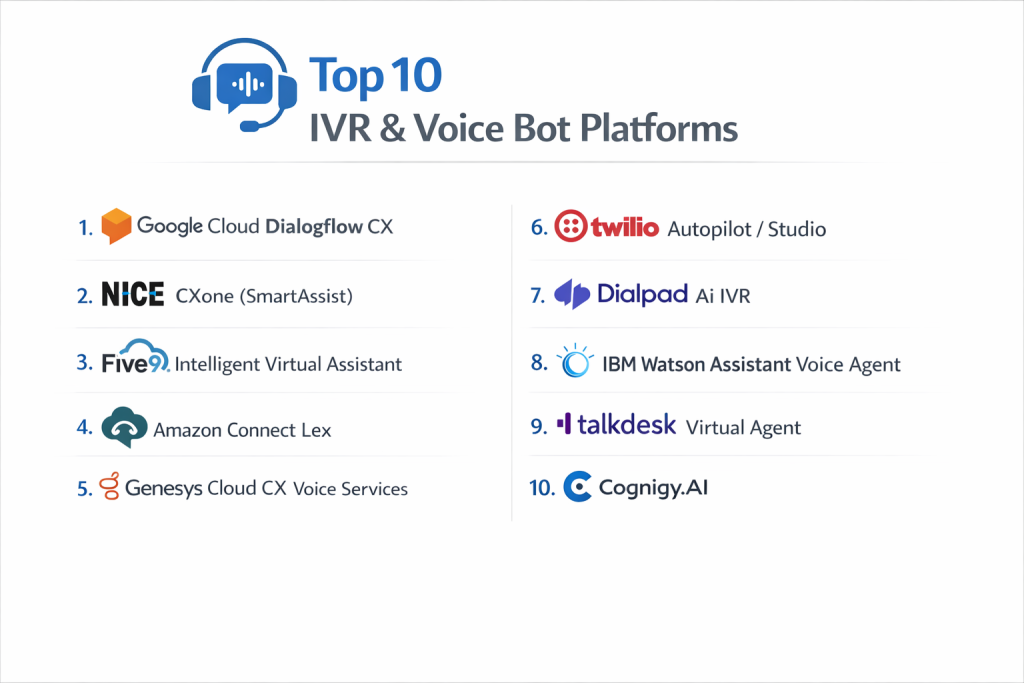
Top 10 IVR & Voice Bot Platforms
1 — Google Cloud Dialogflow (CX)
Dialogflow CX is a premium, AI-driven development suite for building advanced conversational interfaces. It is designed for large-scale enterprises that need to build highly complex, branching voice bot conversations.
- Key Features:
- Visual Flow Builder: State-based graphical editor to map out complex conversation paths.
- Omnichannel Support: Build once and deploy across voice, web, and social messaging.
- Advanced NLU: Google’s industry-leading natural language understanding for intent detection.
- DTMF Support: Seamlessly handles both spoken voice and keypad inputs.
- Native Telephony Integration: Connects directly to phone lines through Google’s “One-Click” telephony.
- Detailed Analytics: Visualizing “drop-off” points where callers get stuck in the bot flow.
- Pros:
- Unrivaled accuracy in understanding different accents and dialects.
- Pay-as-you-go pricing model is highly cost-effective for varying call volumes.
- Cons:
- Requires a high level of technical expertise to set up and maintain.
- The interface can be intimidating for non-technical business users.
- Security & compliance: SOC 2, HIPAA (with BAA), GDPR, ISO 27001, and PCI-DSS.
- Support & community: Massive global developer community, extensive documentation, and tiered Google Cloud support plans.
2 — Nice CXone (SmartAssist)
SmartAssist by Nice CXone is an enterprise-grade AI voice bot solution that integrates directly into one of the world’s most popular cloud contact center platforms.
- Key Features:
- Enlighten AI: Proprietary AI that understands caller sentiment (e.g., frustrated or happy).
- End-to-End Automation: Can execute full tasks like processing payments without a human.
- Natural Text-to-Speech: High-quality, human-like voice synthesis in over 40 languages.
- Workforce Management Sync: Adjusts bot behavior based on live agent availability.
- Knowledge Base Integration: Bots can “read” company documents to answer caller questions.
- Secure Payment Processing: PCI-compliant IVR modules for taking credit card info.
- Pros:
- Perfect for companies already using Nice CXone for their contact center.
- Highly sophisticated sentiment analysis helps in routing angry customers to human managers.
- Cons:
- Expensive licensing fees compared to standalone AI tools.
- Initial implementation usually requires professional services from Nice.
- Security & compliance: HITRUST, SOC 2, HIPAA, GDPR, and PCI DSS Level 1.
- Support & community: Premium 24/7 global support, dedicated account managers, and a robust user community.
3 — Five9 (Intelligent Virtual Assistant)
Five9’s IVA (Intelligent Virtual Assistant) focuses on making AI accessible for business users, allowing non-programmers to build and manage voice bots.
- Key Features:
- Low-Code Studio: Drag-and-drop interface for building voice applications.
- Inference Engine: Uses multiple AI models (Google, IBM, Amazon) to find the best answer.
- Real-Time Sentiment: Triggers an immediate “handoff” to a live agent if the bot fails.
- CRM Data Dip: Identifies the caller and greets them by name using database info.
- Biometric Authentication: Optional voice-print security to verify identity.
- Omnichannel Continuity: Remembers what the user said on chat when they call via phone.
- Pros:
- Very fast deployment times due to the low-code nature of the platform.
- Excellent “hand-off” logic that keeps callers from getting frustrated.
- Cons:
- The reporting dashboard can be less flexible than pure-play AI platforms.
- Advanced customization sometimes hits a “wall” in the low-code editor.
- Security & compliance: SOC 2, HIPAA, PCI DSS, and GDPR.
- Support & community: 24/7 technical support, Five9 University training, and a strong network of implementation partners.
4 — Amazon Connect (Lex)
Amazon Lex is the technology that powers Alexa, packaged as a service for business IVRs. It is designed for companies that value extreme scalability and developer freedom.
- Key Features:
- Alexa-Powered NLU: Uses the same deep learning that powers millions of Alexa devices.
- Contact Lens Integration: Real-time analytics and transcriptions of every bot interaction.
- Poly Text-to-Speech: Wide variety of lifelike voices with adjustable pitch and speed.
- Serverless Architecture: No servers to manage; it scales automatically during peak times.
- Lambda Integration: Easily connect the IVR to external databases (e.g., DynamoDB).
- Barge-In Support: Callers can interrupt the bot to move the conversation along faster.
- Pros:
- The most scalable solution on the market for massive “flash” call volumes.
- Deeply integrated into the AWS ecosystem, perfect for tech-heavy firms.
- Cons:
- Pricing can be unpredictable as it is billed per-request.
- Documentation is vast but can be difficult for beginners to navigate.
- Security & compliance: ISO, SOC, HIPAA, GDPR, and FedRAMP authorized.
- Support & community: AWS Enterprise Support, global developer forums, and extensive partner consultants.
5 — Genesys Cloud CX (Voice Services)
Genesys specializes in “experience orchestration,” providing an IVR that feels like a conversation rather than a maze of menus.
- Key Features:
- Native AI: Genesys’ own NLU combined with the ability to “plug in” Google or Amazon.
- Visual Architect: One of the most intuitive drag-and-drop flow designers.
- Dynamic Menuing: Menus change based on who is calling (e.g., VIPs get different options).
- Multilingual Auto-Detection: The bot identifies the caller’s language and switches automatically.
- Callback Management: IVR offers a “call me back” option if hold times are high.
- Historical Intent Mapping: Analyzes past calls to suggest new bot improvements.
- Pros:
- The “Visual Architect” tool is widely considered the best in the industry.
- Superior ability to blend IVR, Voice Bots, and live agent work seamlessly.
- Cons:
- The platform is a “walled garden”; it works best when you use Genesys for everything.
- High cost of entry for small to mid-sized businesses.
- Security & compliance: ISO 27001, SOC 2 Type II, HIPAA, GDPR, and PCI-DSS.
- Support & community: 24/7 global support, Genesys Community forums, and robust certification programs.
6 — Twilio Autopilot / Studio
Twilio is the developer’s choice. It is a set of APIs that allow businesses to build a completely custom IVR or Voice Bot from scratch.
- Key Features:
- Programmable Voice: Use code to control every aspect of the phone call.
- Twilio Studio: A visual interface for those who want a mix of code and drag-and-drop.
- Natural Language Router: Directs calls based on what the user says, not what they press.
- Global Super Network: Direct connections to carriers in nearly every country.
- TaskRouter Integration: Sophisticated logic to find the best agent for any task.
- Autopilot NLU: A machine-learning layer to build once and deploy anywhere.
- Pros:
- Total freedom to build exactly what you want without “vendor lock-in.”
- Very affordable for developers who can do the work themselves.
- Cons:
- No “out of the box” functionality; you have to build every flow.
- Lack of a dedicated account manager unless you are a very high-volume user.
- Security & compliance: SOC 2, ISO 27001, GDPR, and HIPAA (with specific configurations).
- Support & community: The largest developer community in the communications space.
7 — Dialpad Ai (IVR)
Dialpad is an AI-first communications platform. Their IVR is unique because it uses AI not just to route calls, but to help agents during the call itself.
- Key Features:
- Real-Time Transcription: Supervisors can read live IVR interactions.
- Ai CSAT: Automatically predicts customer satisfaction for every bot call.
- Easy Menu Setup: Simple, web-based interface for building standard IVR menus.
- Searchable Transcripts: Every interaction is saved and indexed for searching.
- Voicemail-to-Text: AI transcribes messages left in the IVR and emails them to agents.
- Cloud-First Design: Set up and change your IVR from a smartphone app.
- Pros:
- The most modern and user-friendly interface for small to mid-market teams.
- AI features are “baked in” and don’t require complex separate setups.
- Cons:
- Less powerful for complex, high-enterprise branching logic.
- Native Voice Bot features are still evolving compared to Google or Amazon.
- Security & compliance: SOC 2 Type II, HIPAA, GDPR, and ISO 27001.
- Support & community: 24/7 live chat and phone support with a very helpful knowledge base.
8 — IBM Watson Assistant (Voice Agent)
IBM Watson is the veteran of the AI world. Its voice agent is designed for high-security industries that need extreme precision and data privacy.
- Key Features:
- Watson Discovery: Allows the voice bot to “search” company manuals to find answers.
- Clarification Logic: The bot asks, “Did you mean X or Y?” if it’s unsure, reducing errors.
- On-Premise Deployment: One of the few AI bots that can run in a private data center.
- NLU Customization: Fine-tune the AI for industry-specific jargon (e.g., Legal or Medical).
- Seamless Transfer: Passes all data gathered by the bot to the live agent’s screen.
- Low Latency: Optimized for speed so the bot doesn’t “stutter” or pause too long.
- Pros:
- Generally considered to have the most “professional” and accurate NLU for complex data.
- Unmatched for organizations with strict data residency/on-prem requirements.
- Cons:
- The most expensive option on the list for both licensing and implementation.
- Requires a dedicated data scientist or AI engineer to reach full potential.
- Security & compliance: FIPS 140-2, SOC 2, HIPAA, GDPR, and ISO 27001.
- Support & community: Enterprise-grade IBM support and deep academic/research documentation.
9 — Talkdesk (Virtual Agent)
Talkdesk is known for its speed of innovation. Its “Virtual Agent” uses AI to resolve customer issues without any human intervention.
- Key Features:
- AI Trainer: A tool that lets business users “teach” the bot after a failed call.
- No-Code Flow: Fully visual builder designed for CX managers, not IT.
- Industry-Specific Packages: Pre-built IVR templates for retail, banking, and more.
- Self-Service Portal: Callers can update their own account info via voice.
- Real-Time Dashboards: Track “containment rate” (the % of calls resolved by the bot).
- Biometric Identity: Securely identifies callers by the sound of their voice.
- Pros:
- Very fast deployment—businesses can go live in weeks rather than months.
- The “AI Trainer” feature makes it easy to improve the bot over time.
- Cons:
- Pricing can be opaque and often requires a custom quote.
- Heavy reliance on a stable internet connection for high-quality voice processing.
- Security & compliance: SOC 2, HIPAA, GDPR, and ISO 27001.
- Support & community: 24/7 global support and “Talkdesk Academy” for certifications.
10 — Cognigy.AI
Cognigy is a “pure-play” conversational AI platform. It is designed for businesses that want a single AI “brain” to control their phone, web, and internal company bots.
- Key Features:
- Cognigy.Voice: A dedicated module for low-latency, high-quality phone interactions.
- Human-in-the-Loop: Allows an agent to “watch” the bot and jump in if needed.
- Context Management: The bot remembers what the user said two weeks ago.
- Open Architecture: Can be used with any existing telephony provider (Avaya, Cisco, etc.).
- Advanced Debugger: Test your voice bot in a “sandbox” before going live.
- Localization: Supports over 100 languages with native-level fluency.
- Pros:
- The best option for companies that want to keep their existing phone system but add a modern AI.
- Incredible flexibility for complex, multi-step business processes.
- Cons:
- It is a standalone platform, so you must integrate it with your telephony system.
- Smaller community compared to Google or Amazon.
- Security & compliance: GDPR, SOC 2, and ISO 27001.
- Support & community: High-touch professional support and a growing ecosystem of AI partners.
Comparison Table
| Tool Name | Best For | Platform(s) Supported | Standout Feature | Rating (Gartner) |
| Google Dialogflow | Developers / NLU | Web, Cloud | Accented Voice Recognition | 4.5 / 5 |
| Nice CXone | Enterprise Centers | Cloud, Mobile | Enlighten Sentiment AI | 4.4 / 5 |
| Five9 IVA | SMB Ease of Use | Cloud | Multi-engine AI Logic | 4.4 / 5 |
| Amazon Connect | Scalability / Cost | Cloud (AWS) | Pay-per-request pricing | 4.3 / 5 |
| Genesys Cloud | CX Orchestration | Cloud | Visual Architect Flow | 4.4 / 5 |
| Twilio Studio | Custom Build | Cloud, API | Total Developer Control | N/A |
| Dialpad Ai | Modern Tech Teams | Cloud, Desktop | Real-time Transcription | 4.4 / 5 |
| IBM Watson | High Security / Gov | Cloud, On-Prem | On-Premise AI Deployment | 4.3 / 5 |
| Talkdesk | Retail / Growth | Cloud | AI Trainer Tool | 4.5 / 5 |
| Cognigy.AI | Specialized AI | Cloud, On-Prem | Single AI “Brain” Logic | N/A |
Evaluation & Scoring of IVR & Voice Bot Platforms
To help you decide, we have evaluated these platforms against a weighted rubric that reflects the priorities of a modern business leader.
| Criteria | Weight | What We Measured |
| Core Features | 25% | NLU accuracy, Flow Builder quality, and voice synthesis. |
| Ease of Use | 15% | Can a non-technical manager build a simple flow? |
| Integrations | 15% | Does it connect to Salesforce, SAP, or legacy databases? |
| Security & Compliance | 10% | Presence of HIPAA, GDPR, and secure payment modules. |
| Performance | 10% | Latency (the time the bot takes to “think”) and uptime. |
| Support & Community | 10% | Quality of documentation and availability of help. |
| Price / Value | 15% | ROI based on cost-per-minute or per-agent. |
Which IVR & Voice Bot Platforms Tool Is Right for You?
1. Solo Users vs. SMB vs. Mid-Market vs. Enterprise
- Solo/Micro: These platforms are generally overkill. A simple business phone with a basic auto-attendant (like Grasshopper) is better.
- SMB (10–50 agents): Dialpad or Five9 are the winners here. They provide AI benefits without needing a team of engineers to manage the system.
- Enterprise (100+ agents): Nice CXone, Genesys, or Talkdesk are built for this scale. They offer the workforce management and security features large companies require.
2. Budget-Conscious vs. Premium
- Budget: Amazon Connect or Twilio are the best. You only pay for what you use, which can be significantly cheaper if your call volumes are low or seasonal.
- Premium: IBM Watson and Nice CXone are the “Gold Standard.” You pay a premium, but you get the highest levels of accuracy, security, and professional support.
3. Feature Depth vs. Ease of Use
If you want to build the future of AI, choose Google Dialogflow or Twilio. If you want a tool that your customer service manager can update on a Monday morning, choose Five9 or Talkdesk.
Frequently Asked Questions (FAQs)
1. What is the difference between IVR and a Voice Bot?
IVR is typically the “legacy” system where you press buttons on a keypad. A Voice Bot is a “modern” system that uses AI to understand spoken language, allowing for much more natural and complex conversations.
2. How much does a voice bot cost?
Pricing varies wildly. Some charge a monthly fee per agent (starting at around $100), while others (like AWS) charge per minute of use (fractions of a cent). Most enterprise solutions require a custom quote.
3. Do I need a programmer to set this up?
For “Low-Code” tools like Five9 or Talkdesk, a tech-savvy manager can do it. For “API-First” tools like Twilio or Google Dialogflow, you will definitely need a developer.
4. Can voice bots handle different accents?
Modern AI from Google and Amazon is incredibly good at accents. However, it is never 100% perfect. Most systems allow you to “train” the bot on specific phrases your customers use.
5. Is my data secure when using a cloud IVR?
Yes, if you choose a reputable provider. Look for SOC 2 and ISO 27001 certifications. If you are in healthcare, you must ensure the provider will sign a BAA for HIPAA compliance.
6. Can a voice bot take payments?
Yes. Look for “PCI-DSS” compliant modules. These systems often “mask” the customer’s voice when they say credit card numbers so that agents and system logs can’t see the sensitive data.
7. How do I prevent people from getting frustrated with the bot?
The “Best Practice” is to always provide a clear path to a human. This is called “Escalation.” If the bot doesn’t understand the caller twice, it should automatically transfer the call to a live agent.
8. Can I use these on my existing phone system?
Many platforms (like Cognigy or Dialogflow) can be “layered” on top of an existing Avaya, Cisco, or Mitel phone system using a protocol called SIP Trunking.
9. Does the bot sound like a robot?
Not anymore. Technologies like “Neural Text-to-Speech” (NTTS) have made voices sound nearly human, with natural breathing sounds and correct emphasis on words.
10. What is a “Containment Rate”?
This is the most important metric for IVRs. It measures the percentage of callers who get their questions answered by the bot without ever needing to talk to a human agent.
Conclusion
Selecting an IVR or Voice Bot platform is a critical step in modernizing your customer experience. The “best” tool depends entirely on your technical resources and your business goals. If you have a team of developers and want to build a unique experience, Twilio or Google Dialogflow are your best bets. If you want a robust, all-in-one contact center where the AI is already integrated, Nice CXone or Genesys are the industry leaders.
Ultimately, the goal is to make life easier for your customers. A well-designed voice bot should feel like a helpful assistant, not a barrier to getting help. Start small—automate your most frequent, simple questions first—and then scale up your AI capabilities as you see your containment rates grow.