Introduction
IP Management Software is a specialized program that helps companies and law firms track, organize, and protect their intellectual property. This includes patents, trademarks, copyrights, and trade secrets. Think of it as a central, smart filing cabinet and alert system for everything related to your ideas and brands—from the first invention note to a patent’s expiry date twenty years later.
This software is important because intellectual property is often a company’s most valuable asset. Losing track of a renewal deadline can mean a trademark is cancelled forever. Missing a patent office action can result in abandoned rights. This software automates these critical deadlines, stores all documents in one searchable place, and provides a clear picture of your entire IP portfolio’s value and status. Real-world use cases include a tech startup managing its first ten patent applications, a global consumer brand tracking thousands of trademarks in over a hundred countries, or a law firm overseeing portfolios for hundreds of client companies.
When choosing a tool, you should look for: rock-solid docketing (deadline tracking), excellent document and correspondence management, powerful search and reporting across your portfolio, tools for tracking costs and annuities, secure client portals for law firms, and the ability to handle global filings with different country rules.
Best for: This software is essential for IP attorneys, paralegals, in-house counsel, and IP managers. It benefits solo practitioners, boutique IP law firms, mid-size companies with growing portfolios, and large enterprises in innovation-driven industries like technology, pharmaceuticals, manufacturing, consumer goods, and biotechnology.
Not ideal for: A very small business or inventor with only one or two simple patents or trademarks might find the cost hard to justify. For them, a well-organized calendar with reminders and a disciplined folder system might work initially. Companies that do not own formal IP rights (patents, registered trademarks) have no use for this specialized software.
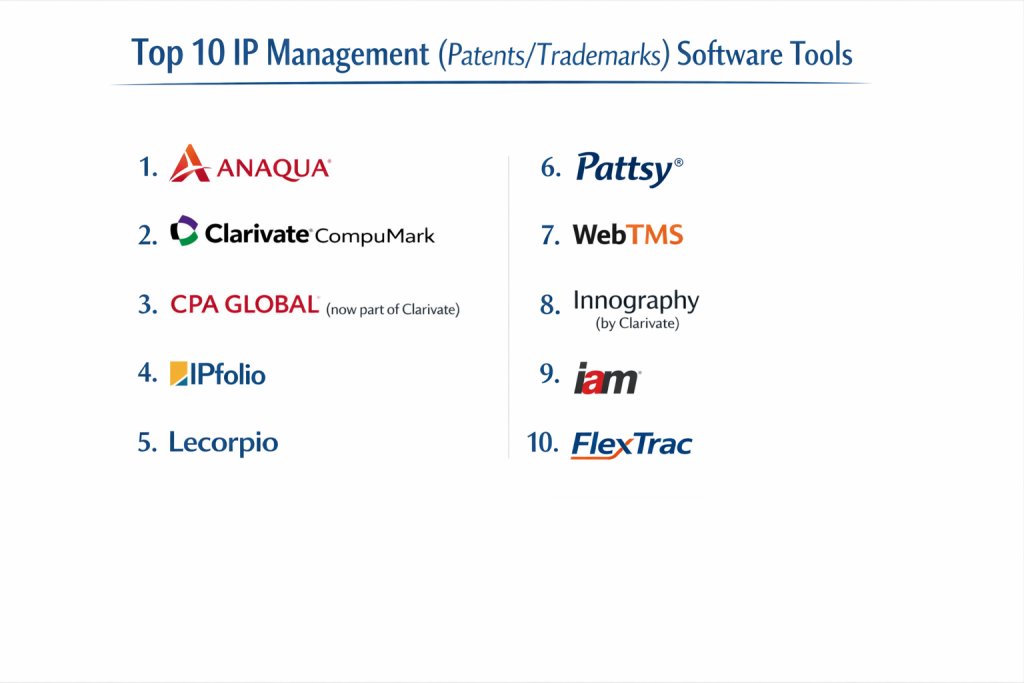
Top 10 IP Management (Patents/Trademarks) Software Tools
1 — Anaqua
Anaqua is a comprehensive, enterprise-grade IP management platform. It is designed for large corporations and law firms with complex, global IP portfolios that require deep functionality and scalability.
Key features:
- Global Docketing: Tracks critical deadlines (office actions, renewals) across hundreds of jurisdictions with high accuracy.
- Financial Management: Robust tools for tracking costs, budgets, annuities, and invoicing.
- Advanced Analytics & Reporting: Provides dashboards and insights on portfolio strength, spending, and risk.
- Integration Hub: Connects with other enterprise systems like ERP, CRM, and legal research tools.
- Customizable Workflows: Allows firms and corporations to automate their unique IP processes.
- IP Intelligence: Some versions include patent search and landscaping tools.
Pros:
- Unmatched depth and power for managing massive, global portfolios.
- Highly configurable to fit the precise workflows of large organizations.
- Strong analytics for strategic decision-making at the executive level.
Cons:
- Can be very expensive, placing it out of reach for smaller entities.
- Implementation can be lengthy and complex due to its depth.
- The interface, while powerful, may not be as modern or intuitive as some newer cloud platforms.
Security & compliance: Enterprise-level security with features like SSO, data encryption, detailed audit logs, and compliance with SOC 2, ISO 27001, and GDPR.
Support & community: Offers dedicated account management, professional services, and 24/7 support for enterprise clients. Has a large, established user base.
2 — Clarivate CompuMark
Clarivate CompuMark is a world leader in trademark research and clearance software. Its management platform is built around this core strength, making it a top choice for brand-focused companies and firms.
Key features:
- World-Class Trademark Search: Access to global trademark databases with powerful screening and similarity analysis tools.
- Trademark Portfolio Management: Docketing and tracking specifically tailored for trademark prosecution and renewals.
- Watch Services: Monitors new filings for conflicting trademarks globally.
- Brand Protection: Tools to help identify potential infringements.
- Integration with Derwent Innovation: Connects to Clarivate’s patent intelligence platform for a full IP view.
Pros:
- The gold standard for trademark search accuracy and global coverage.
- End-to-end solution from brand clearance through registration and renewal.
- Trusted by the largest brand owners and IP firms in the world.
Cons:
- While strong on trademarks, its patent management features are not as deep as dedicated all-IP platforms.
- Pricing models are often premium and based on search volume, which can add up.
- Can be complex for users who only need basic docketing.
Security & compliance: High security standards from a major global provider. Data handling complies with international privacy and security regulations.
Support & community: Access to Clarivate’s expert support and consulting services. Strong industry reputation and user network.
3 — CPA Global (now part of Clarivate)
CPA Global is one of the oldest and most widely used IP management systems, now integrated into the Clarivate suite. It’s known for its robustness, particularly in annuity payment processing and portfolio management for large entities.
Key features:
- Annuity and Renewal Services: Industry-leading, outsourced service for paying patent renewal fees worldwide.
- Core IP Management: Comprehensive docketing, document management, and portfolio tracking.
- IP Portfolio Analytics: Reporting tools to analyze portfolio size, cost, and jurisdiction.
- Law Firm Portal: Secure portal for law firms to manage their clients’ portfolios.
- Global Coverage: Deep understanding of filing rules and procedures in numerous countries.
Pros:
- Extremely reliable and proven at scale for the world’s largest portfolios.
- The annuity service is a major differentiator and reduces administrative burden.
- Deep integration with the wider Clarivate ecosystem of IP tools.
Cons:
- Can be perceived as a more traditional, less modern system compared to newer cloud-native platforms.
- User interface and experience may feel dated to some users.
- Customization and implementation can be a significant undertaking.
Security & compliance: Provides the high level of security and data integrity required for handling critical financial transactions like annuity payments. Complies with global standards.
Support & community: Long-standing presence with a vast global support and service organization.
4 — IPfolio
IPfolio is a modern, cloud-native IP management platform built with user experience in mind. It targets growing tech companies and law firms that want a powerful but intuitive system.
Key features:
- Modern, Intuitive Interface: Clean, drag-and-drop dashboard that is easy to learn and use.
- Customizable Workspaces: Tailor views and workflows for different roles (inventors, attorneys, managers).
- Integrated Idea Disclosure: Captures invention submissions from employees and manages the review process.
- Cost Tracking and Forecasting: Clear visibility into IP-related spending and future budgets.
- API-First Architecture: Built for easy integration with other business tools like Jira, Salesforce, and Slack.
- Strong Reporting: Visual, interactive reports on portfolio metrics.
Pros:
- Excellent user adoption due to its modern, appealing design.
- Flexible and adaptable for fast-growing companies with evolving processes.
- Strong focus on the front-end of innovation (idea capture) as well as prosecution.
Cons:
- May not have the sheer depth of some legacy systems for hyper-complex, global annuity management.
- As a younger company, its market footprint is smaller than the largest incumbents.
- Advanced customization may require more technical know-how.
Security & compliance: Cloud-based security with features like SSO, encryption, and compliance with SOC 2 Type II and GDPR.
Support & community: Known for responsive, high-quality customer success and support. Growing user community.
5 — Lecorpio
Lecorpio is a flexible, cloud-based IP management suite designed to handle the full IP lifecycle. It serves both corporations and law firms with a balance of power and configurability.
Key features:
- End-to-End Lifecycle Management: Tools for invention disclosure, docketing, prosecution, and renewals.
- Matter and Financial Management: Tracks legal matters, budgets, and expenses in detail.
- Contract Management: Can manage IP-related agreements like licenses and NDAs.
- Highly Configurable: Can model complex business rules and approval workflows.
- Business Intelligence: Built-in reporting and dashboard capabilities.
Pros:
- Strong flexibility to adapt to different IP business processes.
- Good breadth of features covering management, legal, and financial aspects.
- Well-suited for mid-market to large enterprises.
Cons:
- The high level of configurability can lead to a more complex setup process.
- Some users note the interface, while functional, could be more modern.
- May require internal IT or admin resources to maintain complex configurations.
Security & compliance: Enterprise cloud security with data encryption, audit trails, and compliance certifications like SOC 2.
Support & community: Provides professional services for implementation and ongoing customer support.
6 — Pattsy
Patsy is known for offering a capable and user-friendly IP management system at a competitive price point. It is a popular choice for small to mid-sized law firms and companies.
Key features:
- Straightforward Docketing: Reliable deadline calculation and tracking with visual calendars.
- Integrated Document Management: Store and organize all correspondence and filings.
- Client Billing Integration: Tools to track time and expenses for easy invoicing.
- Client Portals: Secure portals for clients to view their portfolio status.
- Trademark and Patent Management: Handles both major IP types effectively.
Pros:
- Offers a great balance of core features at a more accessible price.
- Known for being easier to learn and implement than some complex enterprise systems.
- Good customer support and service.
Cons:
- Lacks some of the advanced analytics, customization, and global depth of the largest platforms.
- May not scale seamlessly to the needs of a Fortune 500 company.
- Integrations with other business systems may be more limited.
Security & compliance: Employs standard cloud security practices. Specific compliance certifications may vary.
Support & community: Generally receives positive marks for customer support responsiveness.
7 — WebTMS
WebTMS is a specialized, web-based platform focused primarily on trademark portfolio management. It is widely used by trademark attorneys and brand owners for its depth in this area.
Key features:
- Trademark-Specific Docketing: Calculates deadlines based on trademark prosecution rules.
- Global Watch Services: Integrated tools for monitoring new trademark applications.
- Document Library: Central repository for all trademark correspondence and certificates.
- Cost Tracking: Monitor official fees and professional costs for trademarks.
- Renewal Management: Streamlines the trademark renewal process.
Pros:
- Deep, specialized functionality for trademark professionals.
- Intuitive for users who work exclusively or primarily with trademarks.
- Strong reputation within the trademark community.
Cons:
- Not designed as a comprehensive patent management system.
- Its focused nature means it’s not an all-IP solution for mixed portfolios.
- Interface design may feel utilitarian.
Security & compliance: As a web-based platform handling sensitive data, it employs standard security protocols. Details on certifications vary.
Support & community: Used by many law firms globally, with support channels typical for specialized software.
8 — Innography (by Clarivate)
Innography is an IP analytics and intelligence platform. While it includes portfolio management features, its standout strength is in analyzing large sets of patent data for strategic insights.
Key features:
- Advanced Patent Analytics: Powerful tools for patent landscaping, competitive analysis, and trend spotting.
- Visualization: Creates maps, charts, and graphs to make complex data understandable.
- Strength & Valuation Indicators: Uses algorithms to assess patent quality and potential value.
- Portfolio Management: Basic docketing and tracking tools integrated with the analytics.
- Company Tree Intelligence: Unravels complex corporate ownership structures of IP.
Pros:
- Unparalleled for deriving strategic business insights from patent data.
- Essential for R&D planning, M&A due diligence, and competitive intelligence.
- Makes vast amounts of IP data accessible and actionable.
Cons:
- Its core management (docketing) features are not as robust as dedicated systems like Anaqua or CPA Global.
- Pricing is oriented towards analysts and strategic functions.
- Has a steeper learning curve for non-analytical users.
Security & compliance: Part of the Clarivate ecosystem, adhering to its high data security and privacy standards.
Support & community: Supported by Clarivate’s team, with access to training on advanced analytical techniques.
9 — Innovation Asset Group (IAM)
Innovation Asset Group (IAM) offers a platform that emphasizes the complete innovation lifecycle, from idea capture to commercialized asset management. It’s geared towards R&D-heavy organizations.
Key features:
- Idea & Invention Management: Structured workflow to capture, evaluate, and track employee ideas.
- IP Portfolio Management: Docketing and tracking for formal IP rights.
- Asset Commercialization: Tracks licenses, agreements, and revenue related to IP assets.
- Configurable Process Management: Models stage-gate and other innovation processes.
- Royalty Management: Manages complex royalty calculations and payments.
Pros:
- Excellent for connecting early-stage innovation to formal IP and eventually to revenue.
- Strong for companies that treat IP as a business asset to be commercialized.
- Highly configurable to different innovation models.
Cons:
- May be more than needed for a firm that only handles formal prosecution.
- Can be complex to configure for specific business processes.
- Less focused on the pure legal docketing minutiae.
Security & compliance: Provides enterprise-level security features appropriate for protecting valuable innovation data.
Support & community: Offers implementation services and support tailored to its innovation management focus.
10 — FlexTrac
FlexTrac is a flexible, web-based IP docketing and management system. It positions itself as a cost-effective and adaptable solution for law firms and corporations of various sizes.
Key features:
- Core Docketing: Accurate deadline calculation and management.
- Custom Reporting: Ability to build a wide variety of custom reports.
- Document Management: Store and associate correspondence with cases.
- Client/Department Portals: Provide secure external access.
- Billing & Accounting Integration: Interfaces with systems like QuickBooks.
Pros:
- Often more affordable than the largest enterprise platforms.
- Known for its flexibility and custom reporting capabilities.
- Good option for firms and companies that need solid core features without extreme complexity.
Cons:
- May not have the brand recognition or vast service network of the market leaders.
- Some advanced or very specialized features may be lacking.
- User interface is functional rather than cutting-edge.
Security & compliance: As a SaaS provider, it implements standard web application security measures. Specific certification details should be confirmed.
Support & community: Provides customer support and has a base of long-term users.
Comparison Table
| Tool Name | Best For (target user or scenario) | Platform(s) Supported | Standout Feature | Rating |
|---|---|---|---|---|
| Anaqua | Large enterprises & law firms with massive, complex global portfolios. | Cloud, Web | Enterprise Depth & Global Scalability | High (Enterprise Leader) |
| Clarivate CompuMark | Brand owners & firms specializing in trademark prosecution and strategy. | Cloud, Web | World-Leading Trademark Search & Clearance | High (Trademark Leader) |
| CPA Global | Large entities requiring ultra-reliable annuity payment processing & management. | Cloud, Web | Industry-Standard Annuity & Renewal Services | High (Renewals Leader) |
| IPfolio | Growing tech companies & firms wanting a modern, user-friendly cloud platform. | Cloud, Web | Modern UX & Idea-to-IP Lifecycle | High (Modern Platform Leader) |
| Lecorpio | Mid-market to large firms needing a configurable, full-lifecycle IP suite. | Cloud, Web | Configurability & Process Workflow | Medium/High |
| Patsy | Small to mid-sized law firms and companies seeking capable, affordable management. | Cloud, Web | User-Friendly & Cost-Effective Core Features | Medium/High |
| WebTMS | Trademark attorneys and brand-focused companies. | Web | Specialized Trademark Portfolio Management | Medium/High |
| Innography | IP analysts, strategists, and R&D leaders for patent intelligence & analytics. | Cloud, Web | Advanced Patent Analytics & Visualization | High (Analytics Leader) |
| IAM | R&D-intensive companies managing the full innovation-to-commercialization pipeline. | Cloud, Web | End-to-End Innovation & Asset Commercialization | Medium/High |
| FlexTrac | Law firms & corporations wanting flexible docketing and reporting at a value price. | Web | Flexibility & Custom Reporting | Medium |
Evaluation & Scoring of IP Management Software
Score potential tools (1-10) using this rubric. Multiply by the weight to get a total score out of 100 for your needs.
| Evaluation Category | Weight | What to Look For |
|---|---|---|
| Core Features | 25% | Accuracy of docketing, quality of document management, searchability, cost/annuity tracking, support for patents/trademarks/other IP. |
| Ease of Use | 15% | Intuitive interface, ease of data entry, clarity of dashboards, learning curve for new team members. |
| Integrations & Ecosystem | 15% | Connections to patent office portals (like USPTO), legal research tools (Westlaw), accounting software, and other enterprise systems (CRM, ERP). |
| Security & Compliance | 10% | Data encryption, role-based access, audit trails, and compliance with data privacy laws (GDPR) relevant to your regions of operation. |
| Performance & Reliability | 10% | System uptime, speed with large portfolios, accuracy of deadline calculations (zero tolerance for error). |
| Support & Community | 10% | Responsiveness and expertise of support, quality of training resources, availability of user community for best practices. |
| Price / Value | 15% | Total cost (subscription, per-user, implementation) relative to the risk mitigation, efficiency gains, and strategic insight provided. |
Which IP Management Software Tool Is Right for You?
Your organization’s profile will guide you to the best fit:
- Solo Users vs SMB vs Mid-Market vs Enterprise:
- Solo Practitioner / Tiny Portfolio: A dedicated system may be overkill. Use a robust matter management system with great calendaring. Patsy is the entry point for dedicated software.
- Small Law Firm / Growing Company (SMB): Need reliability and core features at a good price. Patsy, FlexTrac, and IPfolio’s smaller plans are strong contenders.
- Mid-Market Firm/Company: Require more power, scalability, and possibly innovation tools. IPfolio, Lecorpio, and IAM are excellent choices here.
- Large Enterprise / Global Law Firm: Need unparalleled depth, global support, and analytics. Anaqua, CPA Global, and Clarivate CompuMark (for brands) are the market leaders.
- Budget-Conscious vs Premium Solutions:
- Budget-Conscious: Patsy and FlexTrac offer capable core features. Be clear on what “advanced” features you can live without.
- Premium Solutions: Anaqua, CPA Global, and the Clarivate suite represent a significant investment justified by risk reduction, efficiency at scale, and strategic tools.
- Feature Depth vs Ease of Use:
- Prioritize Feature Depth/Power: Choose Anaqua, Lecorpio, or CPA Global for complex docketing and financials. Choose Innography for analytics.
- Prioritize Ease of Use/Adoption: Choose IPfolio or Patsy for their modern, intuitive interfaces.
- Integration and Scalability Needs:
- If trademarks are your primary focus, Clarivate CompuMark or WebTMS are specialists.
- If you need deep patent analytics, Innography is the leader.
- If you manage the full innovation pipeline, IAM is purpose-built.
- For scalability and modern architecture, cloud-native IPfolio is designed to grow with you.
- Security and Compliance Requirements:
- All providers take security seriously. For the highest assurance, look for SOC 2 Type II certification and inquire about their data residency options if you operate under strict regional laws.
Frequently Asked Questions (FAQs)
1. What is “docketing” and why is it so critical?
Docketing is the process of calculating, tracking, and managing all legal deadlines related to your IP (like response deadlines from patent offices). Missing a single deadline can result in the permanent loss of valuable rights, making accurate docketing the most important feature.
2. Can this software file documents directly with patent and trademark offices?
Most software does not file directly. Instead, it integrates with or helps prepare documents for official web portals like the USPTO’s EFS-Web. It ensures you have the right documents ready and tracks the submission confirmation.
3. How does the software handle different countries’ rules?
Reputable systems have a built-in “rules engine” database that knows the procedural laws for dozens of countries. This allows it to automatically calculate deadlines correctly for each jurisdiction in your portfolio.
4. What’s the difference between IP management and IP analytics software?
Management software is for operational control: tracking deadlines, documents, and costs. Analytics software (like Innography) is for strategic insight: analyzing trends, competitors, and portfolio strength. Many platforms now blend both.
5. How long does implementation take?
For a small firm, 1-3 months. For a large enterprise with historical data migration and complex workflows, 6-12 months is common. “Lift-and-shift” from an old system is a major project.
6. Is cloud-based software safe for such sensitive information?
Yes. Leading cloud providers offer security that far exceeds what most individual law firms or companies can achieve on their own servers, including encryption, expert monitoring, and physical data center security.
7. Can I track both patents and trademarks in one system?
Yes, all comprehensive platforms (like Anaqua, IPfolio, Lecorpio, Patsy) handle multiple IP types. Some, like WebTMS, are specialized for trademarks.
8. What is an “annuity” or “renewal” service?
These are fees required to keep a granted patent in force. Many software providers (especially CPA Global) offer a service to pay these fees globally on your behalf, ensuring you never miss a payment.
9. What is a common mistake when choosing IP software?
Choosing a system that matches your portfolio size today but cannot scale for your growth in 5 years. Or, selecting a system so complex that your team refuses to use it properly, creating risk.
10. Do these systems help with inventor reward programs or idea submission?
Some do, like IPfolio and IAM. They include modules for employees to submit invention disclosures, which then flow into a review workflow, helping manage the “front end” of innovation.
Conclusion
Selecting the right IP Management Software is a strategic decision that protects your most valuable intangible assets. The right system acts as both a shield—guarding against missed deadlines and lost rights—and a lens—providing clarity on your portfolio’s value and potential. From the specialized trademark power of Clarivate CompuMark to the enterprise scale of Anaqua and the modern agility of IPfolio, there is a solution engineered for every type of IP owner and manager.
The crucial insight is that the best choice is not about finding the “most powerful” software in a vacuum, but about finding the most appropriate partner for your organization’s specific size, complexity, budget, and strategic goals. Start by rigorously defining your mandatory needs and your growth trajectory. Involve the day-to-day users in the evaluation process. Ultimately, a well-chosen IP management system is more than software; it is a foundational component of your business’s defense and growth strategy, ensuring your innovations and brands are securely managed for the long term.