Introduction
An Investor Relations (IR) platform is a specialized software solution designed to manage the communication, data, and relationship dynamics between a publicly traded company (or a private company seeking funding) and its investment community. Unlike a standard CRM, these platforms are purpose-built to handle the unique workflows of IR professionals, including equity tracking, shareholder identification, and regulatory disclosure. By consolidating market data, investor contact information, and engagement analytics into a single interface, IR platforms enable companies to target the right investors, measure the impact of their outreach, and ensure they are meeting their fiduciary reporting obligations.
The importance of IR platforms has grown as capital markets become more data-driven and global. In today’s high-velocity trading environment, IR teams must be able to distinguish between short-term “activist” investors and long-term “stable” institutional holders. Key real-world use cases include managing “roadshows” for executive teams, tracking institutional ownership changes after quarterly earnings, and hosting secure webcasts for analyst calls. When choosing a tool, users should evaluate the quality of the underlying ownership data, the robustness of the targeting algorithms, and the platform’s ability to integrate with financial wire services and disclosure portals.
Key Real-World Use Cases
- Investor Targeting: Using AI-driven insights to identify institutional funds that are currently under-weight in your sector or have investment profiles that match your company’s growth stage.
- Earnings Call Management: Coordinating the distribution of press releases, hosting the audio webcast, and managing the Q&A queue for analysts and shareholders.
- Shareholder Identification: Analyzing custodial data to see who actually owns the company’s shares, even when they are held behind “nominee” accounts.
- Roadshow Planning: Organizing multi-city meetings between the CEO/CFO and potential investors, including schedule management and meeting note tracking.
- CRM & Engagement Tracking: Maintaining a historical log of every interaction with an analyst or portfolio manager to ensure consistent messaging.
What to Look For (Evaluation Criteria)
- Data Accuracy: The platform is only as good as its data. Look for real-time institutional ownership updates and comprehensive contact databases for buy-side and sell-side professionals.
- Regulatory Compliance: Since IR involves sensitive financial information, the tool must support secure disclosures and maintain audit trails for Reg FD compliance.
- Reporting & Analytics: The ability to generate “Board-ready” reports that visualize shareholder movement and engagement ROI.
- Ease of Use: IR professionals often work under intense pressure during earnings season; the interface must be intuitive and fast.
- Integration Capabilities: Does the platform connect with your website’s IR section, your corporate CRM, and external market data feeds like Bloomberg or Refinitiv?
Best for: Investor Relations Officers (IROs), CFOs, and Corporate Secretaries in publicly traded companies (Small-cap to Mega-cap). It is also increasingly valuable for late-stage private companies preparing for an IPO or managing a large pool of venture capital investors.
Not ideal for: Early-stage startups with only a handful of angel investors. For these users, a simple spreadsheet or a basic cap table management tool is usually sufficient until the investor base expands significantly.
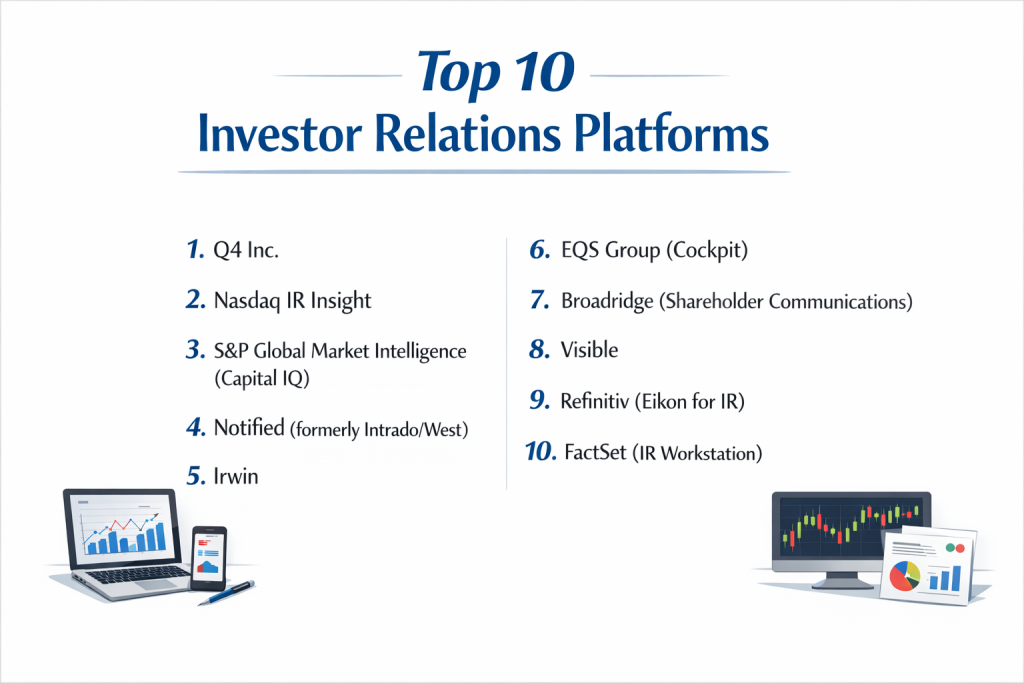
Top 10 Investor Relations Platforms
1 — Q4 Inc.
Q4 is a leading provider of capital markets communications software, offering an integrated “IR Desktop” that combines CRM, analytics, and website management into a single ecosystem.
- Key features:
- Unified IR CRM specifically designed for institutional targeting.
- Integrated website hosting and earnings webcast management.
- AI-powered investor targeting and behavioral analytics.
- Desktop and mobile access to real-time market data and ownership.
- Virtual Events platform for hosting interactive investor days.
- Built-in shareholder identification and surveillance services.
- Pros:
- Excellent “all-in-one” feel where your website, webcasts, and CRM talk to each other.
- High-quality customer success team that provides white-glove service during earnings.
- Cons:
- Pricing can be high for small-cap companies needing only basic features.
- Some users find the transition between different modules (Web vs. CRM) could be smoother.
- Security & compliance: SOC 2 Type II, GDPR, and ISO 27001 compliant.
- Support & community: 24/7 technical support, dedicated implementation managers, and an active IR community portal.
2 — Nasdaq IR Insight
Part of the Nasdaq corporate solutions suite, IR Insight is a high-performance platform that leverages Nasdaq’s massive data infrastructure to provide deep market intelligence.
- Key features:
- Deep institutional ownership data powered by Nasdaq’s proprietary feeds.
- Advanced “Buyside” contact database with detailed investor profiles.
- Integration with Nasdaq’s advisory services for shareholder surveillance.
- Robust mobile app for managing investor meetings on the road.
- Direct connection to Nasdaq’s GlobeNewswire for press release distribution.
- AI-driven “Sentiment Analysis” for transcripts and news.
- Pros:
- Access to some of the most accurate and timely ownership data in the world.
- Highly professional reporting templates that are ready for Board presentation.
- Cons:
- The interface is powerful but has a steeper learning curve than some “SaaS-native” rivals.
- Primarily focused on public markets; less flexible for private-to-public transitions.
- Security & compliance: SOC 2, ISO 27001, and GDPR compliant.
- Support & community: Global 24/7 support and access to Nasdaq’s “Boardvantage” governance insights.
3 — S&P Global Market Intelligence (Capital IQ)
S&P Global provides an expansive platform that is often the “gold standard” for financial data, used by both the companies and the investors themselves.
- Key features:
- The legendary Capital IQ database for deep-dive financial analysis.
- Comprehensive coverage of institutional holdings, fund profiles, and fixed income.
- Advanced screening tools for identifying investors by geography or style.
- Document viewing for filings, transcripts, and analyst research.
- Excel Plug-in for automated financial modeling and reporting.
- Integrated CRM for tracking investor outreach.
- Pros:
- Unmatched depth of financial data and historical information.
- If you want to see exactly what the analysts see, this is the tool.
- Cons:
- Can be overwhelming for IROs who want a simple, streamlined workflow.
- Very expensive, often positioned as a premium enterprise solution.
- Security & compliance: SOC 2 Type II and ISO 27001.
- Support & community: Dedicated account managers and 24/7 technical help desks worldwide.
4 — Notified (formerly Intrado/West)
Notified offers a comprehensive “PR + IR” cloud, making it a favorite for companies that want to manage their public image and investor relations through a single vendor.
- Key features:
- Integrated press release distribution through GlobeNewswire.
- High-end earnings webcast and conference call hosting.
- IR website hosting with automated data feeds.
- Social media monitoring for mentions of your stock ticker.
- ESG (Environmental, Social, and Governance) reporting tools.
- CRM with investor targeting capabilities.
- Pros:
- Best-in-class for managing the “communications” side of IR (Webcasts/Press Releases).
- Very strong international distribution network for news.
- Cons:
- The CRM and targeting data are sometimes seen as secondary to the comms tools.
- Can be complex to manage if you only want the “Relations” part and not the “PR” part.
- Security & compliance: SOC 2, GDPR, and HIPAA (where applicable).
- Support & community: 24/7 support and a robust onboarding process for new IR teams.
5 — Irwin
Irwin is a modern, fast-growing IR platform that focuses on being “SaaS-first.” It is known for its intuitive design and powerful shareholder targeting for small-to-mid-cap companies.
- Key features:
- Full-service shareholder identification (No-Objecting Beneficial Owner data).
- Streamlined CRM with automated meeting logging.
- “Algorithm-based” investor targeting to find new pools of capital.
- Itinerary builder for roadshows and conferences.
- Integrated email marketing for investor newsletters.
- Clean, visual dashboards for engagement analytics.
- Pros:
- One of the most user-friendly interfaces in the IR industry.
- Exceptional value for mid-market companies that need modern tools without legacy bloat.
- Cons:
- Doesn’t host webcasts or wire services natively (though it integrates with them).
- Database is smaller than global giants like S&P or Nasdaq.
- Security & compliance: SOC 2 Type II and GDPR compliant.
- Support & community: Highly responsive chat support and a dedicated “Success Manager” model.
6 — EQS Group (Cockpit)
EQS is a European powerhouse that provides a “Cockpit” for IR professionals, ensuring strict compliance with global financial regulations.
- Key features:
- Disclosure management for meeting transparency requirements (MAR/Transparency Directive).
- Global newswire distribution for regulatory filings.
- IR Website and Webcast hosting.
- Stakeholder management CRM.
- Whistleblowing/Compliance tools integrated into the suite.
- Interactive chart and data tools for IR websites.
- Pros:
- The top choice for European companies needing to meet strict EU regulations.
- Very strong focus on “Compliance” and data integrity.
- Cons:
- Less “Targeting” intelligence compared to US-focused rivals like Nasdaq.
- The interface can feel a bit technical or “form-heavy.”
- Security & compliance: ISO 27001, GDPR, and SOC 2.
- Support & community: Localized support across Europe and Asia; highly technical documentation.
7 — Broadridge (Shareholder Communications)
Broadridge is the industry leader in proxy voting and shareholder communications, offering unique insights into retail shareholder behavior.
- Key features:
- Unrivaled access to beneficial shareholder data (retail and institutional).
- Proxy voting and annual meeting management tools.
- Regulatory disclosure and “Virtual Shareholder Meeting” hosting.
- AI-driven “Shareholder Predictive Analytics.”
- Data-driven investor targeting for retail-heavy stocks.
- Multi-channel document delivery (digital and print).
- Pros:
- If your company has a high percentage of retail investors, Broadridge is essential.
- Dominates the proxy and annual meeting space with high reliability.
- Cons:
- More of a “Service and Data” giant than a “Modern SaaS CRM.”
- Can be difficult to navigate their various legacy divisions.
- Security & compliance: SOC 1, SOC 2, ISO 27001, and HIPAA.
- Support & community: Global enterprise support and extensive regulatory guidance.
8 — Visible
Visible is a specialized platform designed for private companies to manage their relationships with Venture Capital and Private Equity investors.
- Key features:
- Automated data collection from portfolio companies.
- Sleek “Investor Updates” builder with embedded charts.
- Investor CRM for tracking fundraising pipelines.
- Secure Data Room for sharing sensitive documents.
- Portfolio monitoring for VC/PE firms.
- KPI tracking and performance visualization.
- Pros:
- The best option for high-growth startups and private firms.
- Makes sending monthly/quarterly updates professional and painless.
- Cons:
- Not suitable for public companies (no market data or institutional targeting).
- Limited features for managing thousands of shareholders.
- Security & compliance: SOC 2 Type II and GDPR compliant.
- Support & community: Active blog for founders and responsive email support.
9 — Refinitiv (Eikon for IR)
Now part of LSEG (London Stock Exchange Group), Refinitiv offers Eikon, a high-end financial terminal experience tailored for IR teams.
- Key features:
- Real-time market data and analyst consensus estimates.
- Advanced “StarMine” analytics for predictive ownership changes.
- Global institutional contact database.
- Integrated news and research from thousands of sources.
- Powerful screening and targeting tools.
- Built-in CRM and activity tracking.
- Pros:
- Provides the same data that the world’s top traders and analysts use.
- Predictive analytics (StarMine) are industry-leading for “smart” targeting.
- Cons:
- Very high cost, similar to Bloomberg.
- The “Terminal” style interface can be daunting for non-financial staff.
- Security & compliance: ISO 27001 and SOC 2 compliant.
- Support & community: Global 24/7 technical support and on-site training.
10 — FactSet (IR Workstation)
FactSet is another premier financial data provider that offers a dedicated “Workstation” for IROs to track their stock and their competitors.
- Key features:
- Real-time monitoring of stock price, volume, and volatility.
- Detailed analyst estimates and “StreetAccount” news.
- CRM with seamless integration of FactSet’s contact data.
- Transcription services and document search using AI.
- Board-level reporting tools.
- Excel integration for complex data modeling.
- Pros:
- Highly customizable; you can build exactly the dashboards you need.
- Excellent at tracking “Sell-side” analysts and their specific ratings.
- Cons:
- Expensive and requires a significant commitment to learn the platform.
- Can be “overkill” for companies with simple IR needs.
- Security & compliance: SOC 2 Type II and GDPR.
- Support & community: Known for some of the best customer service in the financial industry.
Comparison Table
| Tool Name | Best For | Platform(s) Supported | Standout Feature | Rating |
| Q4 Inc. | All-in-One Public IR | Web / Cloud | Integrated Webcasts | 4.6 / 5 |
| Nasdaq IR | Data-Heavy Public | Web / Mobile | Nasdaq Market Data | 4.5 / 5 |
| Capital IQ | Deep Fin Analysis | Web / Excel | Institutional Depth | 4.8 / 5 |
| Notified | PR + IR Teams | Web / Cloud | Newswire Integration | 4.3 / 5 |
| Irwin | Mid-Market Growth | Web / Cloud | Targeting Algorithms | 4.7 / 5 |
| EQS Cockpit | European Compliance | Web / Cloud | Regulatory Disclosure | 4.4 / 5 |
| Broadridge | Proxy / Retail IR | Web / Enterprise | Shareholder Data | 4.2 / 5 |
| Visible | Private / VC-Backed | Web / Cloud | Private Reporting | 4.7 / 5 |
| Refinitiv | Predictive Analytics | Web / Terminal | StarMine AI Data | 4.5 / 5 |
| FactSet | Analyst Tracking | Web / Desktop | Consensus Modeling | 4.6 / 5 |
Evaluation & Scoring of Investor Relations Platforms
| Criteria | Weight | Evaluation Focus |
| Core Features | 25% | CRM, targeting, ownership data, and reporting. |
| Ease of Use | 15% | Interface intuitiveness and mobile accessibility. |
| Integrations | 15% | Sync with websites, wire services, and Excel. |
| Security & Compliance | 10% | SOC 2, Reg FD support, and data privacy. |
| Performance | 10% | Real-time data speed and webcast reliability. |
| Support & Community | 10% | 24/7 availability during earnings periods. |
| Price / Value | 15% | ROI based on time saved and “Win” rates for capital. |
Which Investor Relations Platform Is Right for You?
Small to Mid-Market vs. Enterprise
For Small and Mid-cap companies, speed and ROI are paramount. Platforms like Irwin or Q4 are often the best fit because they provide a high-quality CRM and targeting tools without requiring a team of financial engineers to operate them. Large Enterprise (Mega-cap) companies usually require the massive data power of FactSet, Nasdaq, or S&P Global to manage their complex, global shareholder bases and track dozens of analysts.
Budget and Value
If you are budget-conscious, starting with a focused tool like Irwin or a private-focused tool like Visible (if not yet public) provides the best value. However, the “cost” of poor data can be far higher than the software subscription. A premium solution like Refinitiv or FactSet pays for itself if it identifies a single “cornerstone” investor that adds millions in market cap.
Feature Depth vs. Ease of Use
There is a clear divide here. Visible and Irwin win on ease of use, making it easy for any executive to jump in and see stats. Capital IQ and FactSet provide incredible feature depth but can be intimidating. Most IR teams find that they need a “Workhorse” (like Q4) for daily comms and a “Data Lab” (like FactSet) for deep research.
Integration and Scalability Needs
If you plan to scale from a private company to an IPO, choosing a platform that can grow with you—like Q4—is vital. Ensure your choice integrates with your IR Website; having to manually upload PDFs to your site after every press release is an unnecessary risk in a Reg FD environment.
Security and Compliance Requirements
For companies in Europe, EQS is the standout for meeting MAR (Market Abuse Regulation) requirements. In the US, ensuring your tool supports Reg FD compliance (fair disclosure) is non-negotiable. All the top 10 tools here offer SOC 2 or ISO 27001 to ensure your non-public financial data remains secure.
Frequently Asked Questions (FAQs)
What is an IR platform?
An IR platform is a specialized CRM and data suite used by companies to manage communication with shareholders, track stock ownership, and target new investors.
Is an IR platform different from a regular CRM?
Yes. A regular CRM (like Salesforce) tracks customers. An IR platform tracks “Institutional Ownership,” “Fund Profiles,” and “Analyst Estimates,” which a standard CRM cannot do natively.
Do these tools help with Reg FD?
Absolutely. By providing secure disclosure paths and auditable communication logs, they help ensure you aren’t leaking material non-public information to select groups.
How often is the ownership data updated?
Institutional data is usually updated quarterly (via 13F filings), but top-tier tools like Nasdaq or Q4 provide “Surveillance” services for near real-time tracking.
Can I host an earnings call on these platforms?
Some tools, like Q4 and Notified, have native webcast hosting. Others focus on the data and require you to integrate a separate conference call provider.
What is “Investor Targeting”?
It is the process of using data to find investors who own stocks similar to yours but don’t yet own your company, allowing you to focus your roadshow on high-probability prospects.
Are these tools useful for private companies?
Yes. Tools like Visible are designed specifically for private companies to keep their VC and PE backers updated with professional reports.
How long does implementation take?
For a CRM-only tool, a few days. For a full suite (Website + Webcast + CRM), it usually takes 4–6 weeks to ensure all data feeds and branding are perfect.
Can I use these tools on my phone?
Most modern IR platforms (Nasdaq, Q4, Irwin) have excellent mobile apps, as IROs spend a lot of time traveling on roadshows.
What is the most common mistake when buying an IR tool?
Buying a tool for its features but not checking the data quality. If the investor contact list is outdated, the features won’t help you reach them.
Conclusion
The role of Investor Relations has evolved from a simple “comms” function into a strategic “data” function. Choosing the right platform is about more than just having a place to store contact info; it’s about having the intelligence to navigate the capital markets with precision.
For most public companies, a platform like Q4 or Nasdaq IR Insight provides the perfect balance of communication tools and market data. If you are a high-growth private firm, Visible is the clear winner for maintaining investor transparency. For the data-obsessed IR team, the depth of FactSet or Capital IQ is unmatched. Ultimately, the best platform is the one that allows your IR team to spend less time on manual data entry and more time on high-value conversations with the people who power your company’s valuation.