Introduction
Insurance Underwriting Platforms are specialized software systems that automate and support the process of evaluating, pricing, and accepting (or declining) risk. They are the digital brain of an insurance company, helping answer the core question: “Should we insure this person or business, and at what price?” Think of it as a sophisticated decision engine that combines data, rules, and expert judgment to make consistent, profitable risk selections.
This software is critically important because underwriting is the foundation of an insurer’s profitability. Good underwriting leads to a balanced, profitable book of business. Manual or inconsistent underwriting leads to adverse selection and financial loss. These platforms bring speed, accuracy, and data-driven insights to a historically paper-based and judgment-heavy process. Real-world use includes an auto insurer instantly quoting a driver online, a commercial insurer analyzing a complex factory risk, or a life insurer processing a medical exam and application.
When choosing a tool, you should look for: rules-based and AI-driven decision engines, seamless integration with data sources (MVRs, credit, property data), workflow automation for referrals and exceptions, robust pricing and rating capabilities, analytics for portfolio management, and a configurable interface that can adapt to new products and regulations.
Best for: This software is essential for Underwriters, Chief Underwriting Officers, Actuaries, Product Managers, and Insurance Carriers of all sizes. It benefits property & casualty insurers, life insurers, health insurers, reinsurers, and Managing General Agents (MGAs). Any entity that makes a living from accurately assessing and pricing risk needs a modern underwriting platform.
Not ideal for: A very small insurance agency that solely sells policies from a few carriers and has no underwriting authority does not need its own underwriting platform. They would use the carrier’s portal. Similarly, an individual buying insurance would interact with a front-end quoting tool, not the core underwriting engine.
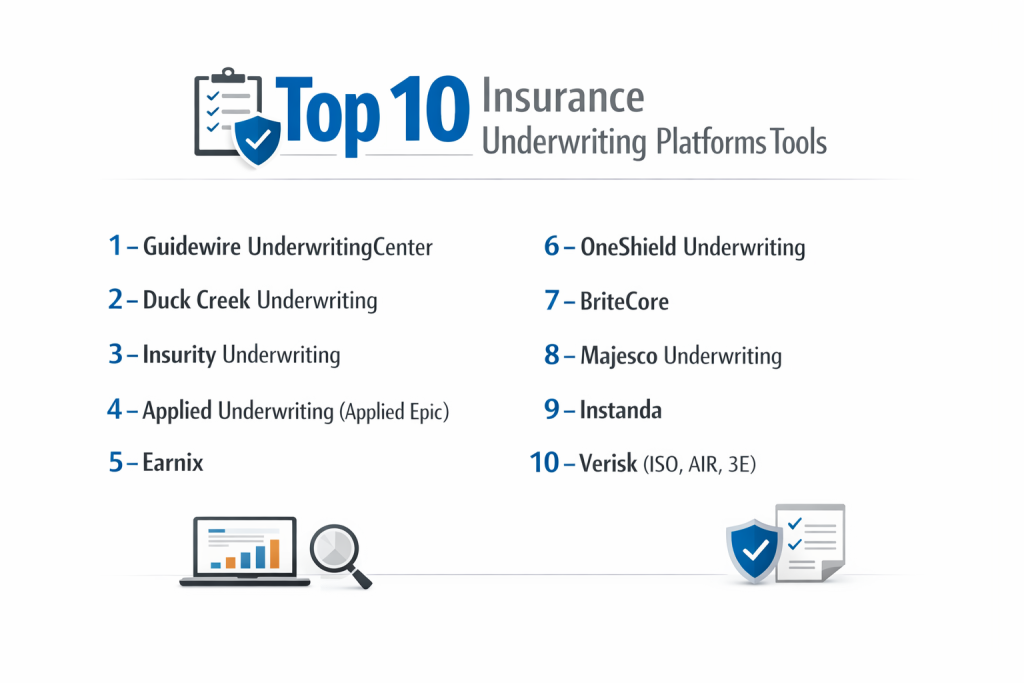
Top 10 Insurance Underwriting Platforms Tools
1 — Guidewire UnderwritingCenter
Guidewire UnderwritingCenter is the underwriting component of the industry-leading Guidewire core suite. It’s designed for large P&C insurers seeking deep integration, powerful workflow, and enterprise-scale configurability.
Key features:
- Deep Integration with PolicyCenter: Provides a unified view of the risk from submission through policy issuance.
- Powerful Workflow Engine: Automates routing, referral rules, and underwriting authority levels.
- Comprehensive Risk Evaluation: Tools to assess both policy and risk-level details, supporting complex commercial lines.
- Portfolio Management Dashboards: Allows chief underwriters to monitor book performance and adherence to guidelines.
- Rules-Based Decisioning: Enforces underwriting guidelines consistently and flags exceptions.
- Submission & Quote Management: Handles the entire lifecycle from broker submission to bound policy.
Pros:
- Unmatched depth and integration for large, complex P&C insurance operations.
- Enforces strict process control and auditability, which is crucial for regulated entities.
- Scalable and reliable for high-volume, multi-line underwriting.
Cons:
- Extremely expensive with long, complex implementation cycles (often years).
- Requires significant IT resources or expensive system integrators to configure and maintain.
- Can be overly rigid and complex for insurers with simpler products or a need for extreme agility.
Security & compliance: Enterprise-grade security, data encryption, and compliance with global insurance regulations (e.g., GDPR, state-specific insurance laws).
Support & community: Supported by a vast ecosystem of Guidewire implementation partners and a large, established user community.
2 — Duck Creek Underwriting
Duck Creek Underwriting is a modern, cloud-native platform built for speed and agility. It empowers insurers to rapidly configure and deploy new underwriting products and guidelines.
Key features:
- Cloud-Native SaaS Platform: Offers scalability, easier updates, and reduced IT overhead.
- Low-Code/No-Code Configuration: Business users (product managers, actuaries) can modify rating rules and underwriting logic without heavy IT involvement.
- Real-Time Data Integration: Pulls in external data (like telematics, property characteristics) for dynamic risk assessment.
- Automated Risk Selection & Pricing: Uses configured rules and AI to make instant decisions on standard risks.
- Seamless Duck Creek Suite Integration: Works with Duck Creek Policy, Billing, and Claims for a unified process.
- Digital Self-Service: Enables direct or agent-based quoting and underwriting through customer portals.
Pros:
- Dramatically faster time-to-market for new insurance products and underwriting changes.
- Greater business agility and empowerment compared to legacy, IT-dependent systems.
- Modern user experience that improves underwriter productivity.
Cons:
- The shift to a full SaaS model requires a change in operations for traditional insurers.
- While configurable, highly unique or complex commercial underwriting logic may still present challenges.
- Best leveraged as part of the full Duck Creek ecosystem.
Security & compliance: Built on major cloud infrastructure (AWS, Azure) with inherent security and compliance certifications (SOC 2, ISO 27001).
Support & community: Supported by Duck Creek and its partner network, with an active user community.
3 — Insurity Underwriting
Insurity offers cloud-based core solutions with a strong focus on analytics. Its underwriting platform leverages AI and external data to enhance risk assessment and automate decisions.
Key features:
- AI-Powered Risk Insights: Predictive models score risks for potential loss, fraud, or profitability.
- Touchless Underwriting: Automates the entire process for simple, low-risk submissions.
- Unified Data View: Aggregates internal and external data (e.g., claims history, credit, public records) into a single underwriter dashboard.
- Dynamic Pricing & Rating: Allows for sophisticated, data-driven price optimization.
- Workflow & Referral Management: Streamlines the process for risks that require human review.
- Cloud-Based Architecture: Provides scalability and agility for midsize to large carriers.
Pros:
- Strong emphasis on using data and AI to improve underwriting accuracy and efficiency.
- Modern platform that helps insurers compete with data-driven insurtechs.
- Well-suited for carriers looking to modernize their underwriting without a full “big bang” core replacement.
Cons:
- May have a stronger presence in certain P&C niches (e.g., personal lines, small commercial).
- The depth of features for highly specialized, large commercial underwriting may differ from legacy suites.
- Success depends on access to quality data for the AI models.
Security & compliance: Cloud security with compliance certifications relevant to the insurance industry and data privacy laws.
Support & community: Offers customer support, training, and a partner ecosystem.
4 — Applied Underwriting (Applied Epic)
Applied Epic is a widely-used agency management system, and its underwriting module is a key strength. It’s designed for insurance agencies, brokerages, and MGAs that have underwriting authority or need robust submission and rating tools.
Key features:
- Centralized Submission Management: Tracks risks from multiple carriers and MGAs in one place.
- Comparative Rating: Quotes and compares rates from different insurers or programs.
- Carrier & MGA Integration: Electronic connectivity for submission, status updates, and policy issuance.
- Document Management & Imaging: Stores all application and supporting documents.
- Client & Policy History: Maintains a complete record for renewal underwriting.
- Workflow Automation: Manages tasks, deadlines, and communications for producers and CSRs.
Pros:
- The leading system for agencies that need to manage the underwriting process across multiple carriers.
- Excellent for streamlining the submission process and improving brokerage efficiency.
- Deeply embedded in the brokerage community with extensive training and support.
Cons:
- It is an agency/brokerage system first, not a carrier core underwriting system like Guidewire.
- Can be complex and expensive for smaller agencies.
- The underwriting logic itself is often driven by the connected carrier/MGA systems.
Security & compliance: Provides security features appropriate for sensitive client and policy data handled by agencies.
Support & community: Massive user base with a strong network of user groups, conferences, and training resources.
5 — Earnix
Earnix is a specialized rating, pricing, and underwriting optimization platform. It focuses on the analytical heart of underwriting: setting the most accurate and competitive price.
Key features:
- Advanced Price Optimization: Uses statistical models and market data to recommend optimal prices for risk segments.
- Real-Time Rating: Integrates sophisticated pricing models into online quoting engines.
- Underwriting Rules Integration: Embeds rules for risk selection and tiering directly into the pricing engine.
- What-If Scenario Analysis: Models the impact of price changes on volume, profitability, and market share.
- Telematics & Usage-Based Insurance (UBI) Support: Specialized for dynamic, behavior-based pricing.
- Cross-Sell/Upsell Recommendations: Suggests additional coverages during the quote process.
Pros:
- Unparalleled depth in predictive analytics and price optimization for insurance.
- Helps insurers move from static manual pricing to dynamic, data-driven pricing.
- Can be integrated with existing core systems to enhance their pricing capabilities.
Cons:
- It is a best-of-breed analytical engine, not a complete underwriting workflow system.
- Requires actuarial and data science expertise to configure and manage.
- The investment is justified by the value of improved pricing accuracy and profitability.
Security & compliance: Enterprise-level security for protecting proprietary pricing models and sensitive customer data.
Support & community: Supported by Earnix’s team of data scientists and consultants, with a focus on achieving business outcomes.
6 — OneShield Underwriting
OneShield offers a flexible, component-based platform for P&C insurance. Its underwriting solution is known for configurability and is aimed at carriers and MGAs looking for a modern alternative to legacy systems.
Key features:
- Component-Based Architecture (Dragonfly): Allows insurers to select and implement specific underwriting capabilities.
- Dynamic Product Designer: Tools for business users to configure underwriting rules, forms, and workflows.
- Rules & Rating Engine: Centralized engine that drives decisions across quoting, underwriting, and policy management.
- Integrated Data Services: Facilitates pulling in third-party data for risk assessment.
- Portal for Agents & Insureds: Supports direct and assisted distribution channels.
- Cloud or On-Premise Deployment: Offers deployment flexibility.
Pros:
- High degree of configurability can lead to faster implementation than traditional monolithic systems.
- Suitable for carriers and MGAs with unique products or those in rapid growth mode.
- Modern architecture designed for integration and agility.
Cons:
- May not have the same market footprint or brand recognition as the largest core suite vendors.
- The component-based approach requires careful planning to ensure all needed functions are covered.
- Implementation can still be a significant project.
Security & compliance: Provides security and compliance features required for insurance operations.
Support & community: Offers implementation services and customer support.
7 — BriteCore
BriteCore is a modern, cloud-native, all-in-one core administration platform. Its underwriting capabilities are built into the unified system, offering a seamless experience for midsize P&C insurers.
Key features:
- Unified Platform: Underwriting is intrinsically linked to policy, billing, and claims data.
- Modern Underwriter Workstation: Clean interface with all risk information, rules, and tools in one place.
- Automated Underwriting Rules: Handles clear-cut accept/decline decisions automatically.
- Integrated Data Services: Easy connectivity to common third-party data providers.
- API-First Design: Simplifies adding new data sources or distribution channels.
- Self-Service Agent & Customer Portals: Enables quoting and underwriting initiation online.
Pros:
- Offers a complete, modern core system with underwriting at a competitive total cost of ownership.
- Particularly attractive to growing and midsize carriers seeking operational efficiency.
- Fast implementation and easier maintenance compared to legacy core systems.
Cons:
- Market presence is strongest with small to midsize carriers.
- May not offer the extreme depth of configuration for highly complex specialty commercial lines.
- As a full suite, it’s a commitment to one vendor.
Security & compliance: Cloud-native security with SOC 2 compliance and adherence to data privacy standards.
Support & community: Known for strong, partnership-oriented customer support.
8 — Majesco Underwriting
Majesco provides a modern core platform with a strong focus on innovation and new business models. Its underwriting solution supports both traditional and emerging insurance models like on-demand or parametric insurance.
Key features:
- Digital-First Platform: Built to support digital distribution and straight-through processing.
- Product & Underwriting Configuration Studio: Allows rapid design and launch of new underwriting products.
- Microservices Architecture: Enables flexible deployment and integration of underwriting services.
- Data & Analytics Hub: Centralizes data for AI/ML-driven underwriting insights.
- Omni-channel Distribution Support: Underwriting logic consistent across web, mobile, agent, and partner channels.
- Cloud-Native: Leverages cloud scalability and services.
Pros:
- Excellent for insurers looking to launch innovative products or experiment with new business models.
- Modern architecture that supports digital transformation journeys.
- Strong in the L&A and Group/Employee Benefits spaces as well as P&C.
Cons:
- May be a less familiar name than the largest legacy players in some markets.
- The focus on innovation might mean less emphasis on replicating every nuance of a legacy process.
- Requires a strategic commitment to a modern tech stack.
Security & compliance: Cloud-based security with relevant industry and data privacy compliance.
Support & community: Supported by Majesco’s services organization and partner network.
9 — Instanda
Instanda is a no-code platform for rapid insurance product development and underwriting. It empowers insurers to design, configure, and launch new products in weeks, not months.
Key features:
- Visual No-Code Studio: Allows product managers to design underwriting rules, questions, and logic without writing code.
- Real-Time Product Deployment: New or modified underwriting products can be launched to market almost instantly.
- Integrated Rating Engine: Visual tools to build complex rating algorithms.
- Omni-channel Distribution: Once built, products are instantly available via API for any digital channel.
- Full Policy Lifecycle Management: Handles the journey from quote and underwriting to policy and claims.
- Cloud-Native Platform: Built for scalability and global reach.
Pros:
- Unmatched speed in bringing new underwriting products and changes to market.
- Democratizes product development, freeing it from IT bottlenecks.
- Ideal for insurers, MGAs, or insurtechs in fast-moving markets.
Cons:
- The no-code approach, while powerful, may have boundaries for extremely complex, legacy-style underwriting logic.
- Represents a different way of working that requires organizational adaptation.
- A newer player compared to established core system vendors.
Security & compliance: Enterprise-grade cloud security with compliance certifications (SOC 2, ISO 27001).
Support & community: Focuses on customer success and enabling rapid product launches.
10 — Verisk (ISO, AIR, 3E)
Verisk is not a single underwriting platform but a comprehensive suite of data, analytics, and standardized tools that form the backbone of underwriting in North America. It’s the intelligence layer that platforms integrate with.
Key features:
- ISO Standardized Forms & Rules: The industry baseline for policy language and underwriting rules.
- ISO Rating Data: Provides advisory loss costs and rating factors used by most insurers.
- Catastrophe Modeling (AIR): Models potential losses from hurricanes, earthquakes, etc., crucial for risk selection and pricing.
- Geospatial & Property Data (3E): Detailed data on property characteristics, replacement costs, and hazard proximity.
- Specialized Data Services: MVRs, credit-based insurance scores, claims history (ISO ClaimSearch).
- Regulatory & Compliance Tools: Helps ensure underwriting practices comply with state regulations.
Pros:
- Provides the essential, trusted data and standardized frameworks that make consistent underwriting possible.
- Its tools are integrated into virtually every major underwriting platform in the U.S.
- Indispensable for credible risk assessment, especially in property insurance.
Cons:
- It is not a workflow or policy administration system; it’s a data and analytics provider.
- Insurers become reliant on its standards, which can limit differentiation.
- Licensing costs for its various services can be significant.
Security & compliance: Handles massive volumes of sensitive data with the highest security and compliance standards.
Support & community: Extensive industry education, training, and consulting services.
Comparison Table
| Tool Name | Best For (target user or scenario) | Platform(s) Supported | Standout Feature | Rating |
|---|---|---|---|---|
| Guidewire UnderwritingCenter | Large P&C insurers needing deep, integrated, and highly configurable enterprise control. | On-premise, Cloud | Enterprise Depth & Workflow Integration | High (Enterprise Leader) |
| Duck Creek Underwriting | Insurers prioritizing cloud agility, speed-to-market, and business-user configurability. | Cloud (SaaS) | Cloud-Native Agility & Low-Code Configuration | High |
| Insurity Underwriting | P&C carriers wanting strong AI/analytics and modern underwriting automation. | Cloud | AI-Powered Risk Insights & Automation | High |
| Applied Epic | Insurance agencies, brokerages, and MGAs managing submissions across multiple carriers. | Cloud, Desktop | Brokerage-Centric Submission & Rating Management | High (Agency Leader) |
| Earnix | Insurers focused on advanced predictive analytics for pricing and underwriting optimization. | Cloud, On-premise | Best-of-Breed Price Optimization & Analytics | High (Analytics Leader) |
| OneShield Underwriting | Carriers & MGAs seeking a configurable, modern alternative to legacy core systems. | Cloud, On-premise | Configurable, Component-Based Architecture | Medium/High |
| BriteCore | Growing/midsize P&C insurers wanting a modern, unified, and efficient all-in-one platform. | Cloud | Unified Core System & Modern UX | High |
| Majesco Underwriting | Insurers launching innovative products or undergoing digital transformation. | Cloud | Digital-First Product Innovation Platform | Medium/High |
| Instanda | Insurers, MGAs, or insurtechs needing to launch and iterate underwriting products at extreme speed. | Cloud | No-Code Product Development & Rapid Launch | Medium/High |
| Verisk | Any insurer in North America needing foundational underwriting data, rules, and catastrophe models. | Data/Service | Industry-Standard Data, Analytics & Forms | N/A (Essential Service) |
Evaluation & Scoring of Insurance Underwriting Platforms
Score tools (1-10) using this rubric. Multiply by the weight to get a total score out of 100.
| Evaluation Category | Weight | What to Look For |
|---|---|---|
| Core Features | 25% | Rules engine, rating/pricing, workflow automation, referral management, submission intake, support for your specific lines of business. |
| Ease of Use | 15% | Intuitive interface for underwriters, clarity of risk presentation, ease of configuring new rules/products, quality of self-service portals. |
| Integrations & Ecosystem | 15% | Pre-built connectors to critical data sources (MVR, credit, property, ISO), policy admin systems, distribution channels, and analytics tools. |
| Security & Compliance | 10% | Data encryption, access controls, audit trails, and compliance with regulations (e.g., state underwriting laws, anti-discrimination laws, GDPR). |
| Performance & Reliability | 10% | Speed of rule execution and quote generation, system uptime, scalability during high-volume periods (e.g., renewal season). |
| Support & Community | 10% | Quality of implementation partners, vendor support responsiveness, user community for sharing best practices, training availability. |
| Price / Value | 15% | Total cost of ownership relative to gains in underwriting efficiency, accuracy, speed-to-market, and portfolio profitability. |
Which Insurance Underwriting Platform Tool Is Right for You?
Find the best match for your organization’s needs:
- By Organization Type & Size:
- Large National/Global P&C Carrier: Guidewire and Duck Creek are the top contenders. Verisk services are mandatory.
- Midsize P&C Insurer or MGA: Duck Creek, Insurity, BriteCore, OneShield, and Majesco offer strong, agile options.
- Insurance Agency/Brokerage with Underwriting: Applied Epic is the dominant platform for submission management.
- Innovator/Insurtech/New MGA: Instanda or Majesco for speed; Duck Creek for scalable agility.
- Life & Health or Specialty Insurer: Evaluate Majesco and Duck Creek for their cross-line capabilities.
- Budget-Conscious vs Premium Solutions:
- Budget-Conscious (for core capability): Modern cloud suites like BriteCore or OneShield can offer better value than multi-year legacy implementations. Instanda’s model can reduce long-term IT costs.
- Premium Solutions: Guidewire is the top-tier investment for those who need its control and have the budget for the journey.
- Feature Depth vs Ease of Use & Agility:
- Prioritize Feature Depth/Control: Guidewire leads in configurability and depth for complex risks.
- Prioritize Ease of Use & Business Agility: Duck Creek, Instanda, and BriteCore excel with modern interfaces and faster configuration.
- Integration and Scalability Needs:
- If you need a unified core system, look at Guidewire, Duck Creek, and BriteCore.
- If you are an agency, integration with carrier portals is key—Applied Epic is built for this.
- For scalability in the cloud and API-driven distribution, Duck Creek, Majesco, and Instanda are designed for it.
- No system is complete without data integration; ensure it connects to Verisk/ISO and other key providers.
- Security and Compliance Requirements:
- Underwriting platforms must enforce compliant underwriting rules. The system should have robust audit trails.
- SOC 2 Type II certification is a key trust indicator for cloud vendors.
- For personal data handling, adherence to GDPR, CCPA, and other privacy laws is critical.
Frequently Asked Questions (FAQs)
1. What is “straight-through processing” (STP) in underwriting?
STP is the full automation of the underwriting decision. For simple, low-risk applications (e.g., a standard auto policy), the system uses rules and data to instantly accept, price, and issue the policy without any human touch.
2. How do these platforms use AI and data?
AI is used to predict risk (e.g., likelihood of a claim), flag anomalies for fraud, optimize pricing, and automate data extraction from documents. Platforms integrate external data (telematics, credit, satellite imagery) to build a richer risk profile.
3. What’s the difference between a rating engine and an underwriting platform?
A rating engine calculates the price based on inputs. An underwriting platform includes the rating engine but also manages the entire process: risk evaluation, rules application, referrals, documentation, and decisioning.
4. Can these systems help ensure underwriting guidelines are followed?
Yes, this is a primary function. The rules engine codifies your guidelines. The system will only allow policies to be issued that pass the rules, or it will flag them for a human underwriter’s review, ensuring consistency and compliance.
5. How long does it take to implement a new underwriting product?
In a legacy system, it can take 6-12 months. In a modern configurable platform (like Duck Creek or Instanda), it can take weeks. This speed-to-market is a major competitive advantage.
6. What is an MGA, and how do they use these platforms?
An MGA (Managing General Agent) is a specialist agent/administrator with underwriting authority from a carrier. They use platforms like Applied Epic, OneShield, or Instanda to manage their unique underwriting programs and operations.
7. Do these platforms integrate with agent/broker portals?
Absolutely. Modern platforms are API-first, allowing seamless integration with an insurer’s or MGA’s agent portal. This enables real-time quoting and underwriting for brokers.
8. What is “portfolio management” in underwriting software?
It allows chief underwriters to monitor the overall health of their book of business: profitability by segment, adherence to risk appetite, concentration of risks, and the performance of underwriting guidelines.
9. What is a common mistake when selecting an underwriting platform?
Choosing a system that simply automates your current, potentially inefficient processes. Instead, look for a platform that enables best practices and provides the agility to improve your processes over time.
10. Can we start with underwriting and add policy later?
With integrated suites (Guidewire, Duck Creek, BriteCore), you can, but the full value is in the integration. With best-of-breed point solutions (like Earnix), you can enhance a specific area, but you’ll face integration challenges with your core policy system.
Conclusion
Selecting the right Insurance Underwriting Platform is a fundamental strategic decision that determines an insurer’s ability to select risk profitably and adapt to a changing market. It is the critical link between data, risk assessment, and profitable growth. From the enterprise control of Guidewire to the cloud agility of Duck Creek, the brokerage focus of Applied Epic, and the revolutionary speed of Instanda, the market offers powerful tools for every underwriting philosophy and business model.
The essential insight is that the “best” system is not just about replicating past practices but about enabling future success. It must balance powerful risk assessment with operational efficiency, enforce compliance while allowing for innovation, and provide underwriters with insight rather than just data. Success depends on aligning the platform’s capabilities with your strategic goals for growth, profitability, and customer experience. Involve underwriters, product managers, actuaries, and IT in the selection to ensure the tool meets both business and technical needs. In the end, a modern underwriting platform is more than software—it’s the engine of sustainable competitive advantage in the fundamental business of insurance.