Introduction
An Insurance Policy Administration System (PAS) is the digital backbone of an insurance company. It is a comprehensive software platform used by carriers, managing general agents (MGAs), and brokers to manage the entire lifecycle of an insurance policy—from initial quoting and underwriting to issuance, renewals, and cancellations. Think of it as the “operating system” for insurance; it stores every detail about the risk being insured, the premium being charged, and the legal language of the contract. In the past, these were rigid, on-premise databases, but modern versions are cloud-native, API-driven ecosystems that allow insurers to launch new products in weeks rather than years.
The importance of a robust PAS cannot be overstated. In an era of increasing competition and “InsurTech” disruption, legacy systems often act as an anchor, preventing companies from providing the digital experience customers expect. A modern PAS automates complex rating algorithms, ensures regulatory compliance through standardized document generation, and provides a “single source of truth” for data. This efficiency reduces operational costs and minimizes human error in the underwriting process. By integrating with third-party data providers—such as vehicle history reports or property satellite imagery—these systems enable “straight-through processing,” where a policy can be quoted and bound in seconds without manual intervention.
Key Real-World Use Cases
Policy Administration Systems are essential for maintaining the velocity and accuracy of insurance operations:
- Product Innovation: Rapidly configuring and launching a new “usage-based” auto insurance product for gig economy workers.
- Automated Renewals: Using preset logic to evaluate expiring policies and automatically sending renewal notices with updated pricing.
- Direct-to-Consumer Portals: Powering the backend of a website where customers can buy a policy and download their ID cards instantly.
- Underwriting Governance: Setting “hard stops” and referral triggers so that junior underwriters cannot approve high-risk cases without senior sign-off.
- Billing and Collections: Managing complex installment plans, premium taxes, and commission payouts to agents.
What to Look For (Evaluation Criteria)
When selecting a PAS, carriers and MGAs should evaluate vendors based on these critical pillars:
- Low-Code/No-Code Configuration: Can business analysts change rates or forms without waiting for IT to write code?
- API Connectivity: Does the system have a “headless” architecture that allows it to connect easily to external portals and data sources?
- Cloud Scalability: Is the platform built for the cloud, ensuring it can handle spikes in traffic during peak renewal seasons?
- Multi-LOB Support: Can it handle different “Lines of Business” (e.g., Auto, Home, Workers’ Comp) within a single instance?
- Compliance and Auditing: Does it maintain a perfect version history of every policy change for regulatory examinations?
Best for:
- Insurance Carriers: Large organizations needing to manage massive volumes of data and complex regulatory requirements across multiple states or countries.
- Managing General Agents (MGAs): Firms that need speed-to-market and high levels of automation to act on behalf of carriers.
- InsurTech Startups: New entrants looking for a cloud-native, “digital-first” foundation to build disruptive products.
- Operations and Underwriting Teams: Professionals who need to streamline manual workflows and reduce administrative burden.
Not ideal for:
- Individual Insurance Agents: Who typically need an Agency Management System (AMS) rather than a full Policy Administration System.
- Small Local Brokerages: Who do not have the authority to issue policies or set rates and primarily act as intermediaries.
- Simple Service Businesses: Companies that are not in the business of risk bearing and only need standard CRM or billing software.
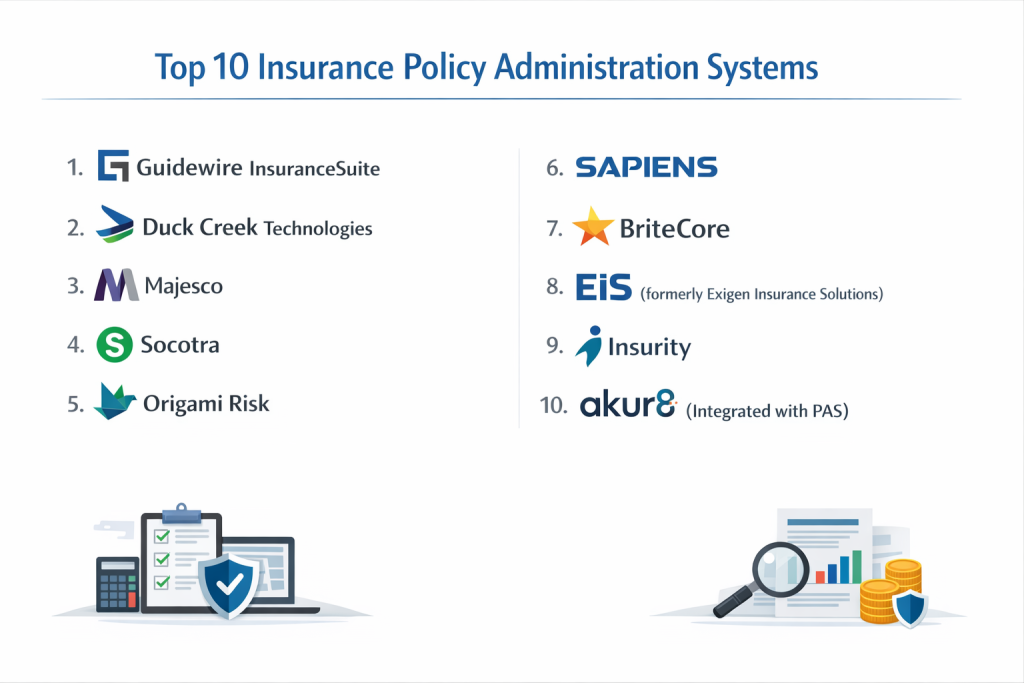
Top 10 Insurance Policy Administration Systems
1 — Guidewire InsuranceSuite
Guidewire is widely recognized as the market leader for P&C (Property and Casualty) insurers globally. Its “InsuranceSuite” provides a comprehensive, end-to-end platform covering policy, billing, and claims, now delivered primarily via the Guidewire Cloud.
Key features:
- PolicyCenter: A highly advanced underwriting and policy management core.
- Guidewire Marketplace: A massive ecosystem of pre-built integrations with third-party data and service providers.
- Advanced Analytics: Integrated predictive scoring to help underwriters make better decisions on the fly.
- Cloud-Native Architecture: Optimized for AWS to provide maximum uptime and scalability.
- Global Content: Pre-configured templates for various international regulatory environments.
Pros:
- The most stable and feature-rich platform on the market with a proven track record for large-scale migrations.
- Massive talent pool of certified developers and consultants available for implementation.
Cons:
- Extremely high cost of ownership, making it accessible mostly to Tier 1 and Tier 2 carriers.
- Implementation projects are notoriously long and complex, often taking years for full deployment.
Security & compliance: SOC 1 & 2, ISO 27001, GDPR, and HIPAA compliant with robust encryption and SSO.
Support & community: World-class enterprise support, a dedicated Guidewire Education portal, and a massive annual user conference (Connections).
2 — Duck Creek Technologies
Duck Creek is the primary competitor to Guidewire, offering a highly flexible, low-code platform. It is famous for its “OnDemand” cloud delivery and its focus on making insurance “product-centric.”
Key features:
- Duck Creek Policy: A low-code environment for configuring complex insurance products.
- Anywhere Integrations: A streamlined framework for connecting to InsurTech partners.
- Author Tool: Allows business users to define rules, rates, and forms without deep programming knowledge.
- Circular Tracking: Automatically tracks changes in ISO (Insurance Services Office) standards to keep policies compliant.
- SaaS Delivery: A fully managed cloud service that handles updates and maintenance.
Pros:
- Generally faster speed-to-market for new products compared to Guidewire.
- The low-code “Author” tool is highly praised for empowering business users over IT.
Cons:
- While powerful, the “inheritance” model in their code can become complex and difficult to debug if over-customized.
- Professional services can be expensive and difficult to secure due to high demand.
Security & compliance: SOC 2 Type II, ISO 27001, and GDPR compliant.
Support & community: Strong online documentation, “Duck Creek University” for training, and a robust partner ecosystem.
3 — Majesco
Majesco focuses on “Core Transformation” for both P&C and Life/Annuity insurers. They have made significant strides in providing “cloud-first” solutions for the mid-market and MGAs.
Key features:
- Majesco CloudInsurer: A comprehensive suite for policy, billing, and claims.
- Digital 360: Tools for building modern agent and customer portals that link directly to the core.
- EcoExchange: A curated marketplace for third-party apps and data services.
- L&A Core: One of the few platforms that handles Life, Annuity, and Group benefits with the same depth as P&C.
- Business Intelligence: Strong built-in reporting for operational and financial metrics.
Pros:
- Excellent for companies that manage both P&C and Life/Annuity lines on a single platform.
- Known for having a very strong roadmap that incorporates emerging tech like Generative AI.
Cons:
- Some legacy components are still being transitioned to the modern cloud architecture.
- Customer support responses can vary depending on the size of the account.
Security & compliance: SOC 1 & 2, GDPR, and ISO 27001 compliant.
Support & community: Comprehensive Majesco Academy and a dedicated customer success model.
4 — Socotra
Socotra is the “modernist” in the group. It was built specifically to be the industry’s first cloud-native, API-first core platform, targeting InsurTechs and innovative legacy carriers.
Key features:
- API-First Design: Every single feature in the platform is accessible via a public API.
- Socotra App Market: A modern way to add features like credit card processing or vehicle lookups in clicks.
- True SaaS: Unlike “cloud-hosted” versions of old software, Socotra is a single-version, multi-tenant platform.
- No-Code Configuration: A clean, modern UI for defining insurance products.
- Data Transparency: Direct access to all data via SQL-like queries and real-time events.
Pros:
- Unmatched speed-to-market; some MGAs have launched new products in less than 3 months.
- The documentation is developer-friendly, making it easy for internal teams to build around it.
Cons:
- It lacks some of the “heavy” legacy features required by complex, centuries-old Tier 1 carriers.
- The ecosystem of specialized third-party consultants is smaller than Guidewire or Duck Creek.
Security & compliance: SOC 2 Type II and GDPR compliant; uses high-level AWS security protocols.
Support & community: Excellent digital documentation and a responsive Slack-based community for developers.
5 — Origami Risk
Origami Risk started as a Risk Management Information System (RMIS) and evolved into a powerful, unified P&C insurance core. It is highly regarded for its flexibility and user-friendly design.
Key features:
- Single Platform: Policy, billing, claims, and risk management all exist in one unified database.
- Self-Service Portals: Highly configurable portals for agents and policyholders.
- Workflow Automation: A drag-and-drop tool for building complex business processes.
- Advanced Dashboards: Real-time visual data that allows users to “drill down” into specific policies.
- Multi-Tenant SaaS: Ensures all customers are on the latest version of the software.
Pros:
- Exceptionally high customer satisfaction scores due to its ease of use.
- Highly flexible—it can handle specialized niche products that rigid systems struggle with.
Cons:
- Not as well-known for “Global” insurance needs compared to Guidewire.
- The system’s flexibility can lead to “configuration sprawl” if not managed by a disciplined admin.
Security & compliance: SOC 1 & 2, HIPAA, and ISO 27001 compliant.
Support & community: Known for a very hands-on implementation and support model.
6 — Sapiens
Sapiens is a global provider with a massive footprint in Europe and Asia, and a growing presence in North America. They offer specialized cores for P&C, Life, and Reinsurance.
Key features:
- Sapiens IDITSuite: A modular P&C core that is highly popular in international markets.
- Sapiens CoreSuite for L&A: Deep functionality for complex life and pension products.
- Decision Management: A specialized tool (Sapiens Decision) for managing complex business logic.
- Reinsurance Core: One of the market-leading tools for managing complex treaty and facultative reinsurance.
- Low-Code Tools: Visual editors for product configuration and business rules.
Pros:
- Unrivaled expertise in the Reinsurance and Life/Annuity sectors.
- Strong global presence with support for multiple currencies, languages, and tax laws.
Cons:
- The interface can feel more “corporate” and less “modern” than Socotra or Origami.
- Implementation can be slow due to the massive depth of the software’s features.
Security & compliance: ISO 27001, SOC 2, and GDPR compliant.
Support & community: Extensive global support centers and a deep bench of subject matter experts.
7 — BriteCore
BriteCore is a cloud-native platform designed specifically for the mid-market and regional P&C carriers. It focuses on providing a modern experience without the Tier 1 price tag.
Key features:
- BriteLines: A graphical tool for building and testing insurance products.
- BriteApps: Pre-built portals for agents and policyholders.
- BriteData: A robust data warehouse and reporting engine.
- AWS-Native: Fully optimized for Amazon Web Services for reliability and speed.
- API Library: A strong set of APIs for integrating with the broader InsurTech ecosystem.
Pros:
- Excellent value for regional carriers who need a modern cloud system but have limited budgets.
- The community-driven roadmap allows users to suggest and vote on new features.
Cons:
- Not designed to handle the “Mega-Carrier” complexity of Guidewire.
- Some users have reported that certain advanced features require more manual effort than expected.
Security & compliance: SOC 2 Type II and standard AWS security protocols.
Support & community: Active user community and a very responsive, North American-based support team.
8 — EIS (formerly Exigen Insurance Solutions)
EIS is an “Insurance Content” powerhouse that focuses on high-volume, customer-centric insurers. They emphasize the “Customer” over the “Policy” in their data model.
Key features:
- CustomerCore: A CRM-like foundation that puts the policyholder at the center of the data.
- PolicyCore: Handles complex, high-volume policy life cycles.
- Cloud-Native Microservices: A highly modern technical architecture that allows for rapid updates.
- D2C Capabilities: Strong support for “Direct-to-Consumer” sales and service models.
- Multi-Line Support: Handles P&C, Life, and Health on a single architectural foundation.
Pros:
- Best for carriers moving toward a “Retail-style” customer experience.
- The microservices architecture is among the most advanced in the industry.
Cons:
- Requires a high level of technical maturity from the internal IT team to manage.
- Can be very expensive to implement and maintain.
Security & compliance: SOC 1 & 2, HIPAA, and ISO 27001 compliant.
Support & community: Strong enterprise support and a focus on long-term “Transformation” partnerships.
9 — Insurity
Insurity is a specialized provider that focuses heavily on “Data and Analytics.” They have acquired several niche players to create a broad suite of P&C solutions.
Key features:
- Policy Decisions: A robust core for commercial lines carriers.
- Insurity Analytics: Deep data science tools integrated directly into the policy workflow.
- SureSuite: A modular approach for policy, billing, and claims.
- Workers’ Comp Specialist: One of the best solutions on the market for Workers’ Compensation carriers.
- Cloud Services: Fully managed AWS-hosted solutions.
Pros:
- The go-to choice for Workers’ Comp and specialized Commercial Lines.
- Their data analytics capabilities are often superior to other core providers.
Cons:
- Because it is built from several acquisitions, some modules can feel slightly less integrated than a “born-together” suite.
- The UI is functional but lacks the “wow factor” of some newer competitors.
Security & compliance: SOC 2 Type II and ISO 27001 compliant.
Support & community: Highly experienced support staff with deep niche industry knowledge.
10 — Akur8 (Integrated with PAS)
While Akur8 is technically a “Pricing and Rating” engine, it has become an essential part of the modern Policy Administration stack. It uses transparent AI to help insurers set the right price for every policy.
Key features:
- Transparent AI: Automates the creation of Generalized Linear Models (GLMs) that are fully auditable.
- Risk Modeling: Rapidly identifies the drivers of risk in a book of business.
- Demand Modeling: Predicts how customers will react to price changes.
- PAS Integration: Connects via API to tools like Socotra, Guidewire, and Duck Creek.
- Rate Impact Analysis: Visualizes how a new rating plan will affect the current portfolio.
Pros:
- Dramatically reduces the time it takes for actuaries to build and file rating plans.
- The AI is “Explainable,” meaning regulators can understand why a price was set.
Cons:
- It is not a standalone PAS; it must be paired with one of the other tools on this list.
- Highly specialized tool that requires actuarial knowledge to use effectively.
Security & compliance: SOC 2 Type II and GDPR compliant.
Support & community: High-touch actuarial support and a strong global user base.
Comparison Table
| Tool Name | Best For | Platform(s) Supported | Standout Feature | Rating |
| Guidewire | Tier 1 Global Carriers | Cloud (AWS) | Ecosystem/Marketplace | N/A |
| Duck Creek | Low-Code Flexibility | Cloud (Azure) | Authoring Tool | N/A |
| Majesco | Multi-Line (P&C + Life) | Cloud | L&A + P&C Maturity | N/A |
| Socotra | InsurTech / API-First | True SaaS | 100% API Exposure | N/A |
| Origami Risk | Specialized P&C / Ease of Use | Multi-Tenant SaaS | Unified Data Model | N/A |
| Sapiens | Global / Reinsurance | Cloud / On-Prem | Reinsurance Depth | N/A |
| BriteCore | Regional Carriers | Cloud (AWS) | Mid-Market Value | N/A |
| EIS | Customer-Centric Models | Cloud (Microservices) | Customer-First Data | N/A |
| Insurity | Workers’ Comp / Analytics | Cloud | Predictive Analytics | N/A |
| Akur8 | AI-Driven Rating | API / Cloud | Transparent AI | N/A |
Evaluation & Scoring of Insurance Policy Administration Systems
| Criterion | Weight | Evaluation Focus |
| Core Features | 25% | Underwriting rules, rating engine, and renewal automation. |
| Ease of Use | 15% | No-code tools for business users and admin UI quality. |
| Integrations | 15% | API quality, marketplace depth, and InsurTech connectivity. |
| Security & Compliance | 10% | SOC 2, ISO 27001, and regulatory reporting tools. |
| Performance | 10% | System uptime, cloud scalability, and speed of quoting. |
| Support | 10% | Implementation partners, training, and 24/7 technical help. |
| Price / Value | 15% | Total cost of ownership vs. operational efficiency gains. |
Which Policy Administration System Is Right for You?
Solo Users vs SMB vs Mid-Market vs Enterprise
There are no “Solo Users” for a full PAS, but for Small MGAs, Socotra or BriteCore are the clear winners. They allow a small team to act like a giant by leveraging high automation. Mid-Market carriers who need more robust “legacy” features but still want modern tech should look at Origami Risk or Majesco. Enterprise giants (Tier 1 carriers) almost always default to Guidewire or Duck Creek because they are the only systems with the proven “heft” to handle billions in premium and complex multi-state regulatory filings.
Budget-Conscious vs Premium Solutions
If you are budget-conscious, BriteCore and Origami Risk provide the most “bang for your buck” by offering integrated suites that reduce the need for third-party add-ons. Guidewire and EIS are the “Premium” solutions—they are significantly more expensive, but they offer the most advanced microservices and the widest ecosystem of partners, which can be a strategic advantage for those who can afford it.
Feature Depth vs Ease of Use
If you need extreme “Feature Depth” (e.g., you write complex reinsurance treaties or pension products), Sapiens is the market leader. However, if “Ease of Use” and speed-to-market are your primary drivers so that your underwriters don’t spend all day fighting the system, Socotra and Origami Risk are much more intuitive and modern.
Integration and Scalability Needs
If you plan to build a “Digital Ecosystem” where you pull in data from 50 different InsurTech partners, Socotra’s API-first architecture or EIS’s microservices are the best choices. For companies that want “Stability” and a pre-integrated “One-Stop-Shop,” the Guidewire Marketplace provides the most mature environment for scaling.
Security and Compliance Requirements
Every tool on this list meets basic insurance security standards, but for those with high-security needs (e.g., government-backed insurance or multi-national compliance), Sapiens and Guidewire have the most experience with complex global regulatory bodies and audit logs.
Frequently Asked Questions (FAQs)
What is the difference between a PAS and a CRM?
A CRM (like Salesforce) manages people and relationships. A PAS manages the actual insurance contract, the premium calculations, and the legal policy documents.
How long does an implementation take?
For a modern SaaS tool like Socotra, it can be 3–6 months. For a Tier 1 system like Guidewire, a full migration can take 2–4 years.
What is ‘Straight-Through Processing’ (STP)?
STP is when a policy is quoted, underwritten by a computer, and issued without a human being ever looking at it.
Can these systems handle ‘Usage-Based’ insurance?
Modern cloud systems like Duck Creek and Socotra are designed for this. Older, on-premise legacy systems often struggle with the rapid data influx from telematics.
What is ‘Low-Code’ in insurance?
It means a business analyst can change a rate (e.g., increase auto rates by 5% in California) by changing a number in a table rather than writing new code.
Is my data safe in the cloud?
Yes. Modern PAS providers use AWS or Azure, which offer security levels (SOC 2, ISO 27001) that are far superior to what most insurance companies can provide in their own data centers.
Do these systems handle claims?
Many (like Guidewire and Duck Creek) are sold as suites that include claims, but they can also be bought as standalone policy modules that integrate with other claims tools.
What is a ‘Multi-Tenant’ SaaS?
It means every customer is on the same version of the software. When the vendor adds a new feature, everyone gets it at the same time, preventing “version lock.”
Why are PAS migrations so expensive?
The cost isn’t just the software; it’s the cost of moving millions of lines of old, messy data from a 30-year-old system into a new one.
Can a PAS help with regulatory filings?
Yes. Systems like Sapiens and Insurity have built-in tools to generate the specific reports required by state regulators and the NAIC.
Conclusion
Choosing an Insurance Policy Administration System is one of the most significant decisions an insurance executive will ever make. It is a long-term commitment that will define the company’s ability to innovate, serve customers, and remain profitable for the next decade. If you are an InsurTech MGA, the speed and openness of Socotra is unbeatable. If you are a regional carrier looking for stability and value, BriteCore or Origami Risk are the most reliable partners. For the global giants, Guidewire and Duck Creek remain the titans of the industry for a reason.
Ultimately, the “best” system depends on your specific product mix and technical maturity. The industry is moving away from “The Big Rip and Replace” projects toward modular, cloud-based ecosystems that allow for continuous improvement. When evaluating these tools, look beyond the sales demo and focus on how easily your team can make changes themselves. In the modern insurance world, the fastest to adapt is the one who wins.