Introduction
An Insurance Claims Management System is a specialized end-to-end software platform designed to manage the entire lifecycle of an insurance claim—from the initial First Notice of Loss (FNOL) to final settlement and payment. These systems serve as the central nervous system for claims adjusters, supervisors, and third-party administrators (TPAs). In the past, claims were handled through a mountain of paperwork, endless phone calls, and disparate spreadsheets. Modern systems digitize this entire process, integrating document management, financial reserves tracking, litigation management, and fraud detection into a single interface. By centralizing data, these platforms ensure that every stakeholder—from the claimant to the reinsurer—has access to real-time, accurate information.
The importance of a modern claims system cannot be overstated, as the claims experience is often the “moment of truth” for the customer relationship. A slow, opaque process leads to policyholder churn, while an efficient, transparent one builds lifelong loyalty. Beyond customer satisfaction, these tools are vital for operational profitability. They help insurers reduce “claims leakage”—money lost through inefficient processing, human error, or undetected fraud. By leveraging automation and AI, these systems can “low-touch” or “no-touch” process simple claims (like a windshield repair), allowing human adjusters to focus their expertise on complex, high-value cases. Furthermore, they provide the rigorous audit trails required for regulatory compliance and financial reporting.
Key Real-World Use Cases
Insurance claims management systems are essential for maintaining the financial integrity and service levels of an insurer:
- Catastrophe Response: Rapidly deploying resources and prioritizing claims in the wake of a major hurricane or wildfire using geospatial data.
- Fraud Detection: Using AI to cross-reference claim details against social media and historical databases to flag suspicious patterns.
- Litigation Management: Tracking legal expenses and defense strategies for complex liability cases to minimize indemnity spend.
- Subrogation Recovery: Identifying opportunities to recover costs from third parties responsible for a loss.
- Vendor Management: Coordinating with repair shops, medical providers, and independent adjusters to ensure quality service and fair pricing.
What to Look For (Evaluation Criteria)
When selecting a claims management tool, decision-makers should evaluate vendors based on these core requirements:
- Workflow Automation: Can the system automatically assign claims to the right adjuster based on workload, geography, and expertise?
- Mobile Accessibility: Does the tool offer a robust mobile app for field adjusters to upload photos and statements directly from the loss site?
- Financial Integrity: Does it provide strict controls for reserve management, payment authorizations, and check issuance?
- Integration Capability: Can it connect seamlessly with Policy Administration Systems (PAS) and external data providers (e.g., vehicle history, medical billing)?
- Analytics & Reporting: Does it offer real-time dashboards to track key performance indicators (KPIs) like cycle time and closing ratios?
Best for:
- Insurance Carriers: Large organizations managing high volumes of diverse claims across multiple lines of business.
- Third-Party Administrators (TPAs): Firms that handle claims on behalf of self-insured corporations or traditional insurers.
- Self-Insured Entities: Large corporations (like retailers or logistics firms) that manage their own risk and claims internally.
- Claims Adjusters and Managers: Professionals who need to streamline their daily tasks and improve decision-making accuracy.
Not ideal for:
- General CRM Users: Companies that only need to track customer interactions but don’t handle financial risk or legal settlements.
- Small Independent Agencies: Who primarily sell policies but do not have the authority to settle or pay out claims.
- Simple Accounting Software: While claims involve payments, standard bookkeeping tools lack the regulatory and investigative depth required for insurance.
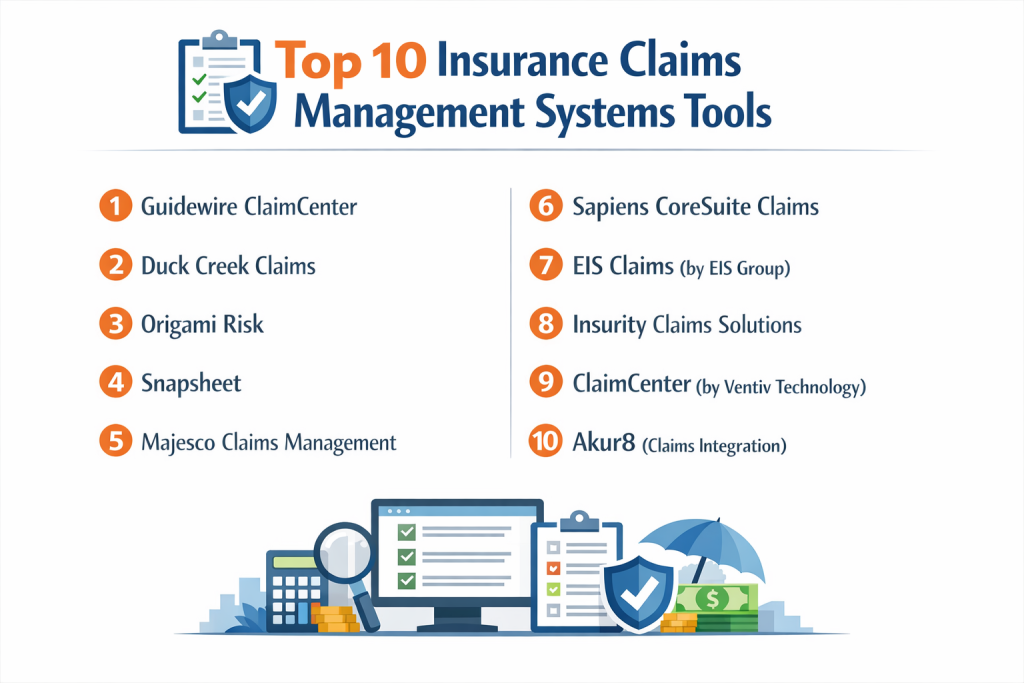
Top 10 Insurance Claims Management Systems Tools
1 — Guidewire ClaimCenter
Guidewire ClaimCenter is widely regarded as the industry benchmark for P&C (Property and Casualty) insurers. It is a comprehensive system designed to handle the most complex claims workflows for the world’s largest carriers.
Key features:
- End-to-End Lifecycle Management: Covers everything from FNOL to recovery and subrogation.
- Smart Assignment: AI-driven logic that matches claims to the most qualified available adjuster.
- Guidewire Cloud: A fully managed SaaS environment optimized for AWS.
- Marketplace Integrations: Hundreds of pre-built “ready for” integrations with InsurTech partners.
- Advanced Financials: Precision tracking of reserves, payments, and bulk invoices.
Pros:
- Unmatched scalability and depth; there is virtually no claims scenario the system cannot handle.
- Massive global community of certified developers and implementation partners.
Cons:
- High total cost of ownership (TCO) makes it a “Premium” choice for larger carriers.
- Implementation can be long and labor-intensive due to the system’s vast complexity.
Security & compliance: SOC 1 & 2, ISO 27001, GDPR, and HIPAA compliant.
Support & community: Extensive documentation, “Guidewire Education” certifications, and a massive global user base.
2 — Duck Creek Claims
Duck Creek Claims is a highly flexible, low-code platform that allows insurers to adapt quickly to changing market conditions. It is known for its “OnDemand” cloud delivery and user-centric design.
Key features:
- Low-Code Configuration: Business users can modify workflows without deep IT involvement.
- Duck Creek Anywhere: An API-first architecture for easy connectivity to the broader ecosystem.
- Anywhere Managed Integrations: Pre-configured connectors for data providers and service vendors.
- Automated Adjudication: Capable of straight-through processing for simple, high-frequency claims.
- Unified Data Model: Ensures consistency across policy, billing, and claims modules.
Pros:
- Faster speed-to-market for workflow changes compared to traditional legacy systems.
- Modern, intuitive interface that reduces training time for new adjusters.
Cons:
- Can become complex to manage if too many custom “low-code” variations are created.
- Smaller third-party consultant pool compared to the market leader.
Security & compliance: SOC 2 Type II, ISO 27001, and GDPR compliant.
Support & community: Strong online training portals and a proactive user community.
3 — Origami Risk
Origami Risk is a highly rated, unified platform that combines claims management with risk management and safety tools. It is famous for its “single-version” SaaS model and extreme configurability.
Key features:
- Unified Platform: Claims, safety, and risk data all exist in one single database.
- Automated Workflows: Drag-and-drop tools to build custom claim lifecycles.
- Standard & Custom Reporting: Exceptional data visualization and “drill-down” capabilities.
- Mobile Adjuster App: Full field functionality with photo capture and GPS tagging.
- Vendor Portal: Allows external partners (like repair shops) to update claim status directly.
Pros:
- Consistently ranked highest for customer satisfaction and ease of implementation.
- One of the most flexible platforms for specialized or niche insurance lines.
Cons:
- Might lack some of the “deep” global regulatory content for very large multi-national carriers.
- The flexibility requires a disciplined admin to prevent “configuration clutter.”
Security & compliance: SOC 1 & 2, HIPAA, and ISO 27001 compliant.
Support & community: High-touch customer service model with dedicated service teams.
4 — Snapsheet
Snapsheet is a “Digital-First” claims platform that originally specialized in virtual auto appraisals. It has evolved into a full cloud-native claims management suite focused on speed and automation.
Key features:
- Virtual Appraisal Integration: Built-in tools for photo-based damage estimation.
- Digital Communications: Native support for SMS and email communication with claimants.
- Automated FNOL: A modern, mobile-friendly intake process for policyholders.
- Payment Hub: Integrated digital payment options (EFT, virtual cards) for instant settlements.
- Omnichannel Support: Syncs all communications (phone, text, email) into a single claim timeline.
Pros:
- Excellent for insurers looking to provide a “Modern/Startup” experience to customers.
- Rapid implementation and a very clean, “uncluttered” user interface.
Cons:
- Primarily focused on P&C; may not be the best fit for complex Life or Health lines.
- Lacks the decades-long legacy of managing high-complexity litigation at scale.
Security & compliance: SOC 2 Type II and GDPR compliant.
Support & community: Strong focus on digital onboarding and rapid tech support.
5 — Majesco Claims Management
Majesco provides a cloud-native claims platform that is part of their broader “CloudInsurer” suite. They are known for their forward-looking roadmap and integration of emerging technologies.
Key features:
- Ready-to-use Content: Pre-configured for various lines of business (Auto, Home, Workers’ Comp).
- Majesco Digital1st: A platform for building innovative digital engagement layers on top of the core.
- AI & Analytics: Embedded tools for predicting claim severity and fraud risk.
- Flexible Financials: Supports multi-currency and complex tax calculations for global operations.
- Customer Self-Service: Robust portals for claimants to track progress and upload documents.
Pros:
- Strongest choice for insurers who want a single vendor for Policy, Billing, and Claims.
- Very proactive in integrating Generative AI into the claims workflow.
Cons:
- Some modules can feel less “unified” as they transition older tech to the modern cloud.
- Professional services can be a significant added cost for complex setups.
Security & compliance: SOC 1 & 2, ISO 27001, and GDPR compliant.
Support & community: “Majesco Academy” for training and a well-structured customer success program.
6 — Sapiens CoreSuite Claims
Sapiens is a global powerhouse with a particularly strong presence in Europe and Asia. Their claims suite is designed for “Global-First” companies that need to manage diverse regulations and languages.
Key features:
- Global Configuration: Native support for multiple languages, currencies, and local legislations.
- Business Logic Engine: A specialized tool (Sapiens Decision) for managing complex rules.
- Enterprise-Wide Search: Powerful indexing that finds data across millions of claim files.
- Workers’ Compensation Specialist: One of the most robust modules for injury management.
- Reinsurance Integration: Seamlessly links claims data to reinsurance recovery workflows.
Pros:
- Unbeatable expertise for multi-national carriers operating in complex regulatory zones.
- Very strong financial controls and audit capabilities.
Cons:
- The interface can feel more “utilitarian” and less modern than some US-based rivals.
- Implementation usually requires a heavy “waterfall” project management approach.
Security & compliance: ISO 27001, SOC 2, and GDPR compliant.
Support & community: Extensive global support network with local offices in multiple countries.
7 — EIS Claims (by EIS Group)
EIS is a customer-centric platform that focuses on high-volume insurers. Their claims system is built on a microservices architecture, making it highly scalable and “API-ready.”
Key features:
- Customer-Centric Data Model: Sees the “Person” first, rather than just the “Claim Number.”
- Microservices Architecture: Allows for parts of the system to be updated without downtime.
- D2C Capabilities: Designed for “Direct-to-Consumer” sales and service models.
- Omnichannel Engagement: Consistent experience across web, mobile, and call centers.
- High-Volume Engine: Specifically engineered to handle massive spikes in transaction volume.
Pros:
- Best choice for large insurers undergoing a total digital transformation toward “Retail” style service.
- Unmatched flexibility for developers to build custom front-end experiences.
Cons:
- Requires a high level of internal technical maturity to manage the microservices environment.
- Can be very expensive to license and maintain for mid-sized players.
Security & compliance: SOC 2 Type II, HIPAA, and ISO 27001 compliant.
Support & community: High-end enterprise support and strategic partnership models.
8 — Insurity Claims Solutions
Insurity specializes in “Data-Forward” insurance solutions. Their claims platform is particularly popular among MGAs (Managing General Agents) and commercial lines carriers.
Key features:
- SureSuite Claims: A modular, cloud-based platform with a focus on commercial lines.
- Insurity Analytics: Deep data science tools integrated directly into the claims dashboard.
- Cloud Services: Fully managed AWS hosting with a focus on high availability.
- Workers’ Comp Specialist: Market-leading tools for managing long-tail injury claims.
- API Integration: Strong track record of connecting to niche InsurTech data sources.
Pros:
- Excellent for commercial insurers who need specialized data for complex risk lines.
- Their “Analytics” add-ons are often superior to the native reporting of larger rivals.
Cons:
- Because it is built from several acquisitions, the UI can feel slightly inconsistent across modules.
- Not as well-known for “Personal Lines” (Home/Auto) as Guidewire or Snapsheet.
Security & compliance: SOC 2 Type II and ISO 27001 compliant.
Support & community: Highly experienced support staff with deep niche industry knowledge.
9 — ClaimCenter (by Ventiv Technology)
Ventiv is a leading provider for the self-insured and TPA market. Their claims system is designed to provide maximum transparency to corporate risk managers who need to see every penny spent.
Key features:
- TPA-Specific Workflows: Designed specifically for firms handling claims for multiple different clients.
- Risk Management Integration: Feeds claims data directly into the Ventiv RMIS (Risk Management Information System).
- Litigation Tracking: Deep tools for managing defense counsel and legal spend.
- Automated Diary/Tasking: High-intensity task management for busy adjusters.
- Self-Service Portals: Customizable portals for corporate clients to see their claim stats.
Pros:
- The “Gold Standard” for TPAs and self-insured retailers or manufacturers.
- Exceptional financial reporting for insurance “captives” and alternative risk groups.
Cons:
- Not designed for high-volume “Personal Lines” carriers with millions of policies.
- The interface is functional but can feel “data-heavy” for casual users.
Security & compliance: SOC 2 Type II, HIPAA, and ISO 27001 compliant.
Support & community: Strong professional services and specialized TPA user groups.
10 — Akur8 (Claims Integration)
While Akur8 is primarily an AI pricing engine, its “Claims Integration” has become essential for modern insurers. It helps adjusters predict the “Indemnity” cost of a claim based on historical patterns.
Key features:
- Predictive Severity Modeling: Predicts which claims are likely to “blow up” into high-cost cases.
- Transparent AI: “Explainable” AI that tells the adjuster why it flagged a claim as high-risk.
- Fraud Detection Support: Identifies patterns that correlate with historical fraud cases.
- Reserving Assistance: Helps set more accurate initial reserves based on AI analysis.
- API Connector: Plugs directly into PAS and Claims cores like Socotra or Guidewire.
Pros:
- Dramatically improves the accuracy of “Initial Reserves,” preventing mid-claim financial surprises.
- Helps senior managers spot “Claims Leakage” patterns across the entire book.
Cons:
- It is an “Intelligence Layer,” not a standalone claims system (it needs a core to plug into).
- Highly technical; requires data-literate staff to interpret some of the deeper findings.
Security & compliance: SOC 2 Type II and GDPR compliant.
Support & community: High-touch actuarial and data science support for implementation.
Comparison Table
| Tool Name | Best For | Platform(s) Supported | Standout Feature | Rating |
| Guidewire | Tier 1 Global Carriers | Cloud (AWS) | Ecosystem / Marketplace | N/A |
| Duck Creek | Speed & Flexibility | Cloud (Azure) | Low-Code Configuration | N/A |
| Origami Risk | Specialized Lines / TPA | Multi-Tenant SaaS | Unified Data Model | N/A |
| Snapsheet | Digital-First Experience | Cloud Native | Virtual Appraisal Engine | N/A |
| Majesco | Suite Synergy | Cloud | AI-Embedded Workflows | N/A |
| Sapiens | Global / Multi-National | Cloud / On-Prem | Multi-Country Content | N/A |
| EIS Claims | Customer-Centricity | Microservices | Person-First Data Model | N/A |
| Insurity | Commercial / Workers’ Comp | Cloud | Advanced Claims Analytics | N/A |
| Ventiv | Self-Insured / TPA | Cloud | Litigation/TPA Focus | N/A |
| Akur8 | AI Severity Prediction | API / Cloud | Transparent/Explainable AI | N/A |
Evaluation & Scoring of Insurance Claims Management Systems
| Criterion | Weight | Evaluation Focus |
| Core Features | 25% | FNOL, reserves, payments, subrogation, and vendor management. |
| Ease of Use | 15% | Adjuster UI/UX, mobile app quality, and intake simplicity. |
| Integrations | 15% | API depth, marketplace, and PAS/InsurTech connectivity. |
| Security & Compliance | 10% | SOC 2, ISO 27001, HIPAA, and audit controls. |
| Performance | 10% | Cloud uptime, speed during spikes, and search latency. |
| Support | 10% | Partner ecosystem, training academy, and 24/7 help. |
| Price / Value | 15% | TCO vs. reduction in claims leakage and cycle time. |
Which Claims Management System Is Right for You?
Solo Users vs SMB vs Mid-Market vs Enterprise
Small MGAs and boutique claims firms should look at Snapsheet or Origami Risk. They offer the “Fastest Time to Value” without needing a 50-person IT team. Mid-Market insurers who want a modern, low-code experience will find Duck Creek or Insurity to be the best balance. Enterprise giants (Tier 1 carriers) with global operations and millions of files almost always require the “Industrial Strength” of Guidewire or Sapiens to ensure they can handle massive scale and complex multi-national laws.
Budget-Conscious vs Premium Solutions
If budget is the primary driver, Origami Risk and Snapsheet often provide the most transparent pricing with the lowest “hidden” implementation costs. Guidewire and EIS are the “Premium” solutions—they require a major investment, but they provide the microservices and global ecosystem that can serve as a strategic competitive advantage for the world’s largest companies.
Feature Depth vs Ease of Use
If you need extreme “Feature Depth” (e.g., you handle complex maritime law or international workers’ comp treaties), Sapiens and Guidewire are the masters of the “High Complexity” claim. However, if your primary goal is “Ease of Use” so your adjusters spend less time clicking and more time helping people, Snapsheet and Origami Risk are much more intuitive.
Integration and Scalability Needs
If you plan to build a “Claims Ecosystem” where you pull in data from satellite imagery, medical providers, and IoT home sensors, EIS and Duck Creek offer the most flexible API-first architectures. For companies that want “Stability” and a pre-vetted list of partners, the Guidewire Marketplace is the most mature environment.
Security and Compliance Requirements
If you handle a high volume of medical claims (Workers’ Comp, Health), ensure the platform is HIPAA compliant—a major strength for Ventiv and Origami Risk. For firms operating heavily in Europe, Sapiens and F24 (if used for crisis) offer the best peace of mind for GDPR and localized data residency laws.
Frequently Asked Questions (FAQs)
What is the difference between a PAS and a Claims system?
A Policy Administration System (PAS) creates and sells the contract. A Claims system manages the “delivery” of the promise when a loss occurs.
What is ‘Claims Leakage’?
It refers to the money lost by an insurer through inefficiencies, payment errors, failure to pursue subrogation, or undetected fraud.
How long does an implementation take?
Cloud-native startups (Snapsheet) can go live in 4-6 months. Legacy transformations for Tier 1 carriers (Guidewire) can take 2-4 years.
What is ‘Straight-Through Processing’ (STP)?
STP is when a claim (like a glass crack) is filed, verified by AI, and paid out without a human being ever touching the file.
Can these systems help with fraud?
Yes. Most modern systems use AI to flag “red flags” such as a claimant filing multiple claims for the same loss with different insurers.
Is my data safe in the cloud?
Professional providers use AWS or Azure, which provide SOC 2 and ISO 27001 security—levels much higher than most private corporate data centers.
Do these tools manage legal expenses?
Yes. High-end platforms (Ventiv, Sapiens) have “Litigation Management” modules to track legal bills and defense strategies.
What is FNOL?
First Notice of Loss. It is the very first step of the claims process where the policyholder informs the insurer that an accident has occurred.
Can a claimant track their own claim?
Most modern platforms provide a “Customer Portal” where policyholders can see their claim status, upload photos, and message their adjuster.
Why are claims migrations so expensive?
The complexity comes from moving “Historical Claims Data.” Insurers must keep years of old data for legal reasons, and moving that data into a new system is technically difficult.
Conclusion
Selecting an Insurance Claims Management System is a decision that impacts every corner of an insurance business—from the finance department’s reserves to the frontline customer experience. If you are an InsurTech MGA focused on speed, the digital-first nature of Snapsheet or Socotra (when paired with a claims layer) is the way forward. If you are a TPA or a self-insured corporation, Ventiv and Origami Risk provide the transparency you need. For the world’s largest carriers, the battle remains between the “Industrial Strength” of Guidewire and the “Low-Code Flexibility” of Duck Creek.
Ultimately, the best system is the one that empowers your adjusters to be more human, not more like a machine. By automating the mundane tasks of document filing and payment routing, these platforms free up your experts to do what they do best: provide empathy and expertise during a customer’s time of need. When evaluating these tools, always look for the one that offers the most open architecture, as the ability to integrate with the “Next Big Thing” in InsurTech will be the key to long-term success.